







What Is Process Mining and How It Turns Event Logs into Better Business Processes
Updated October 13, 2026

 Summarize in ChatGPT
 Summarize in ChatGPT
If you ask three managers to describe your purchase-to-pay process, you’ll likely get three completely different answers. Your ERP system, however, may give you a fourth version, the one backed by real event timestamps. Process mining analyzes those digital footprints to reconstruct exactly how work flows through your company, step by step, revealing what is happening on the ground versus what people think is happening.
Today, many companies are putting serious money behind process mining because it works. Spending on technology globally has skyrocketed by over 30% in 2024 alone, and is projected to surpass $2 billion by 2028. Most importantly, companies are moving beyond small-scale pilots: 48% of organizations have deployed process mining company-wide, and 80% say it delivers tangible value.
AI is moving process mining to the top of the executive agenda. A 2025 Celonis study of more than 1,600 business leaders found that 89% believe AI needs to understand how a company works before it can deliver any real value. Without good process data, AI and automation are basically working on guesswork.
In this guide, we’ll break down how process mining works and where it pays off across your business operations. You’ll also explore how it supports data-driven decision-making and why the process mining market continues to grow.

Content
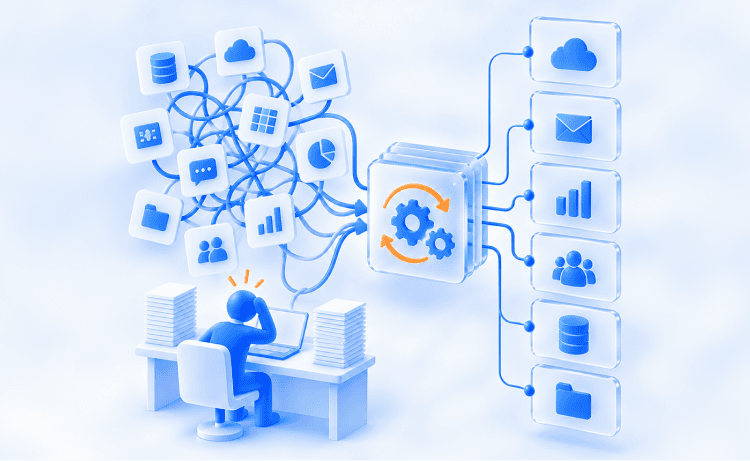
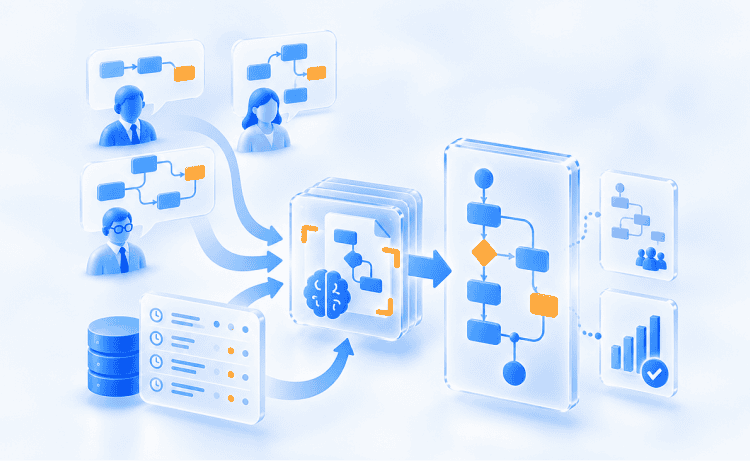
Every time an employee creates an order, approves an invoice, or closes a support ticket, your software records a digital breadcrumb. Process mining is a data analysis method that collects those scattered tracks and transforms them into an interactive visual map of real work.
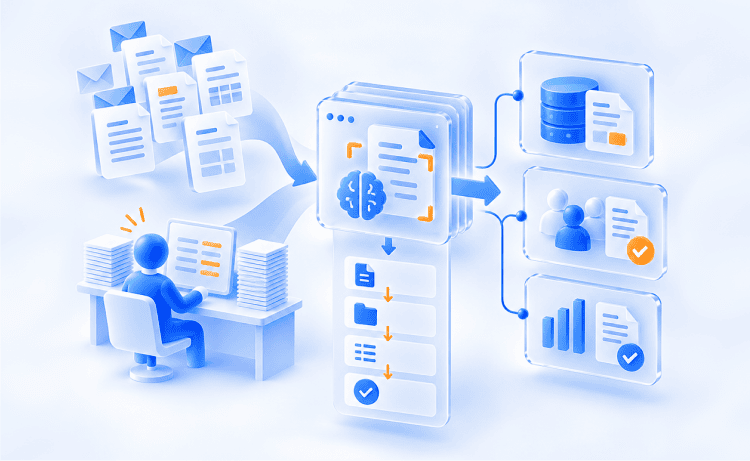
The raw material behind this process is event log data extracted from core platforms like enterprise resource planning systems, customer relationship management platforms, and IT service desks. To build this visual map, process mining requires only three essential data points per action: a case ID, the name of an activity, and an exact timestamp.
Process mining provides you with an objective, fact-based view based on system logs that is simply not possible with traditional interviews and manual workshops. Surveys are based on human memory and bias. Process mining focuses on what your software has captured.
Today, software vendors package these capabilities into broader process intelligence solutions, layering AI and rich business context over the underlying map. This evolution is being described by tech leaders like Celonis as a living “digital twin” of business operations, enabled by modern tools such as object-centric process mining and process graphs.
For business process management (BPM) teams, this move transforms daily operations. You stop debating how existing processes should work and start measuring how they do work. With over 80% of organizations planning to deploy AI across their operations, business leaders increasingly consider process mining important groundwork for AI. A reliable process intelligence platform feeds AI systems the context they need to deliver actual results.
Every process mining work cycle follows the same logic: collect what your systems recorded, organize it, and compare it with what you expected. The steps below show how raw entries become a map you can query. Most of the effort sits in the first two steps, where data gets connected and cleaned.
Here is what three rows of log data look like for an invoice process (illustrative sample):
| Case ID | Activity | Timestamp | Resource |
| INV-1042 | Invoice received | 2026-03-02 09:14 | AP clerk |
| INV-1042 | Price mismatch flagged | 2026-03-02 11:40 | System |
| INV-1042 | Invoice approved | 2026-03-05 16:02 | Finance manager |
Gartner treats this pipeline as the baseline for any serious platform. Its 2025 Magic Quadrant lists event log extraction, process model discovery and analysis, comparative process mining, and model enhancement as mandatory features. The result is a process model grounded in a data-driven approach.
Both academic experts and industry practitioners group process mining techniques into three distinct families, forming a natural progression that takes you from total visibility to targeted action. Most organizations move through all three phases sequentially. It’s a logical journey: you first need to see the real workflow, then check if it obeys the rules, and only then optimize it for maximum efficiency.
It takes an event log with no prior model and produces a diagram of how cases moved. You see the main path, every rework loop, and the rare variants nobody documented. Discovery often surprises teams by revealing dozens of paths where they expected one.
Let’s say you have a 4-step sales order process. Discovery can find 60 variants, including credit checks that are done three times for the same customer.
It compares recorded cases against an intended process model, such as a policy requiring two approvals above $10,000. The software flags every case that skipped a step, ran steps out of order, or involved the wrong role. Internal audit teams use this to test every transaction.
The results double as audit trails, since each deviation links back to its original record. You can score each case against an existing process model based on your approval matrix.
Process enhancement extends an existing process model with extra data, such as durations, costs, or resource names. The map stops being a static picture and starts showing process performance at every step. This is where you find the handoffs that add days and the teams carrying uneven workloads.
Advanced platforms add predictive process monitoring, which uses predictive analytics to flag cases likely to miss deadlines. Teams then tie these findings to key performance indicators and resource allocation decisions.
| Technique | Question It Answers | Input | Output |
| Process discovery | How does work flow today? | Event log | Process map with variants |
| Conformance checking | Where do cases break the rules? | Event log plus intended model | Deviation list and fitness score |
| Process enhancement | Where do time and cost pile up? | Event log plus existing model | Process performance metrics per step |
Process mining types differ mainly in how they structure data and where that data comes from. Some tools follow one case at a time, while others track several linked objects. A second split separates system-level logs from desktop activity recorded on user screens.
Traditional process mining assigns every event to a single case ID, such as one purchase order. That approach works well for simple, linear flows. It struggles when one order splits into three deliveries and two invoices, because forcing those objects into one case distorts the picture.
Object-centric process mining (OCPM) tracks orders, items, deliveries, and invoices together, along with the links between them. Gartner names OCPM among the five directions shaping the platform market. It suits complex processes in supply chain and manufacturing.
Task mining records clicks, keystrokes, and screen activity on employee desktops to show what happens inside a single step. Process mining sees that an invoice waited two days. Task mining shows the clerk copying values between four windows. Together, they give you both the system view and the human view.
Both build on data mining, the broader discipline of finding patterns in large datasets. Modern process mining tools also add generative AI, so you can ask root-cause questions in plain English. AI adoption inside these tools is still early, though.
You can use process mining on any process that leaves a digital trail with case IDs and timestamps. Deloitte’s 2025 survey shows that procurement and accounting remain core applications, while supply chain, IT operations, and customer service are gaining ground. The table maps nine common operational processes.
| Use Case | What the Event Log Reveals | Typical Source | KPI to Watch |
| Accounts payable optimization | Late approvals, duplicate payments, missed early-payment discounts | ERP | Days to pay, first-pass match rate |
| Order-to-cash analysis | Credit holds, manual price edits, delayed invoicing | ERP, CRM | Days sales outstanding |
| Customer journey analysis | Drop-off points across web, call center, and support touchpoints | CRM, web analytics | Conversion and resolution rates |
| Supply chain optimization | Late supplier confirmations, split shipments, rush orders | ERP, WMS, TMS | On-time delivery rate |
| Healthcare workflow improvement | Patient wait times between intake, testing, and discharge | EHR, scheduling tools | Door-to-discharge time |
| Compliance monitoring | Skipped approvals, segregation-of-duties conflicts | ERP, GRC tools | Deviations per 1,000 cases |
| IT service management | Tickets bouncing between teams, reopened incidents | ITSM | Mean time to resolve |
| Fraud and anomaly detection | Vendor bank detail changes before payment, off-hours approvals | ERP, payment logs | Flagged cases per month |
| Employee and operational workflow analysis | Onboarding delays, rework loops, uneven workloads | HRIS, ERP | Cycle time per request |
Across all nine, the goal stays the same: identify inefficiencies fast, then monitor processes after each fix. Ongoing process monitoring confirms that improvements hold as new cases arrive.
Process mining benefits come from replacing opinion with evidence. Deloitte’s respondents ranked process improvements (61%) and cost savings (59%) as top expectations, followed by transparency, monitoring, and finding automation opportunities. Here is how those expectations translate into results you can measure.
These gains compound into continuous process improvement. Deloitte also found that 28% of respondents now expect process mining to raise customer satisfaction, which shows the method reaches beyond back-office efficiency. Teams that optimize business processes this way build a habit of continuous improvement and a stronger process improvement practice.
The difference comes down to the data source and the question each method answers. Workshops and interviews capture what people believe happens. BI dashboards count outcomes such as revenue or ticket volume. Process mining reconstructs the sequence of events behind those outcomes, which is why teams often combine several methods.
| Method | Data Source | Question It Answers | Typical Output |
| Process mining | System event logs | How did each case flow, and where did it deviate? | Process map, variants, conformance results |
| Data mining | Any large dataset | What patterns or correlations exist? | Clusters, predictions, rules |
| Business process management modeling | Interviews and workshops | How should the process run? | BPMN diagrams |
| BI dashboards | Aggregated tables | How much, and how many? | KPIs and charts |
| Task mining | Desktop user activity | What happens inside one step? | Click-level task flows |
| RPA | Rules you define | How can a bot execute this step? | Software bots |
Put simply, process mining reveals what BPM models assume. Good process analysis pairs both, using the map to test and refine the design.
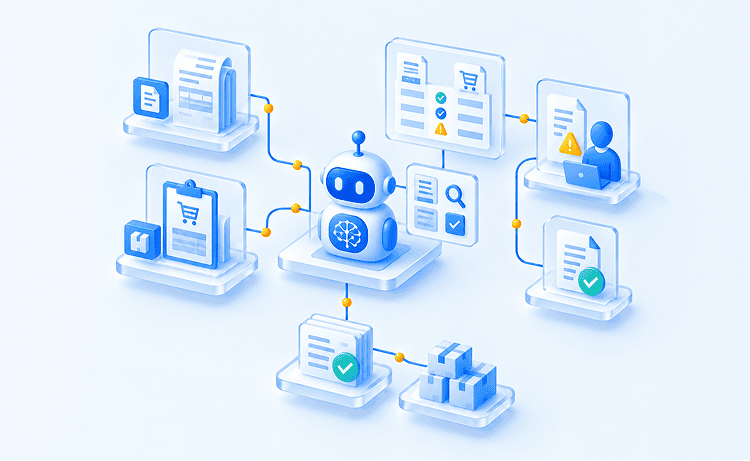
Insight only pays off when it leads to action. Once process mining exposes your actual workflow, it highlights the repetitive, rule-based steps that slow people down. Those steps are prime candidates for process automation. And the story doesn’t end when a fix goes live: those same event logs continuously track each automated process to prove it is performing as planned.
Choosing the right technology depends on where the friction lives:
Match the right tool to the right bottleneck, and you’ll turn raw process data into measurable operational impact.
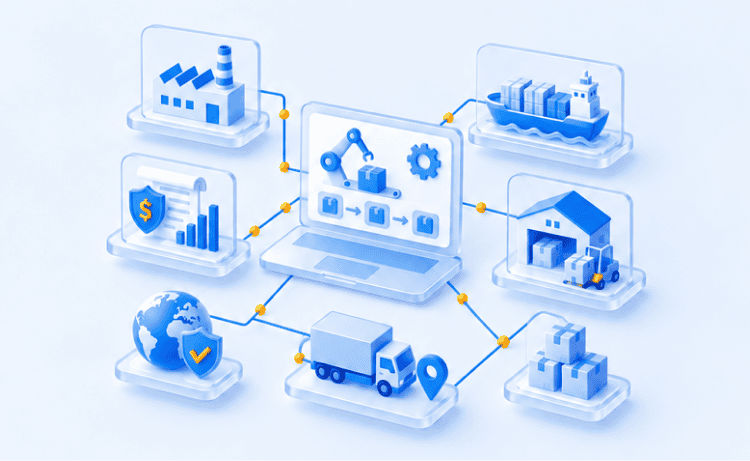
Glorium Technologies applied this pattern when working with a US industrial parts distributor stocking more than 30,000 SKUs across three regional warehouses. The discovery phase mapped its source-to-pay and order-to-ship flows, where purchase approvals ran through email without enforced spend limits. After Approval Rules went live, sign-offs that once took two to three days were completed within one shift, a 52% shorter cycle. In another logistics project, warehouse and dispatch cycles shrank by about 30%. Each step like this moves your digital transformation from slide decks to measured change.
The process mining software market is crowded with competition between pure-play specialists, ERP vendors, and automation suites. Gartner assessed 16 vendors in its 2025 Magic Quadrant for the category. The right choice depends on your systems, data volume, and team skills more than on brand.
| Platform | Position | Typical Fit |
| Celonis | Category leader, framing its output as a digital twin of operations | Large enterprises with several ERPs |
| SAP Signavio | Mining plus BPM modeling within SAP’s suite | SAP-centric organizations |
| UiPath | Entered through its ProcessGold acquisition, bundles mining with RPA | Teams scaling software bots |
| ABBYY, QPR, Apromore, IBM | Alternatives assessed in Gartner’s 2025 Magic Quadrant | Specific stacks and budgets |
When comparing process mining tools or complete process mining solutions, consider five points:
A few persistent myths keep teams from starting or lead them to stop too early. Each one has a simple correction based on how successful programs run. Deloitte found that 41% of respondents cite a lack of management attention as a barrier, so correcting these myths helps you win sponsorship.
Process mining gives you a factual map of how work moves, where it slows, and which steps deserve automation first. The value grows when you treat that map as a living tool that guides each improvement cycle.
With over 16 years of hands-on software delivery experience, Glorium Technologies knows how to solve inefficiencies. Our team seamlessly turns process mining findings into fully working automation. Whether your workflows require native ERP optimization or intelligent AI-driven execution, we build the modern digital architecture your operations need to scale effortlessly.
Book a free process audit to see where your processes lose time and money.
Both systems store timestamped records that can feed an event log. Odoo logs tracked field changes in each record’s chatter, and its external API, available on the Custom plan, supports extraction. Business Central exposes data through its own APIs. Glorium Technologies, a certified Odoo partner and Microsoft partner, builds these data pipelines for clients.
It usually is when you run high transaction volumes through digital systems and lose time on a known process, such as procure-to-pay. Start with one process and one defined KPI. A focused pilot lets you prove value before you commit to a wider rollout or a multi-year license.
First, collect only the fields you need for your analysis, and pseudonymize user and customer IDs before the data lands on the platform. Access to process maps is role-based; resource names may expose individual performance. Task mining needs extra care because it records desktop activity, so involve your legal and HR teams before any rollout.
Glorium Technologies starts with a free process audit. The team maps your current workflows, identifies manual steps, and puts a dollar figure on what that manual work costs you. A paid diagnostic and discovery phase follows, producing as-is and to-be maps, an exception matrix, and an integration plan before any build begins.