







How Supply Chain Automation Cuts Costs and Keeps Orders Moving
Updated October 1, 2026

 Summarize in ChatGPT
 Summarize in ChatGPT
Tariffs, volatile freight rates, and tight labor pools now reshape supply chain plans every few weeks. In McKinsey’s Supply Chain Risk Pulse 2025, 82% of surveyed leaders said new tariffs affect their supply chains, touching 20% to 40% of supply chain activity. If you run operations, you might have felt this in reorder points, landed costs, or carrier quotes.
Look at the companies thriving despite ongoing global supply chain chaos, and you’ll notice a common thread: their planning, warehouse, and transport systems talk to each other automatically. They don’t waste time on manual data entry or copy-pasting numbers between spreadsheets. The 2026 MHI Annual Industry Report, produced with Deloitte, found that 56% of organizations plan to raise supply chain innovation spending, and 52% expect to spend over $1 million. AI use alone climbed to 41% from 30% a year earlier, DC Velocity reports.

Content
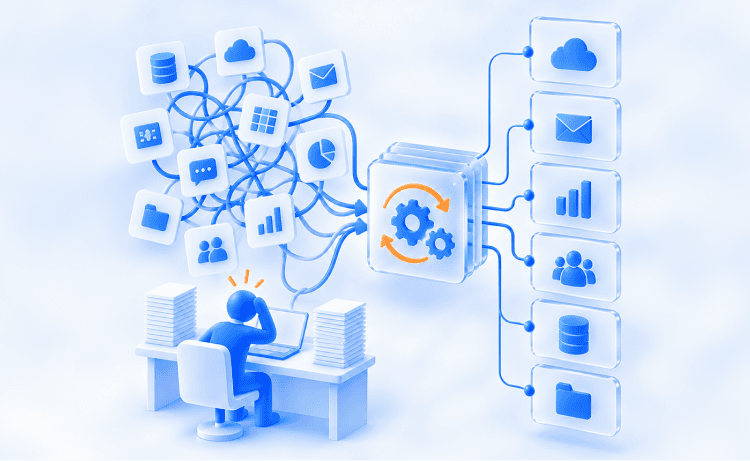
For decades, traditional supply chain operations depended on a loop of back-and-forth communication. Static spreadsheets, endless email threads, and daily phone calls were the only bridge connecting buyers, carriers, and warehouse teams. Each step could create a lag, and every manual data entry could (and did) increase the risk of costly human error.
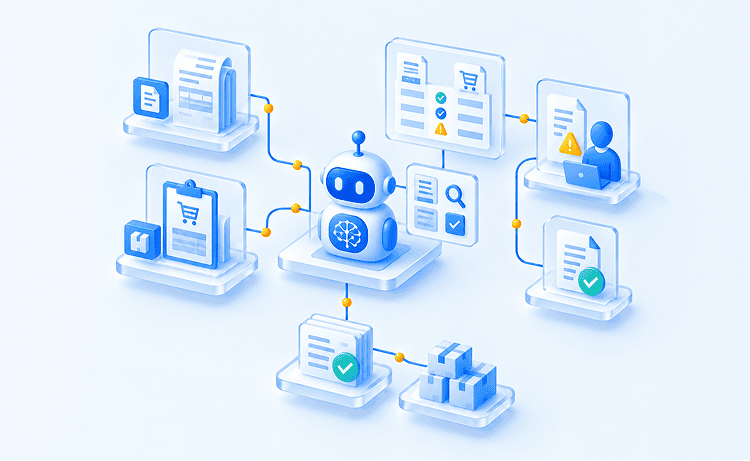
Supply chain automation refers to the integration of software and hardware designed to run daily operations using pre-set rules, live data, and predictive models. A rule might automatically trigger a reorder when stock drops, while an AI model predicts next month’s regional demand down to the individual SKU. For operational events like an incoming goods receipt or a shipment notification delay, automated workflows trigger immediate actions in multiple systems.
We are witnessing a rapid transition toward self-executing supply chains. Gartner forecasts that within the decade, half of cross-functional supply chain management systems will use intelligent agents to run operations on their own. In fact, spending on agentic AI software is expected to explode, growing from under $2 billion in 2025 to $53 billion by the end of the decade.
Supply chain automation follows a predictable cadence: capture, decide, act, and refine. It starts on the floor, gathering real-time data from sensors, barcode scanners, and live system events. Then algorithms or business rules determine the best action. The latter is then performed instantly by specialized software or robotics, and the result is fed back into the system to refine the next decision.
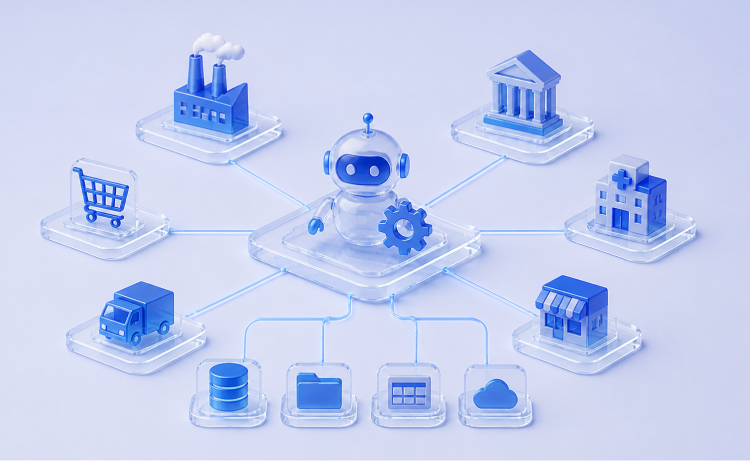
In everyday operations, this engine spans three core software layers, with each layer handling a different tier of decisions:
Many executives map these layers to the SCOR model: Plan, Source, Make, Deliver, and Return. Picture a distributor whose ERP confirms an order at 3 p.m. The WMS releases a pick wave, the TMS books a carrier before cutoff, and your customer gets tracking the same afternoon.
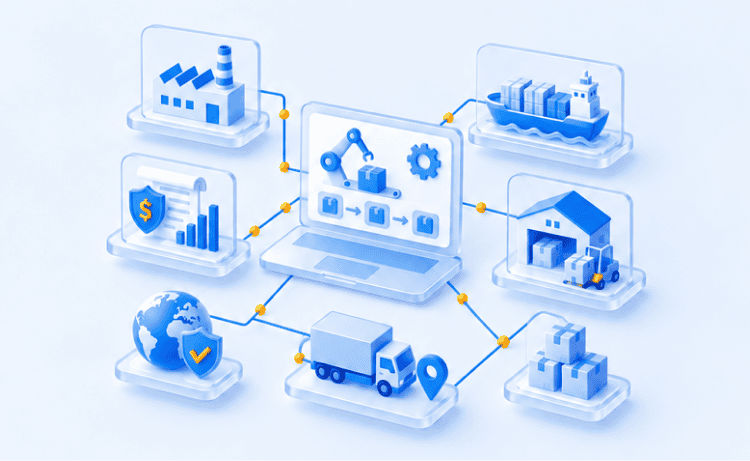
The supply chain automation examples below cover the ten processes where most companies start. Each one replaces manual tasks with system-driven steps and feeds data to the next step. You can automate them one at a time, though the payoff grows once they share the same data.
| Use Case | What Gets Automated | Typical Systems |
| Inventory management | Counts, reorder triggers | WMS, ERP, RFID |
| Demand forecasting | Baseline and promo forecasts | Planning suites, ML |
| Procurement | Purchase orders, confirmations | ERP, RPA |
| Supplier management | Onboarding, scorecards | ERP, AI agents |
| Order processing | Capture, validation, allocation | ERP, OMS, CRM |
| Invoice and payment processing | Three-way matching, approvals | ERP, OCR, RPA |
| Warehouse automation | Picking, storage, sorting | WMS, AMRs, AS/RS |
| Shipment tracking | Status updates, alerts | TMS, IoT |
| Logistics management | Carrier selection, freight audit | TMS |
| Route optimization | Stop sequencing, rerouting | TMS, ML |
Proper inventory management means knowing precisely what’s on your shelves at any given moment without burning hours on manual counts. Barcode scans, RFID tags, and automated transactions update your inventory levels instantly. As stock drops below a safety level, reorder rules automatically create purchase requests, so buyers can make decisions based on live, accurate data.
As McKinsey’s 2025 survey revealed, many companies still tie up massive amounts of capital on emergency shortage buffers. Real-time data removes the urge to over-order, keeping working capital free for growth.
Demand forecasting sits in the planning layer, separate from warehouse execution. This is why platforms like Blue Yonder offer dedicated demand and supply planning suites.
Automated demand forecasting uses machine learning to weigh sales history, promotions, seasonality, and price changes at the SKU and location level. This practical value explains why demand and inventory optimization emerged as a top AI use case in the 2026 MHI survey. This allows planners to move away from manual forecasting and concentrate on higher-impact activities such as product launches and client accounts.
Procurement automation converts approved requisitions into purchase orders, sends them to suppliers, and matches confirmations against contract terms. Supplier management adds onboarding checklists, certificate tracking, and quality control scorecards. Together, they cut the email chasing that slows buying cycles and give supply chain managers a live view of supplier risk.
Most companies in McKinsey’s 2025 survey see risk only at tier-one suppliers, so automated alerts help your buyers catch delays earlier.
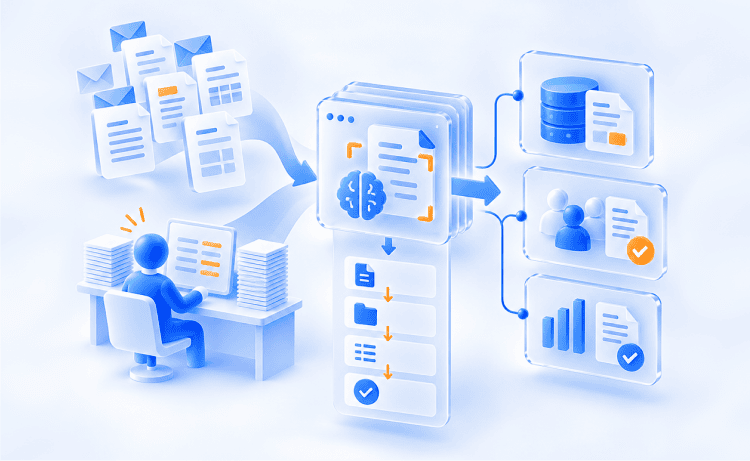
Order processing automation captures orders from EDI, portals, email, and marketplaces, then validates pricing and credit, and allocates inventory. Invoice automation reads supplier invoices with OCR, does three-way matching against POs and receipts, and routes exceptions for approval. Once these steps connect, manual data entry drops sharply.
One Glorium Technologies client, a US industrial MRO distributor, runs three warehouses with 240 employees, $46 million in revenue, and 30,000+ SKUs. Its legacy ERP, warehouse tool, and sales spreadsheets shared no data. Buyers ordered against stale reorder points, matched invoices by eye, and approved POs by email with no spend limits. In each warehouse, the number of stocks was also different between the systems.
We moved procurement, inventory, and order flow to a single Odoo platform. Automated steps replaced the manual moving of records between tools. This project automated purchase order approvals, which cut the approval process by 52%.

On the fulfillment floor, warehouse automation connects software orchestration with physical machinery to optimize warehouse operations. Advanced WMS platforms dynamically route tasks to physical hardware: AMRs direct pickers on the floor, high-density cube storage delivers goods to fixed stations, and mobile pods bring inventory straight to fulfillment teams. The operational return on these automated systems is well-documented.
In 2025, Amazon launched its one millionth robot, using its DeepFleet AI model to deliver a 10% efficiency gain in its fleet. Locus Robotics crossed the 6 billion picks mark in October 2025, achieving its last billion in 24 weeks. Unsurprisingly, the 2025 AutoStore survey showed that AMRs and cube storage and retrieval systems are the most effective options for warehouse operations.
Here, automation covers carrier selection, load building, tendering, tracking, and freight audit. A TMS gives you real-time visibility by pulling carrier updates and GPS pings into one screen, flagging late loads, and suggesting new routes. Route optimization engines resequence stops as traffic, weather, and order changes come in.
Your logistics teams then work from exceptions, and tracking APIs from logistics providers feed carrier data straight into your dashboards.
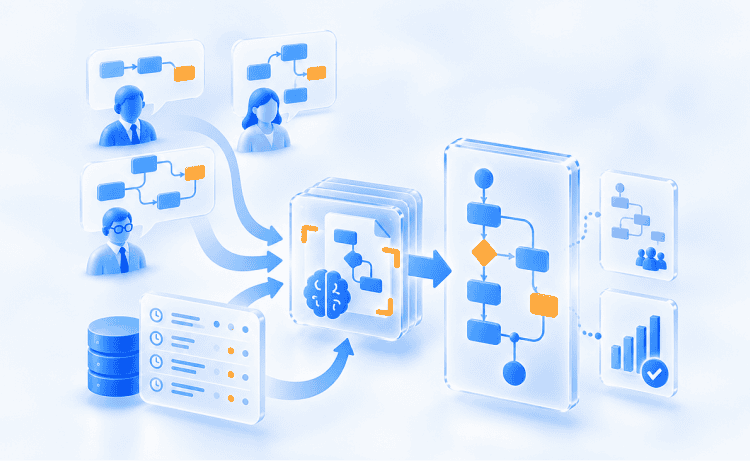
CogniAgent is our AI agent builder platform designed for teams that want AI agents to take action inside business systems. It combines conversational agents, autonomous background agents, and deterministic workflows. Agents connect to your stack through 2,700+ integrations, including Salesforce, HubSpot, Slack, Gmail, and webhooks.
For supply chain professionals, CogniAgent fits the coordination work that sits between ERP, WMS, and TMS platforms. CogniAgent agents can help you with:
These automated processes address supply chain tasks that are outside a WMS or TMS but still consume hours every week. You can give it a try with 5,000 free credits.
End-to-end chain automation relies on several automation technologies, and each one handles a different kind of task. Some make predictions, some move data between screens, and some sense the physical world. Knowing which does what helps you match the tool to the problem before you commit a budget.
AI covers models that predict, classify, and increasingly take action. ML forecasts demand, scores supplier risk, and flags anomalies in freight invoices. The newest layer is agentic AI, where software agents perform multi-step tasks like writing a purchase order based on stock data and validating it against contract terms.
RPA uses software bots that act like humans, clicking, copying, and pasting. RPA is suited for repetitive tasks in portals and older screens such as downloading carrier invoices, keying shipment notices, or updating order status in a supplier portal. Common platforms include UiPath, Automation Anywhere, and Blue Prism.
When a process involves judgment or unstructured documents, you pair RPA with AI, a combination often called intelligent automation.
Internet of Things sensors and radio frequency identification tags let your systems track the physical flow of goods. RFID portals read pallets at the dock, and temperature sensors monitor cold-chain loads. Predictive analytics turns that sensor stream into forecasts, such as which conveyor motor is likely to fail next week.
This predictive maintenance work ranked among top AI uses in the 2026 MHI findings, and camera systems extend it to automating quality control on packing lines.
Cloud platforms host the systems that tie everything together, and APIs connect them. Warehouse management and transport platforms now run as cloud services with prebuilt connectors to ERP, CRM, and carrier networks. This setup gives teams shared supply chain data and the same version of stock, orders, and shipments.
A WMS that cannot read ERP orders in real time pushes people back into spreadsheets and manual processes.
Supply chain automation software falls into three standard categories: demand and supply planning, warehouse management, and transportation management. Robotics platforms form a fourth, physical layer. Large vendors often sell all three software categories, while mid-market buyers frequently pair an ERP with a focused WMS or TMS.
For large, complex distribution networks, Blue Yonder and Manhattan Associates top most shortlists. Blue Yonder was named a Leader in the 2026 Gartner Magic Quadrant for Warehouse Management Systems for the 18th consecutive time. Manhattan Associates was also named a Leader in the same 2026 report.
| Category | Vendors to Know | Best Fit |
| Demand and supply planning | Blue Yonder, SAP, Oracle | Multi-site networks with volatile demand |
| WMS | Blue Yonder, Manhattan Associates, SAP Extended Warehouse Management, Oracle Warehouse Management, Körber | High-volume and highly automated DCs |
| TMS | Blue Yonder, Manhattan Associates, SAP, Oracle | Shippers managing many carriers and modes |
| Warehouse robotics | AutoStore, Locus Robotics, Amazon Robotics (used in Amazon’s own network) | Picking, storage, goods-to-person flows |
| Robotics orchestration | Blue Yonder Robotics Hub | Sites mixing robots from several vendors |
Blue Yonder’s Robotics Hub acts as a vendor-agnostic orchestration layer between the WMS and robots from different makers, so one site can run Locus picking bots beside AutoStore storage. When you compare supply chain automation tools, ask how each one connects to the rest of your stack, since automation software that sits in a silo recreates the handoffs you wanted to remove.
Supply chain automation, when done right, can have an immediate impact, with noticeable improvements in cost, speed, and reliability often in the first year. This is where the real magic happens, and the systems are talking to each other: each automated handoff improves the process, which has a ripple effect that accelerates the entire operational chain. Every business is different, but following a well-scoped rollout, most organizations will experience the following core results:
These gains improve efficiency and raise customer satisfaction through faster, more predictable delivery. Automation also helps you absorb labor shortages.
Success with supply chain automation comes down to taking a phased approach. You don’t need to overhaul everything at once but target your most labor-intensive tasks first, zeroing in on areas where data quality is high. Once you prove the value there, you can expand. Taking it step-by-step allows you to integrate automation without breaking existing processes that already work.
Glorium Technologies structures its chain automation work around a five-level Automation Maturity Model. It runs from fragmented systems at Level 1 to AI-driven supply chain and revenue automation at Level 5. If you’re stuck with legacy systems that lack modern APIs, RPA is a great bridge solution to automate manual tasks while your larger modernization project is underway.
A few persistent myths slow down automation decisions in operations and finance teams. Correcting them early helps you set realistic budgets, timelines, and expectations with leadership. The four below come up often when companies first scope effective supply chain automation for their own networks.
Sustainable supply chain modernization requires a phased methodology. Organizations achieve the highest ROI by laying a foundation of system integration and data quality before layering on AI decisioning or physical automation. By addressing one high-friction workflow at a time, you measure it and expand across the entire supply chain from there.
Glorium Technologies brings the deep engineering expertise required to execute this roadmap. With 16 years of experience, ISO 27001 certification, and official partnerships with Odoo and Microsoft, we integrate ERP, WMS, TMS, and CRM environments for enterprises. Our solutions convert manual overhead into measurable productivity, from custom robotic process automation and data analysis to intelligent CogniAgent deployments.
Book a free process audit with Glorium Technologies to find the workflows worth automating first.
Mid-size companies face the same tariff and labor pressure as large enterprises, usually with smaller teams. What makes supply chain automation important for them is capacity. Automated systems absorb volume spikes, and supply chain operations keep running without a matching increase in headcount or overtime.
Costs depend on scope, the number of connected systems, and whether you add robotics. Software-only projects cost far less than robotic fulfillment. Glorium Technologies engagements typically start at about $25,000, and a free process audit sizes the opportunity before you commit.
A single workflow, such as invoice matching, can go live in four to six weeks. Broader BPA programs at Glorium Technologies typically run 8 to 12 weeks, while complex enterprise projects can take four to six months. Every program starts with a process audit.
CogniAgent works alongside your WMS, TMS, and ERP and does not replace them. Those platforms execute warehouse and transport transactions. CogniAgent AI is not a replacement for your core software; it sits on top of your existing systems. It manages supplier confirmations, answers order tracking inquiries, and raises exceptions before they become an issue. This helps you streamline operations across business processes without having to buy new core software.