
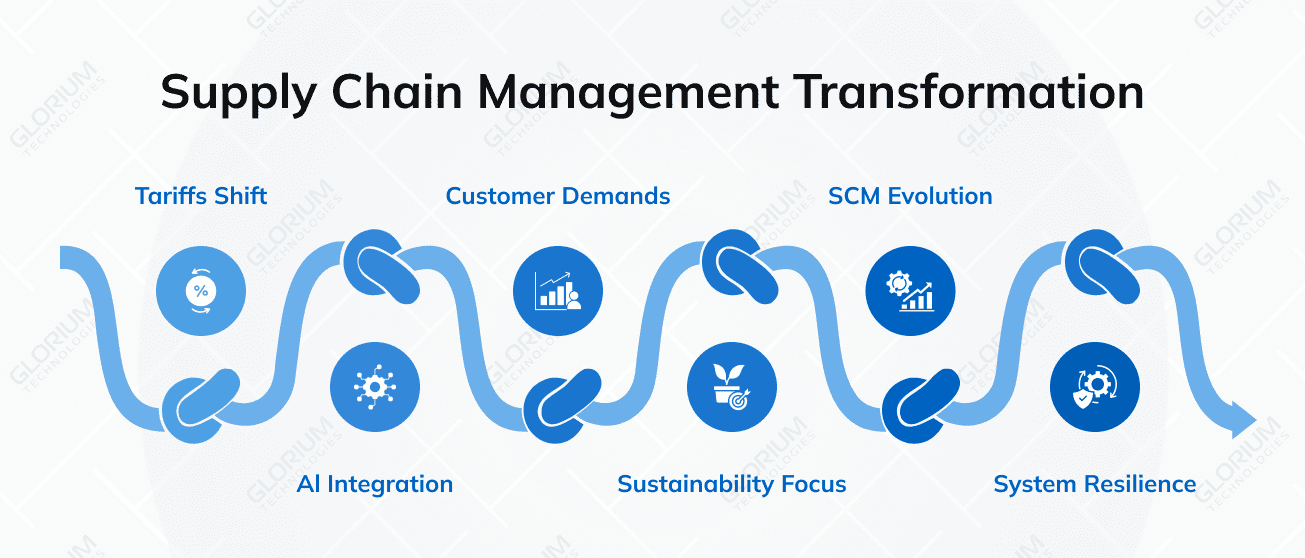
Ask any supply chain leader what's keeping them up in 2026, and you'll usually hear the same three things. Tariffs are moving too often to plan around with any certainty. AI has stopped being a side experiment and started running the planning room. And customers want everything at once: quick delivery, full visibility into where their order is, and proof that the supply chain behind it is genuinely sustainable.
These drivers have transformed the image of supply chain management from a tactical requirement to a top-level governance concern. SCM covers all processes from sourcing raw materials to production, logistics, and delivery to the final customer. And the job now is building a connected, responsive system that absorbs shocks without breaking.
According to McKinsey's 2025 Supply Chain Risk survey, 82% of companies reported that new tariffs are affecting their supply chains. And the aforementioned pressures are only going to increase as AI adoption accelerates.
Below, we’ll cover the main components of supply chain management and the end-to-end process steps. You’ll also discover optimization strategies, the technologies that are transforming digital supply chains, and the trends to watch in 2027.
Why Is Supply Chain Management Important?
Supply chain management is never about moving products from point A to point B. When SCM is working, it affects costs, customer satisfaction, and the company's ability to compete. When it falters, the damage shows up everywhere, from pricing strategies to retention rates. Three business outcomes make the case clear.
Lower costs across the entire value chain
Strong SCM lets organizations reduce costs at every stage, from supplier negotiations and inventory positioning to warehouse efficiency and last-mile logistics. Small percentage gains in any one node compound across thousands of SKUs and shipments. Affordability concerns and softening labor markets are likely to continue testing supply chains in 2026 from both planning and pricing perspectives, making cost discipline a direct lever for protecting margin.
Faster fulfillment, stronger customer relationships
Shorter lead times, better forecasting, and end-to-end visibility translate into customer experiences people actually come back for. Customer-centric growth is all about meeting demand consistently, letting customers know when things change, and using SCM data to adjust service.
Resilience against supply chain disruptions
Changes in tariffs, problems with suppliers, and logistics issues are no longer rare events. When something breaks, companies that invest in digital visibility, scenario modeling, and diversified sourcing get back on their feet faster and lose less money.
According to KPMG, supply chains are now seen as a critical operating lever for driving competitiveness, resilience, and sustainability. Performance metrics are being redefined to keep pace with contemporary complexity and stakeholder pressures. New supply chain measurement areas cover: total value, AI and automation decision accuracy, cybersecurity, human-machine collaboration, ESG, multimodal supply chain orchestration, and more.
Key Components of Supply Chain Management
The entire supply chain spans multiple interconnected functions, and each one influences the others in ways that aren't always visible from inside a single team. Sourcing decisions ripple into manufacturing capacity. Inventory positioning shapes logistics costs. A demand forecast that is missing by 10% can throw off six different downstream operations. Understanding each component on its own terms helps supply chain managers pinpoint where to improve, where to invest, and where existing processes are quietly holding the rest of the chain back.
Supply planning and demand forecasting
Supply planning and demand forecasting form the backbone of supply chain operations. Together, they make sure that production schedules match up with expected customer demand, so the right products are always available. Strong demand management cuts down on extra inventory, makes better use of resources, and stops the expensive cycle of running out of stock and then overcorrecting.
Sourcing and supplier relationship management
Sourcing covers the work of identifying and securing raw materials, evaluating supplier performance, and managing relationships with external partners and trading partners across regions. Supplier relationship management goes beyond procurement. It represents how organizations protect themselves from disruption, maintain quality control, and negotiate from a position of trust rather than transaction.
Inventory and warehouse management
Inventory management and inventory control home in on managing inventory across warehouses to meet demand. Warehouse management allows you to optimize storage, picking, packing, and shipping for efficiency. Inventory control ensures stores can fulfill orders without overstocking goods.
Logistics and transportation management
Logistics management refers to the transportation of goods between suppliers, factories, warehouses, and customers. Modern transportation management systems integrate carriers, routes, and modes across logistics networks. This is especially complicated in a global supply chain where tariffs, port delays, and capacity constraints change on a weekly basis.
Manufacturing and production
Manufacturing turns raw materials into finished products. Operations management includes scheduling of production, management of the product lifecycle, quality control, etc. All this is done to meet demand while minimizing waste. The work itself requires close integration with planning since today’s production decisions determine what’s available to ship next quarter.
The Supply Chain Management Process: How It Works in Practice
The supply chain management process is best understood as a connected sequence rather than a checklist. Each step feeds the next, and a weak handoff anywhere in the chain shows up as cost, delay, or customer churn somewhere else. Most organizations follow a similar end-to-end flow, even if the labels and tooling vary by industry.
- Demand forecasting: Analyzes historical data, market trends, and external signals to project what customers will buy
- Supply planning: Translates demand projections into procurement, production, and logistics plans
- Sourcing raw materials: Procurement teams place orders with vetted suppliers, manage contracts, and track inbound shipments
- Production: Turns raw materials into finished goods on a schedule the planning team has signed off on
- Logistics and delivery: Moves products from factories to distribution centers to retailers or end customers
- Returns and reverse logistics: Handles returns, repairs, recycling, and warranty claims
Most mid-market and enterprise organizations run their supply chain processes through integrated SCM systems and enterprise resource planning platforms that connect business processes across procurement, finance, manufacturing, and logistics.
Glorium Technologies works with organizations to implement and customize ERP-based supply chain solutions that bring these steps into a single operational view, which makes it easier to see the impact of a sourcing change on production or a demand shift on logistics.
We’ve worked with a US-based logistics company managing multiple warehouse facilities. They were dealing with disconnected tools, manual data entry across teams, unreliable shipment tracking, and billing that routinely fell behind actual operations. Our team brought inventory, warehouse execution, dispatch, and finance into the connected Odoo 18 system and automated the most time-intensive processes. Not only did the cycle times drop by 30% and daily manual work fall by up to 60%, but the client also hit ROI within 12 to 18 months.
Strategies to Improve Supply Chain Efficiency
Supply chain efficiency is something you are always working on. Supply chain performance must keep pace with the evolving needs of customers and market nature. Both move faster each year, and it’s an ongoing challenge to keep up. The strategies below are the ones that consistently show up across high-performing operations in 2026. The organizations executing them well are pulling ahead of those still treating optimization as an annual exercise.
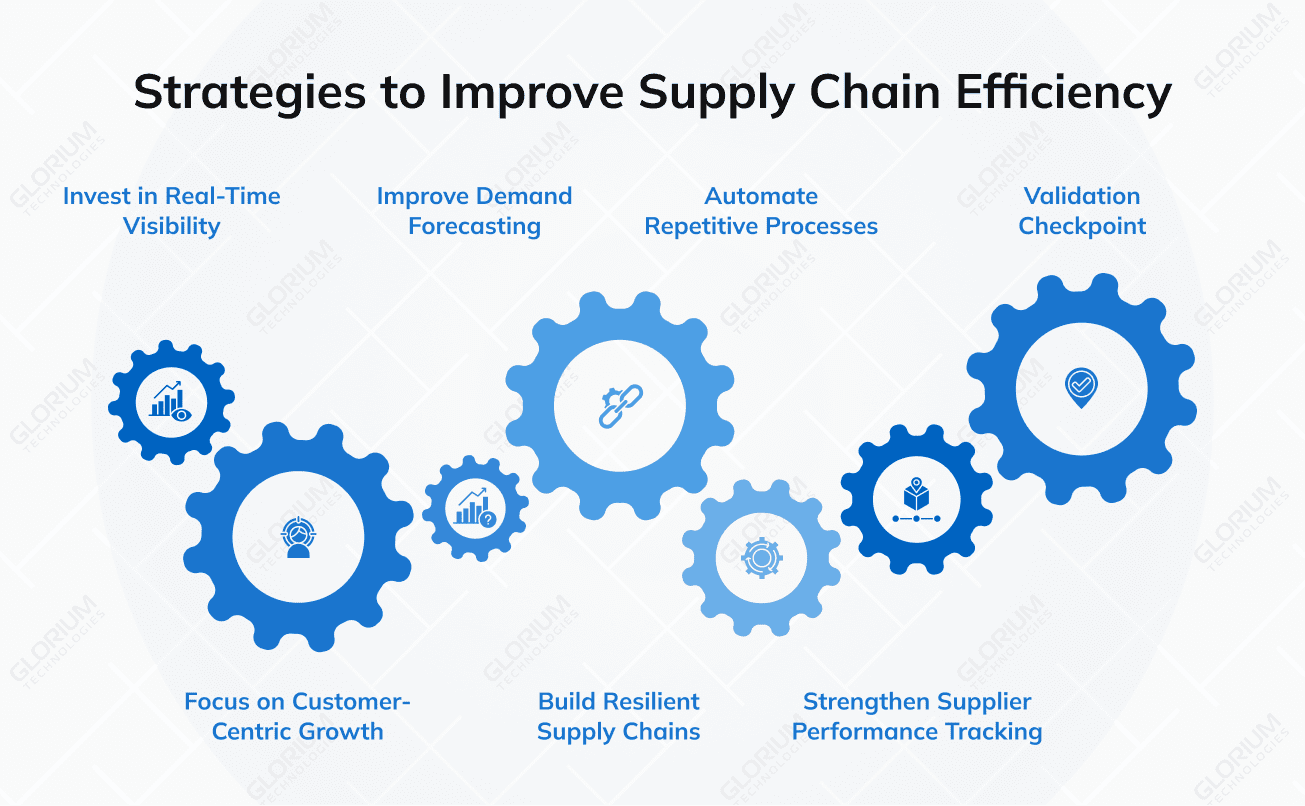
Seven strategies that high-performing supply chains prioritize in 2026:
- Invest in real-time visibility across the supply network: Control towers can help detect exceptions in the supply chain and alert the entire supply chain. 95% of supply chains require rapid responsiveness, but only 7% of companies today make decisions in real time. By 2028 Gartner expects the value of real-time decision-making to grow 5x
- Focus on customer-centric growth: Align supply chain strategy to customer needs: shorter delivery windows, accurate ETAs, transparent sourcing. Remember that efficiency that is not translated into a better customer experience is efficiency aimed at the wrong target
- Improve demand forecasting with predictive analytics: Move from monthly batch forecasts to continuous demand signals. 47% of leaders in retail and manufacturing already use AI for inventory and supply chain optimization or plan to do so. At the industry level, 70% of companies now report that they are implementing AI in transformational or advanced stages for their supply chains, and 75% plan to invest in AI for 2026 supply chain operations
- Build resilient supply chains through supplier diversification: Expand the supply network beyond single-source dependencies, especially for parts tied to unstable countries or trade routes that are subject to tariffs. Dual-sourcing and regional alternates reduce the cost of any one supplier going dark. 73% of supply chain leaders have prioritized dual sourcing, and 60% have prioritized regionalization
- Automate repetitive processes: Apply automation to repetitive tasks in procurement, warehouse operations, and order management, for example, invoice matching or replenishment triggers. Thus, you can free up your supply chain professionals for judgment-heavy work
- Strengthen supplier performance tracking: Set KPIs around on-time delivery, defect rates, and responsiveness, then monitor supplier management metrics consistently to improve supplier performance over time. What gets measured tends to get fixed
- Validation checkpoint: Before taking any of the above steps, you should review your current supply chain performance on several metrics: forecast bias (are you consistently over- or under-predicting demand?), order-to-delivery cycle time, supplier concentration (by tier), inventory days on hand, and cost-to-serve by channel. The strategies above should map to gaps in the above
Technologies Shaping Digital Supply Chains in 2026
In 2026, artificial intelligence, advanced analytics, and integrated platforms aren’t in pilot programs anymore. They’re embedded in the day-to-day workflow that runs supply chains. The conversation has shifted from “should we test this” to “how do we scale it responsibly across our network.” AI is the number one investment priority for companies globally now, and supply chain platforms are becoming integrated, intelligent, data-driven systems.
SCM systems and enterprise resource planning
Modern SCM systems, built into enterprise resource planning platforms, integrate data from procurement, production, inventory, logistics, and finance. ERP systems support SCM functions, such as demand forecasting, warehouse management, and transportation optimization.
Predictive analytics and machine learning
Both solutions move away from reactive firefighting to a more strategic approach to decision-making. They help organizations forecast demand, predict possible failures, identify likely defects and optimize logistics. The change is from reporting (what happened last quarter) to predictive and prescriptive analytics (what’s likely to happen and what to do about it).
Yet technology alone is not enough to guarantee success. Despite the fact that nearly all organizations are increasing their spending in this area, fewer than one in four have made significant improvements to their supply chains by leveraging analytics. Root cause of this failure to achieve desired results is organizational change management, data quality and process re-engineering. A related study found that 76% of logistics transformations fail to achieve the planned outcomes (cost reduction, timeline, and KPIs) with more than 80% of respondents attempting four transformations in less than five years.Real-time visibility and control towers
Real-time visibility platforms aggregate data from suppliers, carriers, warehouses, and point-of-sale systems to create a single operating picture of the supply chain. Supply chain control towers support exception-based monitoring, paying attention to the risky items in a shipment, rather than every shipment.
Glorium Technologies works with organizations on the practical side of getting there. We offer ERP customization, data integration between disconnected platforms, and supply chain management software implementation that fits existing infrastructure rather than forcing a rebuild.
How AI Is Redefining Supply Chain Management
Industry 4.0, or the Fourth Industrial Revolution, brought connected machines, real-time data, and automated workflows into your operations. AI is now taking that further, turning raw operational data into decisions your team used to make manually.
According to McKinsey, AI-enabled distribution operations see 5 to 20% logistics cost reductions, 20 to 30% inventory reductions, and up to 15% procurement spend savings. Gartner forecasts that SCM software with agentic AI capabilities will grow to $53 billion by 2030.
Instead of reacting to problems after they happen, you can now spot them before they do. AI gives you that kind of visibility across the entire chain, from supplier lead times to last-mile delivery.
Here is what that looks like in practice:
- You get demand forecasts that adjust to real market signals instead of last year's averages
- Inventory levels stay closer to what you actually need
- Less time spent on manual tracking across warehouses and carriers
- Disruptions get flagged early, so you can reroute before a delay becomes a crisis
A 2025 Gartner survey of 509 supply chain leaders found that AI and agentic AI will be the most influential drivers of supply chain performance over the next two years. If your competitors are already moving in that direction, waiting can be its own kind of risk.
Managing Supply Chain Disruptions and Operational Risks
Every supply chain professional in 2026 is working through a similar set of obstacles. None of them are new, exactly, but the pace at which they're shifting has changed and so has the playbook for handling them. The five challenges below come up consistently in conversations with leading organizations, along with the approaches that are working.
- Tariff volatility and trade policy shifts: 82% of companies reported tariff-related disruptions last year. An Accenture survey of 3,650 C-suite leaders showed that more than three-quarters expect higher levels of disruption in 2026. 85% plan to increase AI-related expenses this year, and nearly 70% are investing in AI and digital tools to automate processes. Proactive organizations are using scenario-modeling tools to test cost impacts before policies take effect, supporting more informed decision-making under shifting market conditions
- Lack of supply chain transparency: Most companies have limited visibility into their tier-one supply chain partners. They don't know what these companies do or have transparency into their tier two or three supply chains. Disruptions propagate upstream before they are detected. Forward-thinking companies are investing in integrated supply chain solutions that connect ERP, WMS, and supplier data into a single operational view
- Evolving customer expectations: Customers want faster delivery, real-time tracking, and sustainable sourcing. Supply chain professionals must rethink their logistics networks and production processes to meet customer demand without increasing operational costs. The fix is rarely more inventory; it's better demand sensing and tighter coordination with carriers and 3PLs
- Talent gaps: 88% of supply chain leaders think agentic AI will force the need for new processes for talent pipelines, and 76% have already invested, or plan to invest, in capabilities to automate interactions with machine customers. Supply chains of the future will require employees with new skills to manage algorithmic decision tools, rather than traditional planners
- Sustainability and compliance mandates: Regulations like the EU Deforestation Regulation and the Digital Product Passport require multi-tier transparency across the supply network, down to raw material origin. Building that visibility now, rather than scrambling at audit time, becomes a real competitive advantage
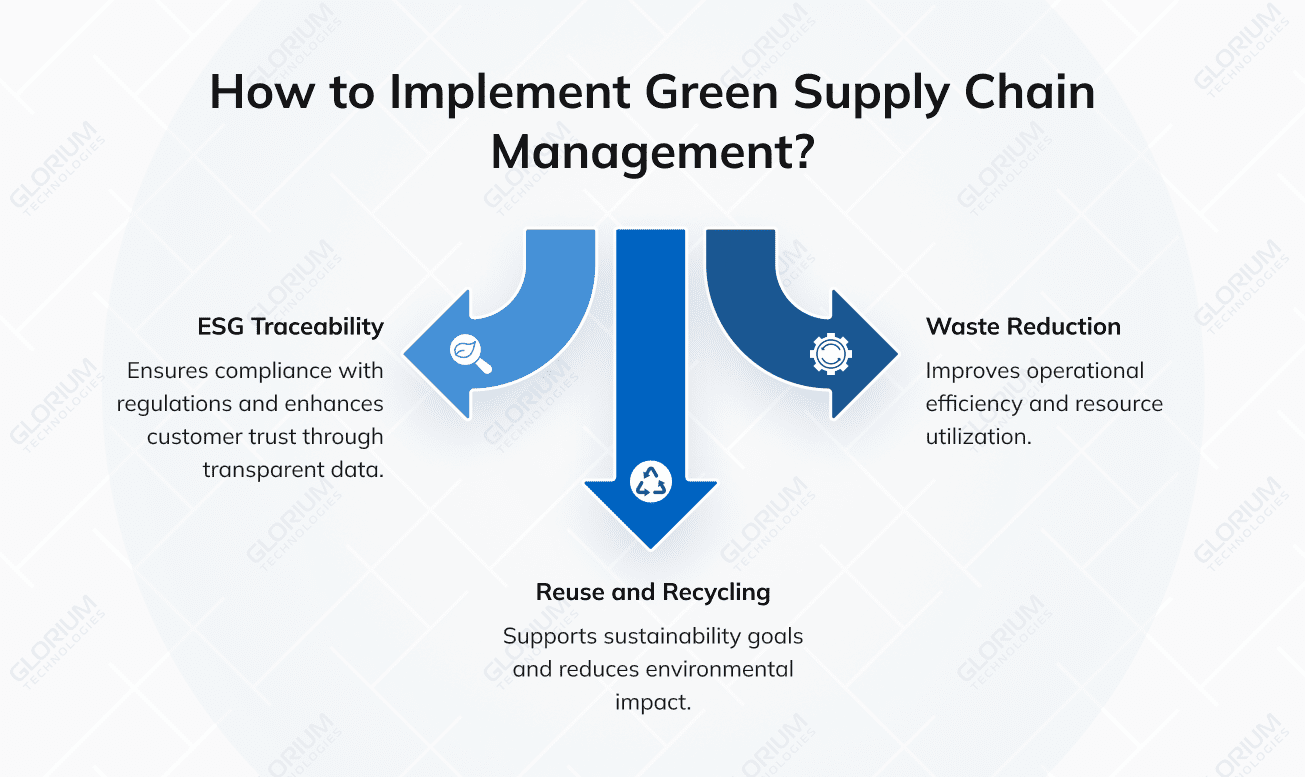
Green Supply Chain Management As a New Compliance Requirement
ESG traceability and regulatory compliance have turned sustainable supply chains into a business requirement. The pressure is coming from two directions at once. Regulators are intensifying their scrutiny — the EU Digital Product Passport will mandate comprehensive product-level data on materials, origin, and recyclability. The EU Deforestation Regulation will require products that are placed on the EU market or exported from the EU after December 30, 2026, to be traceable to the plot-of-land level for seven categories of commodities.
Sustainable supply chains cover the full lifecycle, from sourcing decisions to manufacturing processes that minimize waste and energy use to end-of-life product management that supports reuse and recycling. Done well, the work delivers operational efficiency gains, better resource utilization, and improved customer experience tied to verifiable claims.
How to Build a Supply Chain That Will Last Through 2026 and Beyond
Today, supply chain management is four things working together. The first is connected technology that provides teams with a single view of operations. Second is proactive planning that anticipates disruption. Third is about resilient networks that are built on diversified sourcing. And the last one is a customer-first mindset that centers every decision on the end customer's experience. Integrating these elements is a complex task that rarely succeeds with off-the-shelf software alone.
The best thing you can do is team up with a partner who understands both sides of the equation. That means the technical work of integrating ERP, WMS, TMS, and analytics platforms, as well as the operational reality of how supply chain teams run the business day-to-day. Glorium Technologies works with companies on ERP implementation, supply chain management software integration, and custom solutions built around specific supply chain operations.
If you're rethinking your supply chain strategy, book an intro call with our experts to talk through where to start.
FAQ
What's the difference between supply chain management and logistics?
Logistics is the physical moving and storing of goods. This covers transport, warehousing, and fulfillment. Supply chain management involves raw materials sourcing, supply chain planning, manufacturing, logistics, and returns. You can think of logistics as a specialized function within the broader system that moves your product from concept to customer.
How long does it take to see results from a supply chain technology investment?
That will depend on the scope, but you should see early wins within three to six months – usually around visibility, reporting accuracy, or process automation. The bigger gains, such as measurable improvements in lead times or inventory turns that improve customer satisfaction, typically take six to eighteen months as teams get used to the new tools and the data flows stabilize.
Do small and mid-sized businesses need the same SCM technology as large enterprises?
Not at the same scale, no. You don't need a global tier-one ERP suite to run a tight operation. What matters is fit: choosing platforms that match your transaction volume, supplier network, and growth plans. Many mid-market companies get more value from a well-configured cloud ERP and a few targeted integrations than from enterprise software they only partially use.
How does sustainability fit into supply chain management?
It's now built into every stage, from sourcing decisions and manufacturing energy use to logistics emissions and product lifecycle management at the end of life. Regulations like the EU Digital Product Passport require you to track and report this data, which means sustainability and compliance aren't separate workstreams anymore — they sit inside the same systems running your supply chain.
About Anna Voznaya