
More Time for Patients, Less Time on Paperwork
Pharmacy Automation Solutions
Fewer errors, accurate stock across every site, and more pharmacist time for patients, all built around how your pharmacy already runs.


Tech Partner
Proven since 2010
Dedicated Team
200+ in-house skilled professionals
10+ Industries
Cross-sector know-how
Accelerate Software Development by Up to 60% with AI-Driven SDLC
Launch products up to 60% faster
Add up to 60% more features
Same budget and no extra hires
80-100% Al-Generated Code
Copyright Compliance
Cost-per-Feature Tracked Every Sprint
SAST + Security Review on Every Commit
Multi-Layer Al + Human Review
SOC 2 / HIPAA-Ready
What Pharmacies Gain from Automation
Automation pays back in accuracy, working capital, and time your team gets to spend on patients.
- 76%Fewer Inventory ErrorsCut miscounts and stock variance with inventory software built around your formulary.
- 3.2 hrsMore Clinical TimeGive pharmacists their week back by automating the counting and the reconciliation.
- 22%Lower Stock ValueFree up working capital sitting on shelves you cannot see across in real time.
- 37%Higher Stock TurnoverMove stock faster with continuous counts and reorder points that adjust themselves.
Pharmacy Automation Services Across the Workflow
Automate the step that slows you down most, or connect dispensing, inventory, and billing into one system.
Custom Software
Automation software built around the pharmacy system you already run, or around a new one. See our pharmacy management software development services.
- Central fill or point of care
- Supports retail, hospital, or both
- Owns its own data model
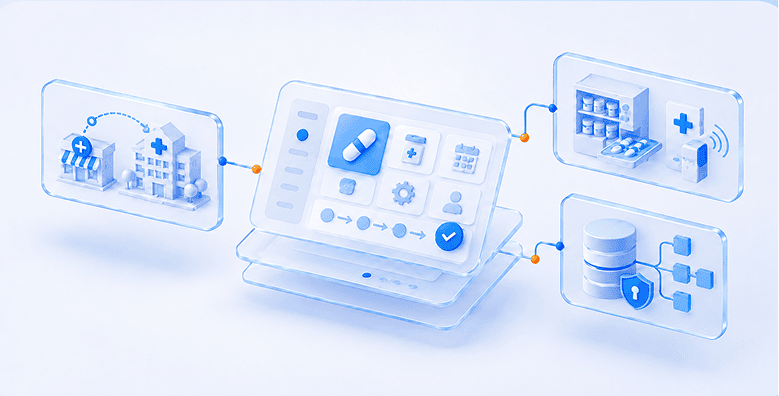
Prescription Management
Scripts move from intake to pickup without rekeying, with NCPDP SCRIPT e-prescribing, real-time adjudication, and refills, renewals, and prior authorizations that never stall in a queue.
- NCPDP SCRIPT e-prescribing
- Refill and renewal automation
- Prior authorisation handling
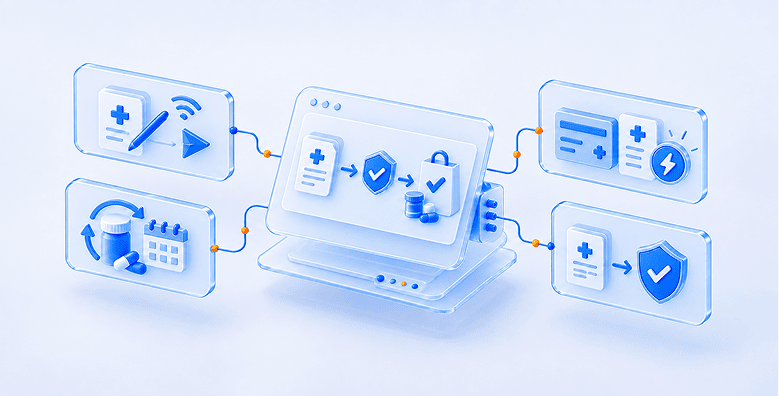
Dispensing Automation
Barcode checks at every handoff catch wrong picks before they reach the patient, while every controlled substance carries a complete, audit-ready DEA record.
- Barcode verification at each step
- DEA controlled substance logs
- Exception handling by pharmacist
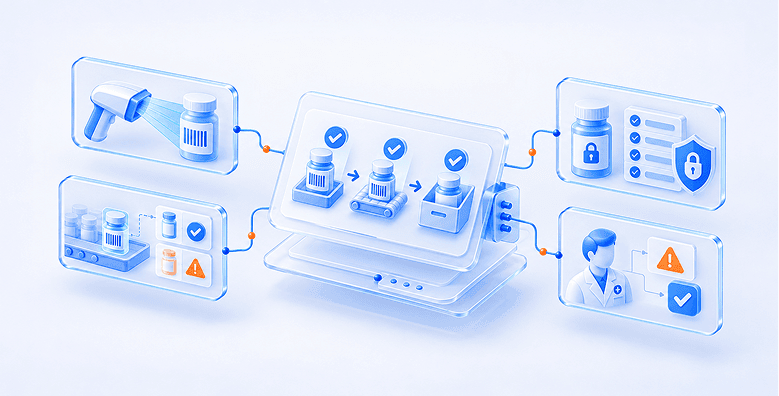
Inventory Automation
Perpetual counts replace manual sweeps, reorder points follow real usage, and expiring or recalled stock is flagged by lot and location across every site.
- Automated perpetual stock counts
- Expiry and recall tracking
- Multi-site inventory visibility
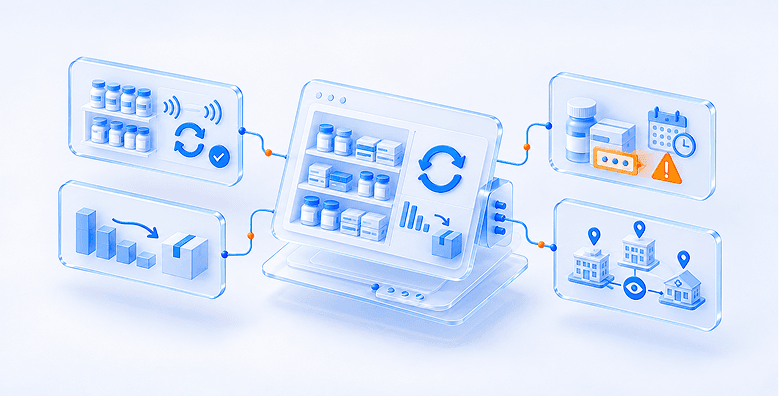
Workflow Automation
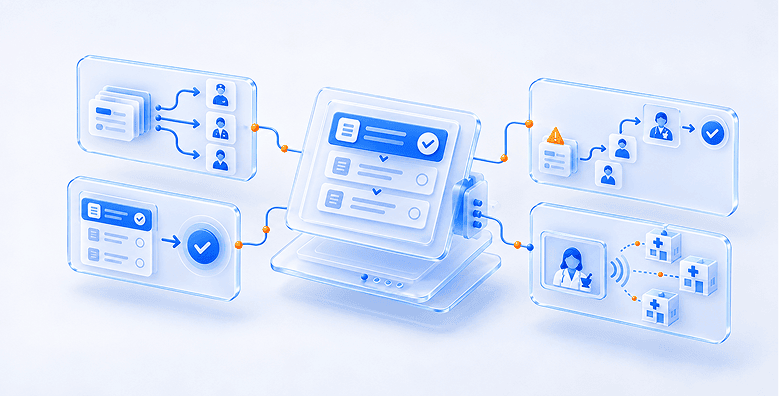
Staff always know what to work on next, exceptions reach the right person automatically, and telepharmacy lets one pharmacist cover several locations.
- Prioritized queue and task routing
- Exception escalation rules
- Telepharmacy workflows
Systems Integration
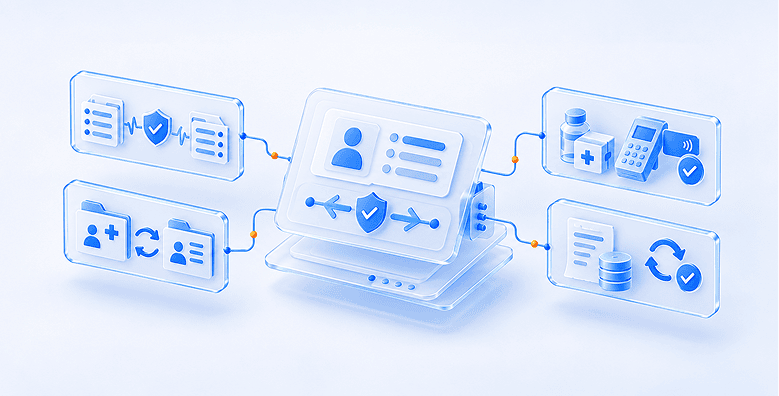
Your pharmacy system, EHR, EMR, POS, and billing share data over HL7 and NCPDP, so patient details and claims are entered once, not three times.
- HL7 and NCPDP messaging
- EHR and EMR integration
- POS and billing data sync
Reporting & Analytics
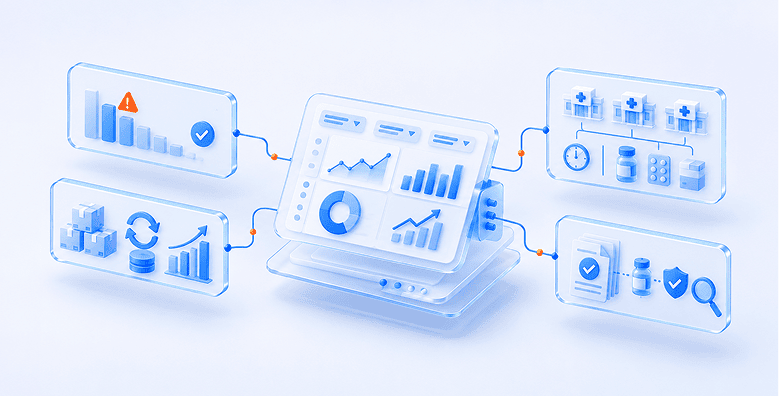
Error rates, turnover, and margin by site, shift, and product are always in view, and DEA and DSCSA reports are ready on demand instead of built by hand.
- Error and exception reporting
- Turnover and margin views
- On-demand regulatory audit reports
AI Automation
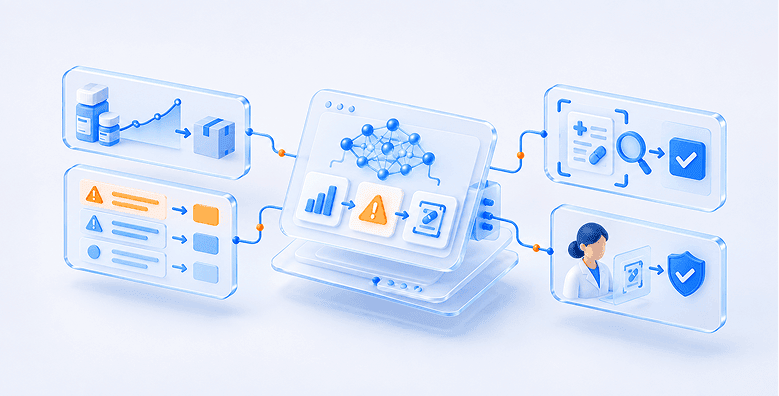
Demand forecasting, exception triage, and script-image verification take the pattern work off your team, with a pharmacist approving anything that touches patient care.
- Demand and reorder forecasting
- Exception triage and ranking
- Pharmacist sign-off retained
Support & Maintenance
Integrations keep running through vendor updates and firmware changes, and compliance stays current, all within the support contract rather than new project fees.
- Interface version monitoring
- Hardware integration upkeep
- Regulatory compliance maintained
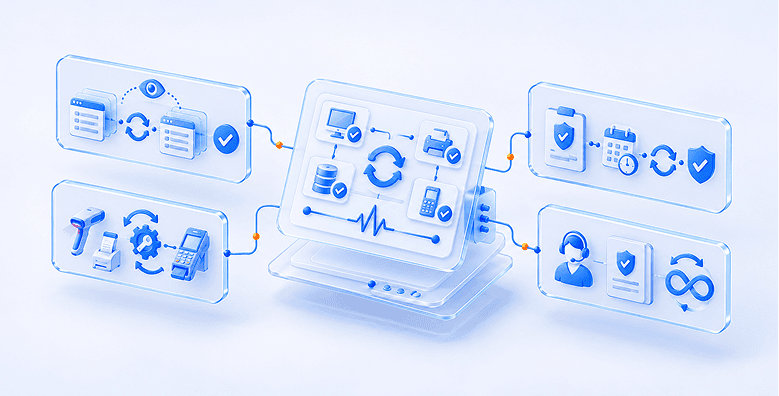
What Pharmacy Automation Software Handles
Launch secure pharmacy software that automates dispensing, protects controlled substances, and keeps inventory accurate across every site.
Electronic Prescribing
Barcode Verification
Controlled Substances
Inventory Tracking
Remote Pharmacy
Workflow Software
How Your Business Benefits from Pharmacy Automation
Every manual step you remove is time back for patients, capital back on the shelf, or an error that never happens. Here’s what automation gives back to your pharmacy.
- Faster PrescriptionsIntake to label without rekeyingRefills renew themselvesQueue routes by urgency
- Fewer Medication ErrorsBarcode scan at every handoffWrong-drug picks caught earlyExceptions reach a pharmacist
- Inventory You Can SeeLive counts across every siteExpiry flagged before it bitesRecalls traced to the lot
- Less Manual WorkCounts and reorders run aloneNo rekeying into the POSReports build themselves
- Better Patient ServiceShorter waits at the counterStatus visible to the patientPharmacists free to counsel
- Decisions Backed by DataError rates by step and shiftTurnover and margin per SKUAudit reports on demand
Automate Without Compliance Risk, with a Certified Partner
Pharmacy automation touches controlled substances, PHI, and claims data. DEA tracking, HIPAA safeguards, and NCPDP messaging are designed into the build rather than reviewed before launch.
- DEA-Ready Tracking
- HL7 and FHIR
- HIPAA-Compliant
- ISO 27001-Certified
- NCPDP SCRIPT
- ISO 13485-Certified
Proven Track Record in Automation
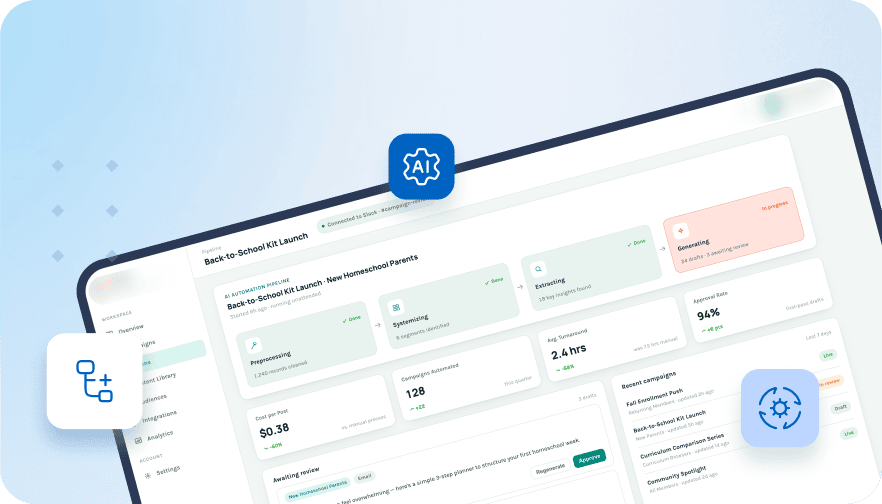
- Healthcare & LifescienceBusiness Process Automation (BPA)AI-Based RPA Platform That Automates Campaign Workflows End to EndRunning campaigns by hand was slow, inconsistent, and expensive. We built a Slack-based automation tool on JavaScript and the OpenAI API that preprocesses the data, segments it, extracts the insights, and generates the content. Cost per post fell by up to 50%, with minimal delay between campaigns.Read the Full Success Story
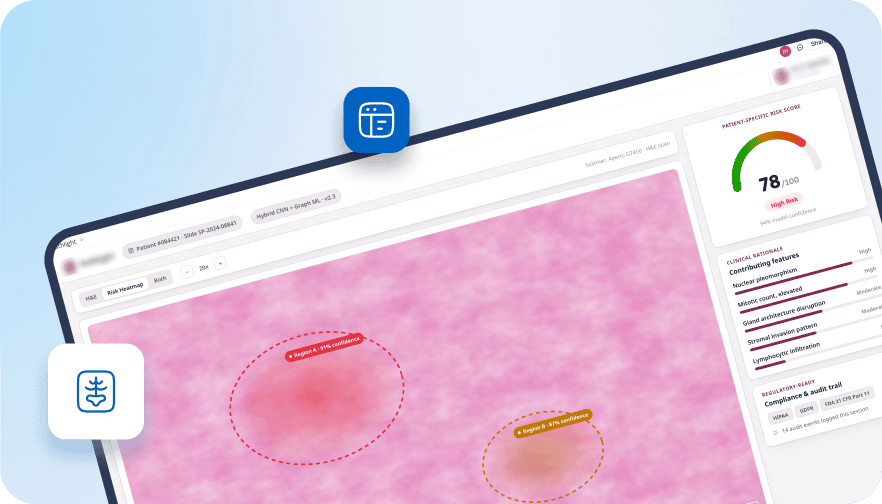
- Healthcare & LifescienceAI & ML DevelopmentAI Diagnostics Platform That Won FDA De Novo Clearance in 18 MonthsGroundbreaking research, no infrastructure to deploy it, slide quality varying by scanner, and clinicians who distrusted a black-box model. We built a cloud platform with multi-scanner normalization, explainable risk scoring, audit trails, and HL7/FHIR integration. Pathologist workload fell 40%.Read the Full Success Story
Proven Track Record in Automation
Proven Track Record in Automation
Hanna Reshetniak
Written by Hanna Reshetniak, Project Manager

From Script Intake to Shelf Replenishment: What Pharmacy Automation Really Takes
Pharmacy automation and a pharmacy management system are not the same project. The management system is the record: prescriptions, patients, stock, and claims. Automation is what removes the manual steps around that record, such as dispensing robots, cabinet and packager integration, refill and reorder rules, and exception routing. Most pharmacies automate on top of the system they already have. If that system is the bottleneck, start withcustom pharmacy management softwareinstead.
What the Research Shows
Vendor case studies are easy to find and hard to trust. Three peer-reviewed studies are worth more than all of them combined.
TheFrontiers in Public Health studymatters most to anyone commissioning software rather than automation hardware. Pharmacists and pharmacy technicians at a 1,460-bed hospital built their own mobile inventory application across a 3,850-item formulary. Inventory accuracy improved by roughly three-quarters, and 3.2 hours per pharmacist per week moved from manual counting to direct patient care and clinical services.
TheAm J Health Syst Pharm studymeasured money. Automating perpetual inventory released roughly $926,000 of working capital and lifted turnover from 1.23 to 1.69. The gain came from continuous visibility, not from faster prescription processing.
Thebarcode verification study by Poon and colleaguesremains the reference point for patient safety: dispensing errors fell from 0.37 percent to 0.06 percent across 254,000 doses, with potential adverse drug events down 63 percent. One caveat. This was a hospital pharmacy with dedicated automation hardware, so it transfers to healthcare facilities more cleanly than to a retail pharmacy counter.
The three studies agree. Returns came from knowing what was on the shelf, checking at every handoff, and ending repeat data entry, not from a machine that could dispense medications faster.
DSCSA, DEA, and What Your Audit Trail Now Has to Prove
Regulatory compliance stopped being a launch-day formality. The Drug Supply Chain Security Act brought package-level electronic tracing into force on 27 November 2023. Dispensers employing twenty-six or more pharmacists and technicians lost their exemption on 27 November 2025, and the FDA hasextended relief for small business dispensersto 27 November 2027. Transaction information must move electronically, products and locations carry GS1 identifiers, and you must produce serialized data on request. Civil penalties reach $500,000 per violation.
Controlled substances sit under a separate regime. DEA rules mean perpetual counts, witnessed waste, and an unbroken record of who touched what. No machine satisfies either obligation by dispensing accurately. Automated systems that log, reconcile, and generate the report do, and they give auditors immediate access to patient information without anyone assembling it by hand.
Choosing Where to Start
Automation budgets are misdirected more often than underspent. The common pattern is automating the most visible step, dispensing, when the constraint sits upstream in intake or downstream in reconciliation.
Where to begin
Typical payback
What makes it hard
Inventory counts and reorder points
Fastest, and the evidence is strongest
Formulary data is messy before it is useful
Barcode verification at handoffs
High safety return, moderate cost
Staff compliance under volume pressure
Prescription intake and refills
Ends repeat data entry immediately
Depends on electronic prescription volumes
Reporting and audit preparation
Quiet, but compounds every month
Needs clean data from the three above
Dispensing hardware integration
Largest capital outlay
Vendor timelines, not code, set the schedule
Sequence matters more than budget. Automation adoption is a complex process, and labor costs only fall when the manual methods around the machine go too. Pharmacies that phase the work and fund each stage from what the last returned tend to finish; those buying everything at once usually stall with two systems running in parallel.
Automation by Pharmacy Setting
A system tuned for a retail pharmacy counter will not serve a ward. Each setting implies a different first project, a different integration list, and a different definition of success.
Setting
First project that usually pays
What complicates it
Hospital pharmacies
Unit dose medication distribution, ward cabinet and retrieval systems integration
Health system pharmacists and accreditation bodies both need reporting
Community pharmacies
Refill automation and prescription turnaround
Nobody to spare for a twelve-month implementation
Specialty pharmacies
Medication management and adherence follow-up
Cold-chain rules and payer documentation
Long-term care
Cycle fill, packaging medications into blister packs and pouch packaging solutions
Delivering medications on time, where packing is the bottleneck rather than picking
Where Pharmacy Automation Is Heading
- From dispensing to deciding:machine learning and artificial intelligence handle demand forecasting, exception triage, and image verification, with a pharmacist in front of anything clinical
- Telepharmacy as coverage:remote verification enables pharmacies to cover several sites with one pharmacist, which changes staffing math more than any machine does
- Measurement over installation:operational performance is tracked as error rate, turnover, and time spent per script, which is how operational efficiency and workflow efficiency become something you can fund
Glorium Technologies: Your Go-to Partner for Pharmacy Automation
Who builds the software shapes the outcome as much as the hardware on your floor. The pharmacies in those studies did not outspend their peers. They automated the repetitive tasks quietly consuming a pharmacist’s week, and built around their own workflow rather than adapting to a platform. Automating routine tasks is what improves patient outcomes in the pharmaceutical sector, because it returns the time that patient satisfaction depends on.
Glorium Technologies has built healthcare software since 2010, with more than 200 in-house engineers and ISO 27001, ISO 13485, and HIPAA-compliant delivery. A workflow audit opens every engagement, so the sequencing question above is answered with your data.Bring your requirements, and we will scope the build around your formulary, your sites, and your compliance obligations.
Let’s Connect!
Send us a message, and we’ll promptly discuss your project with you.