







Beyond Rule-Based Bots: Robotic Process Automation and the Rise of Agentic Automation
Updated August 27, 2026

 Summarize in ChatGPT
 Summarize in ChatGPT
Every week, your team burns hours on tedious behind-the-scenes work. Copying email orders into the ERP, re-typing figures into spreadsheets, hunting down the discrepancies when the numbers don’t match, you name it. That massive drag on your best people is the problem robotic process automation was built to remove. Instead of hiring around the volume, you hand the repetitive steps to software and give your staff back the hours.
According to the McKinsey Global Institute, software agents could theoretically take over repetitive digital tasks that make up 44% of all US work hours today. Most teams start by using RPA to tackle the most mindless chunk of that workload. The payoff is immediate: hours saved, far fewer errors, and processes that move forward without waiting for someone to manually click through them.
Let’s discover how automation works, where it delivers the biggest impact, and how it now connects to AI agents.
Content
Before you choose any automation platform, you should look past marketing hype and understand how technology works. Robotic Process Automation (RPA) is software that does what you would do on a computer. It uses clear rules to complete tasks without anyone sitting at the keyboard.
Robotic process automation software uses configured software robots, often called bots or digital workers, to perform repetitive tasks across your existing systems. A bot logs into systems, reads and moves data, clicks buttons, and copies fields just like an employee would. What separates robotic process work from a custom-coded integration is its approach: RPA bots operate at the user interface layer, so they can automate tasks in enterprise applications that never expose a clean API.
RPA excels at rule-based work with defined inputs and predictable outputs. Think invoice matching, manual data entry, record updates, and report generation. These are the manual tasks that consume hours without demanding judgment, and they are exactly what task automation was built to remove.
Experienced folks may want to check this distinction early on, so it makes sense to cover it first. RPA bots function across three core operating modes, each pulling you down a very different deployment path. Which one you pick changes where the bots live, what triggers them, and how they fit into your enterprise environments:
Walk into any vendor meeting, and you will hear three terms used as if they mean the same thing, though each describes a different capability. AI-driven layers are now built on top of RPA (robotic process automation), and the gap between them is where the market is moving.
Traditional RPA is completely rigid, so it follows the rules you define and won’t adapt on its own. When you layer on machine learning, natural language processing, and intelligent document processing, you get intelligent automation. Suddenly, the bot can read unstructured data, figure out actual intent, and handle exceptions that would normally crash a basic script.
Hyperautomation is the bigger picture. It isn’t about building one-off bots but an end-to-end framework, combining RPA, AI, process mining, and business process management to automate entire workflows across the enterprise.
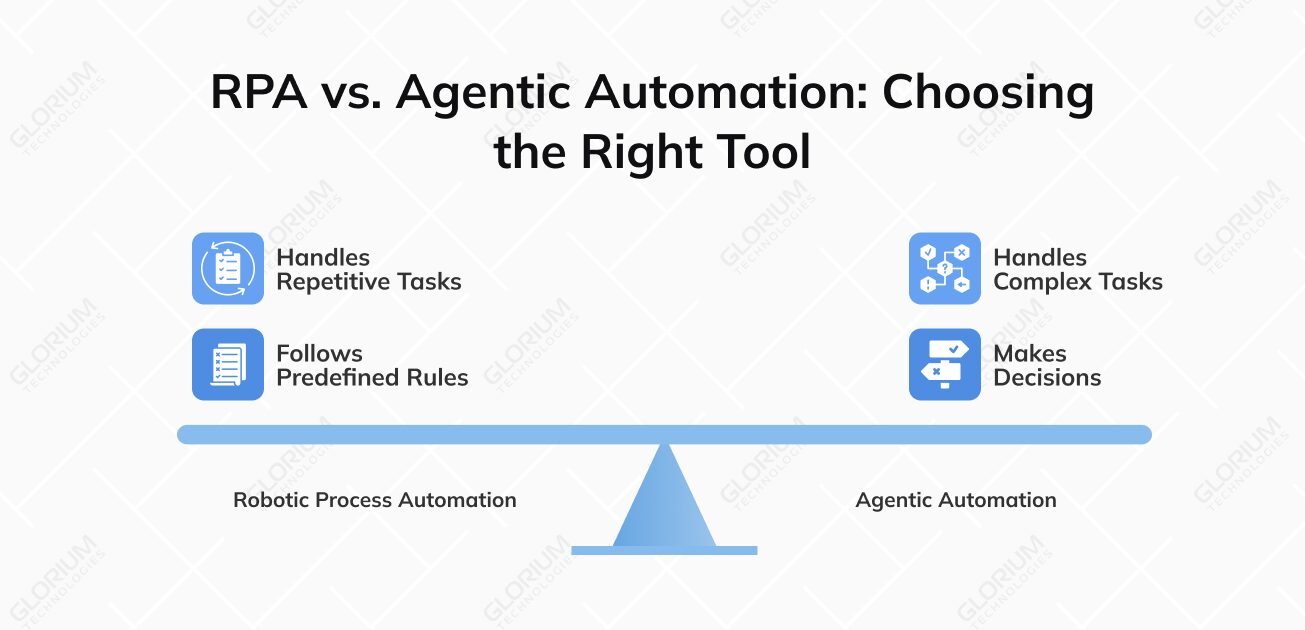
An agentic process automation system is the newest layer. Where a rule-based bot executes a fixed path, AI agents plan across steps, choose tools, and act with limited supervision. The data shows how fast this is arriving: Gartner forecasts that 40% of enterprise applications will embed task-specific AI agents by the end of 2026, up from less than 5% in 2025.
RPA gives you a reliable execution layer for structured, high-volume steps, while agents take on more complex tasks. Agentic automation adds a reasoning layer that manages ambiguity, exceptions, and multi-system decisions, and the two work best when paired together.
This is precisely where building a custom solution yields the best results. Glorium Technologies develops AI agents and custom automation instead of reselling a licensed RPA suite, which means the bridge from traditional robotic process to agentic automation gets designed around your real workflows.
CogniAgent, our own RPA platform for AI agents, ships with 2,700+ integrations. In the internal Comparative Study (February 2026, across 172 scenarios), it recorded a 92% first-attempt success rate against 64.5% for prompt-based alternatives.
Pitch decks are full of buzzwords, but determining real process fit comes down to the specifics. Here’s what’s really happening inside modern RPA tools.
The table below outlines the ideal use cases for each capability.
| Capability | Best used when | Typical output |
| Data extraction and entry | Structured records move between systems | Synced fields, fewer errors |
| Application UI automation | No API is available | Human-like task execution |
| Screen and web scraping | Data sits behind a user interface | Captured data for reuse |
| API-based integration | A stable API exists | Direct system-to-system flow |
| Document processing (OCR/IDP) | Inputs arrive as PDFs or scans | Structured data from documents |
Automating one process in a pilot is easy. The hard part is scaling process automation across business operations without leaving a maintenance mess behind, and that comes down to a disciplined lifecycle. Here is how it plays out in practice.
You cannot automate what you have never measured. Process mining doesn’t rely on old flowcharts that no one follows. It pulls data from your system logs to show you the real workflows. This real-world snapshot makes it easy to see which complex processes are ready for automation and which are too messy to hand over to a bot.
Poor use-case selection could be one of the top reasons why more than 40% of agentic AI projects could be canceled by the end of 2027. The difference between a project that pays off and one that gets scrapped traces back to how well the target process was chosen at the start.
Once you move past a single pilot, you need a governance model. A Center of Excellence gives you centralized management of standards, security, bot maintenance, and reuse. It decides which processes get automated, who owns each bot, and how change is handled when an application updates. Without it, automation spreads as disconnected scripts that no one maintains, and the program loses momentum. With it, you build enterprise automation that survives staff turnover and platform changes. The stakes are documented: Gartner predicts that by 2027, 40% of enterprises will demote or decommission autonomous AI agents because of governance gaps found only after production incidents. Governance is what keeps a program on the right side of that line.
The headline outcome you can measure is operational efficiency. Companies adopting RPA can cut transaction processing times by up to 60% and reduce cost per transaction by 40%. Those cost savings compound when you automate repetitive tasks that run thousands of times a month.
Quality tends to improve alongside speed, because a bot does not fatigue or misread a field on the hundredth pass, so error rates fall and rework drops with it. Adopters reported quality gains of 90%.
Here is how the core benefits map to what you can measure:
“The result of AP automation is faster processing, fewer errors, or duplicate payments, stronger controls, and real-time visibility into what’s pending, approved, or due, which is critical for teams managing growing invoice volumes.”
YouAccel, Overview of Robotic Process Automation: Concepts and Benefits
Knowing where the technology breaks can help you scope projects that succeed and avoid the ones that quietly fail. These limits are well documented by practitioners.
The last two points show up in the field. CIO reports that the extra controls and oversight needed to manage automation risk often wipe out the projected return, which is why disciplined teams cancel weak projects outright. The same gaps sink RPA rollouts built on messy legacy systems without discovery. Skip that groundwork, and the bots disappoint.
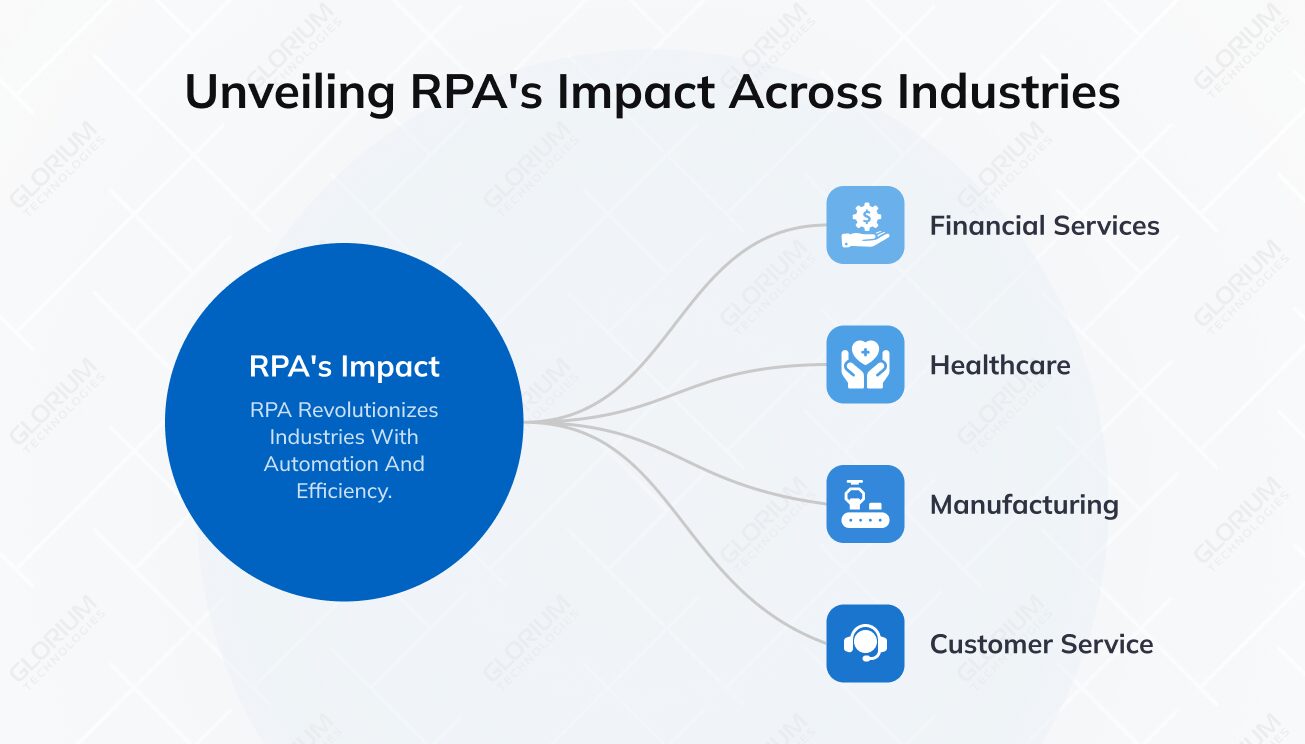
RPA shows up in nearly every sector, but the highest-value use cases cluster where transaction volume is high, and rules are stable. Here is one example per industry:
Market demand backs up this concentration pattern. BFSI took roughly 28% of RPA revenue in 2025, the largest share of any sector, which reflects how well high-volume financial workflows suit automation technology and packaged RPA solutions.
Where this is all heading is easy enough to see, and it should shape how you invest now. Modern RPA platforms keep absorbing artificial intelligence, and the line between a bot and an agent gets blurrier every quarter.
Several shifts are converging at the same time. AI-powered RPA adds machine learning, so bots handle more complex processes. Intelligent document processing reads the unstructured data that stopped older bots, and process mining feeds a cycle of continuous improvement. And agentic AI integration lets systems handle process orchestration across steps instead of following one fixed path.
For proactive teams, the practical move is to treat RPA and agentic automation as one continuum. Build reliable rule-based workflow automation with proven RPA software tools where work is structured, then layer AI agents where judgment and exception handling are needed. Done well, this is how you accelerate digital transformation initiatives without brittle bot sprawl. A partner that builds custom automation and AI agents, as Glorium Technologies does with CogniAgent, can design that continuum around your systems instead of forcing your processes to fit a licensed tool.
Many teams connect existing third-party tools to get automation running, and that approach can work well. Glorium Technologies went a step further and built its own AI-native platform, CogniAgent, with 2,700+ integrations and a proven track record against prompt-based alternatives. That gives you a partner who can start with reliable rule-based RPA software and switch to agentic automation as your processes mature, all on one continuum instead of a patchwork of subscriptions.
Glorium Technologies works as a maturity-driven transformation partner, so the plan meets your team where it stands today and expands in measured steps. Every engagement opens with a free process audit that puts a real dollar figure on your manual work before you commit a cent.
Book a free process audit with our team.
Robotic process automation automates specific routine tasks by mimicking user actions across applications. Business process management and business process automation take a broader view, redesigning and orchestrating entire end-to-end business processes, with RPA as one component.
There is no single sticker price because cost tracks the work involved. A single well-scoped bot automating one clean process sits at the low end. Costs climb with the number of processes, the state of your legacy systems, how much exception handling each workflow needs, and ongoing bot maintenance. Licensing, integration effort, and change management all factor in, too. The practical first step is a process audit that scopes the work and estimates payback before you commit budget.
Traditional RPA follows fixed rules and does not learn. Give it a clean, repeatable process, and it runs that process the same way every time. Artificial intelligence works differently, since it adds perception and prediction, so systems can interpret unstructured data, weigh options, and improve process accuracy as they go. Intelligent automation combines the two, pairing the reliability of rules with the judgment of AI. You get steady execution and flexibility, all in one workflow.
Look for rule-based tasks that are repetitive and predictable. With RPA, you can automate business processes that have clean, structured data and common software that doesn’t change much. Let’s say you want to streamline workflows in your office, such as copying data from one system to another, processing supplier invoices, running routine account reconciliations, or updating employee records.