







What Is a Warehouse Management System (WMS)? A Complete Guide to Processes and Best Practices
Updated September 7, 2026

 Summarize in ChatGPT
 Summarize in ChatGPT
A warehouse can make or break the customer experience long before an order reaches the doorstep. When inventory sits in the wrong place, pickers lose time, orders ship late, and margins quietly shrink. When warehouse operations run well, the same space becomes a fast, controlled, and data-rich part of the supply chain.
That’s why the warehouse management system market is growing so quickly. MarketsandMarkets projects it will rise from USD 4.57 billion in 2025 to USD 10.04 billion by 2030, with a 17.1% CAGR. The pressure behind this growth is easy to see: e-commerce volumes keep rising, SKU catalogs are getting harder to manage, and customers now expect fast, accurate delivery by default.
In this guide, we’ll look at the main warehouse processes, common types of warehouse management systems, how WMS software connects with the wider supply chain, and what to keep in mind when choosing a setup that fits your business today and as it grows.
Content
Warehouse management is the discipline of overseeing daily warehouse operations from end-to-end: receiving, put-away, picking, packing, and shipping. It also pulls in the supporting flows around those activities, including inventory management, labor management, space utilization, order fulfillment, and inbound and outbound logistics.
The reason it matters more now than five years ago comes down to pressure. Customer expectations have shifted, two- to three-day delivery has become a common benchmark, and growing product catalogs make inventory harder to control. A function that used to live quietly in the back office has become a competitive lever. In many categories, it’s the deciding factor between repeat customers and lost ones.
The day-to-day reality has also gotten harder. Many businesses now run multiple warehouses, juggle warehouse locations across regions, and need real-time visibility into inventory levels at all of them. Spreadsheets stop scaling at that complexity. The companies that handle it well usually have a system, a discipline, and a team that treats inbound and outbound logistics as one connected flow.
Warehouse management sits at the operational heart of supply chain management. On one side, it links to procurement and demand forecasting since what you forecast determines what you stock and where you put it. On the other side, it connects to transportation management systems and order management because the moment a unit leaves the warehouse, it becomes a delivery problem. When these connections run cleanly, the whole supply chain moves faster. When they break down, you get the kind of friction that erodes margins quietly for years.
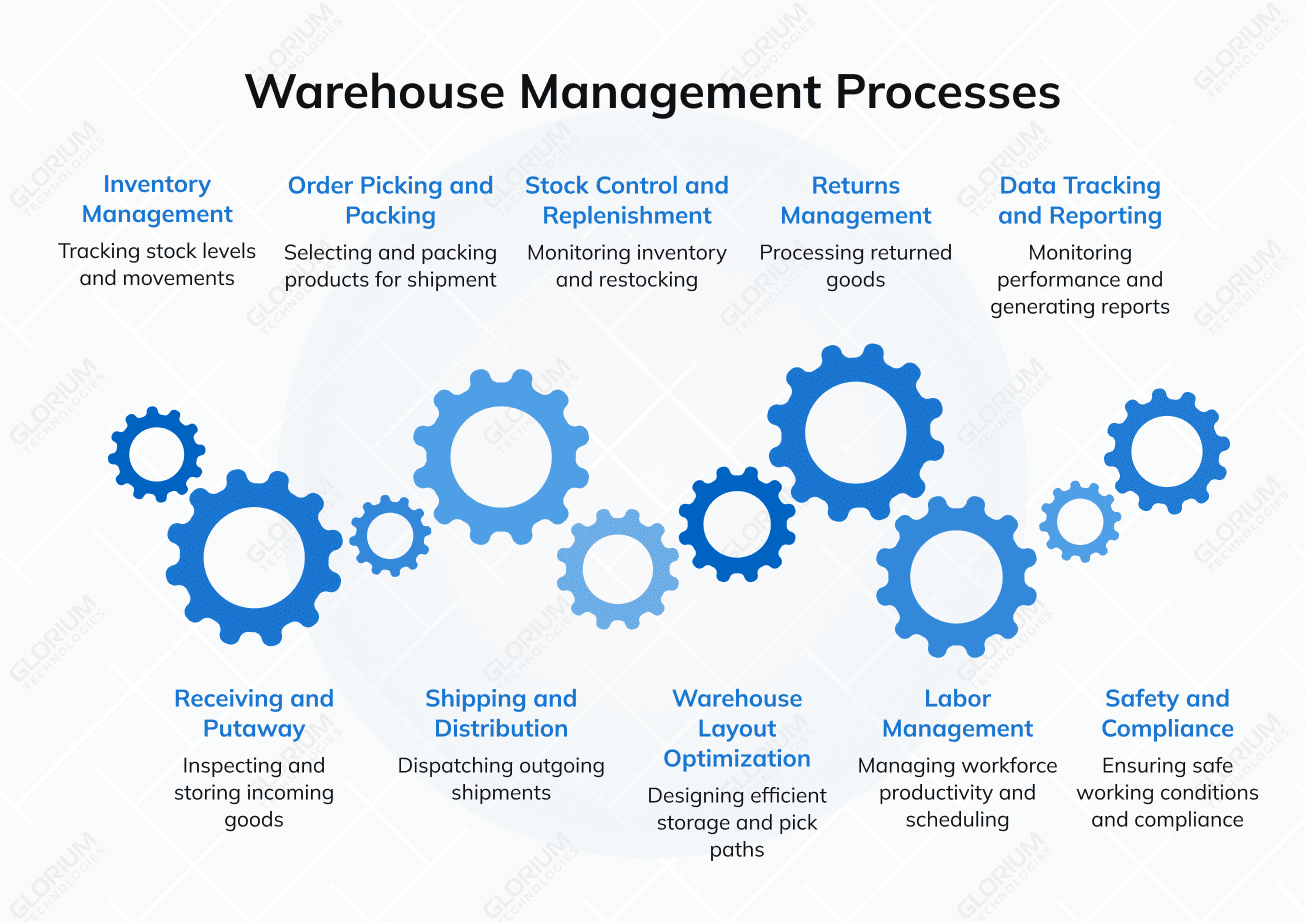
Warehouse management runs on roughly ten interconnected processes that work in sequence and in parallel. When any single process breaks down, the ripple effect tends to touch everything downstream, from order accuracy to customer trust. Here’s how the core warehouse processes line up.
Inventory management is the backbone of every warehouse. It covers tracking stock levels, locations, and movements within the building in real time. Reliable inventory data feeds directly into demand forecasting, order management, and broader supply chain planning. Closely related is inventory control, which refers to the policies and methods used to maintain target inventory levels. Get inventory control wrong, and downstream forecasting becomes guesswork.
Wondering how it looks in real life? A recent Odoo 18 implementation for a U.S. construction project management company brought procurement, inventory, project scheduling, and accounting into one connected platform. As a result, the company saw 2x faster supplier response times, 18% lower procurement costs, and 23% faster project delivery.
Incoming goods get inspected, documented, and assigned to specific storage locations. This is the first operational touchpoint with suppliers, so it shapes both customer and supplier relationships. Receiving quality also determines downstream inventory accuracy. Errors made here, like miscounted cartons or a misread barcode, will travel through the entire supply chain before anyone catches them.
Pickers select products from storage, pack them, and stage them for shipment. Picking is usually the most labor-intensive warehouse process and can account for more than half of total warehouse operating costs. It’s also where speed and error rates have the most direct impact on fulfillment performance. Even a 1% pick error rate can mean hundreds or thousands of incorrect orders a year, depending on order volume, with extra costs tied to reshipping, labor, returns, and customer churn.
Outgoing shipments get staged, loaded, and dispatched. This is where the warehouse hands off to transportation management systems, and where yard management coordinates dock scheduling and carrier handoffs. Sloppy shipping handoffs add hidden hours to lead times that customers feel, even when they never see the cause.
Warehouse managers keep an eye on stock levels and make sure replenishment happens before shortages slow down fulfillment. Modern warehouse management systems make this easier by using real-time inventory data and demand signals to suggest or trigger restocking automatically. That’s a big step up from waiting until stock hits a fixed reorder point. For many businesses, this move from reactive to proactive replenishment becomes one of the clearest benefits after a WMS rollout.
Layout determines accessibility, pick path efficiency, and total throughput. Optimizing warehouse space and assigning optimal storage locations to fast-movers means more orders processed per shift with the same headcount. Layout optimization is an ongoing discipline. The right design today is rarely the right design 18 months from now, after seasonality, new SKUs, and shifting demand have all done their work.
Returned goods need to be received, inspected, and either restocked, repaired, or written off. For e-commerce sellers, reverse logistics can quickly become a costly operational area, especially when products require testing, repackaging, refurbishment, or additional quality checks before they can be sold again. WMS software helps teams process returns faster, apply clear disposition rules, and update inventory data in real time.
Labor management covers how teams are scheduled, assigned, balanced, and measured across shifts and warehouse zones. It’s a practical area to improve because labor is usually one of the biggest costs warehouse managers can actually control. Better planning here can reduce idle time, ease bottlenecks, and improve warehouse productivity without simply adding more people.
Analytics and reporting tools monitor warehouse performance, surface trends, and support faster decisions. Useful reporting depends on clean, connected data from across all warehouse processes. When data is siloed, you get reports that look right but don’t reflect reality. Modern warehouse management systems feed data into broader supply chain management dashboards so leaders can see what’s happening across the whole network without chasing it down by phone.
Warehouses have to maintain safe working conditions, follow OSHA or local regulatory standards, and manage hazardous material handling where applicable. Safety counts as a core operational requirement. WMS systems support compliance through automated documentation, audit trails, and incident tracking, all of which protect the business when something does go wrong.
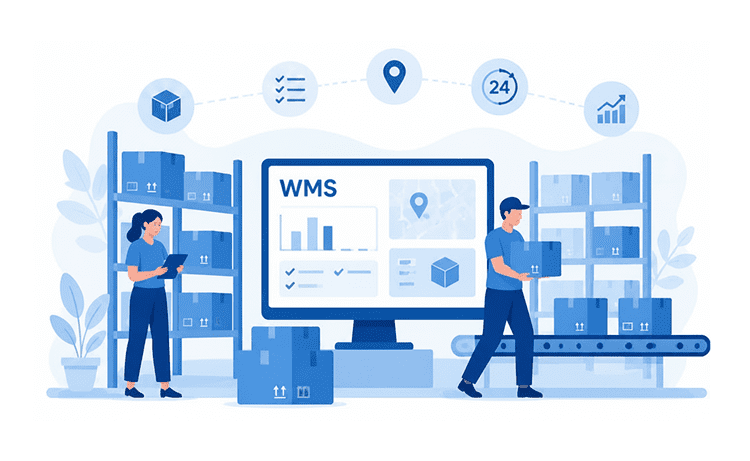
A warehouse management system (WMS) is software designed to control daily warehouse operations, track inventory data in real time, and manage warehouse operations end-to-end. Core warehouse management functionality typically spans inventory management, order management, receiving, shipping, labor management, yard management, and reporting.
WMS solutions usually fall into three buckets. A standalone WMS is a dedicated product focused entirely on warehouse operations. A cloud-based WMS delivers similar software through a subscription, with the vendor handling infrastructure and updates. The third option is a WMS module embedded inside an enterprise resource planning (ERP) system. ERP platforms like Microsoft Dynamics 365 Business Central and Odoo include warehouse management capabilities natively, which simplifies integration when your other operations already live there.
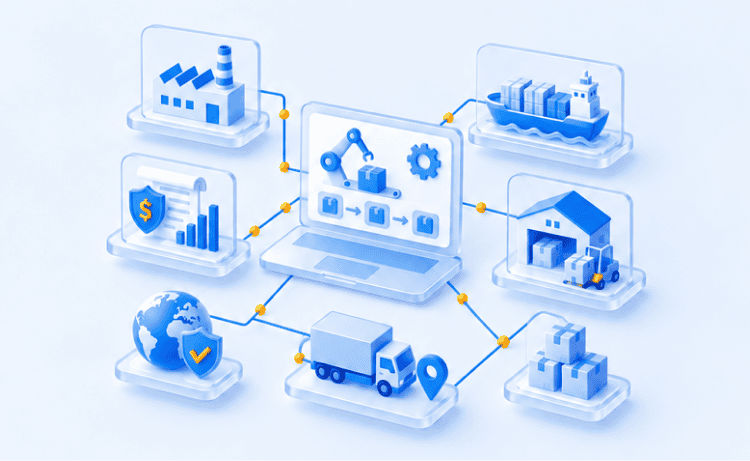
Integration is where most WMS projects either pay off or quietly underperform. Connecting a WMS solution to transportation management systems, ERP systems, and supply chain systems gives you a single version of the truth. When a sales order is confirmed, available stock updates instantly, a purchase order reflects incoming goods, and finance works with the same data set. Real-time visibility across systems also improves supply chain processes by surfacing problems early before they become customer-facing.
Not every warehouse plays the same role. The type of facility a business operates shapes everything from warehouse operating costs to logistics operations. Here’s a quick comparison of the most common types.
| Type | Primary Function | Best For |
| Private warehouse | Company-owned, full operational control | Large-volume businesses with stable, predictable demand |
| Public warehouse | Third-party, shared space | Seasonal businesses, startups testing new markets |
| Distribution or fulfillment center | High-velocity order processing | E-commerce and omnichannel retailers |
| Bonded warehouse | Customs-controlled storage | Importers managing duties and tariffs |
| Cold storage warehouse | Temperature-controlled environment | Food and beverage, pharma, perishable goods |
Most growing businesses end up running a mix. A retailer might keep core SKUs in a private warehouse and use public warehouse space for seasonal overflow. An importer juggling tariffs may add a bonded facility for high-duty goods. The mix works fine, but it requires a WMS solution capable of distribution management across multiple warehouse locations without losing track of stock. Glorium Technologies has helped clients design warehouse management strategies that fit messy, real-world operations: businesses with two facilities and a shared 3PL, food producers with cold storage, manufacturers running bonded inventory alongside their main distribution center.
Effective warehouse management has a direct impact on operational efficiency, customer satisfaction, and bottom-line performance. Done well, it pays for itself within the first year for most mid-market operations. Here’s where the gains usually show up:
Industry research shows that AI-powered WMS modules push inventory accuracy up by roughly 30%. In practice, that means fewer emergency reshuffles, less cash trapped in carrying costs, and a lot fewer apologetic emails to customers about delays.
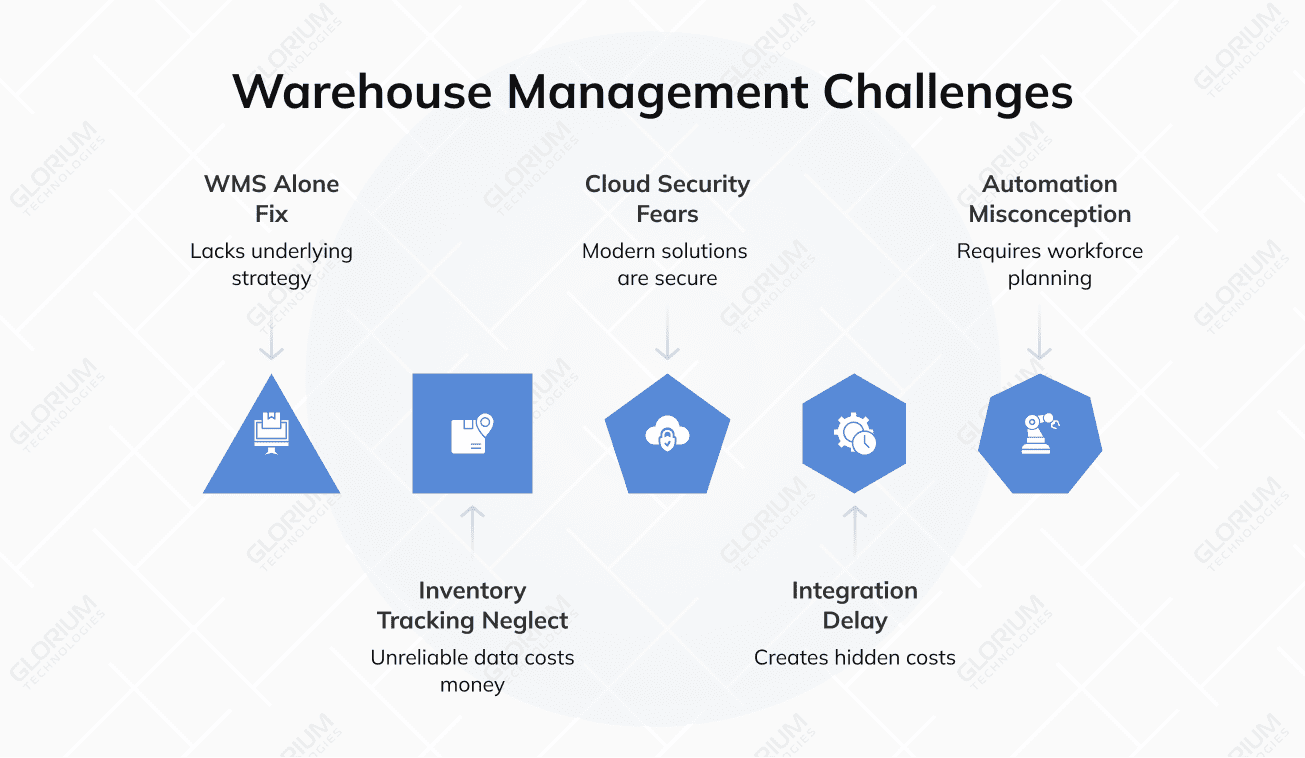
A few misconceptions make warehouse projects trickier than they need to be. Here are the ones we run into most often.
A warehouse management system works as a tool that supports an underlying strategy. Without well-defined warehouse processes underneath it, even the best WMS software will underperform. Technology has to sit on top of sound operational design to deliver real value.
Even small warehouses lose money when inventory data is unreliable. Manual processes break down faster than most warehouse managers expect. By the time you notice the gap, it might have been costing you for months.
This was a fair concern a decade ago. Today, modern cloud-based WMS platforms invest heavily in security and compliance. The cloud vs. on-premise debate has shifted toward cloud-based solutions for most mid-market businesses, with on-premise mostly serving regulated sectors that need full data sovereignty.
Retrofitting integration capabilities after deploying a standalone WMS or ERP system creates hidden costs and data silos that are expensive to undo. Planning for connectivity with transportation management systems, logistics management tools, and other supply chain systems from day one saves time, money, and a lot of frustration.
Automation technologies complement labor management while still requiring it. Demand forecasting and workforce planning remain human-driven disciplines. The smartest automation rollouts we’ve seen actually require more thoughtful labor planning because robotics introduces new shift patterns, exception flows, and maintenance cycles that humans still own.
Optimization is less about silver-bullet technology and more about getting the basics right. The following practices show up consistently in warehouse projects that deliver real, measurable outcomes:
The best practice that doesn’t always make most lists: avoid trying to fix everything at once. Phased rollouts almost always beat big-bang implementations, especially when warehouse staff is already stretched thin.

A few trends are reshaping warehouse management capabilities in 2026. These trends already show up in real deployments today.
Cloud-based WMS platforms have become the default for new deployments. Cloud accounted for roughly 55% of the WMS market share in 2025, driven by lower infrastructure costs, faster updates, and easier scaling across warehouse locations.
Automated guided vehicles (AGVs), robotic picking, and conveyor systems are reducing manual labor in fulfillment operations. According to Expert Market Research, 57% of logistics firms globally plan to adopt smart warehouse solutions by 2030. Still, automation delivers the best results when it builds on solid software, clean data, and well-structured warehouse processes.
Machine learning models improve demand forecasting precision, helping businesses optimize inventory levels and reduce warehouse operating costs. The biggest gains usually come from how the forecasts feed automated replenishment downstream, beyond raw prediction quality.
Sensors and RFID tags feed real-time inventory visibility into WMS systems, improving inventory tracking and enabling proactive logistics operations. IoT-driven visibility is especially useful in cold storage and pharma, where conditions matter as much as counts.
Modern warehouse management systems now connect more often with transportation, yard management, and distribution tools. This gives leadership a clearer view of how goods move across the supply chain, from warehouse activity to outbound delivery. This is where the line between WMS and broader supply chain platforms like Odoo for logistics keeps getting blurrier.
Warehouse management is a multi-layered discipline that encompasses processes, people, and technology. And the right approach depends heavily on your business’s size, complexity, and where you want to be in three years. Choosing between a standalone WMS, a cloud-based WMS, or an ERP-integrated module is more of a strategy question than a software question, and getting it right pays dividends for years.
Glorium Technologies has spent 15+ years helping companies build and modernize business software. Our team handles ERP implementation, custom WMS development, and supply chain systems integration end-to-end. If you’re evaluating a WMS, planning an ERP rollout, or trying to figure out whether your current setup will scale, contact us. We’ll walk through your specific operations and map out a practical path forward.
A warehouse management system focuses on daily warehouse operations: inventory tracking, order fulfillment, labor management, receiving, and shipping. An ERP system like Dynamics 365 BC or Odoo covers broader business functions, including finance, procurement, manufacturing, and HR. Many ERP systems include WMS modules, which is why most businesses need to decide between deploying a standalone WMS and using their ERP-integrated approach. The right choice usually comes down to operational complexity. For intricate warehouse workflows, a dedicated WMS often wins; for moderate operations where other systems already live in your ERP, the embedded module is usually faster and cheaper to deploy.
Yes, and the case for it has gotten stronger every year. Cloud-based solutions and lightweight WMS software have made warehouse management accessible to operations that would have been priced out a decade ago. Even a single-site business can see meaningful improvements in inventory accuracy, space utilization, and warehouse productivity with the right WMS solution. The break-even point for small operations is usually faster than people expect.
The connection between warehouse management and transportation management software handles outbound logistics: shipment scheduling, carrier selection, label printing, and tracking updates. Strong integration capabilities between these systems improve supply chain processes, cut warehouse operating costs, and reduce the manual handoffs that introduce errors. Most modern WMS platforms either include native TMS connectors or expose APIs that make integration relatively painless.
Start with operational complexity, then look at where your other systems live. For complex picking flows, multi-step fulfillment, or high-throughput distribution centers, a dedicated WMS usually wins on functionality. For moderate warehouse operations where finance, procurement, and order management already run on an ERP, the embedded WMS module in platforms like Odoo or Dynamics 365 BC tends to deliver more value for less work.
Odoo has become a strong option for small to mid-sized warehouse operations. Its warehouse management features cover the essentials from the start: inventory tracking, barcode scanning, multi-warehouse operations, FIFO/FEFO rules, and automated replenishment. Since Odoo has a modular, open-source structure, teams can also extend it with custom development when standard functionality no longer covers their workflows. Odoo works particularly well for businesses that want their warehouse management to live inside the same platform as their accounting, sales, and purchasing. As a certified Odoo partner, Glorium Technologies has implemented Odoo ERP solutions, including warehouse and inventory modules, for clients across food manufacturing, retail, and construction.