







Digital Transformation Business Process Management: Key Technologies, Use Cases, and Roadmap for 2026
Updated September 7, 2026

 Summarize in ChatGPT
 Summarize in ChatGPT
A business process rarely breaks all at once. First, an approval waits too long in someone’s inbox. Then, the inventory data falls behind what is happening on the floor. A customer support team works from one system, finance from another, and operations from a third. At some point, the issue is no longer one inefficient workflow. It becomes the way the business runs.
That is where digital transformation and business process management start to overlap. Companies are no longer just adding new tools to old workflows. They are rethinking how work moves across teams, systems, and decisions, then using automation, AI, analytics, and cloud platforms to support that redesign.
Deloitte’s Tech Trends 2026 report shows how widespread this shift has become: only 1% of IT leaders say their organization has no major operating model changes underway. For the other 99%, the question is not whether processes will change, but how structured, measurable, and sustainable that change will be.
This guide covers the practical side of digital transformation business process management: what it involves, which technologies support it, how it appears across industries, and how to build a framework that connects process redesign to measurable business outcomes. The goal is to help operations leaders, IT decision-makers, and process owners move from broad transformation plans to practical execution.
Content
Digital transformation, as it applies to business processes, refers to integrating digital technologies into existing business processes to change how organizations deliver value, serve customers, and operate every day. Business process management provides the structural discipline behind it: process modeling, monitoring, and continuous optimization. The two work together. BPM brings the rigor; digital transformation supplies the tools and the strategic push that make those processes faster, more adaptive, and data-driven.
Enterprises that succeed in 2026 are not running isolated digital projects in a few departments. They are redesigning end-to-end processes around AI, automation, and real-time data, then layering technology on top of a redesigned foundation. When companies add digital tools to inefficient workflows without rethinking the process itself, they often preserve the same bottlenecks in a more expensive form.
This is why terminology matters. Digitization, digitalization, and digital transformation often appear in the same conversations, but they describe different levels of change. For business process management, the difference is important because it shows whether an organization is simply making existing tasks digital or actually redesigning how work gets done.
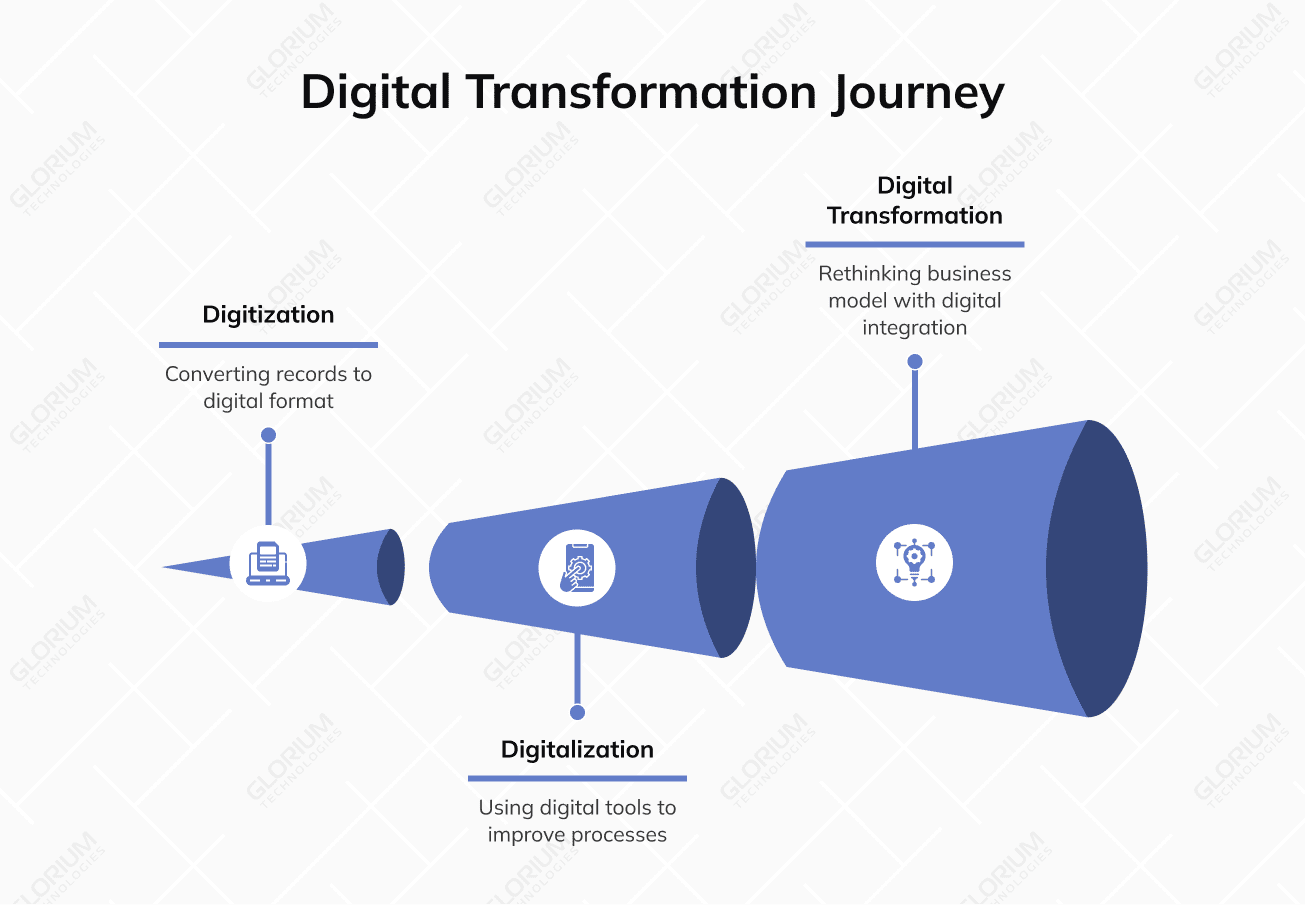
Most companies start with digitization, drift into digitalization, and call the result transformation. Mature business process management programs separate the three. They define digital transformation goals upfront, tie them to business strategy, and measure progress with process-level key performance indicators that hold up in the digital age.
When organizations connect digital transformation efforts to tangible business outcomes, the impact usually appears first in three areas:
Over time, these improvements turn into a competitive advantage. Organizations that move faster can capture market share from companies still dependent on legacy technology, and that gap tends to widen each quarter.
For example, a construction company that Glorium Technologies worked with used to lose days to its monthly close. Purchase orders lived in one system, accounting in another, and someone had to reconcile the two by hand before the books could be trusted. In a single Odoo 18 engagement, Glorium Technologies connected Purchase, Inventory, and Accounting so the data moved on its own. Administrative workload fell by 30%, and the team spent its time analyzing data instead of assembling it.
Modern digital solutions reshape how customers interact with a business by removing friction from everyday service moments. Instead of waiting for a call center agent or sending follow-up emails, customers can complete routine actions faster and with less effort. For example:
The effect is two-sided. Customers report higher satisfaction scores when they can act on their own schedule. Internal teams handle a lower volume of routine inquiries and focus on the cases that need human judgment. Customer loyalty follows when the basics work reliably, day after day. Glorium Technologies’ digital transformation services often start by mapping these customer touchpoints first, because that is where the gap between expectation and delivery tends to show up most painfully.
A digital transformation framework is a structured approach that connects business goals, technology choices, process redesign, and change management into a single coherent plan. Without that connective tissue, transformation projects drift into disconnected automation pilots that never compound into real change.
The components below appear in most working frameworks. The table compares them at a glance, and the H3 sections that follow walk through the operational details.
| Component | What It Covers | Why It Matters |
| Process modeling | Mapping current workflows, identifying inefficiencies, and handoff failures | Provides a baseline before any technology decisions are made |
| Workflow and process automation | Replacing manual steps with rule-based or AI-driven execution | Cuts cycle time, reduces error rates, frees teams for higher-value work |
| Data analytics | Continuous measurement and reporting on process performance | Turns process management into a data-driven discipline instead of guesswork |
| Change management | Communication, training, and leadership alignment | Determines whether new tools get adopted or end up as shelfware |
Before any tool gets purchased, organizations need a baseline. Business process modeling captures how existing processes actually run, not how they are supposed to run. The diagnostic step often surfaces uncomfortable findings: redundant approval steps, three different systems holding the same customer data, and handoffs that depend on someone’s email folder. Business process optimization comes next, removing what does not add value and redesigning what stays. This is the work that Glorium Technologies’ business analysis services focus on during the early phase of any engagement.
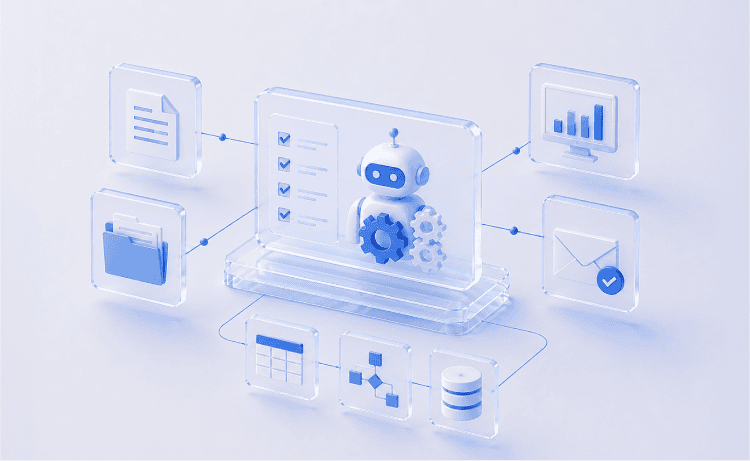
These two terms get mixed up frequently. Workflow automation handles the routing layer: approvals, notifications, status updates, and simple if-this-then-that logic. Process automation goes deeper. Robotic process automation can take over structured, rule-based tasks such as data entry, invoice validation, compliance checks, and reconciliations. Both reduce repetitive manual work, but they support different levels of operational complexity.
Process improvement without measurement is a wish. Data analytics provides the feedback loop. Cycle times, error rates, and exception volumes show what is working. Advanced analytics, including predictive models and anomaly detection, lets organizations spot problems before they hit business performance metrics. A supply chain manager who can see a shipment delay forming three days out has options that a manager finding out at delivery does not. The data foundation for this work is usually built through big data and analytics services that pull together information scattered across internal systems.
Change management is often underfunded, even though it heavily influences whether the transformation succeeds. Most transformation programs prioritize the technology rollout and treat the human side as a communications exercise to handle late in the timeline. That order is backwards. Without leadership buy-in, structured training, and consistent communication, new workflows get bypassed within weeks. People revert to the spreadsheet they trust. The technology was never the obstacle.
The technology stack for process transformation has matured quickly. Organizations in 2026 are figuring out how to integrate them into existing operations without breaking what already works. The table below maps the technologies that appear in most active digital transformation initiatives, and the H3 sections explain how they fit together.
| Technology | What It Does | Where It Applies |
| Cloud computing | Provides scalable infrastructure for process management platforms | Distributed teams working in shared, real-time environments |
| BPM software | Models, executes, and monitors business processes | Finance, HR, operations, customer service |
| Artificial intelligence | Handles unstructured decisions, pattern recognition, and content generation | Document processing, predictive maintenance, and customer support |
| Robotic process automation | Automates structured, rule-based tasks across applications | Accounts payable, invoice validation, compliance reporting |
| Integration platforms | Connect disparate internal systems and data sources | Linking legacy ERP with modern CRM and analytics tools |
Cloud computing provides the foundation for almost every modern transformation program. Workflows hosted in the cloud are accessible from anywhere, scale on demand, and update without IT scheduling a maintenance window. Modern bpm software runs natively in the cloud, supports real-time collaboration across distributed teams, and integrates through APIs with the surrounding tech stack. The cloud-native default has reset expectations about how quickly process changes can ship.
The most interesting work in 2026 sits at the boundary between AI and RPA. Robotic process automation handles structured, rule-based repetitive tasks: data entry, document routing, and system-to-system updates. Artificial intelligence handles the harder cases: interpreting unstructured documents, deciding which exception belongs in which queue, and drafting responses for human review. SS&C Blue Prism research notes that organizations now take a hybrid approach where RPA handles the structured volume and agentic AI manages exceptions. Glorium Technologies has built AI software development programs around exactly this pattern, with deterministic automation taking the structured tasks and AI agents handling the judgment calls.
Collaboration tools, integration platforms, and low-code environments do the connective work. They let business teams ship small workflow changes without filing a six-week IT ticket. They break data silos between internal systems that otherwise force teams to copy and paste between applications. They are also where most successful digital transformation programs see their first wins, because the connection layer surfaces inefficiencies that bigger initiatives address later.
Theory only goes so far. The shape of digital transformation looks different depending on industry, regulatory environment, and the maturity of existing business processes. A few examples show how the same underlying discipline produces different outputs.
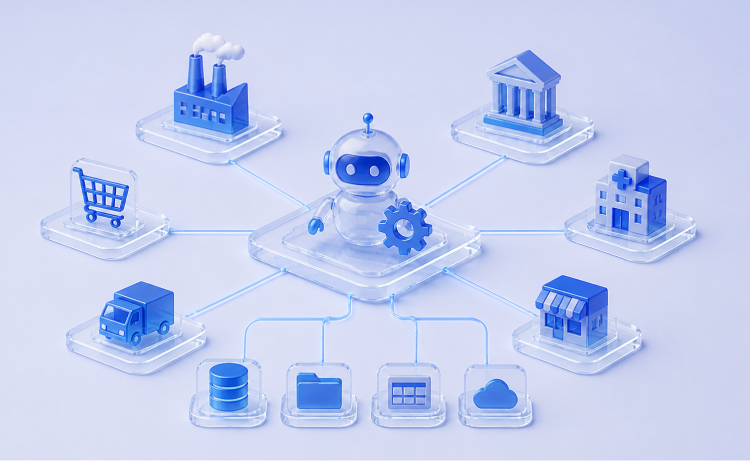
Manufacturers use process automation, AI-driven predictive maintenance, and connected inventory management systems to optimize operations. Recent supply chain disruptions, from the semiconductor shortage to ongoing geopolitical instability, have accelerated the adoption of digital supply chain management tools. The common move is away from inventory tracked across spreadsheets and disconnected systems toward integrated platforms that show stock, production, and shipping data in one view.
A similar shift happens in adjacent operationally complex sectors, where procurement, inventory, project execution, and finance need to work from the same data. For example, Glorium Technologies helped a US construction client running Odoo 18 went through exactly that shift with Glorium Technologies: a rebuild of procurement and execution workflows across Purchase, Inventory, Project, Timesheets, and Accounting that produced 2x faster supplier response, 18% lower procurement costs, 30% less administrative workload, and 23% faster project delivery through RFQ automation, real-time stock control, and connected scheduling.
Banks, insurance companies, and fintech firms use workflow automation and AI for fraud detection, compliance reporting, and loan processing. Regulatory compliance requirements make process documentation and auditability a priority from day one. A loan application moving through automated checks for income verification, identity, and fraud scoring closes in hours instead of days. Compliance teams get an audit trail by default, with every decision logged and reviewable. The combination matters: speed for the customer, evidence for the regulator. Glorium Technologies’ fintech software development practice has built this kind of regulated workflow infrastructure for clients across banking and insurance.
Healthcare organizations digitize patient workflows, appointment scheduling, intake forms, and care coordination. The output is faster check-in, fewer duplicated tests, and more time for clinical work. Glorium Technologies’ healthcare software development experience covers patient platforms, hospital management systems, and medical device integrations.
Retailers transform end-to-end processes from inventory management to personalized customer experience. Stock levels sync with online and in-store inventory. Recommendation engines work off real purchase history. Loyalty programs respond to behavior in close to real time.
Most transformation projects fail because of predictable organizational obstacles treated as afterthoughts. The list below covers the issues that derail digital transformation initiatives most often.
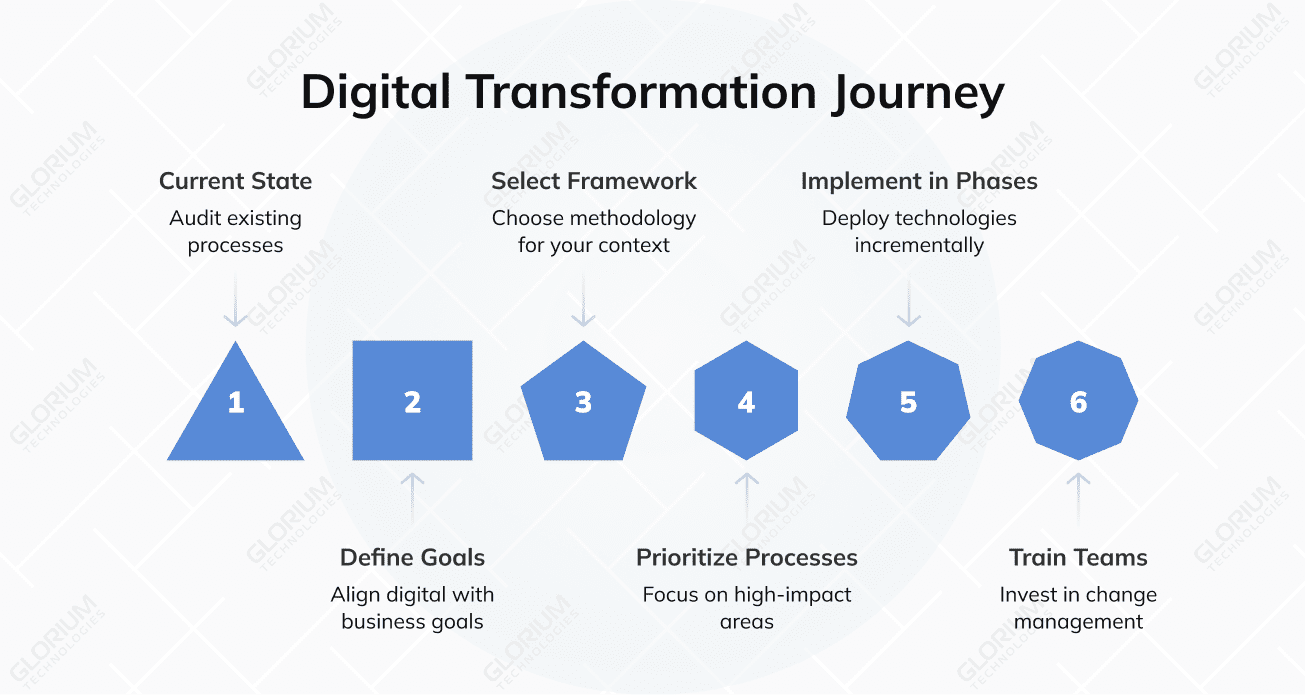
Most transformation efforts benefit from a sequential approach. The seven steps below cover the work from initial audit through measurement. Each phase is one where an experienced partner can shorten the learning curve.
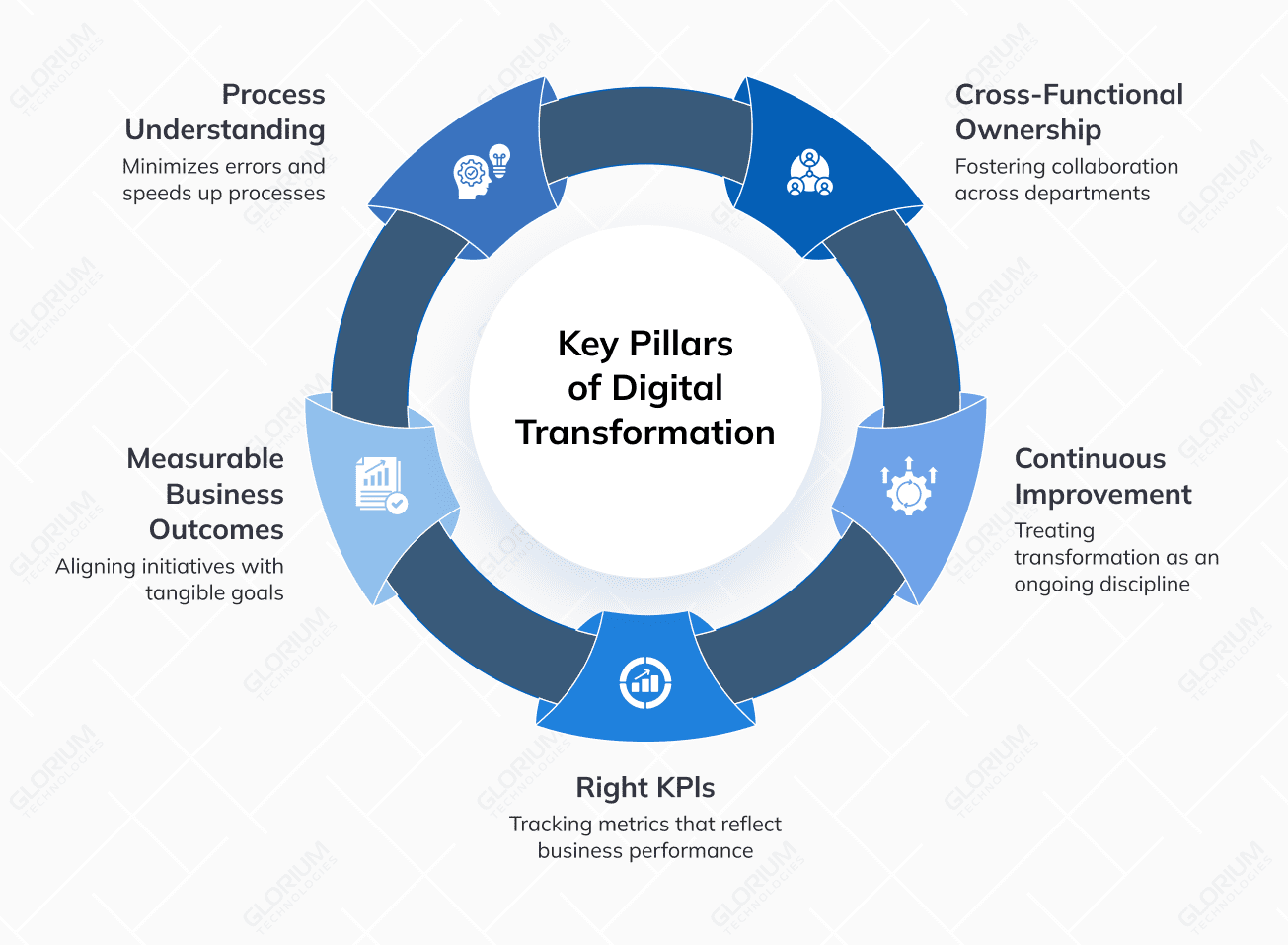
The patterns below show up across successful digital transformation programs. They are not theoretical. They come from looking at what digital transformation leaders do differently.
A few directions in the data point to where digital transformation efforts are heading over the next two to three years. Each one is grounded in recent industry research.
What this means for how businesses operate at scale: the tools to redesign and run digital business processes are improving faster than most organizations can absorb them. The competitive edge goes to teams that pick the right things to adopt, not the most things.
Strategy documents are easy to produce. Execution is where most programs stall. Glorium Technologies brings 15+ years of digital transformation experience to that execution gap, working with organizations across healthcare, manufacturing, fintech, and real estate to modernize operations and integrate digital solutions that hold up in production.
The work spans the full process lifecycle, from diagnostic and business analysis through to custom ERP software development for the process automation layer and AI consulting services for the judgment-heavy steps.
Ready to move from strategy to execution? Contact us to discuss your organization’s digital transformation roadmap and where the highest-impact first step might be.
Timelines vary depending on the organization’s size, the complexity of existing processes, and readiness for change. A single high-impact process can often be transformed within three to six months. Enterprise-wide transformation programs typically run twelve to twenty-four months with phased rollouts.
There is no single best framework. Mid-sized organizations often benefit from a phased approach that starts with process auditing and business process modeling, followed by targeted automation pilots, then scales based on measured results. The framework should match the company’s industry, regulatory environment, and existing technology stack.
Yes. Many organizations integrate new digital tools with existing systems through APIs, middleware, and integration platforms. Full replacement is not always practical or necessary. The aim is to connect and modernize, not to discard everything.
Track key performance indicators tied to specific business outcomes: process cycle time, cost per transaction, error rates, customer satisfaction scores, employee productivity, and compliance adherence. Avoid measuring success only by technology adoption rates. The real indicator is whether business performance improves.