







Business Process Management in Healthcare: Turning Workflows into Better Patient Care
Updated September 17, 2026

 Summarize in ChatGPT
 Summarize in ChatGPT
Hospitals rarely lose money or patient trust over a single bad decision. The real damage happens in the gaps: a referral stuck in a fax queue for days, a duplicate eligibility check, or a discharge summary sent a week late. Healthcare business process management targets these invisible breakdowns, rewires the workflow, and prevents processes from drifting back into old habits.
Most hospital leaders already know their workflows are broken. The harder question is whether fixing them is worth the disruption, and that answer depends on who you ask. A healthcare operations manager buried in a scheduling backlog sees it very differently than an IT leader managing the integration debt underneath it. This guide bridges both perspectives: which healthcare processes benefit from BPM, what the software can handle out of the box, and what implementation realistically costs.
Content
Business process management is a structured method for mapping, analyzing, redesigning, automating, and monitoring how work moves through an organization. Applied to the healthcare industry, BPM treats a patient pathway or a billing cycle the way a clinical protocol treats a treatment plan: defined, measurable, and open to revision when the evidence says so. For healthcare professionals on the floor, the payoff is fewer manual processes, fewer places where human error reaches patient records, and more predictable care delivery.
The scope is broader than most healthcare teams expect. Healthcare business processes span three categories, and BPM in healthcare covers all of them:
Healthcare processes rarely stay neatly inside one department, and workflow improvements have to follow them across the entire organization. A single admission touches multiple teams, and how well a health system operates ultimately comes down to those handoffs.
Most BPM in healthcare programs follow the same five-stage lifecycle. Skipping a stage is the single most common reason a promising initiative stalls after the pilot.
| Lifecycle stage | What happens | Healthcare example | Typical output |
| Discover | Capture how the process runs today, including the workarounds nobody documented | Shadow the front desk through a full outpatient intake | As-is process map, cycle-time baseline |
| Analyze | Quantify delays, rework loops, and handoffs where information gets lost | Measure how often eligibility is checked twice for one visit | Bottleneck list, cost-per-transaction |
| Design | Model the improved process, with decision rules and exception paths made explicit | Define who approves a same-day surgical add-on and within what window | Business process model, target metrics |
| Implement | Configure the workflow engine, integrate systems, train the teams affected | Route prior authorization requests automatically by payer and service line | Live workflow, integration layer, written procedures |
| Monitor and improve | Track performance against the baseline and adjust on a set cadence | Review denial reasons monthly and update the pre-submission rules | Dashboards, change backlog |
The workflow analysis phase reveals operational bottlenecks that organizations have unconsciously normalized. Continuous improvement is what distinguishes long-term business process management from a static automation project, ensuring workflows adapt alongside changing payer rules, staffing models, and regulatory requirements.
Workflow automation executes a defined sequence of steps, and robotic process automation mimics keystrokes across systems that lack proper interfaces. Both are tools inside a wider practice.
BPM works a level above. Business process management asks whether the process should exist in its current shape, models the redesigned version, then decides which parts deserve process automation and which need clinical judgment. Business process automation is the output of that decision, not the starting point. Automating a broken appointment scheduling process simply produces broken appointments faster.
Administrative burdens across the healthcare sector are now measured, not estimated. The 2025 CAQH Index found that US healthcare avoided an estimated $258 billion in administrative costs during 2024 through electronic transactions and better data exchange, with a further $21 billion available if the remaining manual and partially manual transactions were fully automated.
Revenue pressure adds urgency. Experian Health’s State of Claims 2025 survey of 250 revenue cycle leaders found that 41% of healthcare providers now see at least one in ten claims denied, up from 30% in 2022. Half of those leaders name missing or inaccurate claim data as the top driver, which points to a process failure.
Adoption is uneven, which is where the opportunity opens up. CAQH reports that more than half of health plans now use AI tools in administrative workflows, compared with roughly a quarter of healthcare organizations on the provider side. Fix the process foundations first, and intelligent automation has something solid to run on.
Clinical processes carry the highest stakes, so they demand the most careful design. Good clinical process work leaves the judgment to clinicians and strips out the coordination overhead around it, so more of the day goes to patient care.
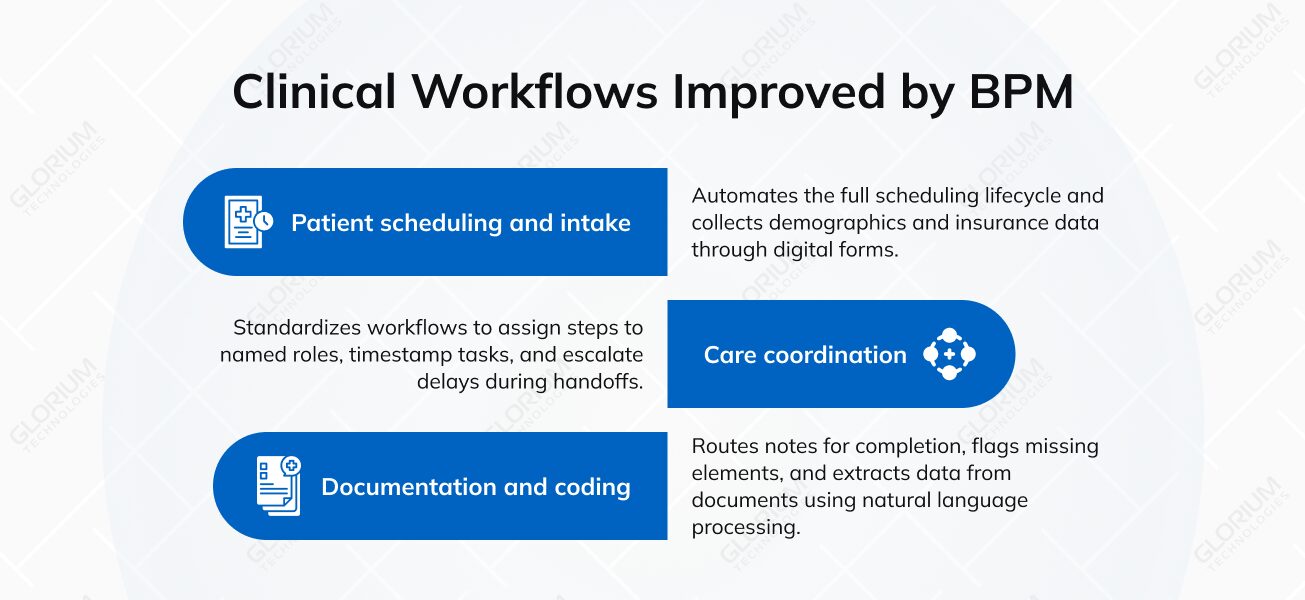
Patient scheduling is where most healthcare organizations start, because the process is high-volume, rule-driven, and visible to patients. BPM automates the full scheduling lifecycle: self-service booking, real-time checks against clinician availability and room capacity, conflict resolution, insurance verification, and automated reminders. Matching slots to patient needs on the first call does more for patient satisfaction than any reminder.
Patient intake follows the same logic. Collecting demographics and validating insurance through digital forms feeding straight into the EHR removes the retyping that generates downstream claim errors.
Glorium Technologies built a virtual assistant module for patient scheduling for a healthcare provider struggling with call volume and no-shows. Combining generative and predictive AI inside the scheduling workflow, the module cut support calls by 55% and reduced the impact of no-show appointments by 73%.
Care coordination breaks down at handoffs: ward to imaging, emergency department to inpatient, hospital to community provider. Standardized workflows assign each step to a named role, timestamp it, and escalate when the clock runs past a threshold. An abnormal test result with no owner is a patient safety event waiting to happen, and missed handoffs are a documented source of medical errors and adverse events, so coordination design carries direct consequences for care quality and patient outcomes.
Bed and patient flow management belongs in the same category. Glorium Technologies rebuilt the front end of a hospital bed management platform for ITR Software in Germany, where ward staff tracked availability manually and reorganized bed requests by hand. The rebuilt system added real-time bed status, customizable dashboards, and a scheduling calendar for bed requests, and bed turnover rates improved across the departments using it.
Documentation management determines whether the clinical record supports the bill. BPM routes notes for completion, flags missing elements before the encounter closes, and passes structured data from electronic health records to clinical coding. Clean documentation is also a data management problem, since patient records feed every downstream report. Intelligent document processing reads referral letters and scanned forms with natural language processing and extracts the fields that matter.
Administrative processes generate less clinical risk and far more measurable savings. These processes are also easier to pilot, which makes them a sensible proving ground before touching clinical pathways.
Revenue cycle management covers eligibility verification, medical coding, claims submission, denial management, and payment posting. Each stage has clear rules, which makes it well suited to BPM tools. Eligibility checks run before the visit, coding edits fire before submission, and denials route by reason code to the specialist most likely to overturn them. Processing claims cleanly the first time also lightens the regulatory compliance load, since fewer corrections mean fewer records to explain at audit.
Denial rates are the metric healthcare providers watch most closely. Select Health, a payer processing roughly 12 million claims a year, used a BPM platform to rework how erroneous claims are held, corrected, and resubmitted, taking resolution time from around 60 days to three. On the provider side, pre-submission validation carries most of the leverage, since Experian Health’s respondents put missing or inaccurate claim data ahead of every other denial cause.
Credentialing usually spans human resources, clinical leadership, and the medical staff office, which is why regulatory compliance slips when the work runs over email. A BPM workflow holds each provider’s credential expiry dates, triggers renewal tasks weeks in advance, blocks scheduling against a lapsed license, and keeps the evidence trail an auditor will ask for. Regulatory quality reporting works the same way, with data collected as a by-product of daily work instead of assembled in a panic before a deadline.
Supply chain management in healthcare tracks procurement of pharmaceuticals, medical supplies, and devices against consumption and expiry. Purchase approvals, three-way matching, and supplier payment management follow defined rules that the territory ERP platforms already occupy. Administrative staff lose hours reconciling approvals by hand, and service delivery suffers when a stockout reaches the ward. Staff scheduling, expense processing, and payroll fall into the same bracket, and connecting them to a custom ERP system beats bolting on a standalone tool.
Business process management software is the execution layer for the processes you have modeled. Business process management systems differ in emphasis, but healthcare deployments lean on a consistent set of capabilities.
| Capability | What it does | Why healthcare needs it |
| Process modeling | Creates a visual business process model of each workflow, with roles, rules, and exceptions | Gives clinicians and administrators one shared picture to argue with |
| Workflow management | Assigns and routes tasks to the right specialist, with escalation timers | Keeps referrals and results from going unowned |
| Integration layer | Connects EHR, PACS, ERP, and payer systems through HL7, FHIR, and APIs | Keeps critical patient data in one flow instead of five silos |
| Intelligent document processing | Reads scanned forms, faxes, and letters and extracts structured fields | Removes manual re-keying, the main source of claim data errors |
| Analytics and reporting | Tracks cycle times, volumes, and exception rates against the baseline | Turns process performance into decision-making leadership can act on |
| Compliance controls | Embeds required steps, permissions, and audit logging into the workflow | Supports HIPAA obligations and keeps documentation audit-ready |
Two things separate BPM solutions that stick from the ones staff quietly abandon: seamless integration with existing infrastructure, so people work in a centralized system instead of instead of constantly switching windows. Second is real-time process monitoring, ensuring whoever optimizes weekly workflows makes decisions based on hard data.
Compliance deserves particular attention. Documented processes are how healthcare institutions demonstrate adherence to federal and state regulations, and a platform that logs every action, approval, and data access produces that evidence continuously, with data security and privacy controls monitored in the same system.
Headline percentages circulate widely in BPM marketing, and most trace back to a single unnamed deployment. The gains worth planning around show up consistently across BPM in healthcare programs:
Operational efficiency in healthcare compounds over time. Removing a handoff doesn’t just speed up the process; it eliminates a potential point of failure.
Data quality gains are easy to underestimate. Guy’s and St Thomas’ NHS Foundation Trust cleaned its waiting lists ahead of an EHR migration by processing more than 78,000 records, fixing clinician and specialty mismatches and removing duplicates. Accurate lists mean accurate reporting, and resources follow the reporting.
“We emphasized the importance of quality in healthcare delivery, because if we have the processes in place, the outcomes will come and the quality will be improved.”
Sandra Buttigieg, Associate Professor, Department of Health Services Management, Dove Medical Press
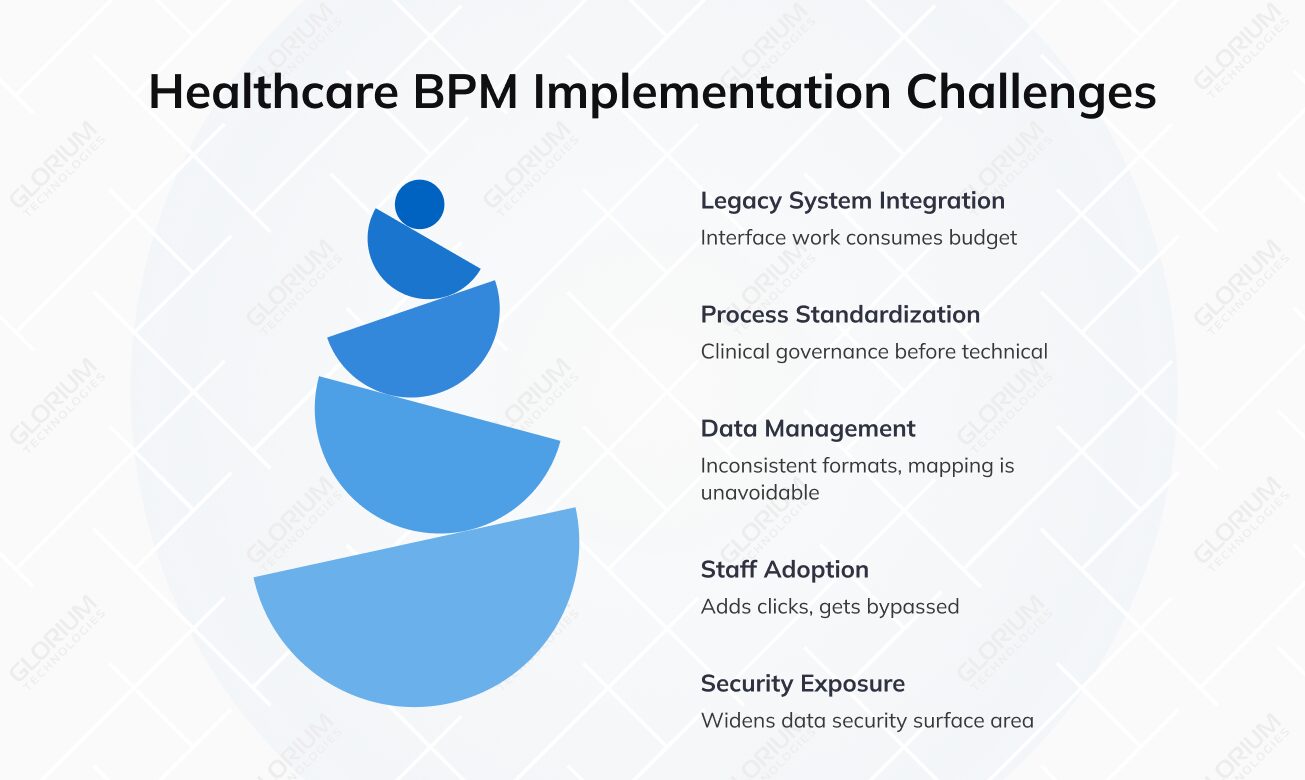
Healthcare BPM programs fail for predictable reasons, and naming them early is cheaper than discovering them in month six.
Process mining is the most immediately practical development. Instead of mapping workflows through interviews, it reads timestamped event logs from the EHR audit trail, the scheduling system, and the billing platform, then reconstructs the real sequence of steps and how often each variant occurs. The gap between that and the documented process is usually instructive.
Agentic AI is moving into care coordination, handling multi-step tasks such as gathering prior authorization documentation or chasing outstanding results, with a clinician approving the outcome. Predictive scheduling forecasts demand from historical volumes and adjusts staffing before a queue forms, which is where business process automation starts to move patient outcomes. Cloud BPM solutions put this within reach of healthcare organizations with no enterprise integration function, and healthcare analytics turns process data into valuable insights about where care slows down.
BPM in healthcare depends on the integration underneath it. Running a modeled pathway against a decade-old patient administration system, a payer portal, and a finance ledger without disrupting clinical work is where programs stall.
Glorium Technologies has built healthcare software since 2010: EHR and EMR platforms, hospital management and patient flow systems, medical billing, HL7 and FHIR integration. Healthcare organizations usually reach us at one of four points:
Our business process management consulting engagements start with a single process, which gives you a measurable operational efficiency result, and often a patient care one, before you commit to a wider rollout. Contact us with the workflow you have in mind, and we can talk through what fixing it would involve.
A single well-scoped process, such as referral intake or prior authorization, runs three to six months from discovery to production. Integration depth drives the timeline more than workflow complexity, so a process touching one system moves much faster than one spanning an EHR, a billing platform, and a payer portal. Glorium Technologies scopes that work during discovery, before any delivery date is committed.
Both work, depending on where your processes live. Healthcare organizations with a mature ERP or EHR often get further by extending what they own, since integration cost falls, and staff knows the interface. Glorium Technologies builds on both paths, so the recommendation is never tied to one product license. Dedicated BPM software makes more sense when processes cross systems, and none can act as the hub.
Baselines make decision-making possible, so set them before you change anything: cycle time per transaction, touches per case, denial rate by reason code, rework volume, staff hours reclaimed. Glorium Technologies captures those during discovery, precisely so the improvement is provable later. Financial return shows up first in denial reduction and overtime, while patient care gains such as shorter waits take a full seasonal cycle to read.
Healthcare operations leadership should own process management, with clinical informatics and IT as permanent partners. Programs owned by IT alone optimize for system elegance, and programs owned by one clinical department rarely secure the integration resources they need. Glorium Technologies works alongside that trio without replacing any part of it.
Most BPM in healthcare programs redeploy rather than reduce, since administrative vacancies are already hard to fill. Glorium Technologies builds that conversation into the design stage, because planning redeployment openly separates staff who refine the workflow from staff who route around it.
Small practices benefit, though the tooling differs. A ten-clinician group gets more from cloud-based workflow features inside its practice management system than from enterprise BPM solutions. Mapping, measuring, and revising applies at any size, and Glorium Technologies sizes engagements accordingly.