









What Digital Therapeutics Software Delivers That Wellness Apps Cannot
Updated August 17, 2026

 Summarize in ChatGPT
 Summarize in ChatGPT
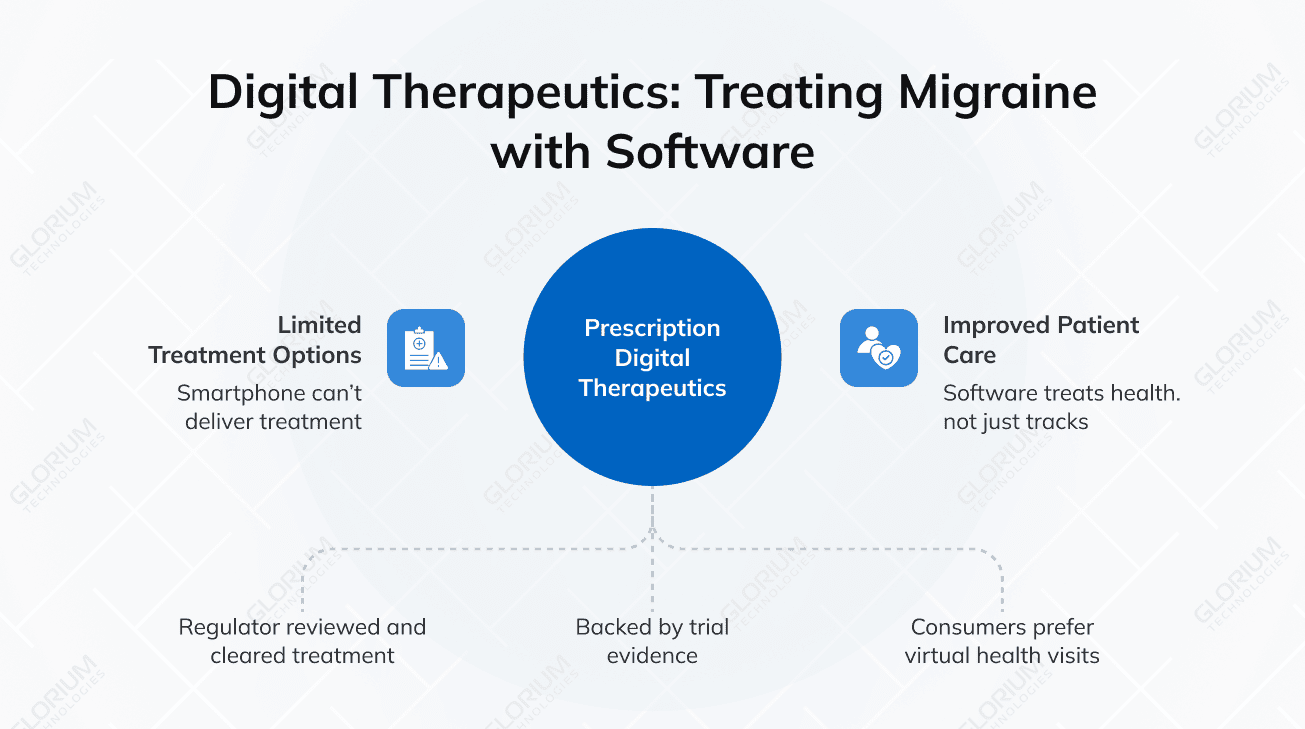
Your smartphone can now do something it couldn’t do a few years ago. It can deliver a treatment that a regulator has reviewed and cleared, backed by the same kind of trial evidence a pill must produce. That shift is real, and it’s already changing how care reaches patients. In April 2025, the FDA granted marketing authorization to CT-132, the first prescription digital therapeutic for the preventive treatment of episodic migraine, cleared through the De Novo pathway on the strength of two randomized controlled trials.
Billions of people use digital health in one way or another, and more than 90% of consumers who had a virtual health visit said they’d do it again. The reality is straightforward: software has moved from tracking health to treating it. The companies that understand the difference are the ones building products that payers and clinicians will stand behind.
By the end of this article, you’ll be able to tell a real digital therapeutics software product from a wellness app. You’ll also know how to judge whether one fits your clinical and financial goals, and what regulatory work stands between it and patients.
Content
Two apps may look identical on the screen, but the gap between the two is the whole game. For example, one of them simply counts steps, while the other has cleared clinical trials that prove it changes a disease. That difference is what matters most to buyers. It shapes what a clinician will prescribe, what a payer will fund, and what a founder can defend against the core principles the field holds to. So, the first real decision here is knowing what makes something a medical intervention.
Digital therapeutics software delivers evidence-based therapeutic interventions driven by software programs to prevent, manage, or treat disease. A digital therapeutics DTx product is built to produce clinically meaningful outcomes, so it faces the same burden of proof as traditional medical devices. That is the line the whole category is built on.
When a product is intended to diagnose, prevent, monitor, or treat a condition without being part of a hardware device, regulators classify it as SaMD (Software as a Medical Device). The term matters because it is the formal category the FDA and international regulators use, and it sets the risk class, the evidence you must produce, and the quality system you operate under. Most prescription digital therapeutics fall under SaMD, so the label is often your first regulatory checkpoint.
A generic digital health app can claim to support your mood. A regulated product has to demonstrate clinical effectiveness through randomized controlled trials, gather clinical evidence at every stage, then support product claims with data that holds up in peer-reviewed journals. When people talk about software-based interventions that behave like medicine, this is the category they mean. Here’s how the pieces relate:
| Category | Primary goal | Evidence required | Example |
| Wellness apps | General well-being | None mandated | Step counters, sleep trackers |
| Digital health solutions | Support and monitoring | Varies | Symptom loggers, patient portals |
| Digital therapeutics | Prevent, manage, or treat disease | Clinical validation required | Cleared prescription digital therapeutics |
| Software-enhanced drugs | Boost a paired medication | Added-benefit trials | Drug plus companion software |
Plenty of apps call themselves therapeutic, but few can prove it. The principles below are the exact test the Digital Therapeutics Alliance applies. They tell you which products deserve investment, coverage, or a place in your care model, and which are marketing dressed up as digital medicine. Every serious product should have these in from day one because bolting them on later rarely satisfies regulatory bodies.
These commitments are why most digital therapeutics take longer and cost more to bring to market than a consumer product. They’re also why healthcare providers are willing to consider them at all. A product that skips validation to save time is not a shortcut to market but a product without a market.
“Rather than just offering temporary relief (such as taking painkillers for back pain), DTx apps coach patients to understand their specific triggers, helping them resolve chronic conditions long-term.”
Dr. Agata Blasiak, the Head of Digital Health Innovation at the Institute for Digital Medicine
Theory means nothing until it moves patient outcomes in a real exam room. The clearest wins come from conditions where daily habits drive the disease and reaching a specialist is hard. That’s exactly where digital therapeutics solutions earn their place, and where certain medical conditions and patient populations benefit most.
Chronic disease management leads the field, and for good reason. Diabetes alone has historically been the single largest application segment, reflecting how much of the disease’s path depends on what a patient does between appointments. Deloitte’s 2025 consumer research found that 37% of consumers already use monitoring devices for health conditions, which shows the behavioral groundwork for remote monitoring and software-guided care is already laid.
Behavioral health is the other engine. Mental health conditions, including major depressive disorder, map cleanly onto software solutions. So much evidence-based care, cognitive behavioral therapy in particular, follows structured protocols that a well-designed app can scale.
This pattern shows up in Glorium Technologies’ own healthcare portfolio. We built an application for treating stuttering, a condition where therapy depends on repeated, structured speech exercises practiced far more often than a weekly clinic visit allows. Moving that protocol into software lets a patient work through guided sessions at home and keeps the practice consistent between appointments. This is the same mechanic that makes cognitive behavioral therapy translate well to a screen.
Addiction medicine has produced some of the earliest cleared products, and chronic pain is an active frontier, as the migraine authorization shows. Unlike ordinary digital health apps, digital therapeutics apps consistently earn their place across these areas in four ways:
The through-line is a demonstrable positive therapeutic impact. A tool that improves patient adherence but never moves a clinical marker is a support product. At the same time, a tool that changes patient health measurably can be called therapeutic.
Clinical merit opens the door, but economics decide whether a product will scale. Digital therapeutics tools speak directly to the cost pressures healthcare systems feel today, which is why payers, providers, and pharmaceutical companies are moving past cautious pilots toward real reimbursement. The value case, it turns out, is one you can put in a budget.
The money is following the evidence, and the evidence points to savings you can model. A 2025 peer review of digital therapeutics in chronic disease found that products for Type 2 Diabetes cut pharmaceutical costs by 22% to 29%. That translated to an estimated $97 to $145 saved per patient each month, while trending toward HbA1c reductions of 0.5% to 0.7%. Growth in the category is driven by value-based care, where payment increasingly ties to measurable clinical outcomes.
Software extends a clinician’s reach without adding headcount; it captures patient care data continuously instead of in snapshots, and it supports programs that would otherwise demand staff no one can hire. Nearly 60% of health system executives said they plan to invest in virtual health services to support preventive care, a signal that budgets are moving in this direction.
For pharmaceutical companies, the appeal is different. A software-enhanced drug pairs a molecule with a digital layer that can improve treatment adherence and produce added clinical benefit the drug alone can’t claim. That combination creates differentiation in crowded therapeutic areas and generates real-world evidence that supports both medical claims and market access. The business case concentrates in four places:
Every serious buyer wants both sides of the ledger before committing. Digital health products in this category deliver real advantages, yet they still stumble in predictable ways. Knowing the friction upfront is what keeps you from betting on a roadmap that quietly fails in the market.
Well-built products scale in a way human-delivered care cannot; they run around the clock, and they generate the longitudinal data that sharpens both patient outcomes and future evidence. They also reach people who would never make it to a specialist’s office, which is why access-limited conditions have been early winners.
Nonetheless, engagement is the quiet killer. Industry analyses found that most health app users churn within the first month, with only a small fraction still active by day 30. A therapy no one opens produces no result, no matter how sound the science. The harder costs come right after that. Clinical trials take time and money, integration with legacy systems is complex, and clinicians need convincing before they prescribe software. Together, those forces sink good products commercially.
| Benefits | Challenges |
| Scales without proportional staffing | Engagement and retention drop-off |
| Continuous data for better care | High cost of validation |
| Reaches underserved patients | Integration with legacy systems |
| Supports personalized care | Clinician adoption and medical training needs |
| Generates defensible evidence | Reimbursement pathways still maturing |
The lesson for anyone evaluating or funding digital therapeutics products is that clinical rigor and product design are not separate workstreams. A therapy has to be both provable and usable, and organizations that treat usability processes as secondary tend to learn this the expensive way.
This is the point where ambition meets hard reality. The word “cleared” carries real weight, and knowing what it demands protects you from committing budget or capital to a product that never passes review. That means understanding regulatory status, device classification, and the privacy laws that govern patient health data before you commit.
In the United States, many of these products are reviewed as class II medical devices, and the pathway matters enormously. The CT-132 migraine authorization moved through the FDA’s De Novo route, which exists for first-of-its-kind devices, and it rested on the Phase 3 ReMMi-D randomized controlled trials and a bridging study. The template is plain: regulatory status is earned through trial data that only demonstrates clinical effectiveness.
Clinical validation is the spine of the whole process. To win regulatory approval and satisfy the regulatory bodies involved, a developer has to run credible studies and document adverse events. Skipping any of that undermines the claims the product depends on.
Privacy sits right beside efficacy because these tools handle sensitive patient health information; data security and patient privacy are regulatory requirements. Products serving US patients must respect the Health Insurance Portability and Accountability Act (HIPAA), and anything touching European users falls under the General Data Protection Regulation (GDPR). Strong security protections and privacy-by-design engineering are what let a product survive audit and scale internationally.
Interoperability is the other requirement that decides whether your product survives contact with a real health system. A therapy that can’t move data into the electronic health record adds work for clinicians, and that friction alone stalls adoption. In practice, you’ll need to exchange data with the major EHR platforms your customers already run, including Epic, Oracle Health (formerly Cerner), athenahealth, and eClinicalWorks. That means building on recognized standards instead of custom one-off connections:
Interoperability as a first-class requirement is what keeps a validated product from getting stuck in procurement.
Glorium Technologies developed the web application behind Project Ipsilon, a cognitive training and testing tool aimed primarily at early dementia, taking it from first MVP through to a finished product as the client’s sole technology advisor. Work like this leans on medical-grade quality practices (Glorium holds ISO 13485 certification for medical device development alongside ISO 27001, SOC 2, and HIPAA-aligned processes), which is the groundwork that lets a health product stand up to the classification, validation, and audit steps described above.
A practical checklist for clearing the bar:
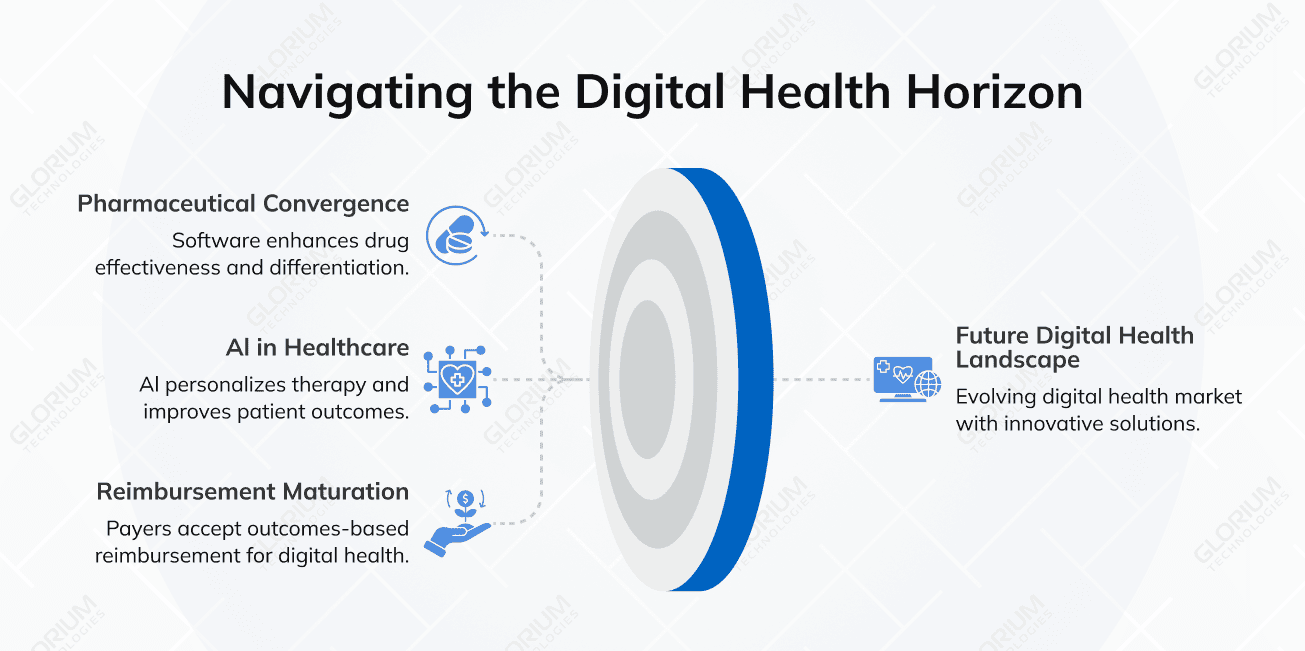
The category is young enough that its shape is still forming, which is good news for anyone setting strategy. Reading where digital health technology is heading, from AI-driven personalization to combination products, lets you position for the market that’s coming instead of the one that already exists.
Three currents are worth watching. The first is convergence between software and pharmaceuticals. The software-plus-drug model, in which a validated app boosts a specific medication, draws serious investment because it solves a real problem: how do you differentiate a drug and prove added benefit at once? Expect drug makers to keep pushing here.
The second is artificial intelligence moving from support to substance. AI adoption in US healthcare organizations reached 50% by the end of 2025, up from 25% in late 2023. Applied well, AI tunes therapy to individual response in ways static software never could. The evidentiary bar doesn’t drop, though; AI-driven therapeutic interventions still need proof.
The third is the maturing of reimbursement. As payers grow comfortable tying payment to outcomes, more of these solutions will reach the patients who need them, particularly in areas where the outcome data is strongest. The market’s projected climb past $12 billion in 2026 reflects exactly this normalization. What to watch over the next few years:
The gap between an app and a therapy is clinical rigor, regulatory readiness, and engineering discipline working together, and closing that gap is where most products succeed or stall. Getting it right takes a partner who understands both the software and the standards it has to meet.
Glorium Technologies brings 16+ years of software development and digital transformation experience to healthcare organizations, with deep work across regulated systems, data security, and compliance-driven builds. Whether you’re evaluating a build-versus-buy decision, engineering a product designed for clinical validation, or preparing digital therapeutics software for the road to regulatory approval, the right technical foundation shapes everything that follows.
Ready to turn a clinical concept into a product that holds up to scrutiny? Book an intro call with our experts and let’s map what your build requires.
You get architecture and engineering built for regulated healthcare, with security and privacy designed in from the start. It also covers support for the trials and documentation that regulatory approval depends on, aligning your software with the evidence standards these products must meet.
Depending on your scope, we work on a time-and-materials basis, but we can also do a discovery phase for a fixed cost up front. What you pay for is a reflection of the engineering hours, the roles of people on the team, and the compliance and validation that your product needs. Regulated builds cost more than consumer apps because the bar sits higher.
It can be you if you build, fund, prescribe, or reimburse healthcare products. That covers digital health companies, HealthTech startups, providers, pharmaceutical and medical device firms, clinical researchers, and investors weighing a build-versus-buy decision. Each one benefits from a partner who understands both the code and the standards behind it.
You start with a discovery phase that scopes requirements and de-risks the build before real money goes in. And then development is done in iterative cycles with regular demos, so you see working software early and adjust as you go. Timelines depend on the regulatory scope and evidence needs. So, a build that is ready for validation takes longer than a standard app. The outcome is a product built for examination by both the clinic and the regulators.