







AI in Education: What Works in Classrooms Right Now
Updated September 18, 2026

 Summarize in ChatGPT
 Summarize in ChatGPT
Most teachers already use AI tools at work, yet hardly any have been given guidance on how. A 2026 study by Gallup and the Walton Family Foundation found only 18% of US public school teachers had received formal guidance from administrators on AI use, and about a third received none at all across ten common tasks.
The tools had reached classrooms before the rules did, which reverses how schools usually adopt anything. A department head approves a grading tool in September, learns in November that student records ran through a server nobody vetted, and spends December explaining that to counsel. Students in that department had been using generative AI long before anyone decided which routine tasks belonged to software.
Separating what works from what poses a risk takes far more than a glossy vendor demo. The sections below trace where artificial intelligence in education earns its keep, what the research says about the risks to student learning, and the compliance work that decides most procurement outcomes. School leaders and EdTech teams will each find their part.
Content
Artificial intelligence in education stopped being an experiment around 2024. Surveys of students and teachers in the modern classroom show near-universal contact with AI technologies, though depth of use varies across the education sector.
Adoption among students in higher education
The Higher Education Policy Institute’s 2026 survey of 1,054 higher education students found 95% using artificial intelligence in at least one way and 94% using generative AI for assessed work, against 51% a year earlier. The share of students pasting AI-generated text directly into submitted work reached 12%, up from 8% in 2025 and 3% in 2024. Higher education sets the pace K-12 follows, which makes these numbers a leading indicator for school leaders.
Gallup and the Walton Family Foundation surveyed 2,232 US public school teachers in 2025 and found six in ten using AI tools that year, and three in ten using them weekly. Weekly users reported saving 5.9 hours per week, roughly six weeks across a school year, and roughly six in ten of those users said the tools sharpened their insight into student learning data.
Vendors describe dozens of AI in education applications. In practice, education AI deployments cluster into a few patterns, and most schools start with one.
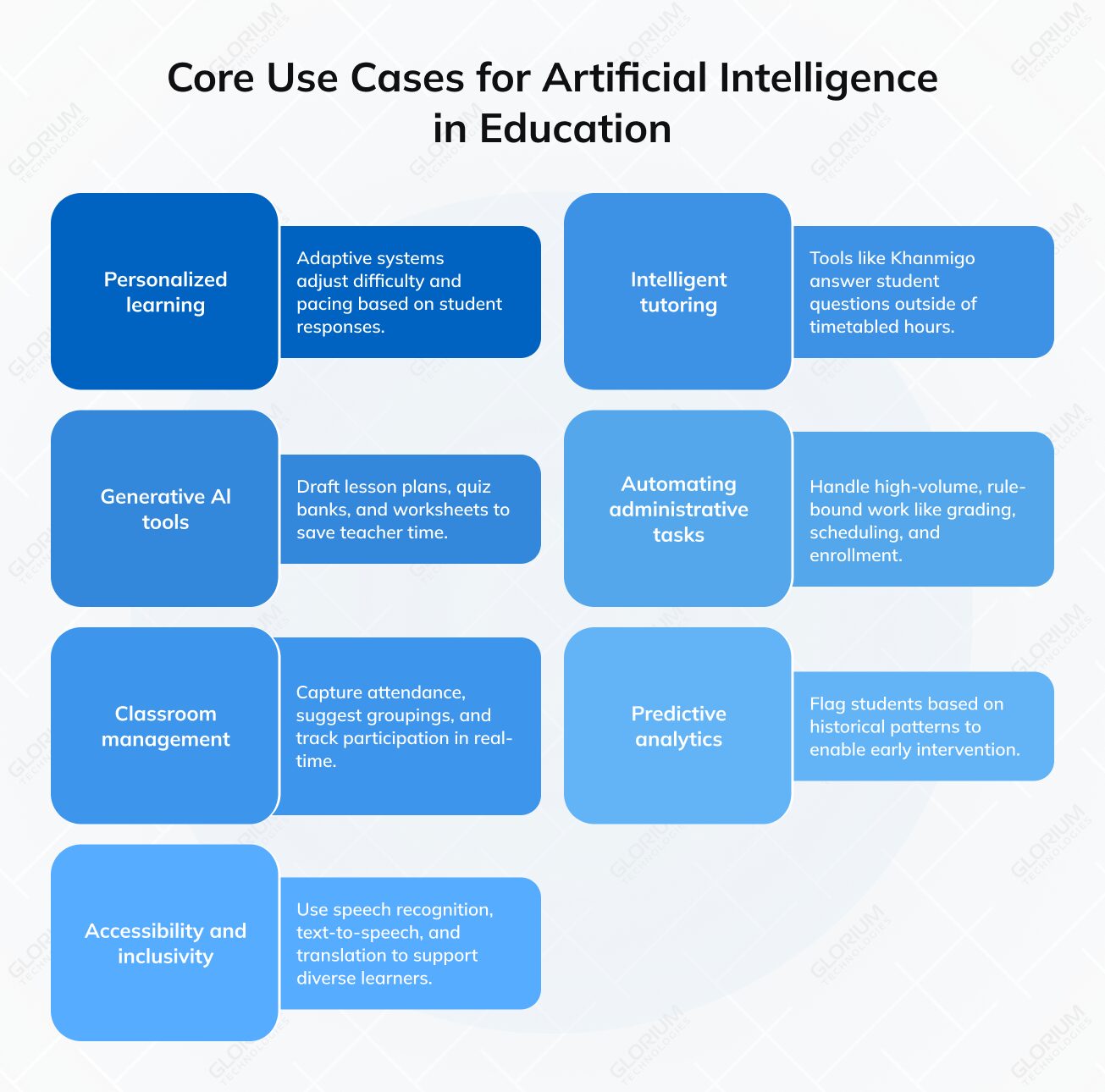
Adaptive AI systems build a personalized learning experience by adjusting difficulty and pacing to how students answer. Third-party products such as DreamBox and Squirrel AI built their businesses on personalized learning of this kind, sequencing problems so struggling students get scaffolding while confident ones move ahead. The mechanism reads real student responses rather than self-reported learning styles, a distinction worth remembering when vendors promise to match content to learning styles. A personalized learning experience holds up when the content library runs deep enough to give students somewhere to go.
Tutoring tools answer student questions at 11 p.m. on a Sunday, which no staffed help desk does. Khan Academy’s Khanmigo is the example most educators recognize, though several LMS platforms now feature similar step-by-step homework assistants. For students without access to private tutoring, that 24/7 lifeline matters immensely.
Generative AI tools draft lesson plans, quiz banks, comprehension questions, and differentiated worksheets for students at several reading levels. Gallup found lesson planning among the tasks where generative AI saved teachers the most time. The draft still needs a subject expert to check it, which is where the remaining minutes go. Content demands escalate in specialist subjects. Building CAE’s mobile educational platform for future doctors, Glorium Technologies delivered the content and assessment layer, where clinical accuracy had to survive faculty review before students saw a question.
Grading platforms such as Gradescope apply one rubric across hundreds of student submissions, then surface the questions students failed. Scheduling engines solve timetable constraints that once consumed a department head’s time. Automating administrative tasks follows the same logic across enrollment, student records, and attendance: high-volume, rule-bound work. Because this work rarely triggers pedagogical objections, schools that start with routine tasks build credibility with staff and students.
AI systems also handle the mechanics that eat teaching time inside the modern classroom. Attendance capture, grouping suggestions, and participation tracking across online discussion boards give teachers a live view of student engagement, not a retrospective one. Interactive lessons powered by AI prompts give quieter students a low-pressure way to participate, while helping educators spot early signs of disengagement in time to turn the term around.
By tracking historical patterns in attendance and grades, AI models can flag students showing early signs of dropping out, giving student success teams a chance to step in before it’s too late. These alerts are meant to spark a human conversation, not deliver a final verdict.
This is where education technology delivers its most undeniable value, reaching the exact students that traditional teaching leaves behind. Speech recognition captions lessons for deaf students, text-to-speech opens inaccessible material to students with dyslexia, and translation puts lessons before families who do not read English. Nearly 60% of teachers in the same Walton Family Foundation study agreed that AI improves accessibility for students with disabilities.
Before choosing, work out who owns each decision and how much student data the tool touches.
| Use case | Who signs off | Student data involved | Reversible if it fails |
| Adaptive learning paths | Curriculum lead | Identifiable performance history | Hard, once pacing depends on it |
| Intelligent tutoring | Department head | Identifiable conversation logs | Easy, runs alongside teaching |
| Lesson planning | Individual teacher | None, if prompts exclude names | Easy |
| Grading and assessment | Assessment board | Identifiable submissions | Hard, appeals reach back a term |
| Classroom management | School administration | Attendance and participation records | Moderate |
| Predictive analytics | Data protection officer | Full student record history | Hard, flags shape staff behavior |
| Accessibility tooling | Disability services | Pseudonymized where possible | Easy |
It’s easy to be skeptical of the hype around AI in education until you look at three areas where the impact is undeniably measurable.
The six-weeks-per-year figure from Gallup is the cleanest number in this field, and the one finance officers act on. Hours recovered from administrative tasks convert into office hours and earlier intervention with students who need it.
Feedback speed changes how students learn. Catching a misunderstanding on Tuesday gives a student time to fix it before Thursday’s lesson turns a minor slip into a major hurdle. Automated grading gives students instant feedback on the mechanical part of assessment, shortening that loop from days to seconds and improving the learning experience more than any redesign.
Educational data spread across separate systems becomes queryable when one platform pulls it together. Department heads track student progress by module, see where to support students earlier, and check whether a curriculum change moved student success rates. Those data-driven insights pay off when someone owns the follow-up. Glorium Technologies hit that constraint by building Project Ipsilon’s cognitive testing app, where the scoring engine carried more weight than the interface, and every result had to hold up for the clinician reading it. The same discipline shapes the team’s EdTech engineering work.
Data privacy decides more AI procurement outcomes in education than feature comparisons. Student records carry legal protections that general-purpose artificial intelligence was never designed around, and the institution is responsible for proving compliance.
FERPA governs personally identifiable information in student records at US institutions receiving federal funding. A vendor processing grades, disciplinary notes, or attendance data must qualify as a school official with a legitimate educational interest, under the institution’s control and barred from redisclosure. Consumer AI subscriptions rarely meet those conditions.
European institutions, and any US institution enrolling EU students, face a second regime. GDPR requires a lawful basis for processing, data minimization, and clear answers on where inference happens. A tool shipping student responses outside the agreed jurisdiction creates legal exposure, however well it teaches.
Glorium Technologies applies the discipline it uses on HIPAA-regulated healthcare platforms, where mishandled data brings regulatory penalties rather than embarrassment.
If we’re being realistic about AI in education, we need to talk about where it fails, too. Jim Chilton, CTO of Cengage Group, traces the problem to where students now go for answers.
Over-reliance and weaker critical thinking
Researchers at Microsoft Research and Carnegie Mellon University surveyed 319 knowledge workers across 936 real tasks and found that high trust in AI tools led to less critical thinking, while high confidence in personal ability led to more. The cognitive offloading they describe applies to students who accept a generated answer without interrogating it. Over-reliance is the mechanism by which AI in education undermines the critical thinking it was brought to support.
A Stanford team publishing in Patterns tested seven commercial GPT detectors and found more than half of TOEFL essays by non-native English speakers misclassified as AI-generated, while the same tools were near-perfect on essays by US eighth graders. Schools treating detector output as evidence risk disciplining the students least able to contest an accusation.
AI algorithms learn from historical data, and historical data encodes historical inequity. When an AI model trains on historical data from a school that underserved certain students, it simply bakes those past biases into its code, reproducing unfair patterns with the unyielding authority of math. That’s why fairness audits aren’t an optional add-on; they belong in the baseline budget of any institution using AI to evaluate students.
Access to AI technologies tracks existing resource gaps. Well-funded schools license AI tools and run AI training, while students in under-resourced schools get whatever the free tier offers. HEPI found wealthier higher education students reporting heavier use, which suggests artificial intelligence widens the gap between students without deliberate intervention.
“Education long rested on three pillars: the textbook with its peer review, the teacher trained in the discipline, and the library holding the evidence. Learners have shifted to generative AI, which trades sourcing for confidence and speed.”
Jim Chilton | AI Will Reshape Education. Are We Building Tools We Can Trust? |
TEDx Talks
Educational institutions getting results treat artificial intelligence as a change management project with a software component. The sequencing below separates a working rollout from a stalled pilot.
UNESCO published its AI Competency Framework for Teachers in 2024, defining 15 competencies across five areas, including human-centered mindset and AI ethics. Set against the 18% reporting formal guidance, the framework measures how far most schools have to go. Professional development covering prompt construction, output verification, and acceptable use pays back faster than another license, and gives teachers language for talking to students.
Start narrow, with the highest-volume task that carries the least judgment, then design the workflow so a person reviews consequential output before students see it, because artificial intelligence has no stake in the outcome. Grade appeals require a human decision-maker, just as risk flags demand a real conversation with an advisor. Keeping humans in the loop may sacrifice a little efficiency, but it buys back the trust essential for a successful rollout.
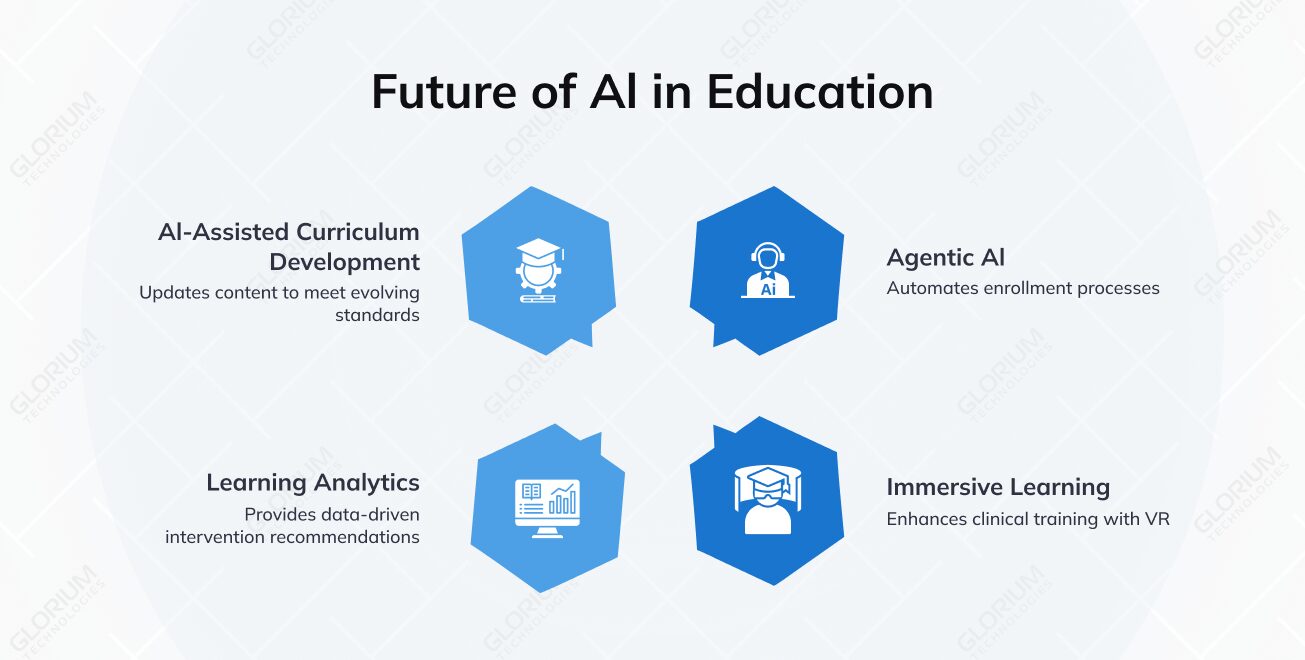
The next phase of artificial intelligence in education runs toward systems that act rather than answer. Education leaders looking to harness AI past chat interfaces are scoping four directions.
Institutions reaching the build conversation on AI in education arrive with three requirements. The tool has to fit the workflow teachers already run, because a parallel system nobody logs into fails quietly. Student data has to stay where the compliance officer says it stays, with the paperwork to prove it. And results have to be legible inside one academic term, so measurement gets designed in from the start.
Off-the-shelf platforms handle the first well and the other two poorly, which is where institutions with unusual workflows or strict data rules start building.
Glorium Technologies has built more than 150 products and has obtained ISO 9001, ISO 13485, and ISO 27001 certifications. The EdTech practice covers learning experience platforms, virtual classrooms, education analytics, and the artificial intelligence layers on top. Teams that have shipped HIPAA-compliant platforms treat FERPA and GDPR as engineering requirements, not afterthoughts.
Bring us the workflow you want to change, and we’ll tell you what it takes to build.
Usually yes. Most learning management systems expose APIs or support LTI integrations, letting AI tools read course data and write results back without a migration. Glorium Technologies builds this way often, since the constraint is data quality inside the LMS.
That depends on the vendor’s terms. Some grant full ownership of outputs; others retain a broad license to the inputs. Institutions with proprietary course material should have counsel read this clause. Glorium Technologies writes ownership into the contract on custom work.
Ask for an export format and deletion certificate before signing, because retrieval terms are harder to negotiate later. Glorium Technologies structures custom builds so the data model stays yours and the AI layer swaps out cleanly.
Smaller deployments run on an existing IT administrator and one academic owner. Anything touching assessment needs someone accountable for reviewing model behavior each term. Glorium Technologies provides post-launch support, covering engineering while your team keeps the pedagogy.
Build the opt-out into the data model rather than bolting it on, so an excluded student gets the same curriculum through a non-AI path. Retrofitting later is expensive, which is why Glorium Technologies raises it in discovery.
Custom development carries higher upfront cost and lower license exposure. Glorium Technologies typically sees small-scale education products land between $20,000 and $50,000, with feature-heavy platforms passing $100,000. Buying suits standard workflows; building pays off when the workflow is the differentiator.