







Predictive Analytics for HR: Turning Workforce Data into Decisions
Updated September 15, 2026

 Summarize in ChatGPT
 Summarize in ChatGPT
Your HR information system (HRIS), the system of record that holds employee status history, can tell you that 43 people from the sales department left the company last quarter. What it rarely tells you is who will leave next quarter, or which manager relationships are driving those exits.
That gap between historical reporting and forecasting is what predictive analytics for HR closes. Predictive models use historical HR data and machine learning algorithms to forecast future workforce outcomes: who will resign, which candidates will perform well, where skills gaps open, what staffing costs will be eighteen months out. Each answer is built from data your HR departments already collect.
Getting value here depends less on budget than on agreement. HR professionals, the people analytics team, and the executive who signs off on headcount must first agree on one question the model answers. That choice drives everything after it: which data gets cleaned, how the score reaches Workday or Visier, what legal asks for, how long the build runs.
Content
Most HR functions already run some form of HR analytics and produce plenty of HR metrics. The question is whether those numbers describe the past or shape the next decision. Predictive HR analytics sits at one point on a spectrum, and knowing which stage of HR analytics you need saves budget.
HR analytics moves through four stages, each answering a different question about the same workforce data. The examples are illustrative.
| Analytics type | Question it answers | HR example | What it needs |
| Descriptive analytics | What happened? | Turnover ran at 18% last year, mostly in field sales | Historical reporting from your HRIS |
| Diagnostic analytics | Why did it happen? | Exits cluster among employees fourteen to twenty months into a role | Historical data plus engagement and performance context |
| Predictive analytics | What is likely to happen next? | These 60 employees carry elevated flight risk over two quarters | Two or more years of employee data across systems |
| Prescriptive analytics | What should we do? | Manager coaching outperforms a pay adjustment here | Predictive output plus past intervention records |
Descriptive reporting remains the base layer everything else builds on. Descriptive analytics answers what happened, diagnostic analytics explains the pattern, predictive analytics forecasts future outcomes, prescriptive analytics recommends the response. Descriptive HR analytics stays useful throughout. The shift happens when you stop asking a dashboard to confirm workforce trends and start asking a model for a probability attached to a named person or team.
Predictive models are only as good as the history behind them. Most teams need two years of consistent employee data before a model produces anything worth acting on, since hiring and review cycles create patterns a single year cannot reveal. Analyzing historical data across the entire employee lifecycle, from application to exit, lets a model separate a seasonal dip from a real signal.
Typical inputs include:
Raw data from these systems rarely lines up. Job codes drift, hierarchies get restated after reorgs, survey vendors change scales. Serious data analysis cannot start until that history is reconciled, which is why data science consulting work often begins months before anyone trains a model.
These five predictive HR analytics examples come up in nearly every serious program and cover most of the employee lifecycle. They differ in difficulty, data requirements, and how fast HR teams can act, so each deserves its own look.
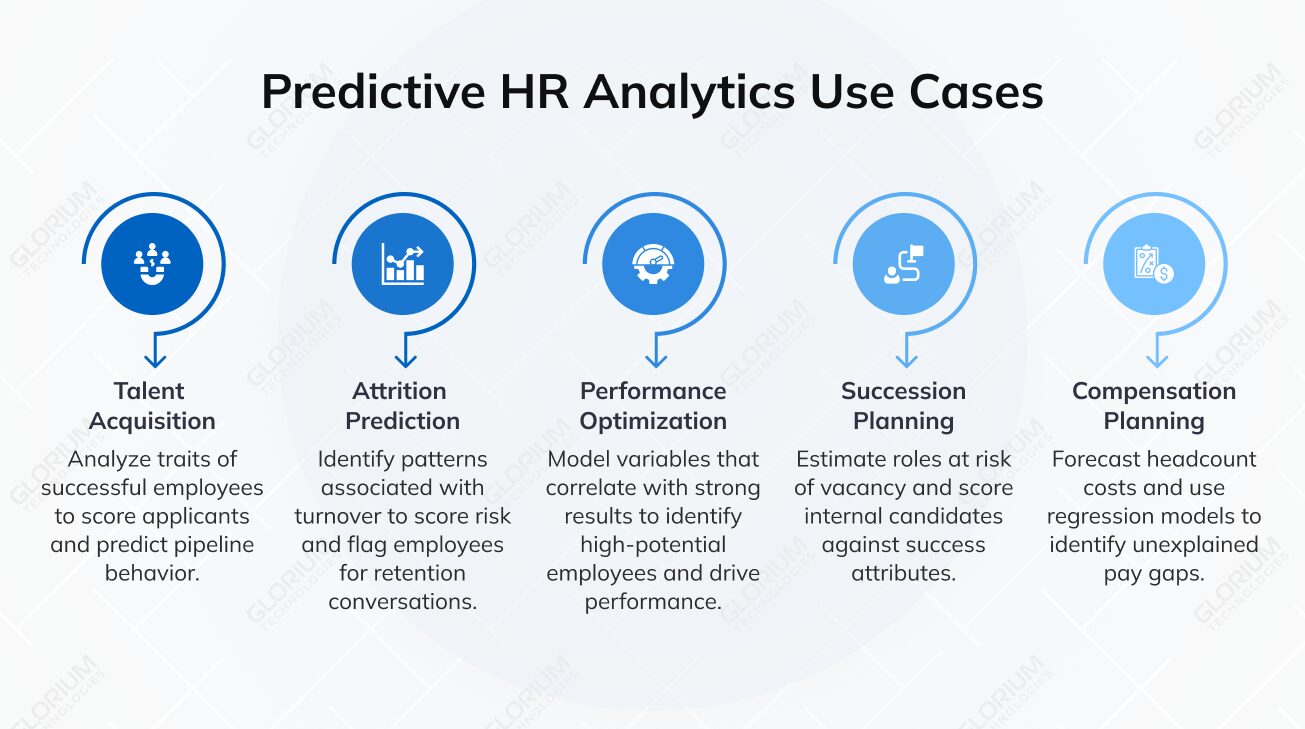
Predictive models analyze the traits of employees who succeeded in a role, then score applicants against that profile. The output is a ranked shortlist a recruiter still works through. Recruitment analytics also predicts pipeline behavior: which sources produce candidates who accept offers, how long a requisition stays open, which stages lose the strongest applicants. A data-driven hiring process turns those forecasts into recruitment strategies: shift spend toward the sources that convert, fix the stage where strong applicants drop out.
Quality-of-hire prediction is harder, since it links pre-hire attributes to performance reviews and ratings collected a year or more after the hire. Organizations that never close that loop optimize for interview scores instead of business outcomes.
Turnover prediction is where most HR analytics programs start. The business case writes itself, the historical data exists, and the intervention window runs in months, not years.
Employee retention analytics works by identifying patterns associated with employee turnover: tenure thresholds, compensation position, manager span of control, engagement drops, reduced internal application activity. Turnover prediction models weigh those signals and score turnover risk for the coming quarters, flagging employee behavior worth a conversation before a resignation letter appears.
“Predictive analytics in HR exists to control attrition and hold on to the employees who actually matter to the business. You shouldn’t try to keep everyone who resigns.”
Predictive Analysis of Data, Edu4Sure
Employee retention programs built this way beat generic engagement pushes, because identifying patterns in real exits shows which lever to pull. What happens after a flag is the decision that matters. Retention strategies work when the score feeds a defined workflow: a manager conversation, a development plan, a role change, a compensation review, with the outcome recorded so the model keeps learning. A flag that lands in an unowned spreadsheet changes nothing.
The strongest use of predictive analytics in performance management is working out which factors drive organizational performance. Statistical modeling ranks the variables that correlate with strong results, and the ranking often overturns internal folklore.
Predictive people analytics feeds performance management the same way. A model built on a few thousand employee records will often show that months with the current manager outweigh total tenure. Findings like that redirect budget: less on the interview loop, more on manager transitions. The same models identify high-potential employees earlier, reading a trajectory across several review cycles instead of one snapshot, which gives L&D a shortlist for development programs before a competitor makes the first offer.
Succession planning is workforce planning at the level of the individual, a prediction problem with a long horizon. The model estimates which roles risk falling vacant and which internal candidates fit them best. Gartner research from October 2024 found that only 30% of leaders in talent reviews believe their leadership bench is strong. Predictive people analytics gives those reviews something firmer than opinion, scoring readiness against the attributes of people who succeeded in similar roles. Historical trend analysis will not predict future trends with no precedent in your data, so treat the output as one workforce insight among several.
Strategic workforce planning depends on forecasting headcount cost as well as headcount, and this is where predictive HR analytics reaches the CFO. Time-series models combine attrition forecasts, hiring lead times, salary progression, and market movement to forecast future outcomes on cost, quarter by quarter. Scenario runs cover a hiring freeze or a growth push, and the numbers drive resource allocation ahead of the budget conversation.
Compensation analysis also supports pay equity work. Regression models estimate expected pay from role, level, location, and tenure, then surface the gaps those factors do not explain. A statistical gap opens an investigation, rarely settles one.
Almost no company builds predictive HR analytics from an empty page. The models sit inside an existing ecosystem, alongside the workforce analytics tooling HR teams open every week.
Visier and Workday provide packaged predictions. HireVue and similar tools handle assessment, while Power BI or Tableau carry the reporting layer HR leaders open every Monday. The gap appears when a company needs a prediction those platforms do not offer, or a score inside a system the vendor does not reach.
| Approach | Best fit | Trade-off |
| Buy a people analytics platform | Standard metrics, fast rollout, limited data science staff | Predictions follow the vendor’s model, not your business logic |
| Build custom predictive models | Non-standard questions, unusual data, competitive stakes | Requires data engineering and ongoing model ownership |
| Integrate custom models with existing platforms | Existing HRIS plus one or two high-value predictions | Needs careful integration design and data governance |
Glorium Technologies works in that third mode, building custom predictive models into the HR stack you already run.
The engineering pattern transfers across domains. In a real estate churn prediction system, our team built a Python and scikit-learn pipeline that scores tenant churn probability, retrains on new data, and explains which features drove each score. Swap tenants for employees and the architecture barely changes. An AI risk platform for a global insurer tackled a different bottleneck: reviewers assembled risk profiles by hand across several systems. Moving model output into their review screen cut evaluation time by 40%.
Predictive HR analytics leans on a small set of statistical modeling techniques, most of them decades old. Nobody needs to write code to buy HR analytics, but the vocabulary makes vendor conversations sharper and weak claims easier to spot.
Three techniques cover most predictive HR analytics work that reaches production. Each takes the same historical HR data and answers a slightly different shape of question.
None of these are exotic. Most run on a prepared dataset from a mid-size HRIS, and machine learning services teams deploy them routinely.
Video-based interview analysis, which scores facial expression, eye movement, or body language, is a real technique with real vendors behind it. Its validity is contested, and several jurisdictions regulate it specifically. Pair anything here with documented bias testing, candidate consent, and a human reviewer who can override the score.
Predictive HR analytics runs on the most sensitive workforce data an organization holds. Ethical considerations are not separate from the engineering here, since they decide what you can build. HR professionals end up explaining a score to the employee it describes, so teams that design for that from the start move faster.
The EU AI Act places employment and worker management in Annex III, its high-risk category, bringing documentation, oversight, and transparency obligations that phase in from December 2027. GDPR already gives employees rights around automated decision-making.
In the United States, the picture is local. New York City’s Local Law 144 requires an annual independent bias audit and advance notice to candidates, and Illinois regulates AI analysis of video interviews through a consent requirement.
The implication is the same everywhere: model documentation, audit trails, and an appeals path have to exist from day one.
Algorithms learn from history, and history contains the hiring and promotion decisions your organization already made. A model trained on those decisions will perpetuate existing biases unless someone tests for that bias. Practical safeguards look like this:
The predictive analytics failure pattern is consistent: a company buys tooling, finds its historical HR data cannot support the models, and shelves the project. Sequencing the work in the other direction gives HR teams something data-driven to act on inside a quarter.
That last step separates a working program from an expensive dashboard. Track model quality with precision and recall, and business impact with the control comparison. Without a comparison group, you cannot tell whether the model helped or the quarter simply went well.
Most HR leaders reach this point in the same position. Workforce data sits across an HRIS, an ATS, a survey vendor, and payroll. Nobody owns the reconciliation, and the prediction the CHRO keeps asking for has never been scoped.
Glorium Technologies has been engineering data-intensive software since 2010, certified to ISO 13485 and ISO 27001, with HIPAA-aligned processes for regulated clients. That background matters in predictive analytics work, where the data is personal, regulation is tightening, and a model that cannot explain itself will not survive its first legal review.
We cover the full path: data engineering to make historical HR data usable, AI software development to build and validate the predictive models, and integration that puts scores inside Workday, Power BI, or whatever your HR teams already use. For organizations still shaping the roadmap, AI consulting identifies which prediction pays for the program and how predictive HR analytics slots into existing workforce planning. Companies keeping the work in-house can take a dedicated development team instead, with our data engineers and ML specialists reporting into your people analytics lead.
The churn pipeline described earlier began as one question about one segment, and grew into a data-driven scoring system the client runs today. Tell us which workforce question you want answered and book a consultation: we will review your data, your systems, and what a first model would take.
A single well-scoped prediction with usable historical data can run eight to sixteen weeks, with reconciliation taking more than half of that. Work that needs a new data warehouse first should be budgeted as two phases. Glorium Technologies starts with a short discovery call that confirms which situation you are in before any timeline gets committed.
You can still build something useful, though a predictive HR analytics model on that much history works better as a directional signal than a scoring system. Start with diagnostic analysis, document the fields you need going forward, and revisit prediction once more history accumulates. Our big data engineers often set up that collection layer first, so the second year lands in usable shape.
Ownership of an HR analytics model belongs with a named person, usually inside the people analytics team. Models decay as the organization changes, so someone has to watch for drift. Clients without in-house ML capacity keep a Glorium Technologies team on retainer for monitoring and retraining, or take the pipeline over after a handover.
Predictive HR analytics earns its place when it feeds decisions HR departments already own: hiring plans, retention budgets, succession slates, the skills gaps behind next year’s workforce planning. Treat the models as one input into HR strategy rather than a parallel program, and the workforce insights land where they affect business success. Teams that run predictive analytics off to one side provide valuable insights nobody acts on, however clean the workforce trends look.
In several jurisdictions, yes, and everywhere else disclosure is still wiser. Notice requirements vary by location and decision type, so legal counsel should confirm your obligations. Employees who discover undisclosed scoring react badly enough to undo whatever the model gained. Glorium Technologies builds documentation and explainability into the pipeline, which makes the disclosure easier to write.
HR predictive analytics gets harder at smaller headcounts, because the model has fewer historical events to learn from. Below roughly five hundred employees, diagnostic analysis and clear reporting usually deliver more. High-volume roles such as field service or contact centers are the exception, since they generate enough turnover history to model. If your case sits near that line, an AI consulting session answers the question faster and cheaper than a full build.