







How Machine Learning in E-commerce Turns Store Data into Revenue
Updated September 21, 2026

 Summarize in ChatGPT
 Summarize in ChatGPT
Most online stores already collect everything a machine learning model needs. Order history, session data, catalog attributes, and support tickets sit in systems you pay for anyway. The difficult part is choosing which model to build first, then defending the decision at the next budget review.
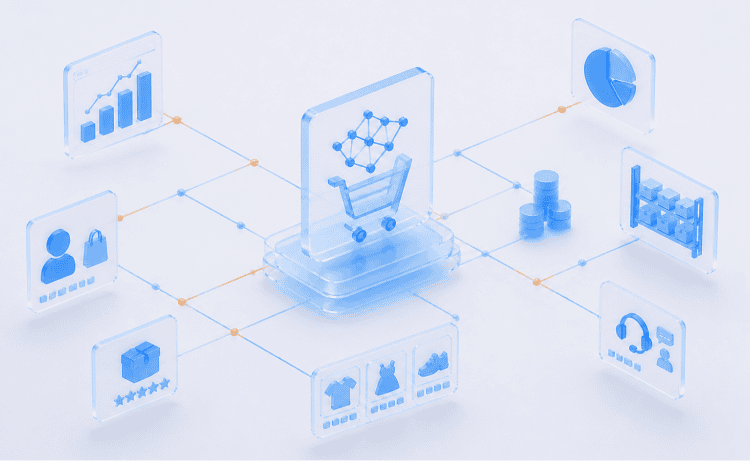
That choice is what machine learning in e-commerce comes down to in practice. Trained on your own transactional data, clickstreams, and catalog, models predict what a shopper wants next, what stock will sell, and which orders deserve a second look. The return lands in three measurable places: revenue per session, working capital locked in inventory, and support cost. Those are the numbers any AI tools should be judged against, whichever use case an e-commerce business starts with.
We created this guide for online retailers, e-commerce managers, and product leaders deciding where the first AI budget goes. Inside you’ll find the use cases that pay back fastest, the data each demands, the failure modes that stall projects, and a sequence for getting a model live.
Content
Recommendation widgets are common; systems that learn are rare. The distinction is whether your tools follow instructions someone wrote once, or adapt to what shoppers do.
AI and machine learning also get used interchangeably, so settle the vocabulary first. Artificial intelligence is the umbrella: any system doing work we would call intelligent. Machine learning is the subset that learns its rules from data rather than from a developer. Nearly every artificial intelligence capability an e-commerce business buys, from recommendations to fraud scoring, is machine learning underneath.
A traditional e-commerce site runs on logic a merchandiser configured by hand. Buy a tent, see a sleeping bag. The rule holds until seasonality shifts or a new category launches, then someone rewrites it.
Machine learning models infer the pattern instead, reading historical sales data alongside live behavior and updating predictions as behavior changes. Three things become possible:
Most e-commerce machine learning falls into a handful of families, and knowing which ML algorithm fits which job helps you scope a project honestly. Machine learning algorithms differ mainly in what they need from your data.
Supervised learning covers anything with labeled history: past purchases predicting the next order, flagged chargebacks training a fraud model. Unsupervised learning handles customer segmentation without anyone defining the groups. Deep learning powers image work such as visual search, natural language processing reads reviews and site search queries for customer sentiment, and reinforcement learning tunes sequential decisions like automated pricing.
Three approaches dominate recommendation engines. User-based collaborative filtering finds shoppers similar to you and surfaces what they bought. Item-based collaborative filtering looks at what gets purchased alongside the product in view. Content-based filtering matches attributes: fabric, price band, brand, color.
The use cases below are ordered roughly by how fast they return value in a mid-sized e-commerce business. Each depends on data you already collect, and each touches the customer experience directly or through the operations behind it.
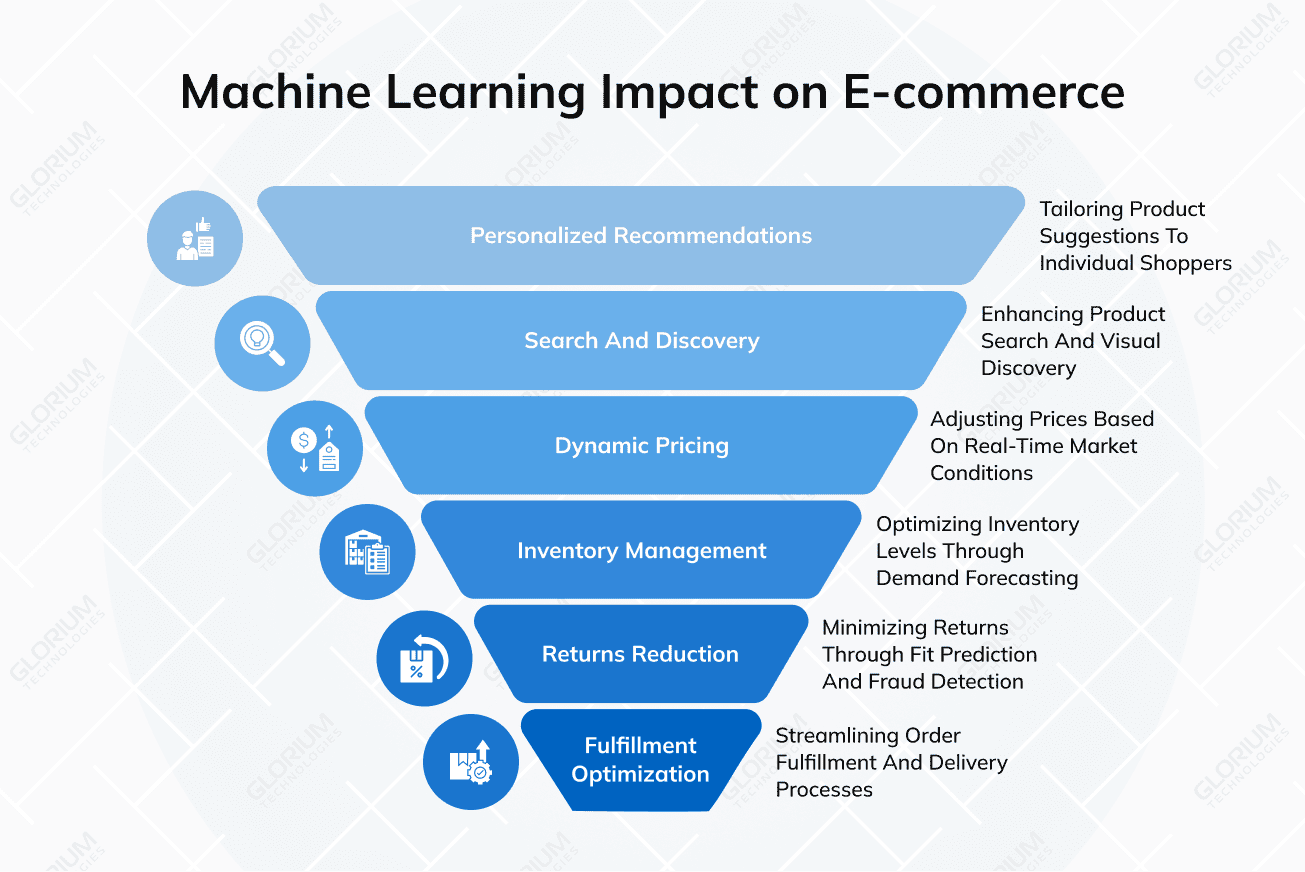
A recommendation engine scores every product against the current shopper and reorders the page, weighing browsing depth, cart contents, past purchases, and similar customers’ behavior, then refreshing mid-session.
eBay runs one of the clearest production examples. Its engineers have described a deep learning retrieval system turning item text and click activity into embeddings, then serving results across roughly 1.5 billion listings for 152 million users. Amazon pairs collaborative filtering with next-in-sequence models to predict what a shopper needs after the current order, not alongside it.
McKinsey puts the revenue lift from personalization done well at 5% to 15%, with marketing spend efficiency improving 10% to 30%. Average order value responds first, since relevant cross-sells reach shoppers already committed to buying.
If you would rather buy than build, Amazon Personalize, Nosto, and Adobe Sensei cover the common patterns, and most major e-commerce platforms ship a native version.
Site search is where high-intent traffic converts or leaves. A 2025 study of 609 million searches across 113 retail sites found that searchers are 24% of shoppers but 44% of revenue.
An ML-backed search engine applies natural language processing to correct typos, resolve synonyms, and read intent, then learns which search results shoppers click. Specialist discovery platforms take over when a native search engine runs out of road.
Visual search extends this to images: a shopper uploads a photo, a deep learning model embeds it, and the system returns similar catalog items. ASOS built Style Match into its app so shoppers can photograph an outfit and find the nearest equivalents, and Google Lens has trained shoppers to expect it. For apparel and home goods, that removes the vocabulary problem.
Dynamic pricing models weigh demand signals, inventory depth, competitor moves across the e-commerce market, and margin floors to price now rather than at the start of the season. Pricing strategies shift from quarterly cycles to continuous adjustment, with price elasticity modeling estimating each segment’s sensitivity to change.
Cadence separates serious implementations from cosmetic ones. Weekly repricing is a reporting exercise; hourly repricing changes how a category performs. Statista puts adoption near 38% of e-commerce companies using or planning dynamic pricing.
The output need not be a shelf price. Many retailers trigger personalized offers for price-sensitive customers while holding list prices steady, protecting brand perception and recovering the sale.
Forecasting is where the operational money sits. Inventory management runs on predictive models reading historical sales data, promotional calendars, seasonality, and wider market trends, then setting reorder points at SKU level. Predictive analytics replaces one static rule with optimal strategies that move as demand does.
McKinsey found AI-driven forecasting cuts supply chain errors by 20% to 50%, with matching drops in lost sales. Gartner expects 70% of large organizations to adopt it by 2030.
Glorium Technologies built this in the DME inventory management module. The client ran stock decisions off static reports that aged faster than the data behind them, so we moved analysis into Python-based ML services inside the platform, putting forecasts in front of the people placing orders. The domain is medical equipment; the forecasting problem is identical.
Returns are the quietest margin leak in online retail. The National Retail Federation’s 2025 Retail Returns Landscape puts online returns at 19.3% of sales, 9% fraudulent.
Machine learning attacks both halves. Size and fit models learn from purchase and return history to flag a wrong-size order before checkout, prompting a swap rather than a refund later. The NRF also reports 85% of retailers deploy AI against return abuse.
Apparel, beauty, and home-goods sellers increasingly use AR-based virtual try-on so shoppers can preview a product before buying. The direct payoff shows up in fewer returns: a shopper who saw roughly how a shade, frame, or piece of furniture would look is less likely to send it back for fit or appearance reasons, reinforcing the returns-reduction case made earlier in this guide.
Machine learning does the work underneath. Segmentation models separate a face, body, or room from the background, pose estimation tracks how the item should sit as the shopper moves, and a renderer places it at the right scale and lighting. Sephora Virtual Artist, Warby Parker’s frame preview, and IKEA Place are the implementations most shoppers have already met.
Catalog readiness sets the timeline. Every SKU needs a 3D asset or a calibrated shade profile, so most retailers start with the category where returns cost the most and widen coverage once the numbers hold.
Once an order exists, ML decides how it moves. Route optimization models weigh live traffic, weather, and driver performance to sequence stops, while fulfillment models pick which warehouse ships each order. The payoff is unglamorous: fewer split shipments, better carrier selection, delivery dates the system can keep.
Traditional fraud detection relies on static rules, and static rules age badly. Fraudsters test them, find the threshold, and stay under it.
An ML algorithm scores transactions against learned patterns in transaction history, device signals, and velocity, then adapts as tactics shift. The practical benefit is fewer false positives, since declining good orders carries a cost that rarely shows on a report. Juniper Research puts global e-commerce fraud losses at $48 billion in 2025, heading toward $107 billion by 2029.
Machine learning automates the repetitive half of support. Chatbots and virtual assistants resolve order status, returns, and sizing questions, while natural language processing models triage and auto-tag tickets so the queue routes itself. Complex cases escalate with context attached.
Two outcomes follow: faster query resolution and lower customer service costs. BCG estimates that conversational commerce built on generative AI can reduce customer service costs by about 30% while lifting customer satisfaction, a rare case where efficiency and experience agree.
Sentiment models on the same customer interactions warn you when a product line generates frustration. Amazon Lex and the virtual assistants inside Salesforce and Adobe cover standard deployments, and our AI chatbot for e-commerce suits stores that would rather configure than build.
Churn prediction spots customers whose behavior resembles people who stopped buying, early enough to intervene. Pair it with customer lifetime value modeling, and targeted marketing stops treating every segment as equally worth winning back.
Glorium Technologies delivered a churn prediction system for a commercial real estate client who saw tenants leaving only once notice was given. Built on Python and scikit-learn, it scores accounts on behavioral signals early enough to act. Swap tenants for repeat buyers, and it transfers to subscription e-commerce.
| Use case | ML approach | Data you need | Success metric |
| Recommendations | Collaborative, content-based filtering | Clickstream, order history, catalog | Average order value |
| Search and discovery | Learning to rank, NLP | Queries, click-through, conversion | Search-to-cart rate |
| Visual search | CNN image embeddings | Product imagery, uploaded photos | Discovery conversions |
| Returns and fit | Classification, size modeling | Purchase and return history, sizing | Return rate by category |
| Fulfillment routing | Optimization, time series | Order, carrier, and location data | Cost per delivery, on-time rate |
| Dynamic pricing | Regression, reinforcement learning | Price history, elasticity, competitor feeds | Gross margin, sell-through |
| Demand forecasting | Time series, gradient boosting | Historical sales data, promotions | Forecast error, stockouts |
| Fraud detection | Anomaly detection, classification | Transactional and device signals | False positive rate |
| Support automation | NLP, intent classification | Tickets, chat logs, knowledge base | Deflection rate |
| Churn and CLV | Survival models, classification | Frequency, recency, engagement | Customer lifetime value |
Benefits are easy to list and hard to prove, so tie each to a number you already track:
Budgets here move with your data rather than with a feature list, which is why two retailers can receive quotes that differ by a factor of three for the same use case. The ranges below reflect what mid-market e-commerce businesses typically spend on a first production model, before platform licensing.
| Cost line | Typical range | What moves the number |
| Data audit and pipeline work | $15,000 to $40,000 | Number of source systems, quality of existing records |
| Model development | $20,000 to $60,000 | Use case complexity, accuracy target, catalog size |
| Storefront and ERP integration | $10,000 to $35,000 | API maturity, legacy constraints, write-back requirements |
| Deployment and MLOps setup | $8,000 to $20,000 | Monitoring, retraining automation, compliance scope |
| Annual running cost | 15% to 25% of build | Retraining cadence, compute, ongoing accuracy review |
A first scoped use case lands between roughly $50,000 and $150,000 in most mid-market engagements, with data work taking the largest share. Platform-native AI tools cost a fraction of that and remain the sensible starting point until the generic model stops matching your catalog.
Run the comparison on your own numbers before any vendor call. Take a store turning over $20 million online. Apply the low end of the McKinsey personalization lift cited earlier to a quarter of sessions, and the first year returns around $250,000 in incremental revenue. Set that against a $90,000 build and $18,000 of annual upkeep, and payback arrives inside twelve months.
Forecasting projects pay back differently. Lower forecast error releases working capital and trims markdowns, so the gain lands on the balance sheet rather than the revenue line, which is why finance belongs in the room when the success metric gets agreed.
Projects implementing machine learning fail for reasons unrelated to the algorithm far more often than they fail on the modeling itself. McKinsey’s 2025 State of AI survey found 88% of organizations using AI somewhere, yet only a third had scaled it. These are the business challenges behind that gap.
Models inherit the flaws in your data collection. Poor data quality compounds: duplicate customer records, inconsistent SKU taxonomies, and missing attribution produce confidently wrong predictions, making data readiness the best predictor of whether a project ships.
Siloed data does the same damage from another direction. When web analytics, the order system, and the support desk each hold partial customer data, no model sees the whole customer. Consolidating into a warehouse or CDP is usually the first invoice on an ML project.
“We work a lot with confidence scores… There are ways to also do that not just by classic LLM stuff but also through machine learning or other ways of classic computing.”
Nicholas Kroger, Rethink Retail’s AIR Conference
Data privacy regulations shape what a model may see, and three matter most:
Models need live access to orders, stock, and pricing. When those sit in a legacy ERP with no usable API, integration often exceeds the modeling work.
Machine learning models degrade. Shopper behavior shifts, catalogs turn over, and a model trained last spring quietly loses accuracy. Monitoring and retraining are running costs, not one-time tasks.
Two problems show up earlier than drift. Overfitting produces a model that scores beautifully on historical data and poorly on live traffic, which is why data gets split into training, validation, and test sets before anyone celebrates an accuracy figure. Explainability is the second: when a recommendation engine stops surfacing anything outside the top sellers, someone must see why. Both are MLOps problems, cheaper to build in than to retrofit.
Between data engineering, MLOps, and domain expertise, staffing is the largest line item. Many mid-sized retailers close the gap with a dedicated development team rather than build an in-house function for one project.
A first ML project should be narrow enough to finish and visible enough to defend. The sequence below reflects how Glorium Technologies scopes AI implementation for retail clients.
Audit how you collect data today and what you end up with: order history, sessions, catalog attributes, support tickets, returns. Check volume, consistency, and how far back clean records go, since most models want twelve months or more. Then plan the plumbing: ETL jobs to pull data from source systems, a warehouse or CDP to consolidate it, and a feature layer turning raw events into model variables.
| Use case | Minimum useful history | Core data sources |
| Recommendations | 12 months, 1,000+ orders/month | Clickstream, orders, catalog |
| Demand forecasting | 24 months across a full season cycle | Sales, promotions, stock movements |
| Fraud detection | 6 months with labeled chargebacks | Payments, device, session data |
| Churn and CLV | 18 months of repeat-purchase history | Orders, engagement, support |
Pick the use case where a small percentage improvement is worth real money, then agree on success metrics before development starts. Forecast error, search-to-cart rate, and chargeback rate all work, since you already measure them.
Second budget reviews go badly when nobody can prove what the first one bought. Decide the test design upfront:
The measurement definition matters as much as the test design. A recommendation engine credited with every order containing a recommended product will look spectacular and tell you nothing, since many of those shoppers were buying anyway. Incrementality, the gap between the treated group and holdout, is what survives scrutiny.
Ship to a traffic slice, keep the holdout intact, and instrument the model for drift from day one. Once one use case proves out, the pipeline carries most of the load for the next, so the second project usually costs less. Our machine learning services team runs this cycle end to end, from data exploration through deployment.
The direction of travel across the e-commerce industry is toward systems that act rather than report. The shifts below already run in production somewhere, making them planning inputs rather than predictions.
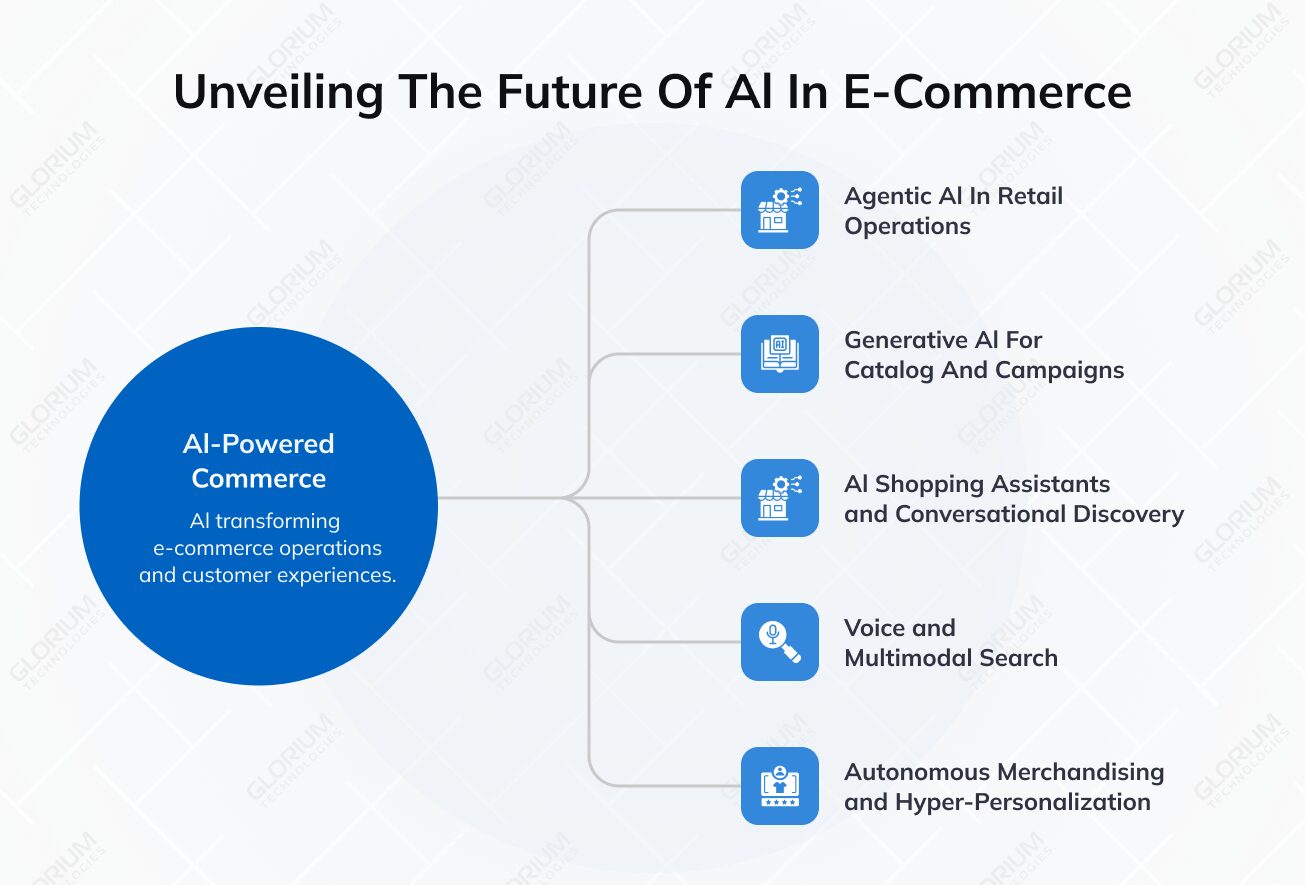
Software agents are starting to own bounded decisions: triggering replenishment, adjusting a promotion, rerouting an order. What separates a working deployment from a reckless one is the layer deciding when the agent may act alone.
AI tools now generate product descriptions, size guides, and campaign variants at volumes no copywriting team could match, then filter them by performance. Brand consistency is the constraint, which is why most e-commerce companies keep a review gate on customer-facing output.
Assistants are absorbing the discovery work that once belonged to category pages. A shopper describes a need in plain language, and the assistant narrows the catalog through dialogue, moving the start of online shopping off the homepage.
Voice search pulls query volume from the keyboard, and multimodal queries pairing a photo with a spoken constraint are following. Both reward clean structured attributes and punish keyword-stuffed titles.
Models are beginning to reorder digital shelves without a human approving each change, shifting merchandisers from setting positions to setting objectives. Major e-commerce platforms keep exposing more model-level control, pushing personalization past category targeting toward per-shopper layouts built from live online interactions.
None of these trends change the entry point. Whether you are chasing agentic replenishment or want search to stop returning empty results, the first move is the same: find the metric that hurts, confirm your data can support a model that moves it, then ship one narrow use case.
The work around the model is where timelines go: pipelines, ERP or storefront integration, monitoring, and the habits that keep predictions trustworthy six months on. Integration is where we see projects break most often. A demand model is worthless if it cannot read live stock from the ERP and write reorder suggestions back, and that round trip is where months disappear.
Platform coverage rarely decides whether a project works. We build against Shopify and Shopify Plus, Adobe Commerce, along with the open-source Magento installs still running a large share of mid-market catalogs, BigCommerce, Salesforce Commerce Cloud, and SAP Commerce Cloud.
Headless and custom storefronts follow the same logic. A model needs a dependable read on orders, stock, and catalog attributes, plus a route back so predictions reach the merchandisers and planners who act on them.
Glorium Technologies has engineered software since 2010, with practices in machine learning, AI consulting, and e-commerce and retail development. We deliver ML solutions through MVP builds, fixed-scope projects, and outstaffing.
Bring the metric you want to move, and we will spend a call working through it. You will come away knowing which use case your data can support, what it takes to get a first model live, and where the time and budget go. Book a call with our team.
Recommendation and forecasting models want twelve to twenty-four months of clean transactional data, enough to cover a seasonal cycle. Fraud models start with less, since they learn from event frequency rather than seasonality. Below roughly a thousand orders per month, rules-based logic performs comparably for far less. Glorium Technologies opens every engagement with data exploration to settle this.
Small merchants get real value, usually by starting with the ML features already in their platform and adding custom models where the generic version underperforms. The constraint is data volume, not company size. Glorium Technologies scopes smaller ML solutions the way we scope an MVP: narrow enough to prove the economics first.
Start with the platform. Shopify, Adobe Commerce, and similar systems ship AI tools for recommendations and search good enough for a baseline. Build custom when you have a data source the platform cannot see, a catalog its models handle poorly, or a margin equation specific to your category. A short AI consulting engagement settles it by benchmarking your platform against a tuned model.
Expect eight to sixteen weeks for a scoped use case with usable data in place, split evenly between data engineering and modeling. Legacy integration adds time, so the estimate should follow a data audit rather than precede it.
Ownership splits three ways: an engineer maintaining the pipeline, an analyst reviewing accuracy against outcomes, and a business owner deciding when a drop matters. Budget retraining on a set cadence, quarterly for recommendations and monthly for fraud, plus compute. Running costs land below the build, though never at zero. Glorium Technologies engagements do not end at deployment.
Set explicit floors, ceilings, and change-frequency limits, and exclude categories where shoppers price-check often. Pricing strategies inside those bounds capture most of the margin benefit without visible volatility, which is why many retailers apply the model to promotional depth rather than list prices. When Glorium Technologies builds pricing logic, those constraints are hard rules in the system rather than something the model must learn.