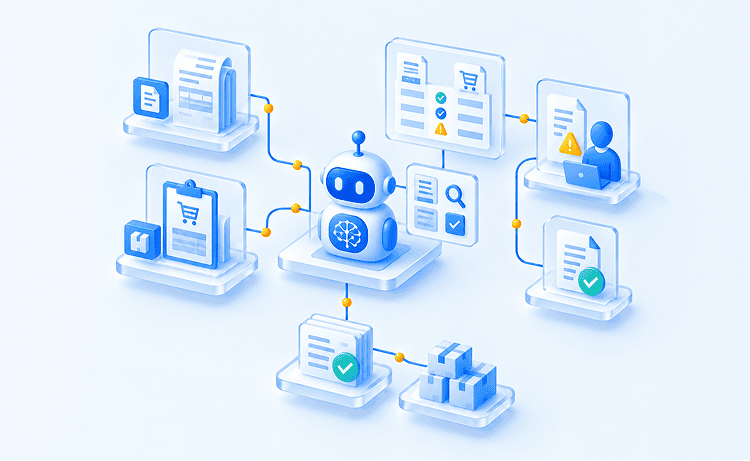









Robotic Process Automation in Banking: A Complete Guide for Finance Teams
Updated September 30, 2026

 Summarize in ChatGPT
 Summarize in ChatGPT
Finance teams at banks spend a large share of the day moving the same customer data between systems that don’t talk to each other — retyping the same numbers into a core banking system, a CRM, and a loan platform that all need identical information. Robotic process automation in banking exists to take that layer of manual data entry and repetitive tasks off a team’s plate, cutting the human intervention needed to move data across multiple systems so people can spend their time on exceptions that actually need judgment. Financial institutions are backing that with real budget: RPA spending across banking, financial services, and insurance is projected to grow from $685.7 million in 2022 to $8.79 billion by 2030, a 39.4% compound annual growth rate, according to Grand View Research.
That gap has a real price tag. Financial crime compliance alone cost financial institutions in the U.S. and Canada $61 billion in 2024, with costs rising for 99% of institutions surveyed, according to LexisNexis Risk Solutions — on top of whatever manual tasks and error-prone reconciliation are already costing a team in hours. It’s why so many finance leaders now treat automation as a standing priority rather than a side project.
From here, you’ll see exactly where robotic process automation delivers the most value across a bank’s finance function, what compliance demands before it touches customer data, and where intelligent automation goes next.
Content
Robotic process automation is software that mimics the keystrokes and data-entry logic a person would use to complete a rule-based task: logging into a system, pulling a record, and moving it into another system under a set of if-then rules. In banking, that means software robots handling the repetitive layer of work sitting on top of core banking systems — pulling account data, validating fields, and moving records between the loan origination platform and the ledger.
Robotic process automation isn’t artificial intelligence in the general sense. Classic RPA follows fixed rules against structured data; add machine learning on top, and it becomes intelligent automation, capable of reading a scanned invoice or flagging an unusual transaction pattern instead of only moving fields that are already structured.
Finance leaders are no longer treating this as optional. Deloitte’s Q4 2025 CFO Signals survey found that 87% of North American CFOs expect artificial intelligence to become an operational backbone of finance by 2026 — and robotic process automation is the foundation most of that gets built on.
The strongest robotic process automation use cases in banking sit wherever a process is high-volume, rule-based, and spread across multiple systems.
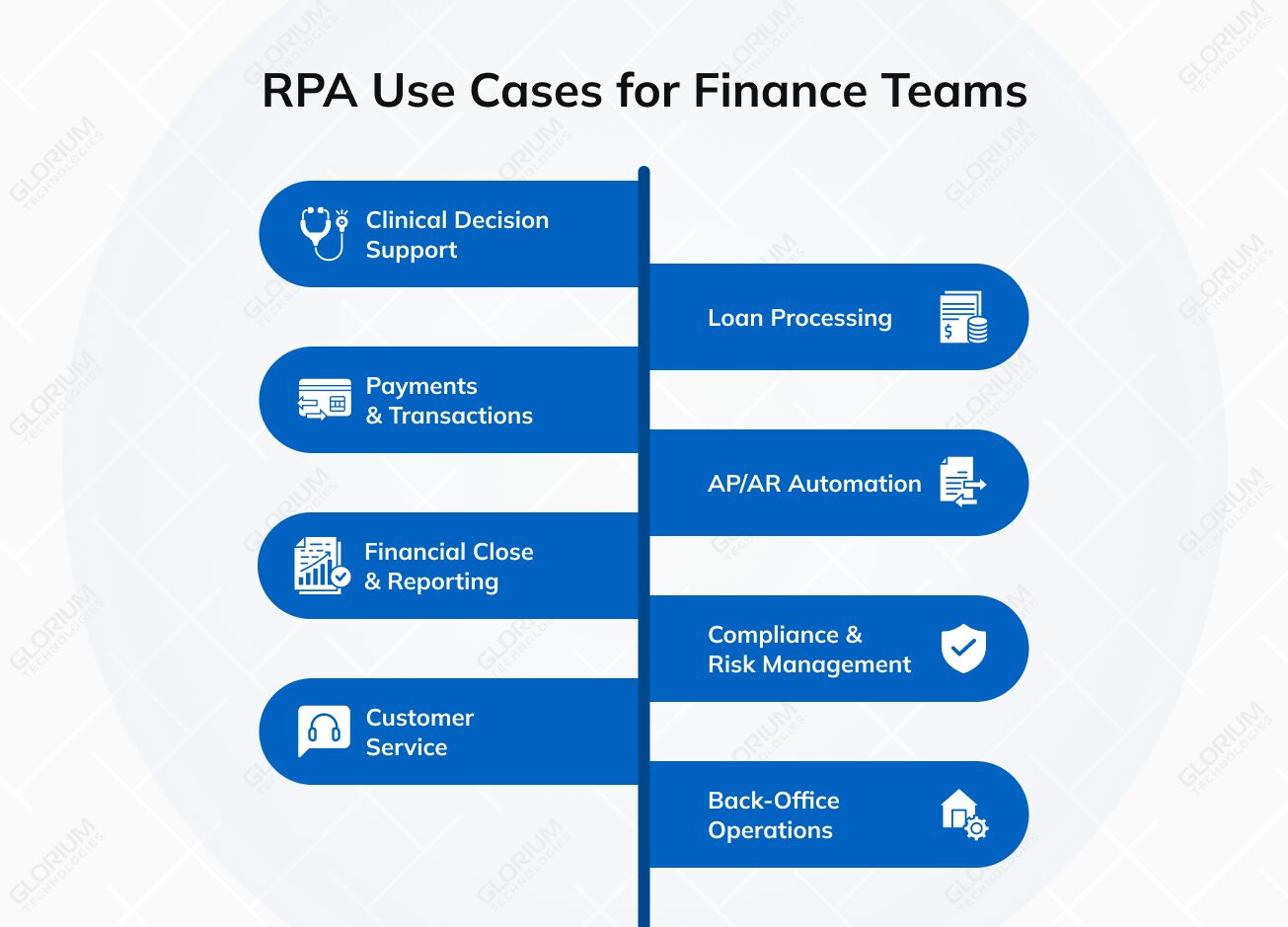
Below are the categories delivering the most measurable value across finance and accounting teams today.
Opening a new account still tends to mean asking a customer for the same documents twice, then having someone key those same details into a core banking system, a CRM, and a compliance case file by hand. It is slow for the customer and repetitive for the person doing it, exactly the kind of work RPA absorbs first.
A loan officer chasing down pay stubs, bank statements, and a credit pull for a single application can burn half a day before underwriting ever sees the file. Multiply that across a busy month, and the backlog becomes the actual bottleneck.
This is the category where automation’s ceiling gets tested on complex, high-value contracts. For example, JPMorgan Chase’s COIN (Contract Intelligence) platform automates the review of commercial loan agreements that previously consumed roughly 360,000 hours of lawyer and loan-officer time each year across about 12,000 contracts, extracting key contract attributes in seconds instead of requiring a person to read each agreement line by line.
Every payment a bank processes eventually has to match against a ledger entry somewhere, and doing that by eye across thousands of daily transactions is exactly where errors creep in.
Invoices arrive in a dozen formats from a dozen vendors, and someone still has to open each one, check it against a purchase order, and decide whether it is ready to pay. On the receivables side, someone else is manually tracking who has and hasn’t paid yet.
This use case carries enough depth on its own that Glorium Technologies covers it in a dedicated guide about Accounts Payable Automation: A Complete Guide, for the deeper mechanics.
Closing the books at month-end usually means someone manually pulling numbers out of five systems into one spreadsheet, then hoping nothing changes upstream before the report goes out the door.
Compliance teams are expected to catch every suspicious pattern and produce a clean audit trail on demand, using a manual review process that was already stretched thin before transaction volume doubled.
KeyBank offers an example of what this looks like in production: the bank paired Automation Anywhere’s platform with generative AI to optimize its suspicious activity referral workflow for AML investigations. Referrals submitted by email or SharePoint are automatically parsed to extract and validate the relevant data points, risk-scored, and escalated to the AML investigation team when they cross a threshold — turning a manual, time-consuming review workflow into a consistent, monitored process.
A customer asking about their balance or a pending transfer shouldn’t have to wait on hold while someone looks it up across three systems — and most of the time, they don’t need a person at all.
The work that keeps a bank running rarely touches a customer directly, which is exactly why it is easy to let it pile up on someone’s desk instead of automating it early.
| Use case | Typical automation trigger | Complexity to automate | Where a person still steps in |
| KYC verification | New application submitted (event-driven) | Medium — depends on how many external databases get queried | Reviewing flagged or high-risk applicants |
| Loan processing | Document upload or status change | High — document formats vary widely by lender and loan type | Underwriting judgment on borderline files |
| Statement reconciliation | Scheduled (daily or nightly batch) | Low to medium — data is already structured | Investigating unmatched line items |
| Accounts payable and receivable | Invoice received or payment due date approaching | Medium — invoice formats vary by vendor | Approving payments above a set threshold |
| Financial close and reporting | Scheduled (tied to the close calendar) | Medium to high — depends on how many source systems feed in | Reviewing exceptions before books close |
| AML and compliance monitoring | Real-time (transaction posted) | High — rule tuning to control false positives | Investigating and clearing or escalating flags |
| Customer service and back office | Customer request received | Low to medium | Handling requests routed as exceptions |
Banking is one of the most heavily regulated industries there is, and that isn’t incidental to why RPA gets built the way it does here. A missed AML flag or an undocumented data-handling decision doesn’t just create rework — it can trigger regulatory fines, a consent order, or reputational damage that outlasts whatever labor cost the bot was meant to save in the first place.
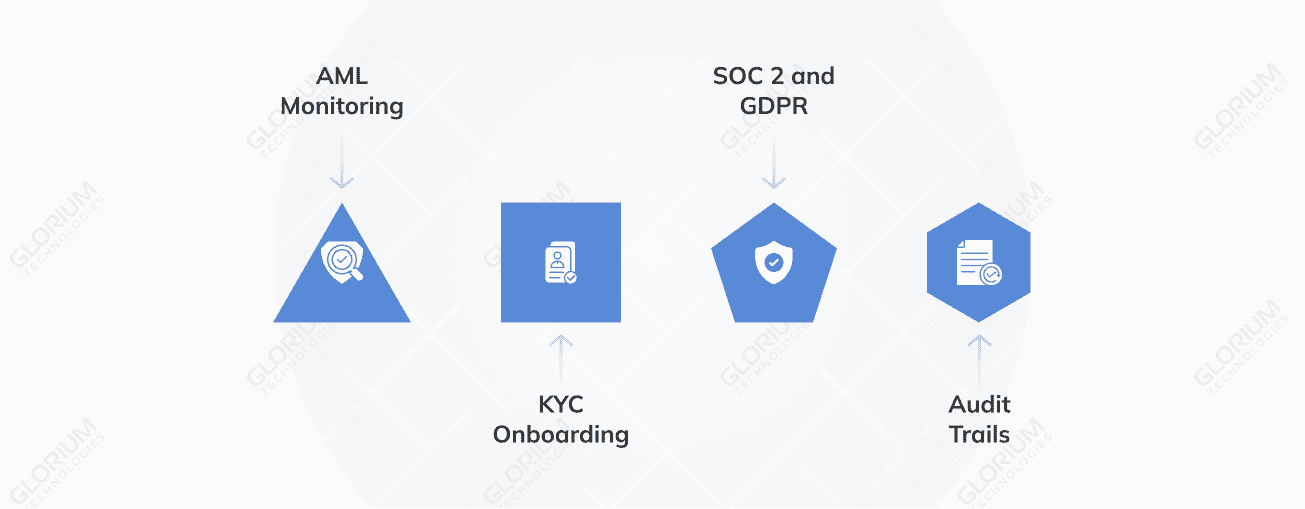
Compliance isn’t a side effect of banking automation — it’s one of the biggest reasons banks adopt it in the first place, and it shapes how every RPA deployment gets built.
This is the layer where generic automation advice breaks down. A workflow tool configured without financial institutions’ specific regulatory requirements in mind can move fast and still leave a bank exposed the first time a regulator asks for evidence of a specific decision. It’s also why the implementation partner matters as much as the automation platform itself: Glorium Technologies builds automation against AML, KYC, and audit-trail requirements as a starting constraint rather than an afterthought, instead of adapting a generic workflow tool to financial services after the fact.
The benefits finance leaders report cluster around five areas: speed, cost, accuracy, compliance, and staff capacity.
| Before automation | With robotic process automation |
| Manual data entry across disparate systems | Data flows automatically between core banking systems, CRM, and ledgers |
| Multi-day reconciliation at month-end | Statement reconciliation completed same-day, exceptions flagged automatically |
| Compliance reporting assembled manually before deadlines | Compliance reporting and audit evidence generated on a schedule |
| Staff spend hours on repetitive tasks | Staff handle exceptions and judgment calls; routine tasks run unattended |
| Errors traced back to manual re-keying | Data validation rules catch mismatches before they reach the ledger |
Beyond the qualitative shift, the numbers finance leaders cite most often are:
None of this is turnkey, and skipping the groundwork is usually what turns a promising pilot into a shelved one. A bot built against the wrong assumption about a legacy system, a security review, or a jurisdiction’s rules doesn’t just underperform; it can create rework, a compliance gap, or a rollout nobody trusts enough to keep using. Understanding these five categories before scoping the first workflow is what separates automation that sticks from a proof of concept that quietly dies after launch:
These are exactly the categories a specialized implementation partner is built to handle. An experienced team knows how to work around a legacy core system’s API gaps instead of discovering them mid-build, designs bot credentials and access scope with the same rigor as a human employee’s onboarding, and maps each jurisdiction’s regulatory requirements before a workflow goes live instead of after an examiner flags it. On the process side, a structured discovery phase surfaces the exceptions a process actually has before anyone writes a rule, and a certified change-management approach — the kind built on frameworks like Prosci’s ADKAR model — keeps a rollout from stalling once the bot is live and the team has to actually change how they work.
This is where Glorium Technologies’ business process automation practice is built to help: a diagnostic and discovery phase precedes every build, every customization is mapped to a specific process rather than bolted on generically, and certified change-management professionals stay involved through adoption, not just go-live.
Robotic process automation in banking is converging with several adjacent technologies rather than staying a standalone tool, and that matters for anyone scoping a program today. A rule-based bot hits its ceiling the moment it meets a document it wasn’t built to read or an exception its rules never anticipated — exactly where machine learning, generative AI, and process mining pick up the work pure RPA can’t finish on its own. The institutions furthest along aren’t necessarily running more bots than everyone else; they’re running fewer, more capable ones that combine several of these layers into a single workflow instead of stitching together isolated point solutions.
Every use case in this guide follows the same underlying pattern: repetitive, rule-based work sitting on top of systems that don’t talk to each other well. That’s exactly the layer Glorium Technologies builds automation for.
Glorium Technologies designs and implements business process automation for finance and accounting teams, combining traditional robotic process automation with AI agents built on its own CogniAgent platform for the parts of a workflow that need conversation, judgment, or live system checks mid-process. Every engagement starts with a process audit that maps where manual work is actually happening and what it’s costing, so the automation gets built against evidence rather than a guess.
If your finance team is still re-keying data between systems or assembling compliance reports by hand, book a free intro call and see exactly where automation would save the most time.
Robotic process automation RPA tools follow a fixed rule set to move data through financial processes without a person re-entering the same fields twice. In practice, that means data extraction from a document or a system screen, pulling matching records from multiple sources, and running validation checks before anything posts. Where a bank has account data sitting in a core system, a lending platform, and a spreadsheet, a bot can consolidate data into one accurate record instead of three inconsistent ones. It handles routine, high-volume financial transactions well; anything that needs a judgment call still goes to a person.
Generic RPA software can move a file from one folder to another; RPA solutions built for the finance sector are designed around financial regulations from the start, with audit logging and jurisdiction-specific compliance requirements built into the workflow instead of bolted on afterward. Finance also tends to involve more complex processes with more exceptions per workflow than a typical back-office task, since a single transaction can touch compliance, customer data, and multiple approval steps at once. That’s why finance robotic process automation tools usually ship with stronger validation and exception-routing logic than a general-purpose automation platform.
Implementing RPA at a banking institution usually starts with a short discovery phase to map the process and its exceptions, followed by a build stage that runs anywhere from a few weeks for a single workflow to several months for a suite of automated workflows spanning multiple systems. Critical tasks — anything touching payments, compliance, or customer funds — typically go through a longer testing and sign-off period than lower-risk back-office work before going live. Automating repetitive tasks like data entry or report generation tends to move faster than RPA in finance projects involving fraud detection or AML, since those carry more regulatory scrutiny before deployment. Most finance RPA programs expand in phases rather than automating everything at once, starting with the highest-volume process and adding others once it’s proven out.
RPA connects to a customer relationship management platform the same way it connects to a core banking system or ledger, syncing customer and account data without manual re-entry on either side. On the reconciliation side, financial services firms use RPA to automate statement reconciliation by matching transactions across systems automatically, and reconciliation automation like this is one of the more common starting points because it delivers measurable operational efficiency and cost reduction fast. Within broader financial operations, this kind of finance automation typically expands from one workflow into several once the first one proves out.
Glorium Technologies builds automation around whatever core banking system, CRM, or ledger a financial institution already runs, rather than requiring a system replacement before automation can start. Where an API exists, the automation connects directly; where it doesn’t, Glorium Technologies designs a workaround that still meets the audit-trail and security standards a regulated institution needs. Every engagement opens with a process audit that maps what’s actually happening across the institution’s existing systems before any bot gets built.
Glorium Technologies delivers custom automation and AI agent workflows built around a specific finance function’s processes — reconciliation, compliance reporting, invoice handling, or loan document processing — rather than a generic bot template. Every engagement runs through a diagnostic and discovery phase to map the process and its exceptions, followed by build, deployment, and a post-launch optimization period. For workflows that need judgment or a conversational layer instead of pure rule-based execution, Glorium Technologies pairs RPA with its own CogniAgent platform rather than bolting on a separate third-party AI tool.