







Smart Hospital Solutions: A Practical Guide to Connected Care in 2026
Updated July 31, 2026

 Summarize in ChatGPT
 Summarize in ChatGPT
A charge nurse on a busy medical floor starts her shift already behind. Vitals on one monitor, medication orders on another screen, bed availability on a whiteboard down the hall, and the last three pages from the lab somewhere in a fax queue. She spends the first hour reconciling systems that were never designed to talk to each other. That gap between what the technology could do and what it actually does is the problem smart hospital solutions were built to close.
The shift toward connected, data-driven hospital systems is no longer a pilot-stage curiosity. The global smart healthcare market was valued at about USD 188.86 billion in 2024 and is projected to reach USD 385.28 billion by 2030, a compound annual growth rate of 12.51% according to Grand View Research. The hospitals segment held the largest share of that market in 2024, driven by demand for technologies that improve patient care, raise operational efficiency, and reduce costs.
Content
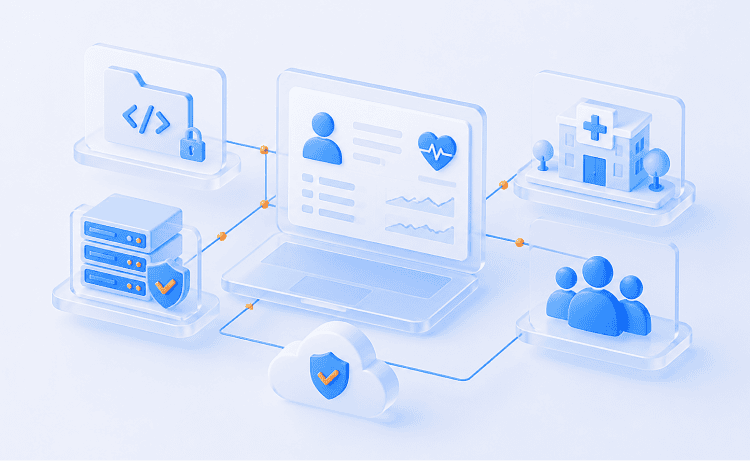
A smart hospital is a healthcare facility that connects its clinical and business systems into a single, data-driven environment. Instead of isolated tools running in separate departments, information moves across the healthcare organization so that clinicians, administrators, and patients all work from the same real-time picture.
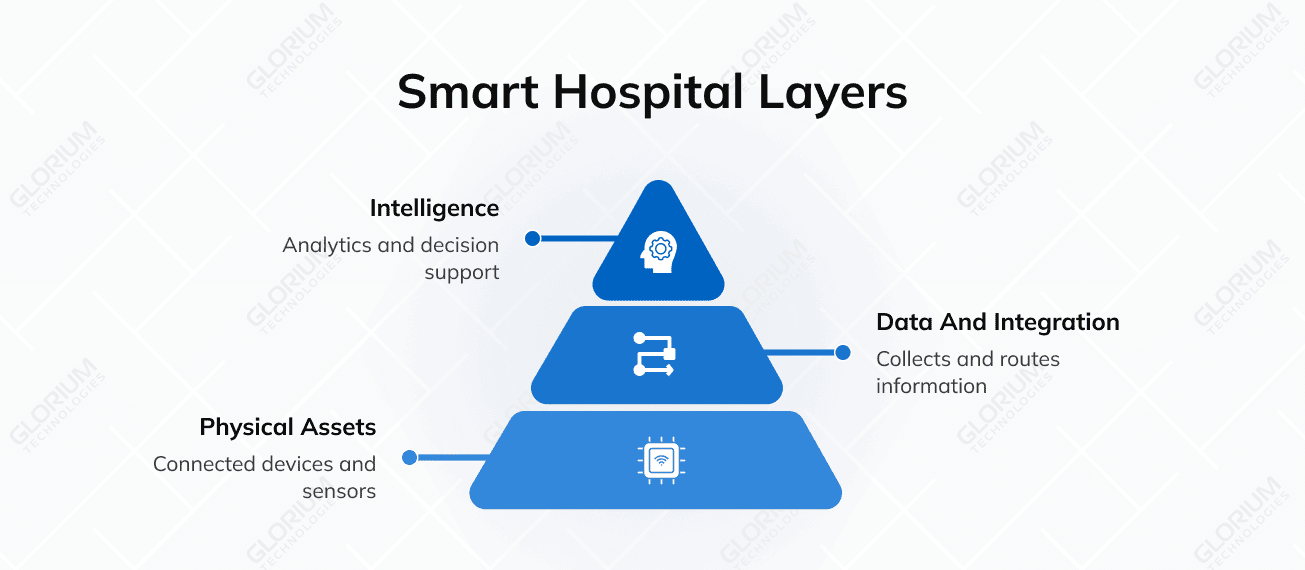
The distinction matters because many hospitals already own advanced technologies. They have an EHR, medical imaging systems, and patient monitoring devices. What they often lack is integration. Smart hospital solutions focus less on buying more hardware and more on making existing systems work together. Three layers define a smart hospital environment:
A smart hospital treats AI, IoT, and advanced analytics as one connected system that streamlines both clinical and administrative workflows, rather than as separate tools bolted onto separate departments. The goal across all three layers stays consistent: connect patients, staff, and data, so care delivery improves, and hospital operations run with less friction.
Plenty of hospitals have digitized individual workflows. A traditional facility might run a modern billing platform, a separate scheduling tool, and a standalone imaging archive, each working well on its own.
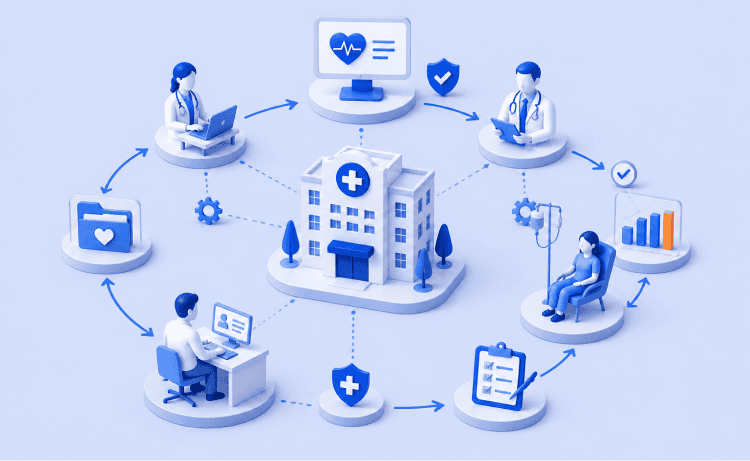
A smart hospital changes the wiring underneath. Patient data flows from a monitoring device to the EHR, triggers an alert to the right care team, updates the patient record, and feeds an analytics dashboard that operations managers watch in real time. The tools may look familiar; the difference is that they share one nervous system.
Smart hospital solutions are based on a range of technologies, each solving a specific class of problems. Understanding what each layer does helps leaders prioritize investment rather than chase every trend at once.
Before comparing them, one point is worth stating plainly: no single technology makes a hospital smart. Value comes from how these advanced technologies connect to existing systems and to each other.
Artificial intelligence sits at the center of most smart hospital solutions, powering predictive analytics, medical imaging analysis, and clinical decision support that help physicians act faster and with more confidence.
Adoption has moved quickly. About two in three physicians reported using some form of health AI as of early 2025, up 78% from 2023, according to American Medical Association survey data. Much of that momentum comes from tools that reduce documentation load, giving clinicians more time for direct patient care.
“AI is actually mature enough to fix the problems and not just think about the fixes and suggest them, not just generate dashboards, but actually fix them autonomously.”
Smart Hospitals: How AI Is Changing the Way Care Happens
IoT-connected devices give hospitals continuous visibility into patient vitals and physical assets. Wearable monitors, smart infusion pumps, and connected imaging systems collect real-time data that would otherwise be captured only during periodic checks.
The payoff shows up in patient safety. AI-powered monitoring systems can detect subtle physiological changes, such as early fever onset, well before traditional intermittent observation, which shortens hospital stays and lowers readmission rates, per an integrative review of AI in nursing.
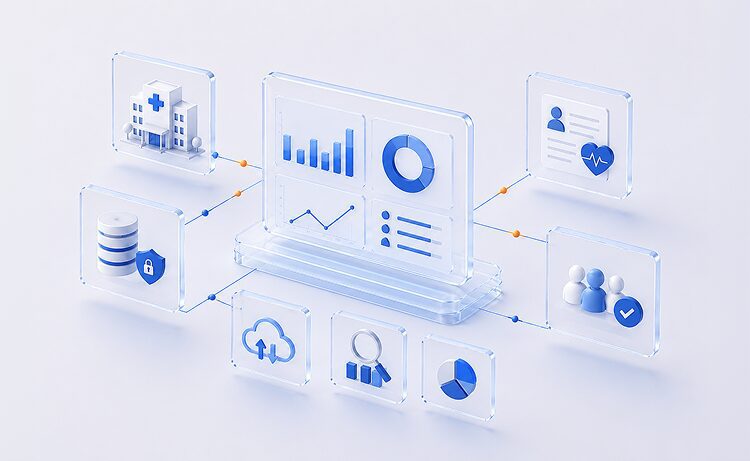
Advanced analytics turns collected data into decisions. Once patient data lands in a shared repository, machine learning can flag risk, support diagnostics, and give hospital operations teams a clearer view of patient flow.
None of this works without interoperability. Smart hospital solutions depend on standards like FHIR, HL7, and DICOM so that clinical systems, medical devices, and business systems exchange information cleanly. Glorium Technologies builds healthcare software on exactly these standards to keep clinical accuracy and full data interoperability intact across connected systems.
Here is how the core technologies map to the problems they solve:
| Technology | Primary function | Example use in a smart hospital | Main benefit |
| Artificial intelligence | Prediction and decision support | Ambient documentation, imaging analysis, risk scoring | Faster clinical decisions, lower administrative burden |
| Internet of Medical Things | Continuous data capture | Patient monitoring, asset tracking, smart infusion pumps | Improved patient safety and real-time visibility |
| Data analytics | Insight generation | Patient flow dashboards, readmission risk models | Better operational efficiency and clinical outcomes |
| Interoperability standards | System integration | FHIR and HL7 data exchange across departments | Unified records and connected workflows |
| Automation and robotics | Task execution | Pharmacy automation, RPA for claims processing | Reduced routine and repetitive tasks |
Hospital leaders rarely fund technology for its own sake. Smart hospital solutions earn their budget through measurable gains across care quality, efficiency, and cost.
Connected monitoring and predictive analytics help care teams intervene earlier. When an early-warning algorithm flags deterioration before a scheduled check, the result is fewer complications and shorter stays. That improvement in patient outcomes is the clearest argument for the whole model.
Administrative work consumes a large share of hospital budgets, and much of it can shift to automation. The healthcare industry has a roughly USD 20 billion opportunity to reduce administrative waste by moving from manual to electronic workflows, according to the 2024 CAQH Index, which also found that fully automated administrative workflows save about 70 minutes per patient visit. Automating those routine and repetitive tasks frees staff for higher-value work.
The upside at scale is large. Research by Healthcare Dive estimates that broader AI adoption could cut hospital costs by 4 to 11%, worth USD 60 billion to USD 120 billion a year, mostly through better clinical operations, patient flow optimization, and administrative automation.
Those gains show up across the whole organization. Patients get a smoother experience, with faster check-in and fewer repeated questions between departments. Staff productivity rises as documentation and manual data entry shrink. Clinical decisions grow stronger when analytics surface actionable insights at the point of care. And operational costs drop as billing, scheduling, and inventory workflows move to automation.
The same effect plays out in real projects. When Glorium Technologies built a remote fertility testing platform, pulling scattered patient data into one system doubled operational speed and let clinicians validate results without jumping between tools. A single care journey shows the pattern in miniature, and a smart hospital applies the same connected-data approach across every department.
Smart hospital solutions deliver real value, and they also carry real obstacles. Naming them early keeps projects on track.
Most hospitals already run legacy clinical systems that were never designed to share data. In a 2025 survey reported by the HIPAA Journal, 37% of U.S. healthcare professionals said they lacked modern, effective systems, with common complaints including platforms that do not exchange data and daily reliance on manual workarounds. Connecting these existing systems to new tools is usually the hard part of any smart hospital project.
Patient data is among the most sensitive and valuable data any organization holds, which makes security and regulatory compliance non-negotiable. Smart hospital solutions have to honor frameworks like HIPAA, GDPR, and HITECH from the first line of code.
Taken together, the obstacles hospital leaders plan for tend to be consistent: high upfront implementation costs for integration, devices, and training; data privacy and cybersecurity across a larger connected footprint; legacy system integration between old and new platforms; staff training and adoption so care teams trust the new digital tools; and regulatory compliance across every workflow. Each is manageable with the right sequencing, and none is a reason to delay.
Adoption depends on tools that fit real clinical workflows rather than adding steps. The Cedars-Sinai pilot of an AI nurse documentation assistant is instructive: nurses reported shorter documentation time and lower cognitive load precisely because the voice-enabled tool mapped cleanly into their existing routine, as reported by the American Hospital Association.
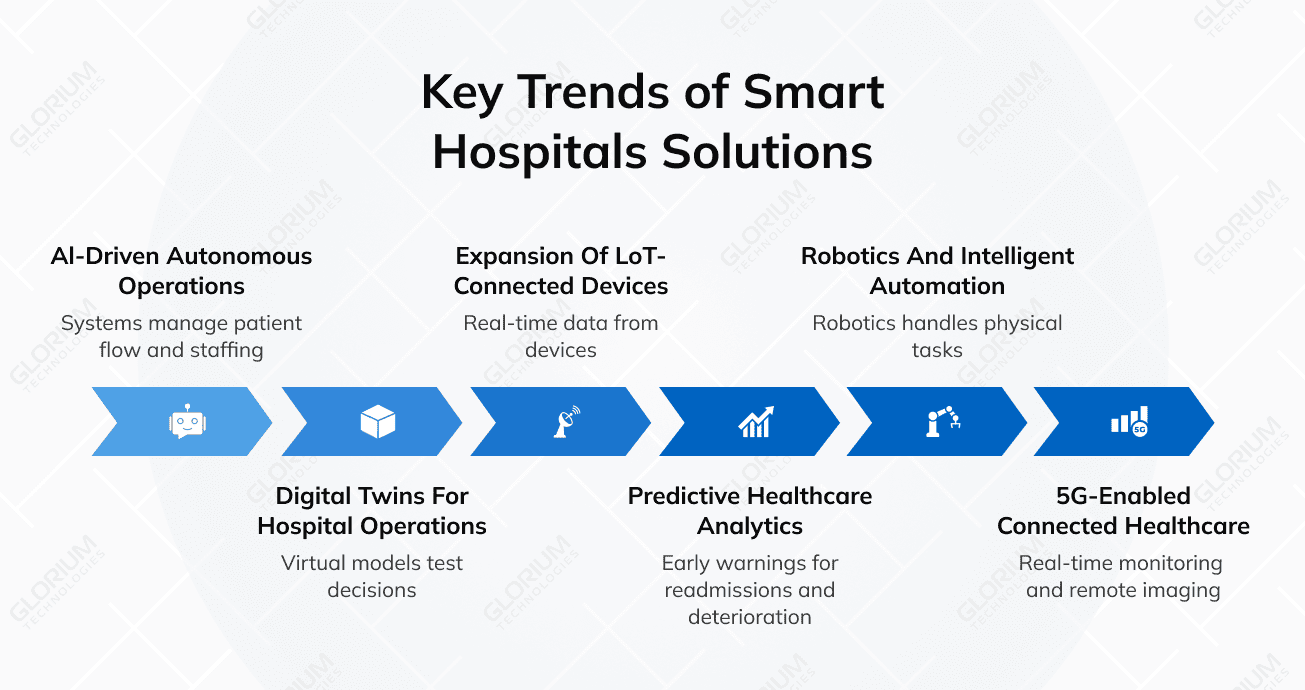
Smart hospitals are steadily moving toward fully connected healthcare ecosystems, where every system feeds the next. The trends below build on foundations many hospitals are already laying, and each depends on clean medical data moving between existing systems.
Instead of only flagging bottlenecks, systems will automatically manage patient flow, staffing levels, and supply orders based on real-time data. Agentic AI, which can plan and carry out multistep tasks, is beginning to handle work like scheduling follow-ups and ordering labs across EHR systems. The practical value is fewer manual handoffs and faster response when conditions change on the floor.
A digital twin is a live virtual model of the hospital, fed by data from its physical assets and clinical systems. Leaders can test a decision, such as reallocating beds or adjusting an operating room schedule, in the model before applying it in the real building. That lowers the risk of costly missteps and gives operations teams a safe place to plan for surges, staffing gaps, or equipment downtime.
The Internet of Medical Things keeps growing, with more monitors, pumps, wearables, and tracked assets feeding continuous data into clinical and business systems. The direct benefit is broader visibility: care teams see patient vitals and equipment status in real time, and the same data streams power the analytics and automation layers above them. Growth here also raises the stakes on security, since every device is one more endpoint to protect.
Predictive models turn accumulated clinical and operational data into early warnings. They anticipate readmissions, patient deterioration, and demand spikes before those events fully unfold, which lets teams intervene sooner and plan capacity with more confidence. As models trained on hospital-specific data mature, their forecasts grow more accurate and better tailored to each facility’s patient population.
Robotics handles the physical and repetitive side of hospital work. Pharmacy automation fills and checks medications with fewer errors, while robotic process automation clears digital backlogs like claims processing and eligibility checks. The result is less time spent on routine and repetitive tasks and more clinician time returned to patients. Adoption tends to start in high-volume, rules-based workflows where accuracy and speed matter most.
Faster, more reliable connectivity extends the smart hospital beyond its own walls. 5G supports real-time monitoring for patients at home, high-bandwidth uses like remote imaging review, and dependable links between distributed sites. For health systems that span several locations, that connectivity is what makes a single, coordinated care model workable.
The through-line across all of these is digital integration. Each advance depends on data moving freely between existing systems, which is why hospitals that invest in a strong integration foundation now will adopt future capabilities faster than those still stitching point solutions together.
Glorium Technologies has spent more than 15 years building software for healthcare providers, startups, and technology companies, with deep experience across EMR and EHR systems, hospital management platforms, telemedicine, and connected medical devices. That background matters for smart hospital projects, where the real work is integrating clinical and business systems while meeting standards like HIPAA, GDPR, HITECH, FHIR, and HL7.
Our teams have delivered connected healthcare products that turn fragmented data into unified, usable systems, from an IoT platform with machine learning for medical device monitoring to hospital management and medical billing software built to integrate cleanly with existing EMR and EHR tools.
Planning a smart hospital initiative and need it built to integrate cleanly and stay compliant? Contact us, and we will map your integration priorities alongside the build.
Timelines depend on scope and the state of your existing systems. A single integrated module, such as patient monitoring tied into your EHR, can take a few months, while a facility-wide connected environment is a phased program that runs over a year or more. Hospital management software builds alone typically range from 8 to 24 weeks per phase, so most organizations sequence rollouts by priority rather than attempting everything at once.
In most cases, yes. Modern integration relies on interoperability standards like FHIR and HL7, which let new tools exchange data with an existing EHR rather than forcing a rip-and-replace. Keeping your current system of record and connecting around it is often the faster and lower-risk path.
Track a small set of metrics tied to your goals: documentation time per clinician, average length of stay, readmission rate, staff overtime, and administrative cost per case. Establish a baseline before launch, then compare after each phase. Because smart hospital gains show up across both clinical outcomes and operational efficiency, ROI is usually a blend of quality improvement and cost reduction rather than a single number.
Start where the friction is highest, and the data is cleanest. Emergency departments, ICUs, and inpatient units tend to see fast value from patient monitoring and documentation tools because the volume of routine tasks is high. A focused first project also builds staff trust before you scale across the facility.
Security has to be designed in. That means encryption in transit and at rest, role-based access control, continuous monitoring, and compliance with frameworks such as HIPAA, GDPR, and HITECH from the start. Working with a technology partner experienced in healthcare data privacy reduces the risk that integration widens your exposure.
They do, often with a shorter path to value. Smaller facilities usually run fewer legacy systems, which makes integration simpler, and can target high-impact areas like scheduling automation, remote patient monitoring, or clinical documentation without a large upfront program. A connected approach to facilities management, covering equipment status and room readiness, delivers quick wins without a large program. The model scales down as well as up.