







AI Solutions in Healthcare: How Intelligent Systems Are Reshaping Patient Care in 2026
Updated July 9, 2026

 Summarize in ChatGPT
 Summarize in ChatGPT
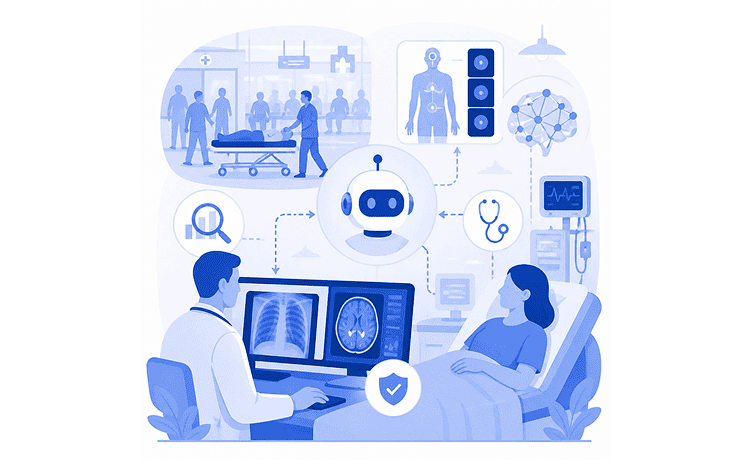
A radiologist starts the morning shift with 600 images waiting for review, and a backlog that grew overnight while the on-call team was handling emergencies. A few years ago, every scan needed a human pass before anything could move. Now an AI algorithm has already flagged three cases that look time-sensitive, pushed them to the top of the priority list, and left a short note on each. The radiologist still needs to make the call, but the worklist now arrives sorted by urgency.
That shift, from raw volume to triaged priority, captures what AI solutions in healthcare actually do in 2026. They reshape the work around the clinician so that attention lands where it matters. Across health systems, hospitals, payers, and digital health startups, artificial intelligence has moved out of the pilot phase and into daily clinical workflows.
The momentum shows up in the numbers. McKinsey has tracked generative AI use among U.S. healthcare leaders since 2023. Adoption rose from 25% of organizations in late 2023 to 47% in 2024, then reached 50% by the end of 2025. In the latest round, every respondent said they planned to pursue the technology. On the market side, Grand View Research valued the global AI in healthcare market at $36.67 billion in 2025, on track to reach $505.59 billion by 2033, at a 38.9% compound annual growth rate. The direction is clear: AI technology is becoming infrastructure.
Content
Before mapping individual use cases, you might be interested in what healthcare organizations are actually buying when they invest in AI solutions. The value tends to cluster in a few areas, and most real deployments touch more than one at once. The table below summarizes the core gains and where they show up day-to-day.
| Benefit | What It Looks Like in Practice |
| Improved diagnostic accuracy | Image analysis models catch subtle findings on scans that a tired human eye may pass over, supporting earlier detection |
| Faster treatment decisions | Clinical decision support surfaces relevant history, guidelines, and risk scores at the point of care |
| Reduced operational costs | Automation handles coding, scheduling, and prior authorizations that once consumed staff hours |
| Enhanced patient experience | Chatbots and voice agents handle intake, reminders, and triage without long hold times |
| Better resource utilization | Predictive analytics forecast admissions and staffing so that capacity matches demand |
| Increased healthcare accessibility | Remote monitoring and telehealth extend specialist reach into underserved communities |
Each of these benefits depends on the same foundation: clean, well-governed data and tools that fit into existing EHR systems rather than sitting beside them. When AI is seamlessly integrated into the systems clinicians already use, adoption follows. When it is bolted on, it gathers dust. The benefit that ties the rest together is time: every minute AI returns to a clinician is a minute redirected toward judgment, communication, and the parts of medicine that still require a human.
The strongest healthcare AI deployments tend to solve a narrow, well-defined problem before expanding. The sections below cover the areas where adoption is deepest, moving from diagnosis through operations to research. Each one is already in production somewhere, not on a roadmap slide. What unites them is a design choice: the AI runs in the background while the clinician stays in front of the patient.
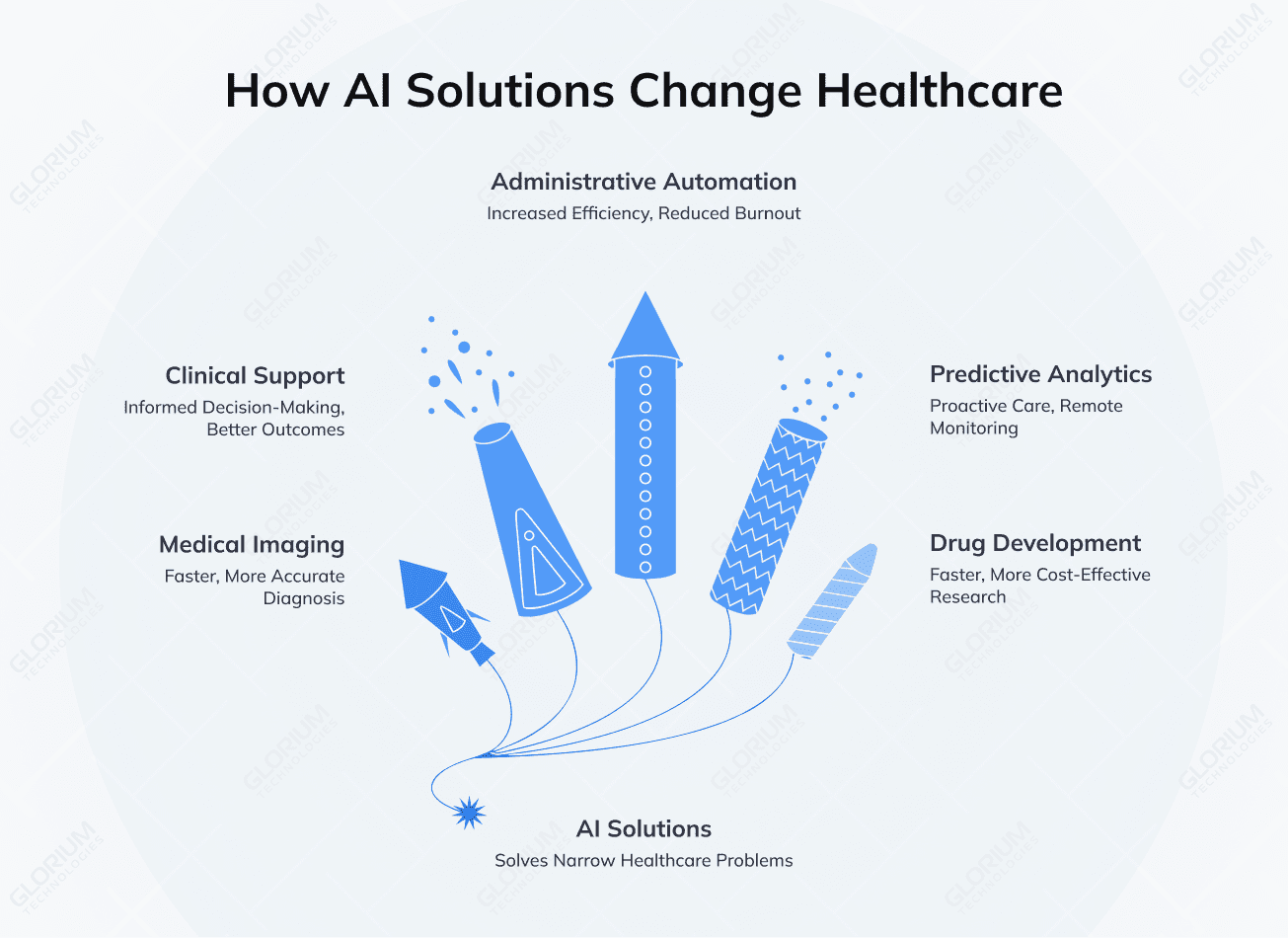
Medical exams generate a flood of medical images, from MRI and CT to ultrasound and pathology slides, and each one is critical to an accurate diagnosis. This is where computer vision earns its keep. Convolutional neural networks trained on large datasets perform image recognition at a scale no team of human radiologists could match, scanning thousands of studies and flagging anomalies that may sit below the threshold of the human eye. The point is not to remove the specialist. It is to route urgent cases first and give care providers a second set of eyes.
Wondering how it looks in real life? Recently, Glorium Technologies has built an AI ophthalmological measurement system that uses computer-vision segmentation to measure the eyelids, iris, and sclera from a patient’s own device. It lets proptosis patients run accurate assessments from home, cutting pre-surgery hospital visits and supporting real-time post-surgery checks.
Beyond imaging, generative AI now reads clinical notes, synthesizes historical and real-time records, and helps create personalized treatment plans. Using natural language processing, these systems cross-reference findings against past scans, clinical trials, and guidelines, turning scattered data into interventional insights that a physician can act on. The result is informed decision-making that keeps the clinician in control while cutting the time spent hunting for context. Done well, this directly helps improve patient outcomes because the right information reaches the care teams at the right moment.
A vivid example comes from sepsis detection. Sepsis is one of the leading causes of in-hospital death in the U.S., and its early signs are easy to miss when a patient presents with something that looks like a different emergency. At the Cleveland Clinic, an AI model watches incoming vitals such as heart rate, temperature, and oxygen and quietly checks whether the pattern fits sepsis while the physician focuses on the patient in front of them. The health system reported over 30,000 sepsis cases and roughly 2,000 deaths across its network in a single year, with its sepsis program credited for cutting those deaths by hundreds annually. That is AI-powered support working exactly as intended: a quiet pattern-checker running in parallel with human attention.
That framing, AI as a partner to clinical decision making rather than a substitute for it, runs through nearly every credible deployment. The Cleveland Clinic is also preparing to test a neurological model trained not on text but on electrical brainwaves, aiming to recognize seizure patterns within seconds, far faster than continuous human monitoring of dozens of EEG feeds can manage. Even there, the model advises, and the neurologist decides.
Some of the clearest returns come from the least glamorous administrative workflows. Coding, claims, scheduling, and prior authorizations are repetitive tasks that drain clinician time and lead to burnout. McKinsey found that administrative efficiency is the most-cited (87%) area where gen AI and multi-agent workflows hold the greatest near-term potential, with 58% saying the same about clinical productivity.
Automating this manual work lifts operational efficiency and frees healthcare professionals to spend more time on patient care instead of paperwork. For many hospitals, this is the use case that pays for the rest.
Predictive models built on big data forecast deterioration, readmission risk, and capacity needs before they become emergencies. Paired with wearables, they send push alerts to care providers when a chronic patient’s metrics drift, which matters most for those far from a hospital. Biofourmis, for example, uses AI for remote monitoring that delivers real-time health analytics for chronic conditions. This is where AI-powered tooling extends reach into underserved communities and supports health equity rather than widening the gap. A patient in a rural county gains access to the kind of continuous oversight that used to require physical proximity to a specialist.
Bringing a therapy to market costs billions and takes years. AI compresses both. By spotting patterns in real-world evidence and molecular data, models identify promising drug candidates and predict effectiveness before expensive clinical trials begin. Surfacing new drug candidates earlier shortens drug development timelines and raises the odds that a treatment reaches patients faster. The same analytical engine that reads a scan can read a research corpus, which is why pharmaceutical companies now sit alongside hospitals in the healthcare ecosystem, adopting these AI solutions.
“Use artificial intelligence to complement human intelligence, and human intelligence to make the final decision.”
Dr. Ayman Najm, Cleveland Clinic Epilepsy Center, NBC News, “How AI is transforming healthcare”
The use cases above answer the what. The why comes down to pressures that have been building across the healthcare ecosystem for a decade. Most organizations are responding to structural strain that existing staffing and budgets cannot absorb.
Adoption is real, but so is friction. McKinsey’s 2025 tech trends work found that only 1% of organizations describe their AI adoption as fully mature, with many stuck between pilot and scale. This gap usually traces back to a handful of obstacles that are often the root causes of failed projects.
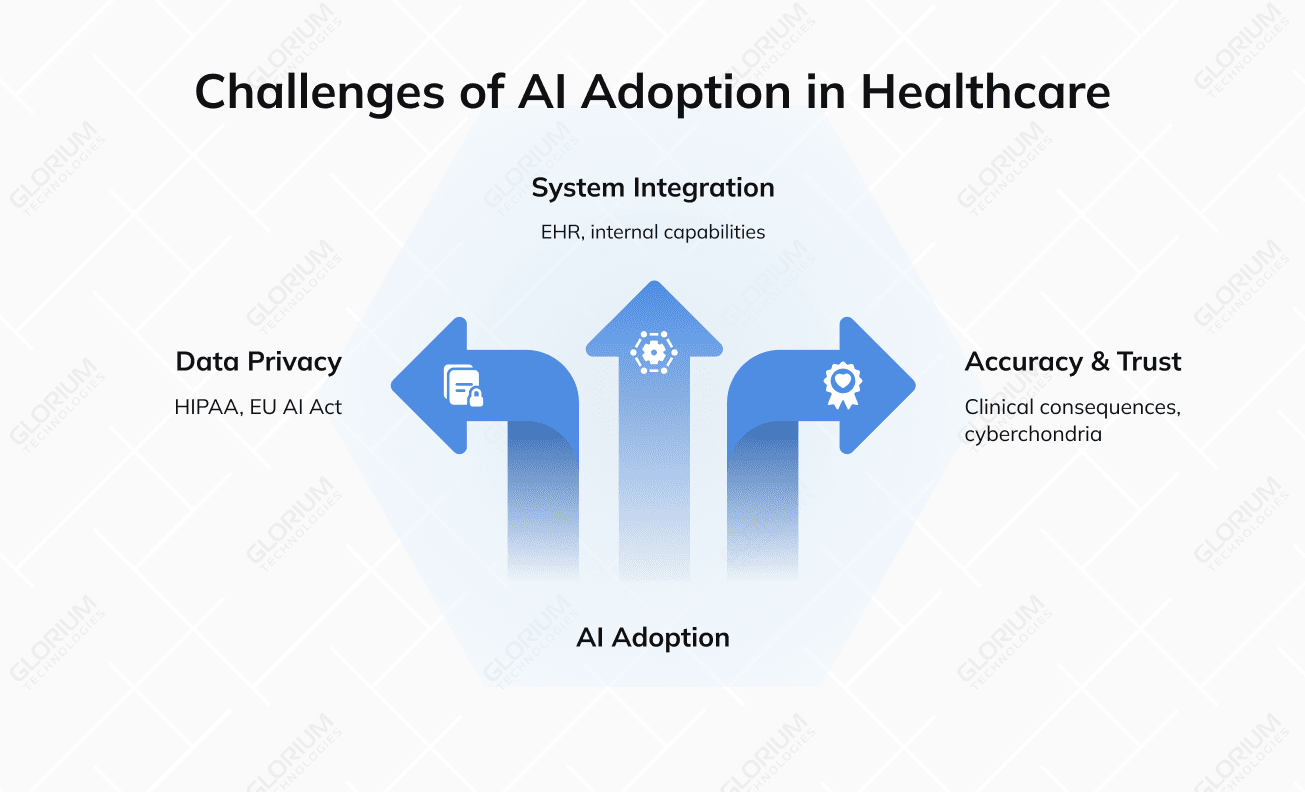
Patient records are among the most sensitive data anywhere, and any tool that manages them must meet HIPAA in the U.S. and the EU AI Act in Europe. Anonymization, encryption, and access controls are non-negotiable, and cyberattacks on the sector keep rising. Vendors increasingly train models on synthetic data so they can learn patterns without exposing real records.
McKinsey’s leaders cite integrating AI into existing healthcare systems and a shortage of internal capabilities as the top barriers to scaling. A model that cannot read the EHR is a science project, not a solution, which is why integration work usually consumes more of a project timeline than the data science does.
Inaccurate predictions carry clinical consequences, so AI needs human oversight and clear explainability. There is also a behavioral risk worth watching: as more people turn to AI for self-diagnosis, experts warn of a new wave of health anxiety, sometimes called cyberchondria. High implementation costs and adoption barriers among clinicians who do not trust a black box round out the list. The fix is rarely more technology; it is better governance and change management.
For more than 15 years, Glorium Technologies has been building healthcare software where compliance, accuracy, and clinical fit are treated as requirements rather than afterthoughts. We combine deep domain knowledge with AI development services that account for HIPAA, legacy EHR systems, and the clinical workflows your staff already depend on.
Whether you are validating an idea or scaling a deployment across multiple health systems, we can help you move from concept to a product that earns clinician trust and improves outcomes. Contact us to map your first or next AI initiative.
Timelines vary with scope and data readiness. A focused tool, such as an imaging triage assistant on clean datasets, can reach a working pilot in a few months. Enterprise rollouts that integrate with multiple EHR systems and clear regulatory review typically run a year or more, with most of that time spent on integration and validation rather than model building.
It depends on the intended use. Software that diagnoses, drives treatment decisions, or functions as a medical device usually falls under FDA oversight in the U.S., while purely administrative tools often do not. Some surgical navigation tools, for instance, are already FDA-approved and in active use. Mapping your product to the right regulatory class early saves expensive rework later.
Cloud-based and subscription models have lowered the entry point considerably. Smaller practices normally adopt narrow AI tools, such as documentation assistants or scheduling automation, as they pay off through saved staff hours.
Trust grows from transparency and workflow fit. Clinicians adopt a system faster when it shows why a case was flagged, leaves the final decision to them, and presents its insights within the tools they already use. Involving care teams during design, not after launch, is the single most reliable predictor of uptake.
You need a few things at the start: a representative, well-labeled dataset for the task at hand, and a clear sense of where that data actually sits. Many projects begin with a data audit because the quality and accessibility of your records, not the sophistication of the model, usually determine how fast you can move.