







AI for Mental Health: How Smart Tools Are Reshaping Care in 2026
Updated July 31, 2026

 Summarize in ChatGPT
 Summarize in ChatGPT
Far more people need help with their mental health than the healthcare system can reach. Long waitlists, steep costs, and too few clinicians leave millions without timely support. That pressure is why technology companies, hospitals, and startups have turned to artificial intelligence, and to generative AI in particular, to widen access to care and improve the ability to support more people at scale.
World Health Organization data published in 2025 shows there are only about 13 mental health workers per 100,000 people globally, with even fewer in many low- and middle-income countries. This limited capacity leaves large gaps in access to care, driving interest in AI tools that can provide support and ease pressure on clinical services.
Let’s explore the common use cases of AI in mental health, its benefits, challenges, and future trends to watch.
“Our field hasn’t had a great deal of innovation since the basic architecture was laid down by Freud in the 1890s. That’s not how we live our lives today. We have to modernize psychotherapy.”
Alison Darcy, founder of Woebot Health
Content
Independent research firms pegged the global AI in mental health market between USD 1.7 and 1.82 billion in 2025. Grand View Research projects the market to reach USD 9.12 billion by 2033 (23.3% CAGR), while Mordor Intelligence estimates it will approach USD 10 billion by 2031.
A 2025 RAND survey found that 19.2% of US adolescents and young adults, roughly 8.2 million people, had used an AI chatbot for mental health advice, up from 13.1% the year before, and 91.7% called it helpful. That surge tracks the rise of large language models. With about 85% of people who have a condition still untreated, per AllAboutAI, AI is filling a gap that the old model never could.
AI could help patients all along the care journey, from a late-night chat to the notes a psychiatrist reads the next morning. The use cases below are sorted by who they help and what they fix.
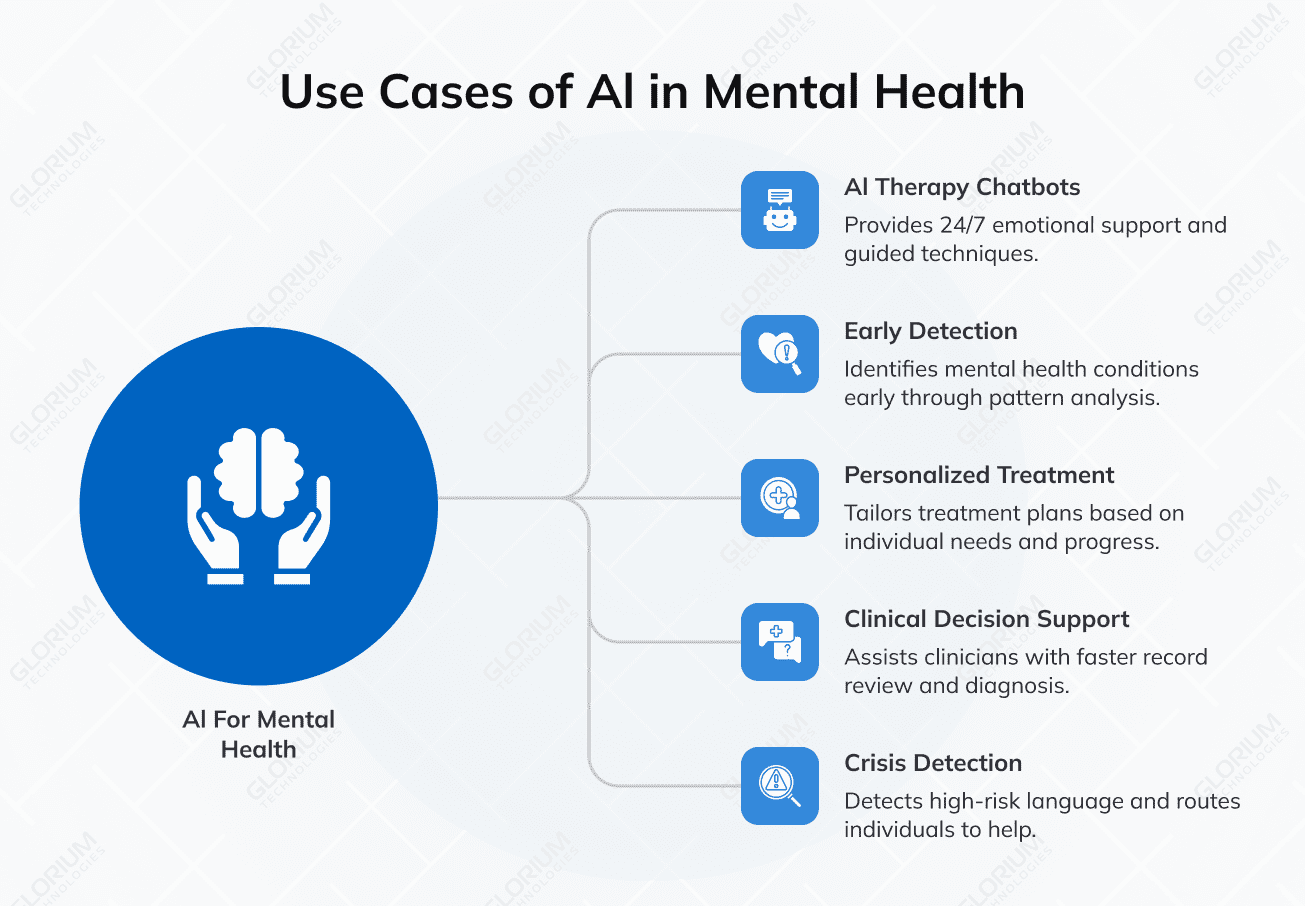
The AI chatbot makes for a virtual place many people go to for mental health support whenever they need it, often as a first step before or between sessions with a mental health professional. For anyone juggling everyday stress management, anxiety, or low mood, being able to reach out at any hour is the whole point. The benefits that AI therapy chatbots provide:
A 2025 randomized controlled trial at NEJM AI tracked adults using a clinically validated therapy chatbot. Participants reported meaningful reductions in symptoms and rated their therapeutic alliance with the bot as comparable to that with a human therapist. While studies of this rigor are still rare and not definitive, the results suggest that well-designed AI tools may offer real support for mental health conditions.
That said, an AI companion is no substitute for human relationships. For young people especially, it works best as a low-pressure entry point to therapy. The therapeutic relationship still rests on a real person, and the best products reinforce that rather than replace it.
Subtle changes in sleep, mood, or how someone handles their job, education, and everyday routines can surface before a person notices them. AI models read speech, text, and behavior, catching warning signs of mental illness that a rushed clinic visit tends to miss, which lets a clinician step in sooner. Quality depends entirely on the inputs, so the datasets for training AI in mental health and the clinical expertise behind them matter more than the algorithm itself. The main ways it helps:
People are not interchangeable, and their care should not be either. This is where AI earns its keep. As a digital tool for ongoing emotional wellness, it shapes recommendations around the individual and keeps adjusting as fresh data lands, a real advantage in remote or long-term care. Here is where that helps most:
AI does not need to replace clinicians to earn its place. As a decision-support layer, it hands therapists and psychiatrists deeper insights into a patient’s history and progress, so their time goes where it counts. A few ways it lightens the load:
Clinical decision support becomes most powerful when it is embedded into real care workflows. One example is TurtleHealth. The client offered at-home fertility testing, and we built the full platform across portals for patients, doctors, and admins. We automated the remote flow: a patient fills out the health intake online, and a special ultrasound device is mailed to their home for self-testing. We then built a rules engine that pulls every input together into a fertility report for a clinician to validate. As a result, operational speed increased by two times.
This is the highest-stakes use case, and the one needing the most caution. In crisis care, AI can scan conversations for high-risk language, including signs of self-harm or substance use, and route someone to human help fast. It is a safety net, never the decision-maker. Here is how that plays out:
Most AI mental health tools fall into one of three categories: general-purpose chatbots that offer emotional support without a clinical claim, clinically grounded tools tested in peer-reviewed trials, and decision-support platforms built for the clinical workflow. The table below covers the tools that come up most often in each category.
| Tool | Category | What it does | Clinical evidence |
| Woebot | Clinically grounded chatbot | CBT-based conversational support; consumer app retired June 2025, now enterprise-only through partner organizations | Multiple RCTs on depression and anxiety reduction |
| Therabot | Clinically grounded chatbot (research stage) | Structured, clinician-reviewed therapy conversations; developed at Dartmouth | 2025 NEJM AI trial: 51% average reduction in depression symptoms |
| Wysa | Clinically grounded chatbot | CBT, DBT, and mindfulness exercises, with escalation to human support | NHS pilot programs; peer-reviewed evidence on anxiety |
| Spring Health | Clinical decision support | Matches employees to care pathways; used by employers and insurers | Published efficacy data focused on time-to-treatment reduction |
| Headspace Care | Digital mental health platform | Coaching and therapy routed algorithmically to human clinicians; enterprise benefit (formerly Ginger) | Company-reported engagement gains over traditional EAP programs |
| Ash | Consumer chatbot | General emotional support with no clinical claim | Not clinically validated |
The distinction between clinically grounded tools and general support matters when building a product. A general support chatbot sits largely outside FDA regulation. One that claims to assess, diagnose, or treat a condition moves into Software as a Medical Device territory, with the requirements that come with it. That line is worth drawing early in any product brief.
Used responsibly, AI closes the gap between those who need care and those who can get it, while keeping human connection at the center. The potential benefits are clear:
None of those benefits cancels the risks. Mental health is high-stakes, so these challenges are design requirements:
One more worry deserves its own mention. Lean on chatbots too heavily, with no oversight, and they can reinforce delusional thinking in vulnerable users, a pattern sometimes called AI psychosis. The potential harm is real, which is why responsible use matters. The strongest studies all point the same way: AI does best with clinical validation and a human in the loop, with real people owning the high-risk calls. It is not a stand-in for a therapist.
The rules that apply to an AI mental health product depend almost entirely on what it claims to do. A wellness chatbot that helps someone breathe through a stressful moment sits in a different category from a tool that tells a clinician a patient is at high risk of relapse. Getting the classification right at the start shapes the whole product roadmap.
In the United States, the FDA regulates AI tools that make a clinical claim (diagnosis, treatment recommendation, or risk assessment) as software as a medical device. General wellness tools that offer support without a medical claim usually sit outside this framework, though the line is easy to cross. In January 2025, the FDA issued comprehensive draft guidance on AI-enabled device software functions covering lifecycle management and marketing submissions, building on its Good Machine Learning Practice principles and its 2024 final guidance on predetermined change control plans.
In the European Union, AI systems used in health care for diagnosis, prognosis, or treatment recommendations are classified as high-risk under the EU AI Act, which entered into force in 2024. The Act’s obligations phase in over several years, with high-risk requirements landing around 2026 and 2027, and the schedule is still being revised by the Commission. High-risk systems require a conformity assessment before deployment, ongoing monitoring, and human oversight. A mental health AI product intended for any EU market should be designed for these rules from the first sprint rather than retrofitted after launch.
Any AI system that processes protected health information (session notes, diagnostic history, intake data) falls under HIPAA’s requirements for security, access control, and breach notification. This applies whether the AI is a standalone product or a layer inside a larger clinical platform.
The common thread across all three frameworks is human oversight. Each one requires that a qualified person remain accountable for the high-stakes calls, regardless of the AI’s role. Building that oversight in early is both a compliance requirement and the right design choice.
AI for mental health is heading toward systems that read more context and stay with the patient over time. Each trend builds on the last, and the numbers show how fast it is moving.
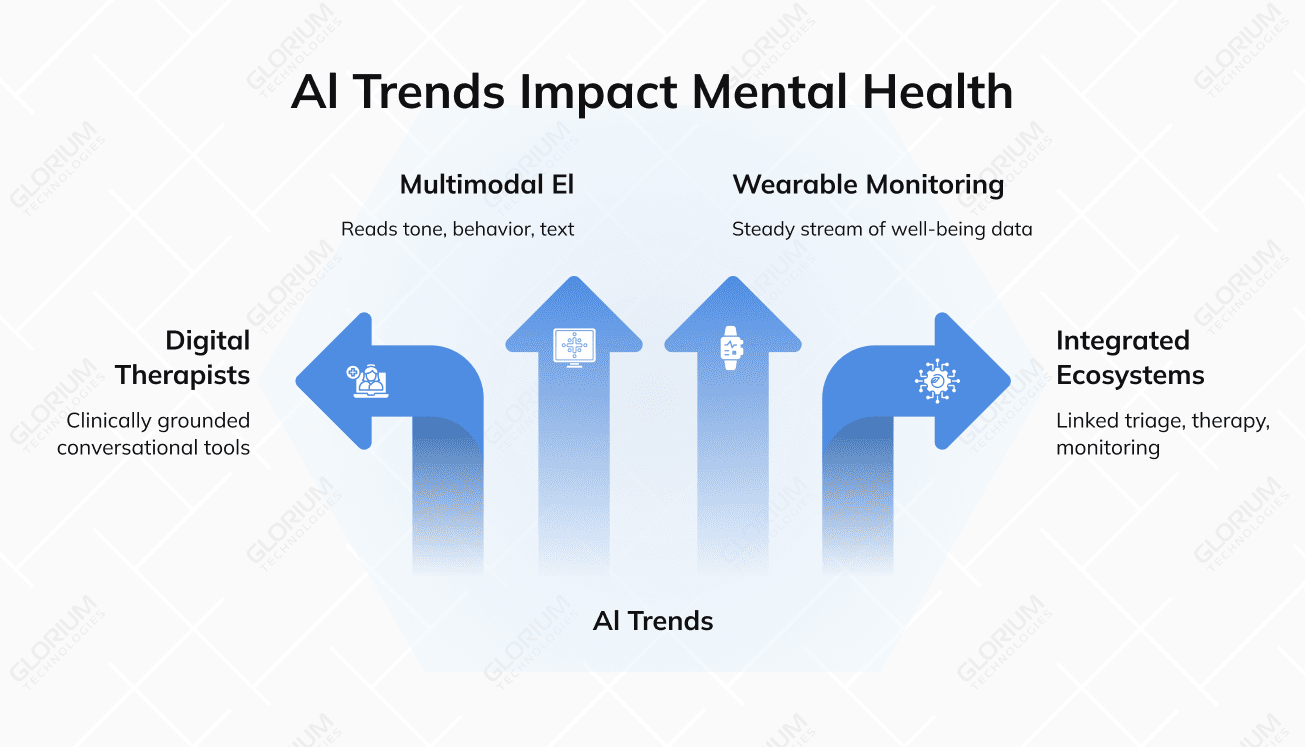
Conversational tools are moving past generic chat toward therapy with real clinical grounding. That matters because clinicians and regulators trust evidence.
Dartmouth’s Therabot is the example people keep citing. Its 2025 NEJM AI trial reported a 51% average drop in depression symptoms and a 31% drop in anxiety symptoms, and users trusted it nearly as much as a human therapist. Tools like this lean on expert-curated clinical data, not whatever sits on the open internet, and more are on the way.
The next wave reads more than words. These AI systems listen to tone, weigh what someone types, and watch behavior to gauge how a person is really doing. The results are promising. A 2025 study paired biometric and acoustic data and reached 89% accuracy in flagging early signs of symptom exacerbation. Another model spotted depressive episodes with 91% accuracy. Pulling several channels together is fast becoming the norm.
Smartwatches, rings, and fitness bands have quietly changed monitoring. Instead of a check-in every few weeks, emotional well-being becomes a steady stream of data, always on in the background.
Heart rate variability, sleep, and regular activities give a model concrete signals. A 2026 umbrella review found AI tools could detect depression, anxiety, and suicidal ideation with diagnostic accuracy between 78% and 92%, and a 2025 study predicted depressive episodes with 91% accuracy. For someone at relapse risk, that signal is valuable, though the reviews are blunt about the bias and privacy issues still unsolved.
Standalone apps are losing ground to connected platforms that link triage, therapy, monitoring, and clinician tools, pushed by both budgets and clinical reality.
Most demand sits where the systems already run. Hospitals and clinics drove about 49% of the market in 2025, and employer programs now reach roughly 17 million lives through integrated suites. Buyers are tired of juggling disconnected tools and want one system that talks to itself.
Building software for mental health demands clinical awareness, strict data protection, and a real grasp of how patients and providers behave. Glorium Technologies brings deep healthcare specialization to this work, from AI software development and AI consulting to full healthcare software engineering. We have shipped telemedicine platforms, patient portals, and clinical systems that treat sensitive data with care, whether you are testing an idea as an MVP or scaling with a dedicated development team.
If you are ready to explore what an AI mental health product could look like, contact us for a short introduction call. We will help you scope the right approach, timeline, and safeguards your users deserve.
It depends on what the tool claims to do. A wellness chatbot offering general support usually sits outside strict medical-device rules, while a tool that diagnoses or treats a condition may fall under the FDA’s jurisdiction. The safest path is to define the clinical claim early and design compliance around it from day one.
High-quality models rely on a carefully curated knowledge base, often professionally written therapist-patient dialogues, and clinically reviewed content rather than scraped internet text. Quality and clinical oversight of the data matter far more than raw volume.
There are fundamental differences. A human therapist brings empathy, lived judgment, and accountability, while an AI tool offers scale, availability, and consistent responses. The biggest gap is scientific validation: few tools have been tested in formal trials, so a clinically validated product carries far more weight than an unproven app marketed as therapy.
A responsible tool detects high-risk language and immediately points the person toward human help, such as a crisis line or emergency services, rather than managing a mental health crisis alone. Clear escalation paths and human review are essential safety features when providing mental health care at scale.
Increasingly, yes. Cloud-based platforms and modular tools lower the upfront cost, and AI that cuts documentation time can pay for itself in recovered clinician hours. Starting with one narrow, well-defined use case keeps the investment and the risk contained.