







Machine Learning for Manufacturing: From Sensor Data to Smarter Production
Updated July 21, 2026

 Summarize in ChatGPT
 Summarize in ChatGPT
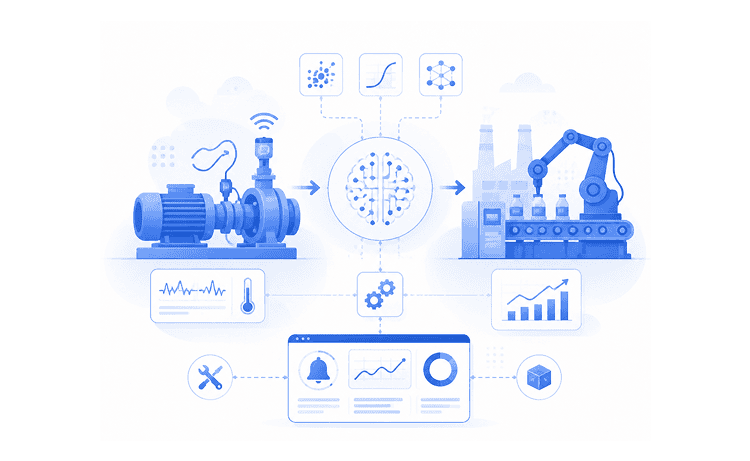
Ask any plant manager about their worst weeks and a familiar story comes up. A critical pump sounds perfectly fine on Monday, and by Friday the line has stopped, and a six-figure order is shipping late. Machine learning in manufacturing exists to close that gap, reading the vibration and temperature data your equipment already produces and turning it into a warning that arrives days before the failure does.
The appeal for most manufacturers is refreshingly practical. You get fewer surprises on the floor, and the resulting output is steadier because decisions are based on production data.
Content
Machine learning is a branch of artificial intelligence that learns patterns directly from data rather than from hand-written rules. In a factory, that data comes from PLCs, IoT sensors, quality logs, and ERP records. The manufacturing machine learning model studies those inputs to spot what a person would miss, then predicts an outcome such as a coming breakdown or a defect risk.
Older factory software relied on thresholds. If a temperature crossed a set line, an alarm fired. That works for simple cases and breaks down fast once a process has dozens of interacting variables. Machine learning models handle that complexity by learning the shape of the data itself, which is why they hold up on the edge cases where rule-based systems tend to fail.
The shift also changes who can build these tools. Early neural network projects demanded a specialist and weeks of tuning. Today, well-documented libraries such as PyTorch and scikit-learn put supervised and unsupervised methods within reach of a capable engineering team, so the bottleneck has moved from algorithms to data readiness and clear problem definition.
Long before large language models arrived, three types of machine learning algorithms did the heavy lifting in industry, and they still do. Each answers a different question about your production processes.
The table below shows where each one fits.
| Model type | What it needs | Best manufacturing use | Main limitation |
| Expert systems | Human-coded rules | Simple, well-understood checks | Becomes brittle at scale |
| Unsupervised learning | Unlabeled data | Anomaly detection, segmentation | Flags a problem without explaining it |
| Supervised learning | Labeled input-output data | Process modeling, failure prediction | Needs quality training data |
Supervised learning, often built on neural networks, is the workhorse for advanced process modeling because it handles highly nonlinear input-output relationships. Unsupervised methods earn their place when you have a messy pile of manufacturing data and want to know where the outliers hide.
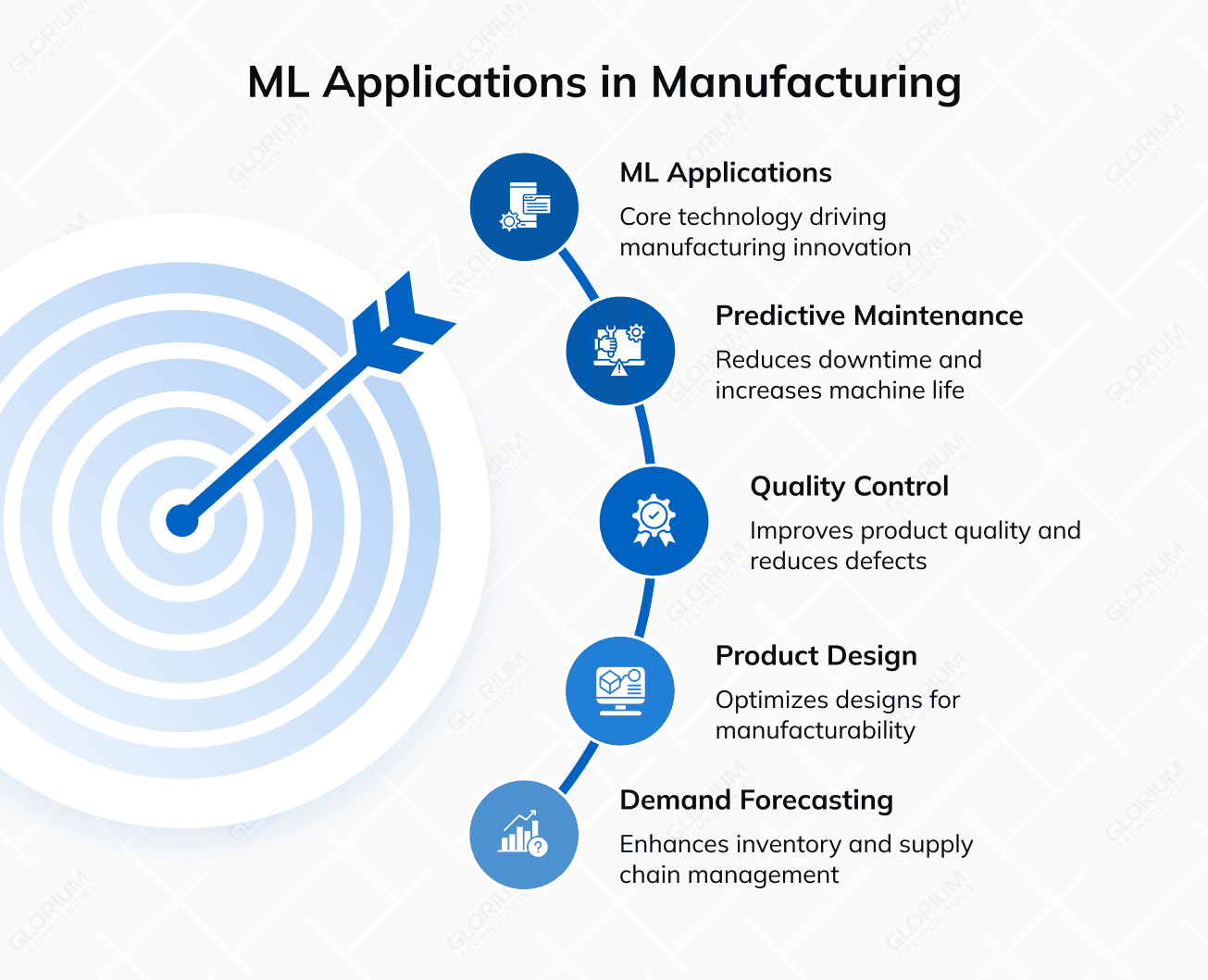
The strongest returns cluster around a handful of use cases. Each one starts with data you likely already collect and ends with a decision you can act on the same shift.
Predictive maintenance is the clearest win for most manufacturing companies. ML models learn the normal signature of a motor, pump, or spindle from historical data and real-time data, then flag the subtle drift that precedes a fault.
Deloitte estimates that unplanned downtime costs industrial manufacturers roughly $50 billion a year. Predicting equipment failures a few days out lets a maintenance team order the right part and schedule the fix during a planned window, so the production line keeps running.
The mechanism is straightforward once the data is in place. Vibration and acoustic readings carry early signatures of wear that a human ear or a fixed alarm threshold misses. A trained model compares live readings against thousands of past cycles and raises a flag when the signature starts to drift, often giving days of notice on a gradually degrading motor or bearing. That lead time is the whole point, since it converts a chaotic emergency stop into a planned, low-cost intervention during a scheduled window.
Machine learning sharpens quality control by pairing computer vision with defect data. Cameras capture every unit on the line, and a trained model spots microscopic flaws faster and more consistently than a tired inspector at hour seven. Automated inspection also removes the human error and subjective judgment that creep into manual checks, and the same models run 24/7 to keep production flow and inspection cycles steady around the clock.
Beyond catching bad parts, these ML systems feed root cause analysis. When a defect pattern appears, the model can point to the upstream setting that changed, turning a week of investigation into a shift. The gains on product quality can be large: at a Dana axle plant, machine learning that flagged the assembly signals driving failures cut axle rework rates by 65%, according to the vendor Acerta that ran the deployment. Over time, the same data supports end-of-line testing for complex assemblies, where subtle interactions between components are hard for any manual check to catch.
Machine learning is also moving upstream into how parts get designed. Generative design uses artificial intelligence and machine learning to generate and test multiple design simulations against goals like weight, cost, and manufacturing method, surfacing options a human team would not have time to model by hand. According to Autodesk, the software explores manufacturing-ready outcomes early in the development process, which shortens iteration and helps reduce material waste. Bringing product quality and manufacturability into the picture before a prototype is cut means fewer problems reach the factory floor later.
Machine learning models read historical sales data alongside seasonality and market signals to sharpen demand forecasting. Better forecasts flow straight into inventory management and supply chain optimization, since a plant that predicts consumer demand more accurately can optimize inventory levels and reduce waste. Logistics teams also use ML algorithms to predict shipping delays and adjust routes dynamically, which trims transportation and storage costs.
The gains compound across supply chains. When a forecasting model shares its output with production scheduling, the ML system can recommend efficient run sequences that reduce changeovers and idle time. Manufacturers with volatile order patterns benefit most, because the model absorbs signals a spreadsheet cannot, from weather to regional promotions, and adjusts recommended stock levels before a shortage or a pile of excess inventory forms.
Energy is a controllable cost once you can see it clearly. ML tracks energy consumption across a manufacturing facility, and forecasts demand from historical data, then recommends settings that hold quality while cutting energy consumption. On the process optimization side, controls engineers have long known that most loops on the factory floor are simple single-input controllers running well below their potential. Machine learning solutions bring multi-variable optimization to those loops, tuning manufacturing processes to lift production efficiency and operational efficiency without new hardware.
“I’m 100% certain [large language models] will be revolutionary in the industrial space. Having said that, I’m also quick to say I’m seeing very little impact so far.”
Glenn Gardner, Beyond the Hype: Machine Learning for Manufacturing
For manufacturing companies, adopting machine learning is a capital decision with a return you can model, not a science project. The gains show up as recovered production hours, fewer scrapped parts, and lower maintenance costs.
The market reflects that momentum. Fortune Business Insights projects the AI in manufacturing market to grow from $9.85 billion in 2026 to $128.81 billion by 2034, a compound annual growth rate near 38%, with machine learning as the leading technology segment.
A phased rollout keeps risk low:
Glorium Technologies applied the approach mentioned above for a US durable medical equipment provider that needed to control inventory and delivery costs. Our team built deep learning models that drew on patient schedules and medical records, together with location and demographic data, to optimize inventory allocation and forecast expense reductions, paired with an interactive analytics dashboard. The result was lower operational costs and faster, data-driven decisions.
Machine learning rewards preparation. The barriers below are the ones the manufacturing industry hits most often, and each has a practical path through it.
Models are only as good as the data behind them. Many manufacturing companies still store readings in disconnected logs, and a large share of collected production data never gets used. The fix starts with digitizing analog measurements and investing in data governance so the ML models train on clean, well-structured inputs.
Older PLCs, SCADA setups, and MES platforms rarely speak the same language as modern analytics tools. Connecting them without disrupting live production takes careful engineering, which is where experienced custom software development earns its cost.
Finding data scientists who also understand a factory floor is hard. The people who can bridge manufacturing engineering and modeling are scarce, and hiring one onto the payroll can take months you may not have. Rather than compete for those rare hires, many manufacturers fill the gap through tech outstaffing, embedding dedicated ML engineers into their own team for the length of a project.
Connecting equipment to the network widens the attack surface, and leaders reasonably worry about both breaches and upfront spend. A staged budget, clear access controls, and a small proof of concept address both at once by proving value before the large investment. Rolling out ML solutions in phases also keeps manufacturing operations running while the case is made.
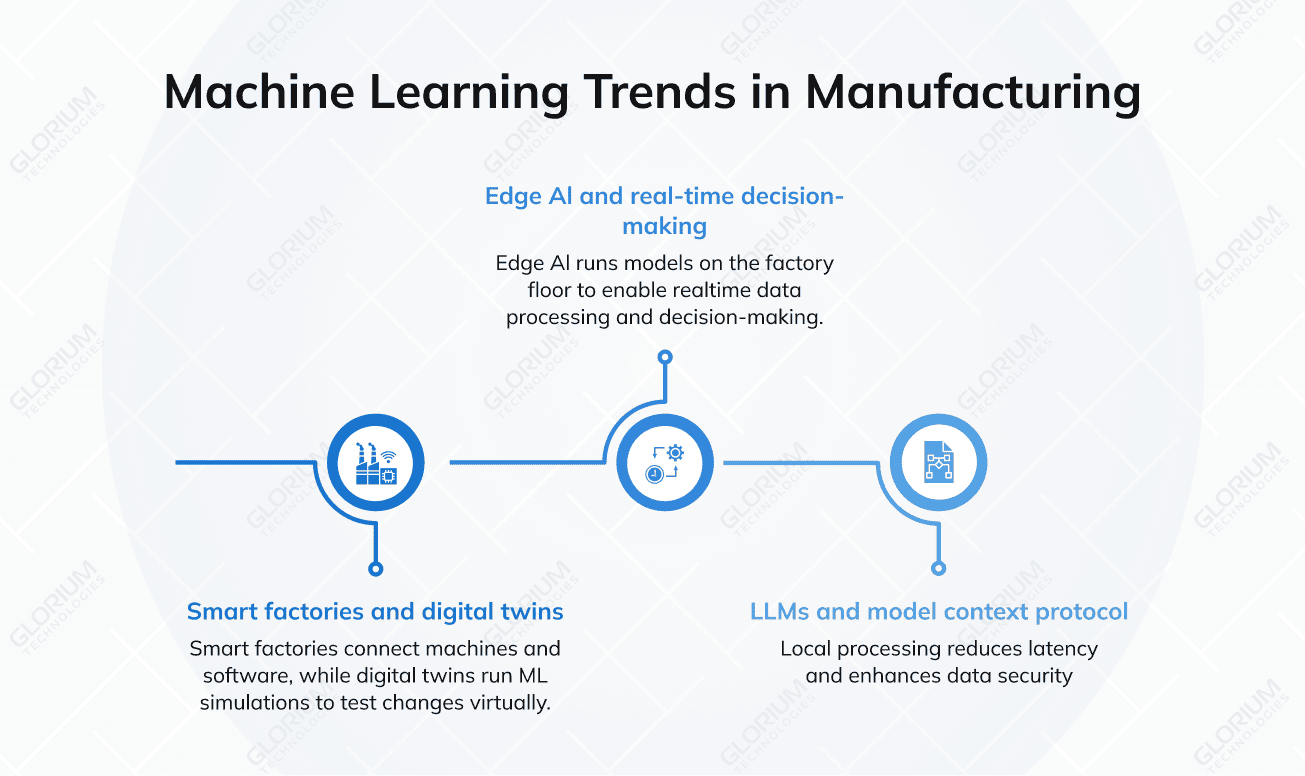
Across the manufacturing sector, machine learning is moving from standalone models toward connected systems that act on their own data. A few emerging trends show where that shift is heading.
Smart factories connect machines and software into one responsive system, and machine learning is the layer that turns that connection into action. Digital twins push this further by running ML simulations of a line so teams can test a change virtually before touching real equipment.
Sending every reading to the cloud adds delay that a fast line cannot afford. Edge AI runs models directly on the factory floor, enabling real-time data processing and real-time decision-making for repetitive tasks like inline defect rejection.
Large language models are starting to reach industrial data through the model context protocol, a standard for connecting a pretrained model to a plant’s proprietary datasets. The promise is real, though most deployments remain in early pilots while the classic ML methods keep carrying the load.
Glorium Technologies has spent 15+ years building custom software and has delivered more than 100 products across regulated, data-heavy industries, from healthcare and real estate to manufacturing. Our teams cover the full path from data science and model training through AI software development and IoT integration, backed by long-term support.
We take raw production and operational data and turn it into machine learning models that predict real, measurable outcomes. Our teams apply that approach across the use cases in this guide, from predictive maintenance and quality control through to supply chain optimization, for manufacturers who want results they can act on. When you need to move fast, dedicated ML engineers can plug into your project through tech outstaffing.
Ready to put machine learning to work on your factory floor? Contact us for a consultation and a tailored project plan.
A focused predictive maintenance or quality pilot on a single line usually needs about 90 days. That window covers instrumenting the equipment and collecting a baseline, then training the first model and gathering enough evidence to compare against past performance before you scale.
In most cases, no. Machine learning reads data from sensors and controllers you already run, and many projects add low-cost vibration or temperature sensors to older assets rather than replacing them. The heavier work is integration, not a rip-and-replace of the production line.
There is no single number, but the quality of the data matters more than raw volume. A model needs enough labeled examples to learn the pattern you care about, such as records of past equipment failures or confirmed defects. Digitizing analog logs and cleaning existing records often takes longer than the modeling itself.
The choice depends on how central ML is to your roadmap. Building a permanent team makes sense when you plan continuous, plant-wide programs. Partnering or outstaffing suits a defined project or a first pilot, since you get experienced ML engineers quickly without a long hiring cycle.
Models drift as materials, tooling, or product mix change, so they need monitoring and periodic retraining. A good deployment tracks prediction accuracy over time and refreshes the model on new data, which keeps performance steady as the process evolves.
Tie it to a specific cost you already track. For predictive maintenance, compare downtime hours and emergency repair spend before and after. For quality, measure scrap and rework rates. Setting that baseline before the pilot is what makes the return provable to a CFO.
Machine learning solutions are based on the automation you already run. On the assembly line, robots keep performing the repetitive tasks they handle well, while ML systems watch the sensor and vision data those machines produce and surface the complex tasks that need a human decision. Across manufacturing plants, that pairing lets existing PLCs and robots carry the routine work while the models add a judgment layer, so you get more value from equipment already on the floor.
Both. Alongside the statistical models that read numeric sensor streams, natural language processing can mine maintenance logs and warranty notes for recurring issues, while computer vision handles images from the line. Feeding in customer data and free-text records helps models identify patterns across large volumes of information that a numbers-only view would miss, which is part of why machine learning in manufacturing keeps widening its reach.