







Voice Recognition in Healthcare: How Speech Technology Reshapes Clinical Work in 2026
Updated September 7, 2026

 Summarize in ChatGPT
 Summarize in ChatGPT
Healthcare workers spend a striking share of their day typing rather than treating. Hours that could go toward patients are absorbed by charting, order entry, and after-hours notes. Voice recognition in healthcare has moved from a convenience feature into a core operational tool that gives some of that time back.
The global voice and speech recognition market was valued at USD 20.25 billion in 2023 and is projected to reach USD 53.67 billion by 2030, growing at a 14.6% compound annual growth rate. The healthcare sector has historically held one of the largest shares of that market. A specialized medical speech recognition software segment alone is expected to reach USD 3.17 billion by 2030, driven by EHR integration and advances in natural language processing.
Content
Voice recognition technology in the healthcare industry covers a family of tools that turn spoken language into structured, usable data. Each tool serves a different clinical purpose, so you should know how to distinguish the terms before discovering how they are applied.
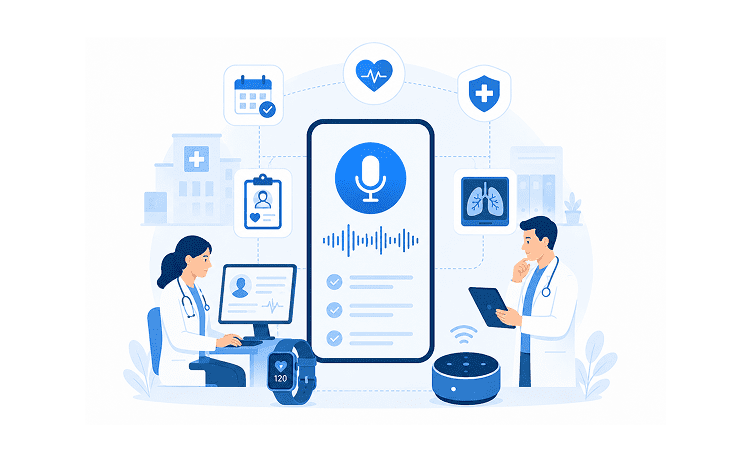
At the most basic level, speech recognition technology helps convert spoken words into written text. Layered on top of that, natural language processing and machine learning interpret meaning. So, a system can route dictated content into the right fields of a patient record rather than dropping it into a single undifferentiated block. The most advanced versions, often called ambient AI scribes, listen passively to a full clinical interaction and draft a structured note without anyone directly dictating to the machine.
“Voice recognition also enables health care providers to use voice commands within telehealth platforms. Imagine a doctor accessing patient data or scheduling appointments without needing to type or click. This hands-free interaction streamlines processes and makes virtual consultations much smoother.”
Before comparing tools, it is worth seeing how the underlying capabilities differ in practice. The table below maps each technology layer to its main healthcare use.
| Technology layer | What it does | Typical healthcare use |
| Speech recognition | Transcribes spoken words into written text | Dictating notes, voice commands in the EHR |
| Natural language processing | Interprets the meaning and structures the text | Sorting content into clinical note sections |
| AI medical scribes | Passively capture and summarize a full visit | Drafting clinical notes during patient interactions |
| Voice biometrics | Verifies identity through voice patterns | Secure access to patient data and systems |
Most modern voice recognition software blends several of these layers. A clinician might issue voice commands to navigate the EHR system while an ambient tool drafts the encounter note in the background, with voice biometrics governing who can open the record in the first place.
General-purpose dictation tools stumble on clinical language. Drug names, anatomical terms, and dosing conventions sit far outside everyday vocabulary, so medical voice recognition relies on specialized language models trained on clinical corpora.
These models learn the patterns of medical documentation, including abbreviations, specialty-specific phrasing, and the structure of a SOAP note. That training is why medical speech recognition can produce structured clinical notes that slot cleanly into patient records, while consumer voice assistants cannot.
The strongest case for voice recognition technology lies in the documentation burden that drives so much clinician frustration. Time spent in the electronic health record is one of the most-cited contributors to burnout, and recent research shows voice tools chipping away at it. For example, a trial run by UW Health and the University of Wisconsin found that ambient AI notetaking reduced time spent on clinical documentation and helped lower practitioner burnout, with results published in two parts in NEJM AI.
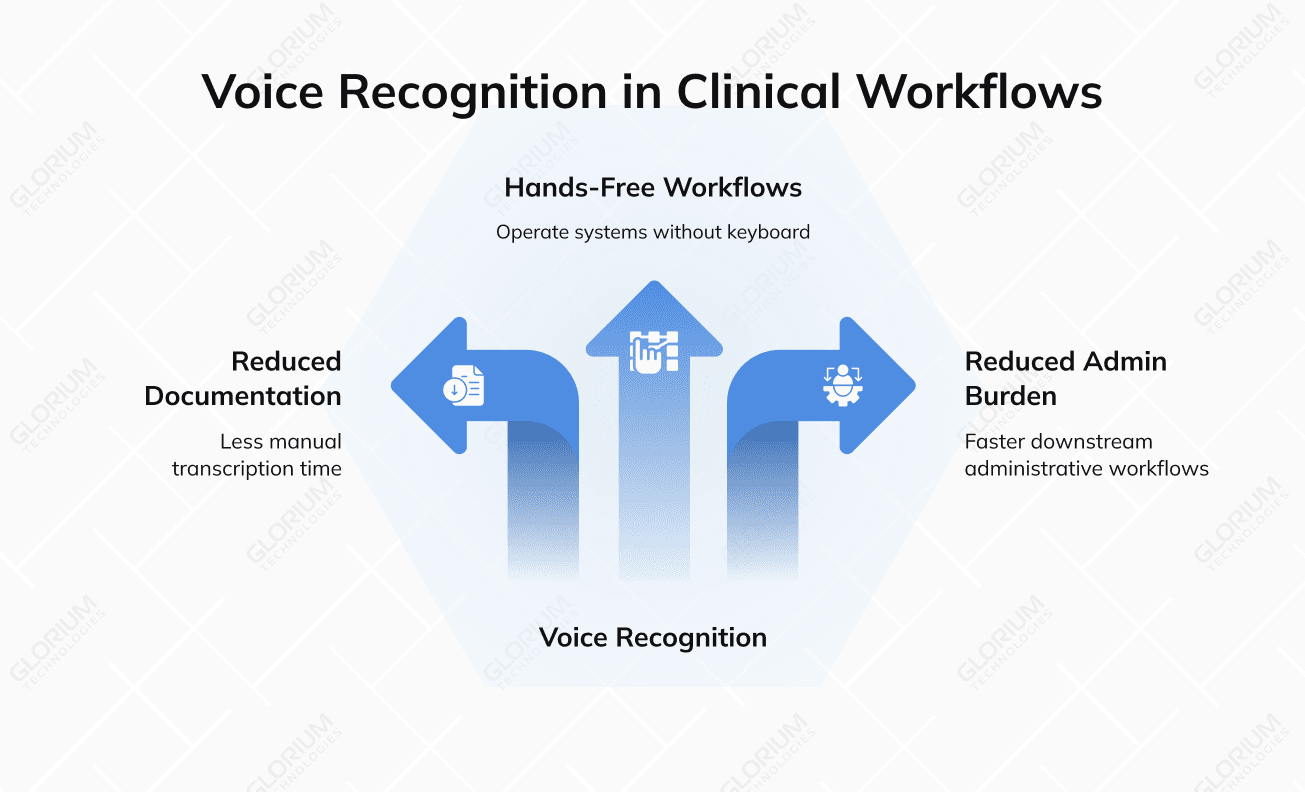
Documentation is where the technology earns its keep first. Ambient AI scribes record the natural conversation during a visit and generate a draft note for the clinician to review and sign, removing much of the manual transcription and after-hours charting that otherwise pile up.
Kaiser Permanente Medical Group offers one of the largest real-world readouts. Across a 63-week evaluation from October 2023 through December 2024, physicians using an ambient AI scribe saw statistically significant reductions in note-taking time and time per appointment.
The gains are real but not uniform. A study of 1,800 clinicians across five academic medical centers from 2023 to 2025 found a more modest saving of roughly 16 minutes of documentation time per eight hours of patient care, and noted that clinicians often need guidance to use the tools well. The lesson for healthcare organizations is that results depend heavily on workflow design and training, not just the software itself.
Most healthcare organizations arrive at a voice AI vendor decision with a short list of the same four or five names. The table below maps the platforms that come up most often in purchasing conversations, from established dictation products to the newer generation of ambient AI scribes.
| Tool | Type | Best fit | EHR integration |
| Dragon Medical One (Microsoft Nuance) | Medical dictation | Physician-directed dictation and EHR voice commands | Epic, Cerner, Oracle Health, most major EHRs |
| Microsoft Dragon Copilot | Ambient AI scribe | Full-visit ambient capture with structured note output | Epic, Cerner; embedded in Microsoft Cloud for Healthcare |
| DeepScribe | Specialty ambient AI scribe | Oncology, cardiology, and other specialties with complex documentation requirements | Epic; specialty workflow integrations |
| Suki | AI voice assistant | Voice-driven note drafting and EHR navigation from inside the clinical interface | Epic, Cerner, Athenahealth, and others |
| Abridge | Ambient AI scribe | Visit-level documentation in academic medical centers; strong Epic-native integration | Epic; UCSF, Stanford Medicine, Duke Health deployments |
The pattern that runs through this table matters more than any individual product. Every mature platform leads with EHR compatibility and workflow fit ahead of transcription accuracy, since model-level accuracy is largely a solved problem now.
What separates a clean deployment from an expensive pilot is whether the structured output lands in the right fields of the right EHR without adding a manual step. That is an integration question as much as an AI one, and it is where the implementation work concentrates.
Beyond the note, voice commands let medical professionals operate systems without breaking stride. A surgeon reviewing imaging, a nurse updating a chart at the bedside, or a clinician with mobility challenges can all act through speech rather than a keyboard.
Allowing healthcare providers to keep their hands free and their eyes on the patient changes the texture of an encounter. The same ambient tools that draft notes also free clinicians to maintain eye contact during patient interactions, which is one of the more consistently valued outcomes in the research. Voice technology here is less about raw efficiency and more about restoring the human side of care.
The value of voice recognition stretches well beyond the individual clinician. When notes are drafted and structured automatically, the downstream administrative workflows tied to each visit move faster, from coding and billing to referrals and order entry. For healthcare organizations under staffing pressure, that compounding effect on operational efficiency is often the real return on investment.
Healthcare professionals feel it differently across a practice. A physician gains face-to-face time, a nurse spends less on manual data entry, and administrators see cleaner, more complete medical records flowing into the EHR system. The reduction in administrative workload also tends to improve data accuracy, since structured clinical notes captured at the point of care leave less room for the transcription gaps and missing details that creep in when documentation is deferred to the end of a long day.
Documentation is the use case that clinical staff feel immediately. The one that healthcare administrators feel is the phone queue. Before a clinician enters the room, a patient has usually navigated a call, an intake form, or a reminder. That work lands on front-desk staff and carries real capacity risk when volumes rise, and staffing does not.
AI voice agents built for patient communication use the same core stack as ambient scribes: automatic speech recognition, a large language model, and integrations into scheduling and clinical systems. The difference is direction. These agents face outward rather than inward, handling live inbound and outbound patient calls without a staff member on the other end.
What these systems manage in practice:
For telehealth providers and multi-location clinics operating under staffing pressure, this use case can return value faster than documentation automation. A voice agent that handles intake and scheduling frees front-desk staff for the calls that genuinely require judgment, while reducing no-show rates and the abandoned calls that leave patients without the appointment they needed.
The integration requirement matches the one that applies to ambient scribes. The HL7 and FHIR interfaces that route a structured visit note into the EHR are also what let a scheduling agent read and update a patient’s appointment record in real time. That infrastructure investment pays for both use cases.
Voice recognition is not a plug-and-play fix, and treating it as one creates its own problems. The technology carries accuracy, legal, integration, and fairness risks that healthcare teams need to plan for deliberately.
No speech recognition system transcribes perfectly. Background noise, overlapping speakers, and atypical phrasing all introduce documentation errors, and an unreviewed AI-generated note can carry a mistake straight into the patient record.
This is why every credible deployment keeps a clinician in the loop as the final reviewer. The scribe drafts; the medical professional verifies and signs. Skipping that review step is where accuracy risk turns into a genuine patient safety concern.
Recording a clinical interaction raises consent and privacy obligations that vary by jurisdiction. Patients generally need to know when a conversation is being captured, and patient data flowing through a voice system falls squarely under HIPAA and, in many cases, GDPR.
Data security has to be designed in rather than added later. Encryption, access controls, audit logging, and clear retention policies all need to be settled before the first visit is recorded, not after.
Two further constraints deserve attention. The first is technical: a voice tool that does not integrate cleanly with the existing EHR system creates more work than it saves, forcing medical staff into copy-paste workarounds that reintroduce manual data entry.
The standards that govern this integration are HL7 and FHIR. A voice system that cannot exchange data through FHIR-compliant interfaces has no automatic route to write structured notes back to the patient record. The system falls back on custom middleware, which becomes a maintenance liability every time the EHR releases an update. Confirming HL7 and FHIR compliance at the vendor-selection stage, or building to those standards from the first sprint, is the most reliable way to avoid that problem later.
The second is fairness. Speech recognition in healthcare can perform unevenly across accents, dialects, and languages, which means accuracy is not equal for every clinician or patient.
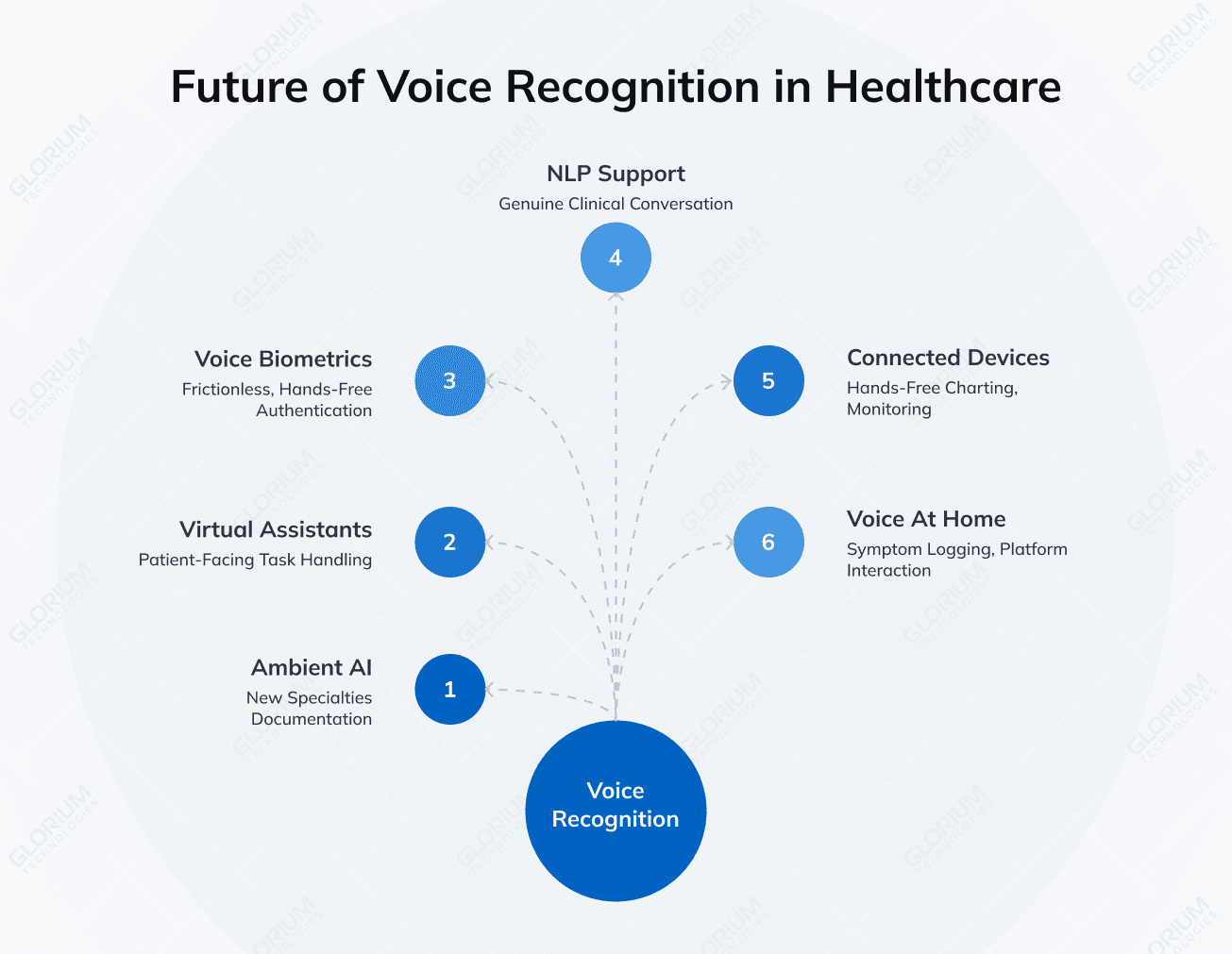
Voice recognition is shifting from a documentation aid toward a broader interface for healthcare delivery. The trajectory points to systems that do more than transcribe, gradually weaving speech into how care is coordinated and delivered. A few trends stand out for the years ahead:
Across all of these, the speech recognition adoption curve in healthcare depends less on the cleverness of the model and more on thoughtful implementation: redesigned workflows, solid EHR integration, and disciplined data security that fit the way medical professionals actually work.
Glorium Technologies brings more than 15 years of healthcare software experience to teams building voice-enabled and AI-driven clinical tools. We hold ISO 27001 certification and build under HIPAA and GDPR compliance frameworks, so patient data protection is engineered into the product from the first line of code.
Whether you need AI software development for an ambient documentation feature or machine learning expertise to fine-tune a clinical language model, our teams plug into your roadmap and contribute from the first weeks. Explore our healthcare case studies to see how this plays out in real products. Contact us to scope a voice-enabled solution built for your clinical workflows and compliance requirements.
Modern medical speech recognition trained on clinical language can reach high accuracy on well-recorded dictation, but accuracy drops with background noise, accents, and overlapping speech. Because of that variability, leading deployments treat the AI output as a draft that a clinician reviews and signs rather than a finished record. The accuracy question is less “can it match a human” and more “is the review workflow strong enough to catch the errors it does make.”
Yes, and these were among the earliest adopters. Specialty-tuned language models handle the structured reporting and dense terminology common in radiology, pathology, and emergency medicine.
Dictation software transcribes what a clinician deliberately speaks into it, word for word. An AI medical scribe instead listens passively to the natural conversation between clinician and patient, then uses natural language processing to draft a structured note on its own. The scribe removes the act of dictating; the clinician only reviews and edits the result.
Timelines depend on the EHR system, the depth of integration, and data security requirements rather than the voice engine itself. A surface-level dictation add-on can go live quickly, while a deeply embedded ambient scribe that writes structured content into specific record fields requires more integration and testing work. Scoping the integration early is what keeps a project from stalling later.
Cloud-based speech recognition software has made voice recognition technology far more accessible to smaller practices in the healthcare sector, removing the need for costly IT infrastructure while offering the scalability and remote access that smaller healthcare teams require. The real barrier to adoption is workflow design and staff training, but once those are addressed, the benefits are clear: reduced administrative burden, less manual transcription, improved data accuracy in EHR systems, and speech recognition tools powered by natural language processing and machine learning that handle medical terminology with ease. Smaller clinics that embrace voice recognition capabilities can expect meaningful gains in operational efficiency, fewer documentation errors, better patient interactions, and ultimately improved patient outcomes across their healthcare delivery.