






Healthcare Data Analytics: Turning Patient Records into Smarter Care
Updated July 9, 2026

 Summarize in ChatGPT
 Summarize in ChatGPT
Hospitals, clinics, and insurers produce enormous volumes of information. Patient charts, lab results, and claims all pile up every day, yet most of that data stays unused. Health data analytics changes the picture by turning raw records into decisions that affect real patients and real budgets.
The market reflects how seriously healthcare organizations now take this work. According to Grand View Research, the global healthcare data analytics market generated about $43 billion in revenue in 2023 and is projected to reach roughly $167 billion by 2030, growing at a 21.4% compound annual rate. Such momentum points to a clear shift, as care teams increasingly want answers from their data rather than simple storage.
This article focuses on population health data analytics, areas where it delivers measurable value, the obstacles healthcare professionals still face, and how the field is moving toward predictive, connected, and personalized care. Along the way, it highlights the data foundation that separates successful programs from stalled ones.
“Hospitals and pharmaceutical companies and doctors, they collect a lot of data on their patients and the claims and the insurance side… there’s so much data that is collected, and they want to actually use that data effectively.”
Alex The Analyst, What is Healthcare Analytics?
Content
Health data analytics is the practice of collecting, cleaning, and analyzing healthcare data to support better clinical and operational decisions. The inputs arrive from many places, including electronic health records, claims data, medical devices, lab systems, and patient-reported information. The objective remains constant throughout: to convert scattered records into insights that improve patient outcomes and lower costs.
Analysts usually group the work into four layers, and each layer answers a different kind of question. Most healthcare organizations build capability in stages rather than all at once, starting with reporting and moving toward prediction as their data matures.
| Analytics type | Question it answers | Example in healthcare |
| Descriptive | What happened? | Monthly readmission rates by department |
| Diagnostic | Why did it happen? | Drivers behind a spike in emergency visits |
| Predictive | What is likely next? | Patients at high risk of readmission |
| Prescriptive | What should we do? | Suggested care plans and resource allocation |
The clearest returns come from a handful of well-defined use cases. Each one connects a data source to a specific decision, which makes the value straightforward to measure and easier to defend to leadership. The sections below walk through the use cases that health systems adopt most often.
Population health analytics studies groups of patients to spot rising risks early. By combining clinical data, demographic data, and claims data through careful data collection, teams can prioritize at-risk populations and reach out before a condition worsens. The healthcare predictive analytics market reflects this demand, with population health ranked as its fastest-growing application segment by Grand View Research.
Risk stratification sits at the center of population health management. A model scores each patient, care managers focus on the highest-risk group first, and resources flow toward the people who need them most. Public health teams use the same approach at a wider scale, tracking disease patterns across whole communities. The payoff shows up as fewer avoidable admissions and steadier health outcomes across an entire panel of patients.
Clinical decision support brings analytics into the moment of care. A model can flag a dangerous drug interaction, surface a likely diagnosis, or recommend a screening based on a patient’s history. The clinician still makes the call, yet the system narrows the search and lowers the chance of a missed signal. Automated decision support of this kind works best when it is built into the existing workflow.
Personalized treatment planning uses analytics to match care to the person. By analyzing a patient’s history, lab values, and sometimes genetic markers, models help clinicians choose treatment strategies that suit that specific patient. This approach feeds directly into precision medicine, where therapies are tailored to a patient or a small subgroup, supporting better patient health outcomes and fewer trial-and-error cycles.
Operational analytics keeps the hospital running. Forecasting bed demand, planning staff shifts, and tracking supply levels all depend on data that hospitals already collect. Better forecasts mean fewer bottlenecks, shorter waits, and smarter resource allocation across departments.
Financial and cost analytics extend the same logic to the budget. By studying claims data, utilization, and reimbursement patterns, finance teams can spot waste, predict spending, and support value-based care models that reward outcomes over volume. The result is healthcare delivery that stays efficient without cutting into the quality of care.
Provider performance benchmarking applies the same data to the clinicians delivering that care. Most EHR systems already capture the relevant quality metrics: adherence to care protocols, outcomes by diagnosis, referral patterns, and complication rates. Analytics surfaces them in a consistent format, so administrators can compare results across departments and flag outliers early. Improvement efforts then target the specific gaps instead of guessing at them. Value-based care contracts, where reimbursement shifts from volume to outcomes, make this visibility a payer requirement. Health systems that cannot demonstrate performance against quality benchmarks leave reimbursement at risk.
Remote monitoring and connected devices stream vitals such as heart rate, glucose, and activity throughout the day. Real-time patient monitoring analyzes that flow and raises an alert the moment a reading drifts out of a safe range. For patients managing chronic conditions, the approach catches problems sooner and reduces unnecessary hospital visits, while clinicians gain a clearer view between appointments.
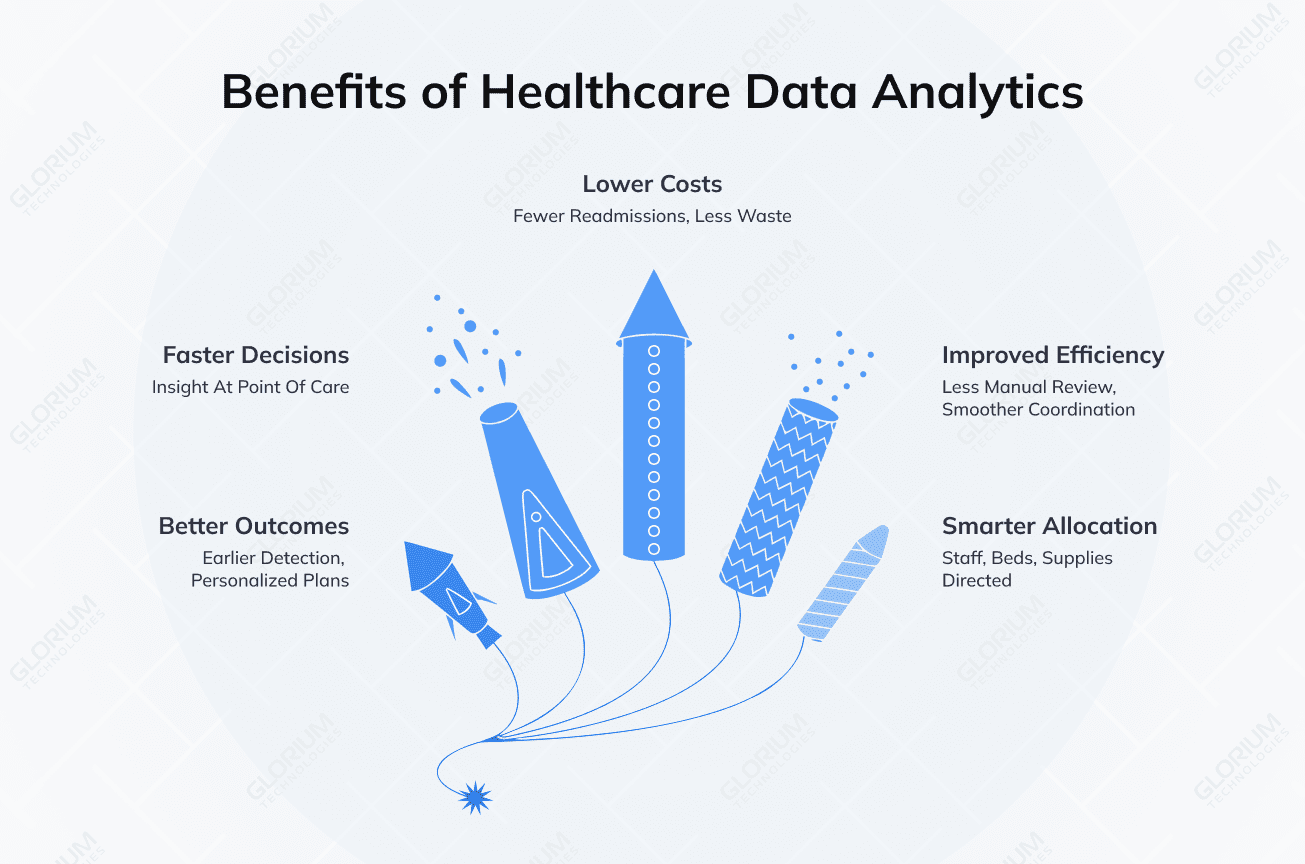
When the use cases above come together, the benefits compound across clinical and operational teams, turning scattered records into data-driven decision-making that leaders can trust.
These outcomes also strengthen patient engagement since patients who receive timely, relevant care tend to stay more involved in their own treatment. Engagement, in turn, feeds cleaner data back into the system, which improves the next round of analysis.
Strong analytics depends on strong data. When records are messy, incomplete, or trapped in disconnected systems, even advanced models produce weak results. Most failed projects trace back to the foundation rather than the algorithm, so the groundwork deserves real attention before any model is trained.
Data quality covers accuracy, completeness, and consistency. A single patient often has records spread across several systems, so data integration pulls those pieces into one reliable view. Without that step, a model trained on partial information will return partial answers. Investing in data management early saves far more time than fixing bad inputs later.
The architecture that makes cross-system queries possible is a healthcare data warehouse or data lake, a central repository that holds standardized, cleansed records from every source the analytics layer needs to read. Without one, each query hits a different system in a different format, and the results cannot be compared. Interoperability standards handle the ingestion, primarily HL7 and FHIR, which define how records move from EHR systems, lab platforms, and connected devices into the central store. Building or selecting that foundation is usually where an analytics initiative starts, since everything downstream depends on it.
Healthcare data is sensitive by nature, so privacy and security cannot sit at the end of the process. Clear data governance defines who can access what, how records move between systems, and how patient data stays protected under regulations such as the Health Insurance Portability and Accountability Act. Sound governance also builds the trust that lets clinicians rely on the output without second-guessing it.
The raw material keeps expanding. The National Electronic Health Records Survey reported that 95% of U.S. office-based physicians had adopted electronic health record systems by 2024, with most using certified platforms. When wearables and remote monitoring add their own streams of medical data, the volume grows faster than manual review can handle, which is one reason advanced analytics adoption continues to climb across the healthcare industry.
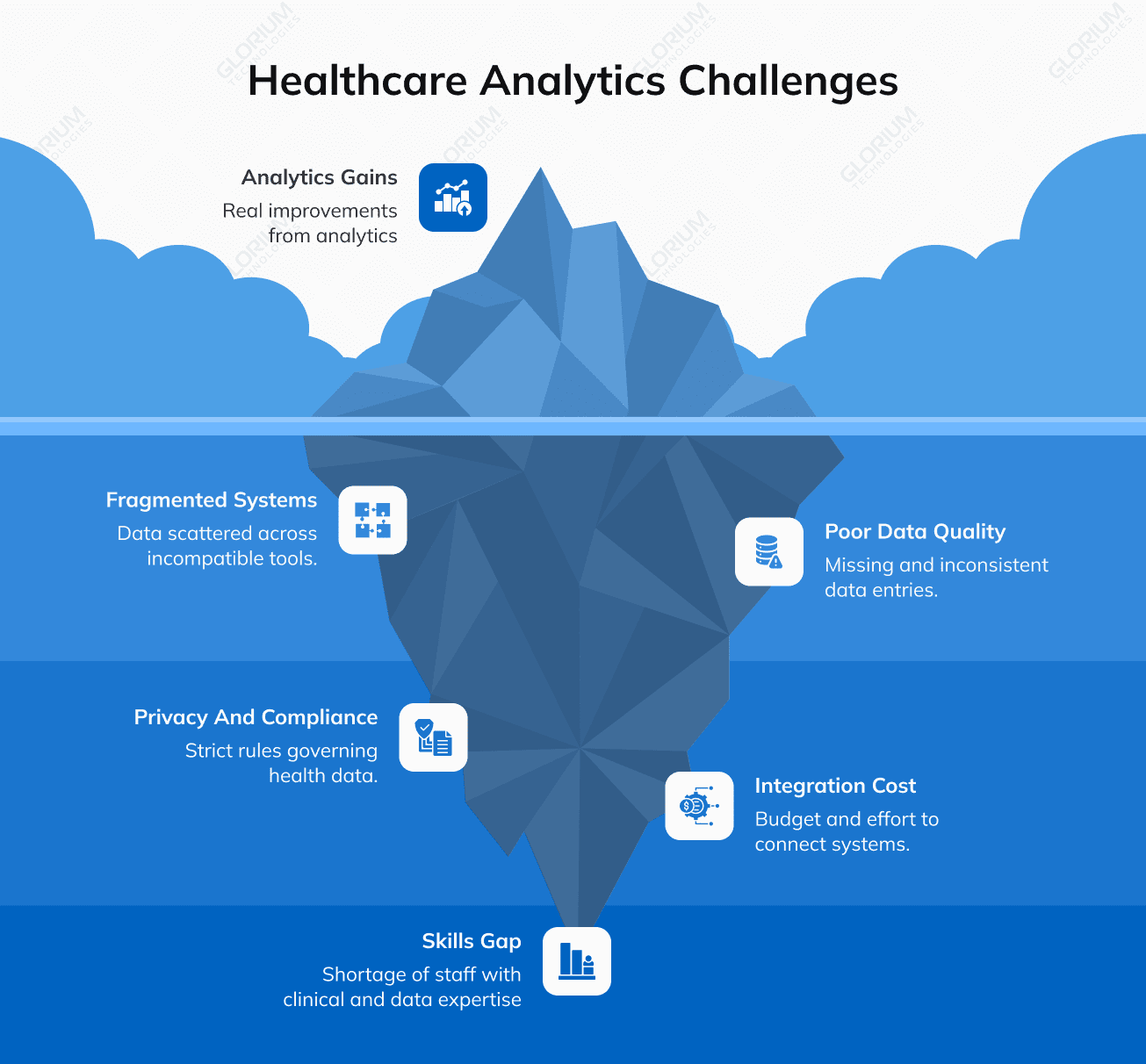
Analytics delivers real gains, yet the path is rarely smooth. Knowing the common obstacles up front helps teams plan around them instead of stalling midway through a project. The list below captures the issues that surface most often during healthcare analytics work.
None of these obstacles is permanent. A phased approach, paired with the right development partner, lets health care providers tackle them in order rather than all at once, which keeps early wins visible while the harder integration work continues in the background.
The next phase focuses less on dashboards and more on action. Several trends already shape how forward-looking healthcare providers plan their roadmaps, and each one builds on the data foundation described earlier.
Artificial intelligence and machine learning increasingly read complex, unstructured data such as imaging and clinical notes. These models support earlier detection and more personalized treatment strategies, moving care from reactive to proactive. As big data analytics matures, predictive modeling becomes a routine part of how clinicians plan ahead rather than a specialist tool reserved for research.
A data brief from the Assistant Secretary for Technology Policy and the American Hospital Association found that 71% of U.S. hospitals used predictive AI integrated with their electronic health records in 2024, up from 66% in 2023. The most common application was forecasting health trajectories or risks for inpatients, which shows that predictive analytics has already moved into mainstream clinical use.
Wearables and remote monitors stream data continuously, which opens the door to real-time alerts rather than periodic checkups. Analytics that run on this live feed help care teams respond within minutes, supporting the kind of continuous oversight that chronic care has long needed.
According to Grand View Research, the global wearable medical devices market reached about $42.74 billion in 2024 and is projected to hit $168.29 billion by 2030, growing at a 25.53% compound annual rate. The same analysis names remote patient monitoring as the fastest-growing application, which signals more live data flowing into healthcare analytics every year.
As health information exchange standards mature, connected ecosystems let data move safely between providers, payers, and patients. Stronger data exchange standards reduce duplication, support coordinated care, and make data-driven healthcare practical across organizational boundaries rather than inside a single system.
An ONC data brief reported that 70% of U.S. hospitals engaged in interoperable exchange at least sometimes as of 2023, covering the ability to send, receive, find, and integrate outside records. National efforts such as the Trusted Exchange Framework and Common Agreement aim to raise that figure further, which suggests connected ecosystems will keep expanding through the rest of the decade.
Turning healthcare data into reliable insight takes more than a model. It requires clean integration, secure architecture, and a partner who understands clinical workflows. That combination is where Glorium Technologies fits in.
With over 15 years of experience in software development and expertise in Healthcare and MedTech, Glorium Technologies builds HIPAA-compliant platforms, data and analytics solutions, and AI-powered tools designed around how care teams actually work. Our team supports projects end-to-end, from early planning through deployment and ongoing support, so the technology stays aligned with the people who use it.
The results show up in real projects. Working with Astarte Medical, Glorium Technologies built a forecasting and tracking app that combined feeding protocols, microbiome profiles, and clinical information into a proprietary dataset, then delivered personalized recommendations through an AI-powered decision tree. In another engagement, a single technology platform for HME/DME providers pulled revenue-cycle insight into one view, helping the client go paperless and improve operational efficiency across years of production use.
If your organization is ready to put its data to work, Glorium Technologies can help you design a solution that improves patient care and supports smarter decisions. Contact the team to discuss your project and map out a clear first step.
Clinical data analytics works with information generated during care, such as lab results, vitals, and notes inside electronic health records. Claims data analytics works with billing and insurance records that show which services were delivered and paid for. Clinical data gives depth on patient health, while claims data gives breadth across cost and utilization. Many strong programs blend both sources so they can see the full picture rather than half of it.
A capable analyst combines technical and clinical fluency. On the technical side, that means data analysis, statistics, and tools for data visualization. On the domain side, it means understanding medical terminology, healthcare workflows, and the privacy rules that govern patient data. The mix matters, since insight is only useful when it fits how clinicians actually work day to day.
Timelines depend on data readiness. When records are already structured and integrated, a focused use case such as readmission risk can show results within a few months. When data is fragmented, the cleanup and integration work comes first, which extends the schedule but improves every result that follows. Starting with one well-defined use case usually delivers value faster than a broad rollout across the whole organization.
No. Smaller clinics, HealthTech startups, and payer organizations all benefit from analytics scaled to their size. A startup might begin with a single predictive feature inside its product, while a clinic might focus on scheduling and resource allocation. The underlying principles stay the same regardless of scale, even though the scope and budget differ from one organization to the next.
Value-based care ties payment to outcomes rather than the number of services delivered. Analytics supports the model by measuring those outcomes, identifying high-risk patients who need early attention, and tracking the cost of care against results. With that visibility, healthcare providers can show payers the quality they deliver and adjust programs where the data points to gaps.