







EHR vs. EMR Systems: Key Differences, Benefits, and How to Choose
Updated July 31, 2026

 Summarize in ChatGPT
 Summarize in ChatGPT
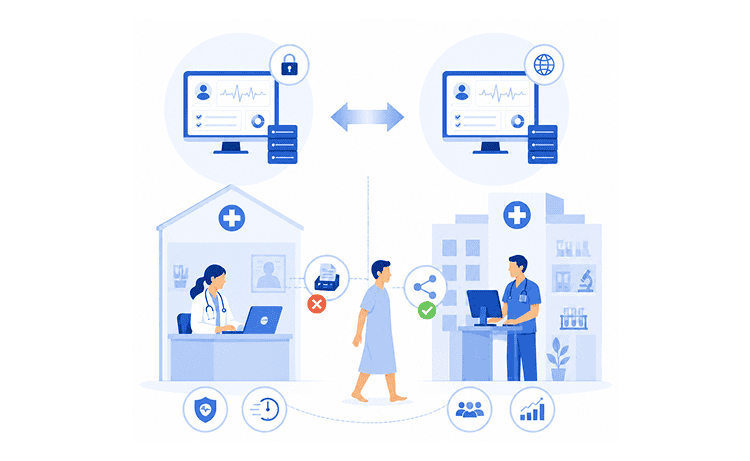
Picture a patient who ends up in a hospital across town — one their usual clinic refers patients to every week. That clinic spent two years building an electronic medical record that runs well within its own walls, but none of the clinical history entered into it can travel with the patient to the new building. Staff fax over paper records. A specialist orders bloodwork that was already drawn that morning. The chart is digital from end to end, and the information still never leaves the building where it was created.
That gap sits at the center of the EHR vs. EMR systems debate. Both replace paper charts with searchable digital health records, and both improve accuracy and speed. The real difference shows up the moment patient data has to travel. This guide breaks down what separates the two, where each one earns its keep, and how healthcare organizations can pick the system that matches how they actually deliver care.

Content
The two terms get used interchangeably, and that habit causes real confusion during software selection. Both describe a digital version of a patient’s chart, and both hold demographic data, diagnoses, medications, allergies, and lab results. The distinction lives in scope: who the digital patient records are built to serve and how far the information is designed to reach.
Every electronic health record is an electronic medical record at its core, yet not every electronic medical record qualifies as an electronic health record. The naming is deliberate, too. Medical records contain a clinician’s notes on diagnosis and treatment, while health records provide a broader view of the patient’s overall health across all settings where care occurs.
An electronic medical record is the digital successor to the paper charts that once filled a doctor’s office. Electronic medical records store a patient’s medical history within one medical practice, covering visit notes, prescriptions, immunizations, and test results for the patients that particular practice treats.
EMR software shines at internal work. Clinicians track a condition over time, spot trends, and reduce handwriting errors. Usability decides whether that value is realized. Customizable templates and intuitive interfaces matter here because an electronic medical record that mirrors real clinical workflows gets adopted, while one that fights daily routines gets worked around.
When a patient switches providers, that record doesn’t switch with them. It stays behind on the old system, and staff ends up printing and mailing pages to move it by hand. Electronic medical record systems solved documentation. They never solved the harder problem of care that follows the patient across providers.
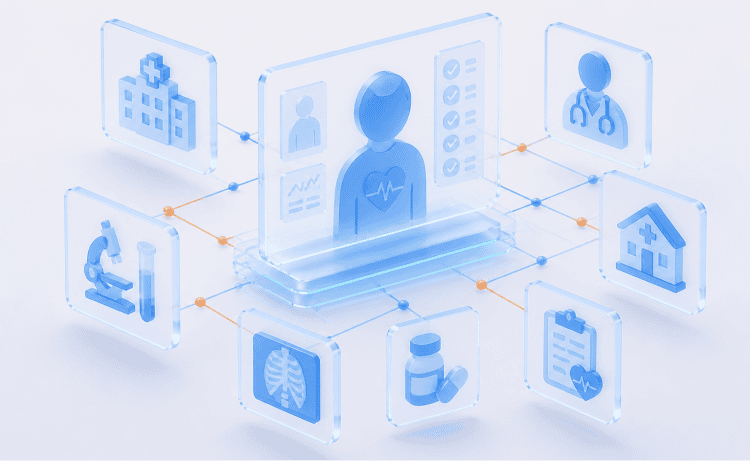
An electronic health record covers the same ground and then keeps going. An EHR is built to share information beyond the health organization that first collected it, pulling together clinical data from every provider involved in a patient’s care. Laboratories, imaging centers, specialists, and hospitals all contribute to a single, longitudinal patient record.
EHRs are designed so that a patient’s information follows them to the specialist, the hospital, and even across state lines. Citing HIMSS Analytics, the ONC describes the EHR as offering the ability to easily share medical information among stakeholders. That shareable, patient-centered design is what turns a digital record into a coordination tool.
“Electronic health records go beyond electronic medical records; they can do a lot more.”
Alex, Jotform (EMR vs. EHR: Key Differences Explained)
The choice between EHR and EMR affects how patient information moves, how providers coordinate, and how well the system holds up as an organization grows. The table below sums up the main differences, and the sections that follow explain why each one matters.
| Comparison point | EMR systems | EHR systems |
| Data sharing | Limited to one practice | Secure data sharing across providers |
| Interoperability | Minimal by design | Built for seamless data exchange |
| Patient access | Basic or none | Patient portals with self-service access |
| Care coordination | Single-provider focus | Multi-provider collaboration |
| Compliance | Core documentation | Regulatory reporting and quality measures |
| Best fit | Small, self-contained practices | Hospitals and healthcare networks |
EMR software keeps clinical data inside a single practice, which works when patients rarely leave that network. EHR systems follow HL7 and FHIR standards so that records can move securely between different healthcare systems.
Adoption is close to universal: the CDC’s 2024 National Electronic Health Records Survey found 95% of office-based physicians use an EHR system, with 83.6% on a certified system. The differentiator is no longer whether a practice has a digital record, but whether that record exchanges data with other healthcare systems. As of 2023, 70% of non-federal acute care hospitals engaged in all four interoperability domains, meaning they could send, receive, find, and integrate patient data with outside systems. That capability is what lets an EHR replace faxed pages with real-time exchange, and it is the frontier where healthcare organizations now compete on quality.
An EMR supports one clinician making decisions about the patients they see directly. An EHR supports a whole care team. When authorized providers can pull a patient’s full history, they order fewer duplicate tests and catch drug interactions faster.
Patient access follows the same pattern. Patient portals, a standard EHR feature, let people view lab results, message their provider, and follow care plans. By 2024, 99% of hospitals let patients view their records electronically, a level of patient engagement that basic EMR systems were never designed to reach.
EMR systems handle core documentation well, which covers many small practices. EHR systems go further, supporting the regulatory and reporting requirements tied to value-based care initiatives and quality programs.
Scale is the deciding factor. A single medical practice with in-house specialists may run efficiently on EMR software for years. A hospital or a multi-location group needs a system that grows across departments, sites, and patient volumes without breaking down. That is where an EHR’s architecture pays off.
Both systems deliver real value, and the right label depends on what a healthcare organization is trying to improve. Understanding the specific gains helps clarify which investment makes sense for a given setting.
EHR systems are built for connected, long-term care. Their strengths tend to show up across a full patient journey:
EMR systems trade breadth for simplicity, and for many practices that trade is worth making:
Billing accuracy is a recurring theme for smaller practices, and a well-built EMR ties charting to reimbursement directly. Our team goes deeper on this in our work on medical billing software development, where EHR and EMR integration keeps patient information flowing without rekeying.
Payment models are shifting, and that shift raises the stakes on which record system you run. Value-based care focuses on the quality of services over the quantity of visits, rewarding healthcare providers for outcomes. Programs run through the Centers for Medicare & Medicaid Services tie reimbursement to quality measures, and certified electronic health record systems are essential for participating in value-based care programs. Electronic medical records, built for a single practice, rarely carry the reporting depth these programs demand.
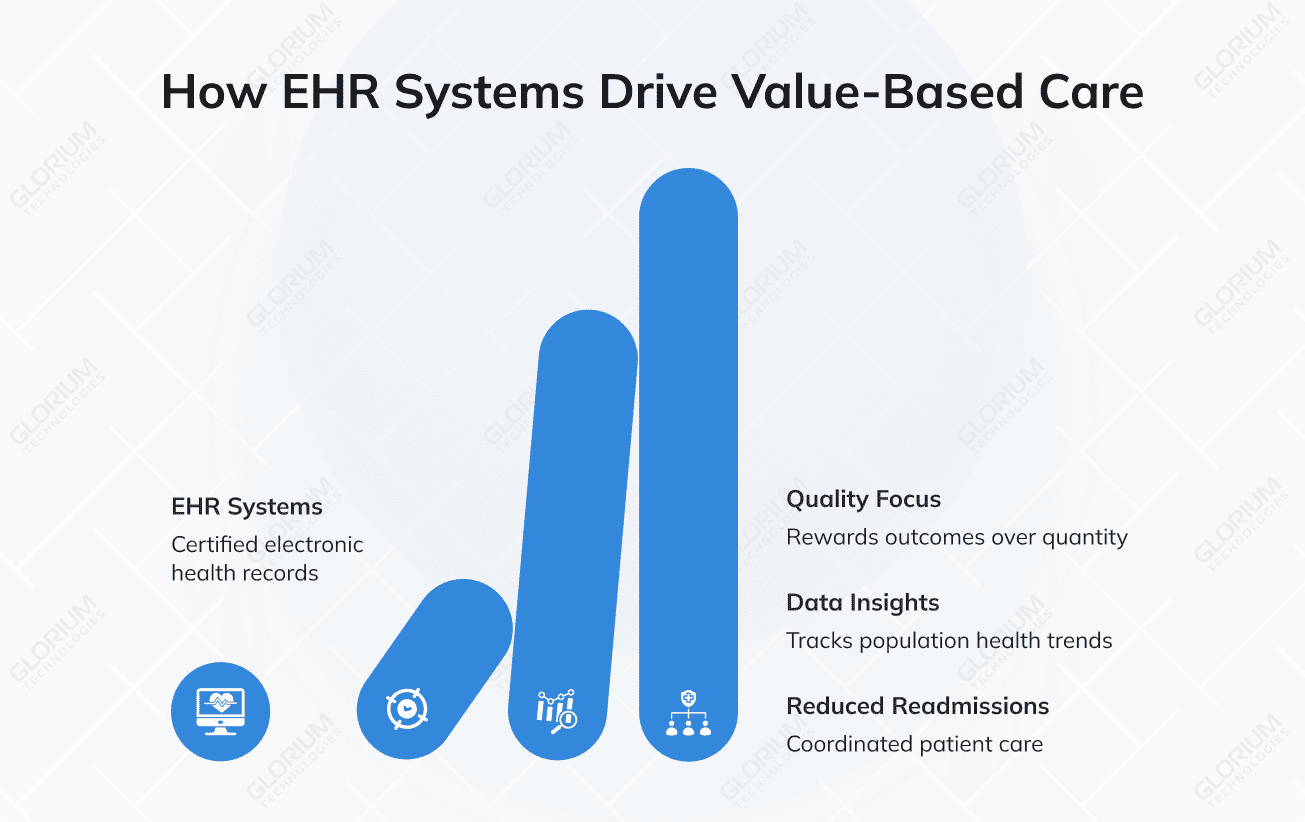
Under value-based care initiatives, providers have to prove results with clinical data. Certified EHR systems capture the quality measures programs require and feed population health management dashboards that track whole patient groups. That reporting layer turns raw EHR data into data-driven insights about a population’s health, and it is a key difference that separates EHR software from basic EMR software.
Interoperable EHRs reduce hospital readmissions, one of the most closely watched value-based metrics, by giving everyone involved in the patient’s care the same up-to-date record. When a primary care physician, a specialist, and a pharmacy all see the same medications, test results, and care plans, the gaps that send patients back to the hospital close faster. Siloed electronic medical records cannot coordinate that hand-off, which is why connected records carry real financial weight under outcome-based payment.
Near-universal adoption has not made rollouts easy. By 2024, more than 99% of non-federal acute care hospitals had adopted a certified EHR, yet the hard work has shifted from installing systems to making them usable and connected. Most difficulties fall into two groups.
A rushed rollout is the most common reason projects fail. When a system does not match the daily tasks of doctors and nurses, staff treat it as a burden and use it only partially. Our team walks through this in detail in our guide to EHR implementation.
Data migration adds its own risk. Moving years of medical records from paper charts or a legacy system without losing accuracy takes planning, testing, and validation.
HIPAA compliance, encryption, access controls, and audit logging are baseline requirements. A concentrated vendor market adds pressure too, since three EHR developers now supply technology to more than 80% of U.S. hospitals, which makes integration and vendor lock-in real considerations during selection.
Early involvement from the clinicians who will use the system, paired with hands-on training, turns resistance into routine use. Systems built around real clinical workflows get adopted; generic ones get worked around.
The decision comes down to how your organization delivers care today and where it plans to grow. A dentist running a solo practice and a regional hospital network face different problems, and the same software will not serve both well.
A short set of honest answers usually points to the right system:
Off-the-shelf software forces your workflows to fit the vendor’s template. For many healthcare providers, that friction is exactly what slows adoption and buries useful features. Custom EHR and EMR systems flip the relationship, shaping the software around how your teams already work.
Custom development is worth serious consideration when you need deep integration with existing tools, specialty-specific templates, or live interoperability with major platforms. Glorium Technologies builds systems that connect with Epic, Cerner, Allscripts, Meditech, and athenahealth using HL7 and FHIR standards, so patient data flows without the silos that come from rigid products. Our EHR software development services and hospital management software both center on that kind of tailored fit.
The market keeps expanding. According to Grand View Research, the North America EHR market reached USD 14.72 billion in 2024, and the emphasis has moved from adoption to smarter, more connected systems. A few directions stand out.
Machine learning is starting to read patterns in clinical data that humans would miss. AI-powered EHR systems can surface early warnings, support diagnosis, and cut administrative load. Ambient documentation tools are a fast-growing piece of this, listening during a visit and drafting the clinical note so physicians spend less time typing and more time with patients. Predictive analytics turns the record from a history book into a forward-looking tool for population health management.
Adoption is largely settled, so the pressure has shifted to whether data actually moves. Regulators are leaning on the information blocking provisions of the 2016 Cures Act, and the ONC has flagged that the practice remains widespread. Expect stronger enforcement, wider FHIR-based APIs, and nationwide exchange frameworks that let records follow the patient by default. For EMR systems, that trend narrows the space where siloed data is acceptable.
The record is no longer built only from clinic visits. Personal wellness devices, remote monitors, and mobile health apps now feed vitals and daily readings straight into the patient’s health records. Bringing patient-generated health data into EHR systems gives clinicians a more continuous view between appointments, which supports value-based care initiatives and earlier intervention for chronic conditions.
Cloud hosting makes health records accessible from anywhere and easier to scale as patient volumes climb. Paired with expanding patient portals, the direction is clear: records that follow the patient, invite them in, and support genuinely patient-centered care. Greater interoperability sits underneath all of it, since none of these gains matter if the data cannot move.
Choosing between EHR and EMR systems is really a question about how connected you want your patient data to be, and the right software should reflect that answer.
Glorium Technologies has spent more than 15 years building custom healthcare software, backed by ISO 13485, ISO 27001, and HIPAA-aligned processes. As an AWS Select Tier Partner recognized on the IAOP Global Outsourcing 100 for three consecutive years, our team delivers EHR and EMR platforms, patient portals, and the interoperability layers that tie them together. When we worked with the healthcare startup TurtleHealth on an at-home fertility testing platform, the focus was exactly this: an intuitive patient experience built on secure, connected data.
If you are weighing a build, a migration, or an integration, contact us for an intro call, and we will map the right starting point together.
An EMR built for a single practice usually lacks the interoperability layer, patient portal, and data-exchange standards an EHR needs. Migrating is possible, and often smart, but it involves mapping data to HL7 or FHIR formats, adding secure sharing, and re-validating records.
Cost depends on scope: the number of users, the features, whether you need EHR integration or multi-location support, and cloud versus on-premise hosting. A focused EMR for one practice sits at the lower end, while an enterprise EHR with interoperability and analytics runs higher. A discovery phase gives you a realistic estimate before commitment.
Timelines vary with organization size and system complexity. Small practices or modifications to an existing system often take six to nine months, while a large healthcare organization rolling out a new system may need close to a year. Cloud-based deployments can move faster, sometimes in weeks, because there is less on-site infrastructure to configure.
Yes. Any electronic health record or electronic medical record that stores protected health information falls under HIPAA, whether it serves one practice or a hospital network. The difference is exposure. Because an EHR shares medical records across more systems and providers, it carries a wider security surface, which makes encryption, access controls, and audit logging even more important.
An EHR. When authorized providers see results from labs and imaging centers a patient has already visited, they avoid reordering the same tests. An EMR keeps those results inside one practice, so a specialist across town has no visibility and may repeat work that was already done, adding cost and delay for the patient.
Prioritize open standards and integration flexibility. Systems built on HL7 and FHIR, with documented APIs, keep your data portable and let you connect new tools later. Custom or standards-based development reduces dependence on a single vendor’s roadmap, which matters in a market where a handful of developers dominate hospital adoption.