Reconciling enrollment counts across 14 trial sites should not require detective work. Yet, right now, your clinical operations lead might be manually cross-referencing disparate spreadsheets and email threads, trying to resolve conflicting metrics for a single study. Every hour spent decoding mismatched data is an hour lost to study progress.
That scenario is all too common because modern clinical trials simply involve too many moving parts for manual systems to keep up. In a 2025 WCG survey of more than 600 research sites, 35% named trial complexity as their single greatest challenge. Schedules suffer too, since 54% of trials now run at least 20% late, up from 44% before 2020, according to a 2026 Bain & Company survey.
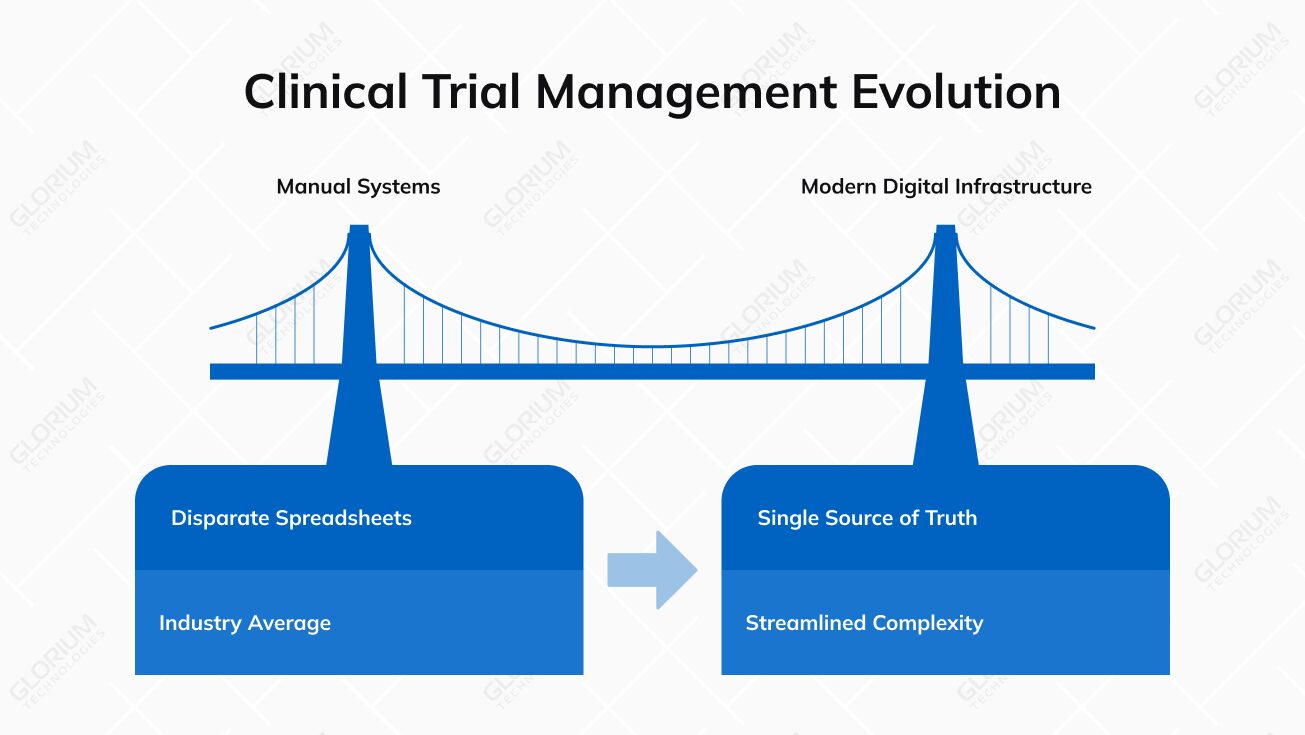
As soon as a protocol scales across multiple sites, intricate visit schedules, and competing budgets, spreadsheets become an operational liability. Clinical trial management software (CTMS) replaces that disjointed approach with a single source of truth, bringing together every site detail, patient visit, study milestone, and payment in one place. Companies are replacing legacy systems with modern digital infrastructure to handle rising protocol complexity and decentralization.
What Is Clinical Trial Management Software?
A clinical trial management system is software that plans, tracks, and manages the operational and financial side of a clinical study. It records which sites are active, how many participants enrolled, which visits took place, and what each site is owed. In short, it runs the business side of your trial.
CTMS does not hold the medical measurements captured during patient visits because other systems own that layer. Instead, it answers the operational questions your team asks every week. Which site is falling behind on its enrollment target? Which monitoring visit report is still overdue? How much of the approved budget has the study already consumed?
Several different labels describe this same software category. Some vendors and academic teams prefer the term clinical research management, which Glorium Technologies explores in its guide to clinical research management systems. CTMS also falls within a broader family of healthcare software that hospitals and life sciences firms run side by side.
Timing matters as well for teams planning a purchase. The revised ICH E6(R3) Good Clinical Practice guideline has been applied in the EU since July 23, 2025, and it calls for risk-proportionate oversight backed by traceable records. CTMS gives you the structure to show regulators how you planned, monitored, and documented that oversight.
Who uses CTMS and which roles depend on it?
CTMS users span the entire research ecosystem, from clinical trial sponsors to pharmaceutical and biotechnology companies. Sponsors in pharma, biotech, and medtech use it for portfolio oversight, while contract research organizations run it across client studies. Research sites, site management organizations (SMOs), academic medical centers, and Contract research organizations (CROs) rely on site-level versions to manage their own workload, staff, and payments.
|
Role |
What they do in the CTMS |
|
Principal investigator (PI) |
Reviews site enrollment, deviations, and delegated tasks |
|
Clinical research coordinator (CRC) |
Schedules visits, logs enrollment, and tracks site documents |
|
Clinical research associate (CRA) |
Plans monitoring visits and files trip reports |
|
IRB or ethics committee |
Issues approvals that the CTMS tracks by date and version |
|
Data manager |
Reconciles CTMS milestones with data held in other systems |
Each of these research team members sees a different slice of the same record. That shared record keeps clinical trial sponsors, CROs, and sites aligned on one version of study status.
How Does a Clinical Trial Management System Work?
CTMS supports your study across its entire lifecycle, from the first feasibility assessment to final site close-out. Data entered in the early phases automatically carries forward into later stages, so your team inputs information once and relies on it throughout the study. Here is how that end-to-end journey unfolds for those managing international, multi-site trials.
- Study start-up: The team runs feasibility surveys, selects sites, and negotiates contracts and budgets inside the system
- Site activation: CTMS tracks IRB approvals, staff training records, and the green light for each site
- Enrollment and conduct: Coordinators log screening, enrollment, and visits, while the system flags sites drifting from targets
- Monitoring: CRAs schedule visits, file reports, and log protocol deviations against each site record
- Close-out: The team confirms final payments, reconciles documents, and archives the study for inspection
Study scale changes how much of the CTMS you use. A Phase I study with two sites may run on a light setup, while a Phase III program can involve hundreds of clinical sites on several continents. Phase II tests dosing and early efficacy, and Phase IV follows a product after approval. CTMS applies the same logic at each phase, only with more records and more stakeholders involved.
Throughout the lifecycle, dashboards roll site operations data into portfolio views. That rollup lets a director compare trial progress across programs without asking every study manager for a status email. It also keeps study management decisions anchored in current numbers, which is the whole point of digitizing clinical trial operations in the first place.
Key Features to Expect from Clinical Trial Software
Feature lists from clinical trial software vendors often look alike, yet depth varies widely between platforms. The eight capabilities below cover the operational core that users rely on daily. Use them as your baseline when you compare products or scope a custom build.
Study planning and milestone tracking
Study planning tools turn a protocol into a timeline with owners and dates. You set milestones such as first patient in, last patient out, and database lock, then track each one against the plan. Study tracking at this level shows slippage weeks earlier than a quarterly review would.
Portfolio teams running multiple studies use the same records to compare timelines side by side. Protocol deviation tracking also lives here, so each deviation links to the site, the visit, and the corrective action that followed.
Clinical site and investigator management
Site management features store each site’s profile, investigator credentials, contracts, and performance history. When you plan a new study, that history helps you pick sites with proven enrollment records. It also shows which investigators need refreshed training or updated financial disclosure forms.
Start-up is where this module earns its keep. In 2025, 31% of sites ranked study start-up as a top challenge, and 39% of larger sites put it first. Tools that manage research sites through feasibility, contracting, and activation shorten that window for everyone involved.
Patient recruitment and enrollment tracking
Patient recruitment modules log every referral, prescreen, consent, and screen failure by site. Enrollment tracking dashboards then compare actual counts with planned curves, so you spot a lagging site before it threatens the timeline. Many teams also track screen-failure reasons to refine eligibility messaging or outreach channels.
Reliable patient enrollment numbers also feed budget forecasts, since many site payments depend on enrolled and completed participants.
Visit scheduling and monitoring
Visit scheduling tools build each participant’s calendar from the protocol’s visit windows. Coordinators see upcoming visits, missed windows, and overdue procedures in one queue. This kind of patient management reduces out-of-window visits, which often trigger protocol deviations and extra monitoring work later.
On the monitoring side, CRAs plan site visits, complete trip reports, and assign follow-up items. Risk-based monitoring (RBM) and risk-based quality management (RBQM) features use key risk indicators to target visits at sites showing unusual patterns.
Budgeting, billing, and site payments
Financial management tools hold study budgets, site contracts, and payment schedules in one place. When a coordinator marks a visit complete, the CTMS can calculate what the sponsor owes the site. That link between conduct and payment cuts manual invoicing and reduces disputes over unpaid procedures.
Many platforms also handle investigator payments, routing fees to the institution or the principal investigator as each contract specifies. Every invoice, approval, and payment date stays logged for audits.
Good financial tracking also shows forecast versus actual spend per site, which helps you control trial costs before overruns pile up. Holdbacks, pass-through costs, and screen-failure fees should all be configurable without custom code.
Document and compliance tracking
Compliance tracking keeps IRB approvals, protocol versions, consent form versions, and staff training records tied to each site. The system alerts you when an approval nears expiry or a new amendment needs site sign-off. Corrective and preventive actions (CAPA) can link back to the deviations that triggered them.
Every change carries a timestamp and user ID, so audit trails stay complete for inspections and keep you aligned with regulatory requirements. Clinical trial sponsors with a formal quality management system often connect CTMS events to their QMS workflows.
Reporting and study performance analytics
Reporting is where operational records turn into everyday decisions. Dashboards show enrollment velocity, monitoring backlog, deviation rates, and payment status across sites or programs. Role-based views mean a finance lead and a CRA each see the KPIs they own, without building custom spreadsheets every month.
Mobile apps and remote access can keep dashboards up to date by allowing CRAs to update records between visits to the site. Look for exportable reports, scheduled distribution, and filters by country, phase, or therapeutic area.
Integration with EDC, EHR/EMR, and eTMF systems
CTMS acts as the central hub of your clinical operations, and it integrates well with your core software systems. It pulls real-time updates of visits and queries directly from electronic data capture platforms and syncs document completion statuses to your electronic trial master file. The platform also makes it easier for monitors to verify source data and speeds patient prescreening by linking to electronic medical records.
Strong integration capabilities cut duplicate data entry at sites, and fewer re-keyed values enhance data accuracy at the source. At Memorial Sloan Kettering Cancer Center, an EHR-to-EDC pilot captured 58% more data elements in the same timeframe. Ask vendors how their platform connects with your existing systems, including the EHR software your hospital partners already run.
How CTMS Benefits Clinical Research Teams
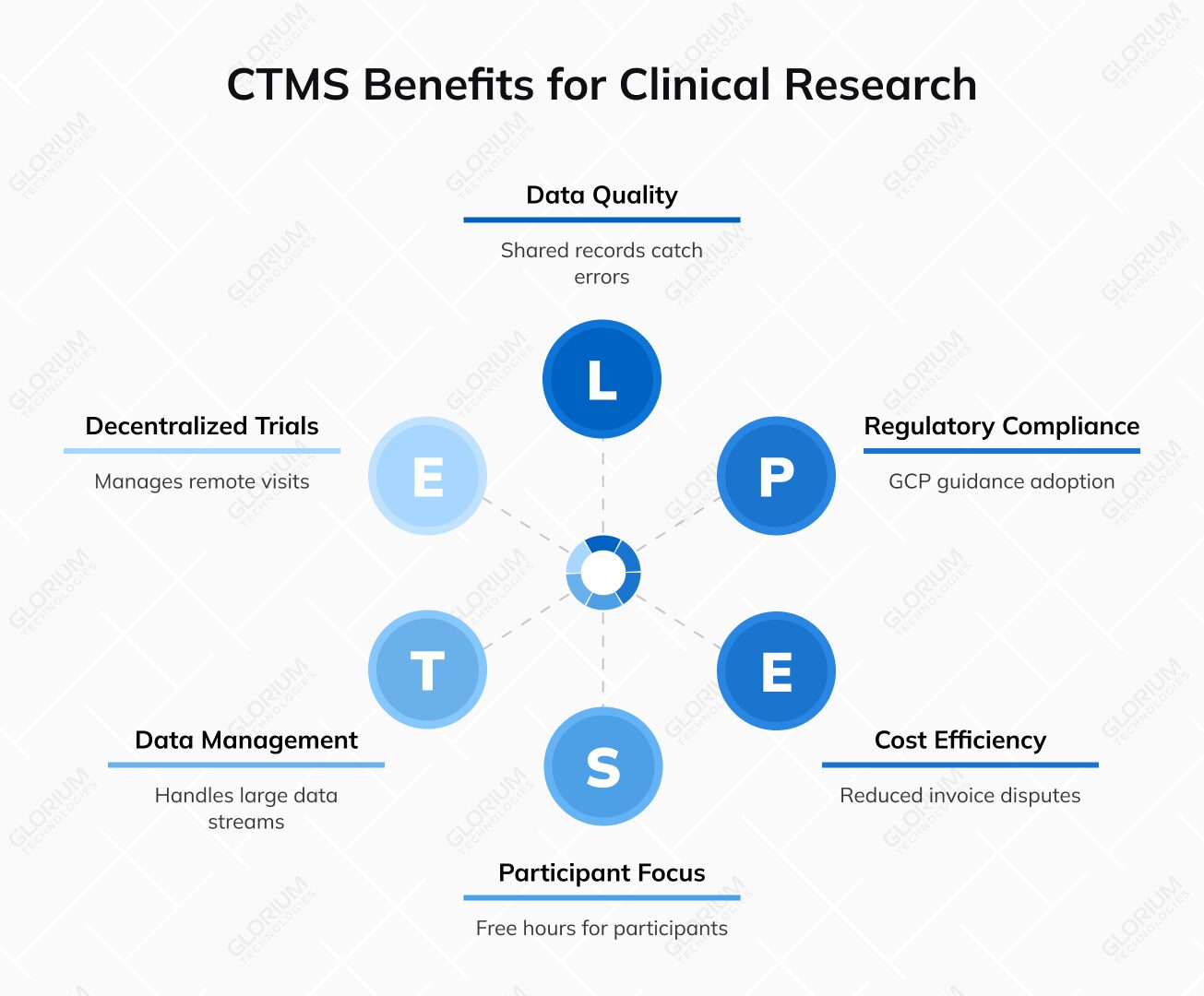
CTMS delivers its greatest value by eliminating repetitive manual tasks and giving every team member a single view of study health. Naturally, the true return on investment scales with your operational footprint. The more studies, sites, and disconnected software systems your research team juggles today, the greater the impact will be.
- Operational efficiency: Coordinators and CRAs spend less time chasing status updates and reconciling spreadsheets
- Data quality: Shared records and validation rules catch missing dates, duplicate entries, and inconsistent site counts early
- Resource allocation: Workload dashboards show which CRAs, coordinators, or sites need support before deadlines slip
- Regulatory oversight: Complete histories of approvals, deviations, and actions make inspections far less stressful for teams
- Cost efficiency: Payments tied to completed visits reduce invoice disputes and overpayments across large site networks
- Faster decisions: Real-time portfolio dashboards let leaders shift budget or staff to studies that need help
Administrative relief matters most at the research sites themselves. In 2025, 45% of sites said operational challenges limited their ability to take on new trials. CTMS cannot solve staffing shortages by itself, yet it frees hours that coordinators can return to participants.
These gains also help clinical trial sponsors and site coordinators streamline operations together because both sides finally work from matching numbers.
In decentralized and hybrid designs, the CTMS manages site visits, home nursing visits, telehealth appointments, direct-to-patient shipments, and eConsent status. The designs are based on telehealth, home nursing, and wearable sensors, whose data streams are too much for older on-premise systems to handle. In 2026, ICH adopted E6(R3) Annex 2, which adds GCP guidance on decentralized and pragmatic trial elements. Before you buy, find out if a vendor counts remote visits as full visits with their own windows, staff, and payments.
CTMS vs. EDC vs. eTMF and How Clinical Data Moves Between Them
People often confuse CTMS with other eClinical tools because they share users and screens. The difference lies in what each system owns. CTMS runs trial operations, an EDC collects patient data, and an eTMF stores the regulatory documents that prove the trial followed its plan.
Several other systems sit around those three core platforms. A clinical data management system (CDMS) handles queries, coding, data cleaning, and database lock for the clinical data an EDC collects. In some vendor suites, CDMS and EDC appear as one product.
|
System |
What it owns |
Typical owner |
|
CTMS |
Sites, milestones, enrollment status, budgets, and payments |
Clinical operations |
|
EDC |
Electronic case report forms and visit data |
Sites and data managers |
|
CDMS |
Queries, medical coding, cleaning, and database lock |
Data management team |
|
eTMF |
Core trial documents and inspection readiness |
Regulatory and quality |
|
IRT/RTSM |
Randomization and trial supply |
Clinical supply |
|
ePRO/eCOA |
Electronic patient-reported outcome and clinician assessments |
Participants and sites |
|
eConsent, eSource, eISF |
Consent records, source data, and investigator site files |
Sites |
|
Safety (Oracle Argus) |
Adverse event case processing |
Pharmacovigilance |
|
LIMS |
Sample tracking and lab results |
Central and local labs |
CTMS usually pulls status from these systems without copying their content. That boundary protects data collection workflows and keeps access rights tidy. For lab-heavy studies, a laboratory information management system often feeds sample status into the same operational view. ePRO design deserves attention too, since 32% of participants called diaries and questionnaires burdensome in 2025, versus 18% in 2021.
Unified eClinical platform or best-of-breed tools
Your next decision concerns the overall system architecture. A unified suite runs CTMS, EDC, eTMF, and other modules on a single platform with shared master data. Best-of-breed setups combine specialist tools from different vendors through APIs and integration middleware. Each approach trades simplicity against flexibility, so the choice depends on your portfolio.
Tool sprawl carries a real cost at sites. In 2025, 22% of sites named the number of technologies and vendors as the greatest driver of complexity. Unified suites provide seamless integration within a single vendor’s ecosystem, while best-of-breed setups let you select the strongest tool for each job.
“…returning information as you saw, makes it highly personalized… Participants are very interested in seeing their own data, not just contributing to your research, but actually getting some feedback from that research as well.”
Basyl Durnan, Using a Clinical Trial Management System to Reduce Administrative Burden
Clinical Trial Software Companies to Know in 2026
Most clinical trial software companies now sell CTMS inside a broader eClinical platform. Grand View Research reports that enterprise solutions held 75.24% of CTMS revenue in 2025, so the table starts there.
Enterprise platforms for sponsors and CROs
Enterprise platforms are for sponsors and CROs that do a lot of studies across countries and need portfolio views, vendor oversight, and deep integrations. Contracts are usually for a few modules at a time, from CTMS and EDC through to eTMF. Longer implementations, formal validation packages, and pricing negotiated around users, studies, and modules will all become the norm.
|
Vendor and product |
Best fit |
What to know |
|
Medidata Rave CTMS |
Enterprise sponsors and CROs |
Unified with Rave EDC; Medidata has been owned by Dassault Systèmes since 2019 |
|
Veeva Vault CTMS |
Enterprise sponsors and CROs |
Part of the Veeva Vault Clinical suite with eTMF and data management apps |
|
Enterprise sponsors and CROs |
Siebel CTMS exchanges data two ways with the Clinical One platform |
|
|
Cloudbyz CTMS |
Mid-market sponsors and CROs |
Built natively on Salesforce |
Site-focused and academic tools
Site-focused tools serve research sites, site networks, and academic programs that manage their own calendars, staff effort, and payments. They favor fast setup, coordinator-friendly screens, and billing compliance over portfolio analytics. Some products here are data-capture platforms first, so check which CTMS functions each one covers before you shortlist it.
|
Vendor and product |
Best fit |
What to know |
|
Advarra OnCore |
Academic medical centers and cancer centers |
Enterprise CTMS for institution-wide research portfolios |
|
Advarra Clinical Conductor |
Sites and site networks |
Site CTMS for scheduling, billing, and payments |
|
RealTime CTMS |
Sites and site networks |
Part of the RealTime eClinical product suite |
|
Florence |
Research sites |
eISF and eBinders that integrate with site CTMS tools such as OnCore |
|
TrialKit |
Small sponsors and sites |
EDC with CTMS modules and a native mobile app |
|
MasterControl Clinical Excellence |
Sponsors and sites |
Clinical workflows built around document and quality control |
|
Medrio, Castor, OpenClinica |
Data-capture-first buyers |
EDC-led platforms with ePRO, eCOA, or eConsent options |
|
REDCap |
Academic institutions |
Free EDC and survey tool for consortium members, not a full CTMS |
Which CTMS fits which buyer
Vendor names only help once you match them to your operating model. The notes below answer the most common search questions, from OnCore to Medidata ownership, and show which product types tend to fit sponsors, CROs, sites, and academic programs. Treat them only as a shortlist starting point.
When evaluating the CTMS landscape, buyers consistently ask about the major market players and how they fit together. Veeva and Medidata both provide leading CTMS capabilities, though both structure their offerings as part of an integrated, end-to-end platform. Oracle’s clinical solutions follow a similar enterprise approach, recently rebranded from Oracle Health Sciences to Oracle Life Sciences.
Advarra OnCore deserves a direct answer because buyers search for it often. It is an enterprise CTMS built for academic medical centers, cancer centers, and health systems that run hundreds of studies at once. OnCore centralizes protocol records, subject registrations, study calendars, and research billing across the whole institution.
Most clinical research organizations standardize on one enterprise CTMS but still connect to sponsor systems on each project. Across the life science industry, buyers rarely choose on features alone. Integration fit, validation support, and service quality decide which management software survives the first year.
Medidata, Veeva or Oracle are often shortlisted by global sponsors and large CROs for their unified suites. Cloudbyz is already on the radar of mid-market sponsors on Salesforce. Independent sites and site networks tend to evaluate Clinical Conductor and RealTime, whereas academic medical centers tend to evaluate OnCore. Small teams with lean budgets may start with TrialKit or an EDC-first platform and add CTMS features later.
Challenges in Clinical Trial Management
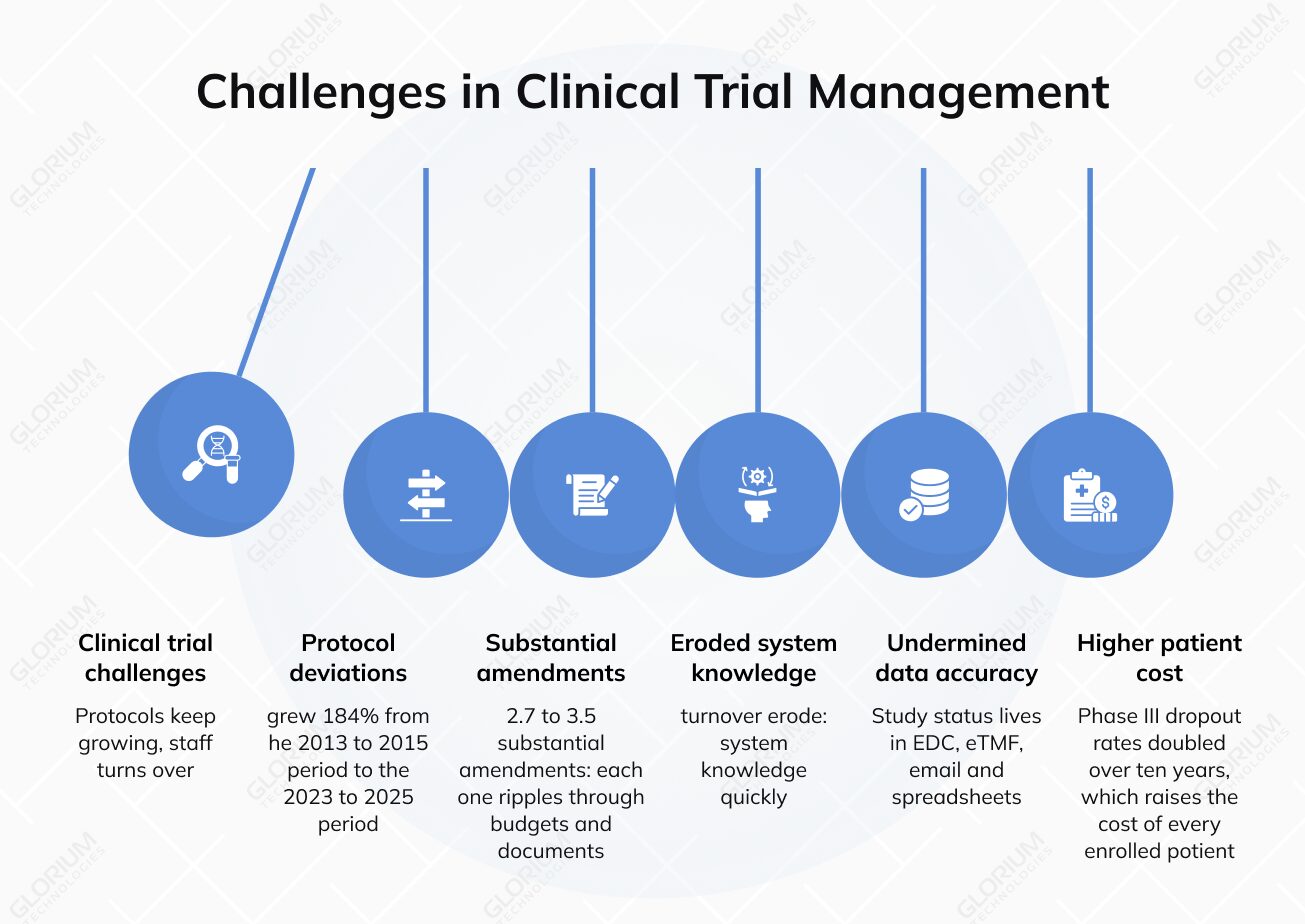
Even with good software, clinical trial management remains demanding work. Protocols keep growing, staff turns over, and every new vendor adds another login for sites. Knowing the common obstacles helps you configure CTMS around them and set realistic expectations with leadership before rollout begins.
- Rising protocol complexity: Tufts CSDD data shows protocol deviations grew 184% from the 2013 to 2015 period to the 2023 to 2025 period
- Frequent amendments: Phase II and III studies often carry 2.7 to 3.5 substantial amendments, and each one ripples through budgets and documents
- Staffing gaps: In 2025, 30% of sites ranked staffing as a top challenge, so turnover erodes system knowledge quickly
- Fragmented data: Study status lives in EDC, eTMF, email, and spreadsheets, which undermines data accuracy across reports
- Participant retention: Tufts CSDD found that Phase III dropout rates doubled over ten years, which raises the cost of every enrolled patient
- Change resistance: Teams that built the old spreadsheets often distrust new dashboards until the numbers match their records
Each of these critical aspects points to the same response. Configure CTMS around real workflows, and train people in the context of their own studies. Integration matters as well, because CTMS fed by manual uploads inherits every gap it was meant to close.
How to Pick the Best Clinical Trial Management Platform
The best clinical trial platform for a global company is rarely the right pick for a 10-person research site. A structured evaluation protects you from polished demos that fail on your real workflows. The sections below cover selection criteria, pricing, build-versus-buy logic, and what implementation involves.
Start with the key factors that match your operating model. For example, a clinical trial sponsor needs portfolio views and vendor oversight, a CRO needs client-level separation, while site coordinators might be more interested in scheduling and billing. Score every shortlisted product against one checklist and ask vendors to demo your own workflows.
- Operating fit: The product supports your workflows without heavy customization
- Integrations: Prebuilt connectors exist for your EDC, eTMF, IRT, and finance systems
- Part 11 support: Electronic signatures, audit trails, and security access meet FDA 21 CFR Part 11
- Validation support: The vendor supplies test scripts, release notes, and a reusable validation package
- Reporting depth: Users can build role-based dashboards without filing tickets with IT
- Scalability: Pricing and performance hold up as your studies, sites, and users grow
How much a CTMS costs
CTMS pricing follows four common models: per study, per site, per user, or an enterprise license. Cloud vendors bill subscriptions, while some enterprise buyers still pay a license plus annual maintenance. Implementation, configuration, data migration, validation, and training then add one-time costs on top of the subscription.
Published prices exist mainly at the lower end. SimpleTrials, for example, lists plans from $599 per month for small teams, rising to $2,399 or $3,599 per month for larger teams and premium features. Enterprise vendors such as Veeva, Medidata, and Oracle quote privately based on users, studies, modules, and integrations. Smaller research organizations should also budget for validating each new vendor release.
One-time costs deserve as much scrutiny as the subscription itself. Mordor Intelligence estimates that full-scope CTMS rollouts cost smaller sponsors $0.5 million to $2 million upfront, mostly for licenses, infrastructure, and Part 11 validation. The same report notes that validation commonly runs six to twelve months, so your team may keep parallel manual workflows during that window.
Build vs. buy for custom CTMS modules
Buying commercial CTMS suits many organizations because vendors absorb maintenance and regulatory updates. A custom build or custom modules make sense when your workflows are unusual, when you must connect in-house systems, or when you run a site network with its own billing logic.
Typical custom scenarios include a sponsor-specific feasibility portal, a payment engine for a site network, or a dashboard layer that unifies data from several vendors. In each case, the custom software system extends the commercial core instead of replacing it. Teams weighing this route often start with a healthcare software development partner to scope integration and validation effort.
Implementation, validation, and free options
A typical rollout moves through discovery, configuration, data migration, validation, training, and a pilot study. Migrating legacy sites, contacts, and in-flight studies usually sets the pace. Validation follows a computer system validation (CSV) plan, and many teams now borrow risk-based computer software assurance (CSA) thinking.
Rollout timelines vary widely with scope and data volume. A site-focused tool built on standard templates can go live within weeks, according to Mordor Intelligence. Enterprise programs take much longer, and one top-20 biopharma migrated more than nine million records from five systems into Veeva CTMS over 18 months. It also ran four pilot studies for about eight months before the full rollout.
FDA finalized its CSA guidance for production and quality system software on September 24, 2025, and the updated version was issued on February 3, 2026. There are free options as well, including OpenClinica Community edition and REDCap (for eligible institutions). Both are good at data capture, but neither has full CTMS features such as site payments, CRA trip reports, and portfolio budgeting.
Integration, Security, and Compliance for Clinical Trial Data
CTMS handles personal data, financial records, and inspection evidence, so regulatory compliance shapes every design choice. Integration adds another layer because each connection moves clinical trial data between systems with different owners. The table below maps the regulations and standards your platform should support, along with what each one means in practice.
|
Regulation or standard |
What it means for your CTMS |
|
The new GCP version, finalized in 2025, expects planned review of data, metadata, and audit trails, risk-proportionate system validation, controlled user access, and documented data flows |
|
|
FDA 21 CFR Part 11 |
Electronic records and signatures need audit trails, access controls, and validation |
|
HIPAA |
US patient data requires safeguards, minimum-necessary access, and breach procedures |
|
GDPR |
EU personal data needs a lawful basis, data minimization, and transfer safeguards |
|
EU CTR 536/2014 and CTIS |
All EU trials have run under the CTR and its CTIS portal since January 31, 2025 |
|
ALCOA+ |
Records stay attributable, legible, contemporaneous, original, accurate, complete, consistent, enduring, and available |
|
CSV and CSA |
Validation effort scales with the risk each function carries |
|
CDISC CDASH, SDTM, ODM |
Standard formats for collecting, tabulating, and exchanging study data |
|
HL7 FHIR |
Standard APIs for pulling EHR data into research workflows |
|
ClinicalTrials.gov |
Registration and results-posting deadlines the CTMS can track |
Data security starts with role-based access controls, encryption in transit and at rest, and single sign-on. For US programs, Glorium Technologies explains the engineering side of HIPAA-compliant app development in a separate guide. Interoperability depends on standards, so review what HL7 does for healthcare products and how FHIR differs from HL7 v2 before you scope EHR feeds.
What ICH E6(R3) changed for trial systems
ICH E6(R3) reached final adoption on January 6, 2025, and replaced the R2 text from 2016. The EU applied it from July 23, 2025, and FDA published it as final guidance in September 2025. For systems, the biggest shift is a dedicated focus on data governance.
The guideline requires data and metadata, including audit trails, to be reviewed as part of a plan. It also needs to be validated to the level of risk, with controlled user access and documented data flows between systems.” Annex 2 to the Regulation on decentralized and pragmatic designs shall enter into force in the EU on 15 January 2027.
AI and Automation Trends Shaping Clinical Operations
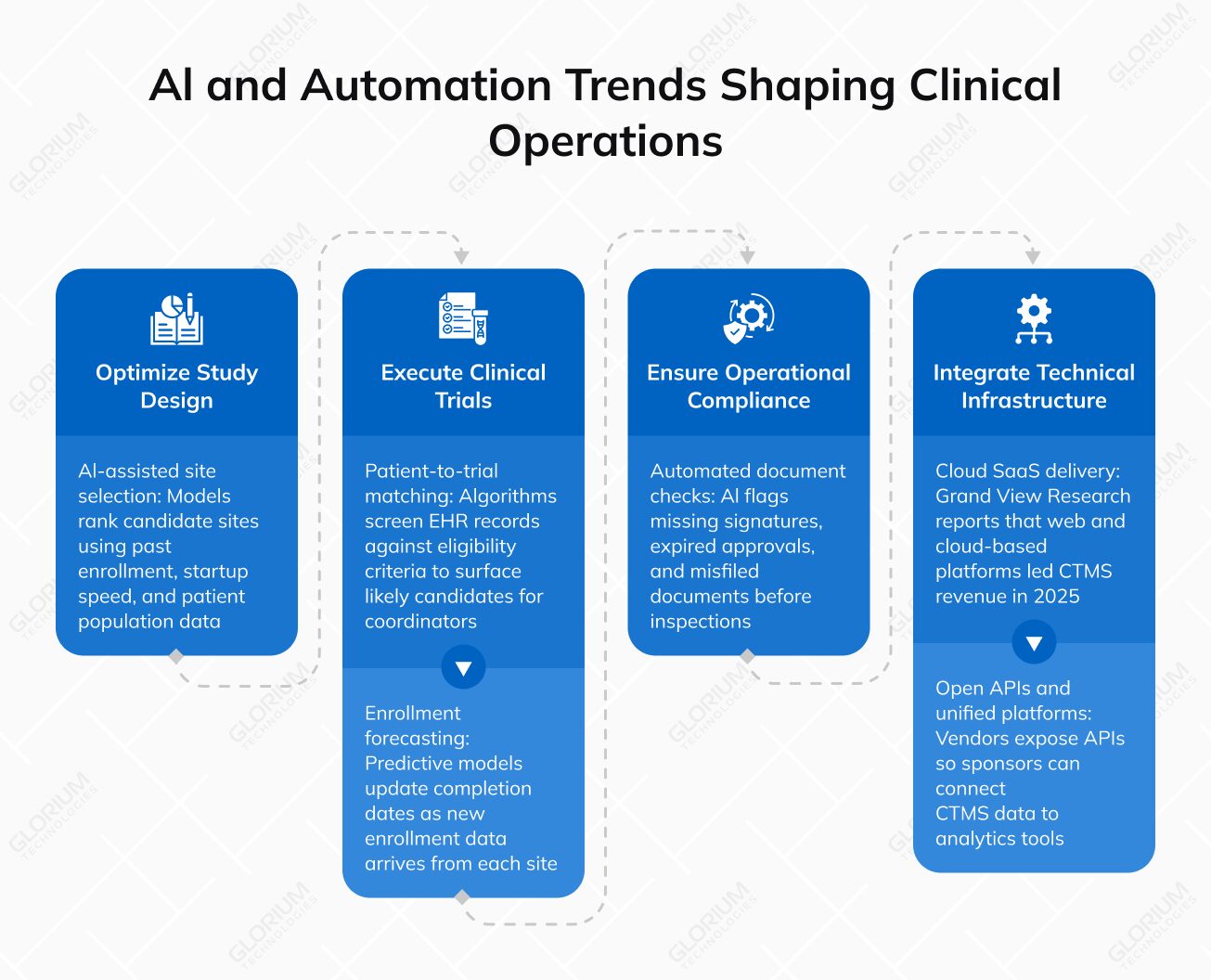
Vendors of Clinical Trial Management Systems (CTMS) are scrambling to keep pace as AI moves from isolated pilot programs to the center of daily clinical operations. In 2026, a survey of sponsors and CROs by Bain & Company revealed that 65% are already actively piloting AI tools across their portfolios. This momentum is a clear transition from early-stage experimentation to scalable implementation. Here are trends that illustrate precisely how intelligent automation is already changing the design, execution, and optimization of clinical studies.
- AI-assisted site selection: Models rank candidate sites using past enrollment, start-up speed, and patient population data
- Patient-to-trial matching: Algorithms screen EHR records against eligibility criteria to surface likely candidates for coordinators
- Enrollment forecasting: Predictive models update completion dates as new enrollment data arrives from each site
- Automated document checks: AI flags missing signatures, expired approvals, and misfiled documents before inspections
- Cloud SaaS delivery: Grand View Research reports that web and cloud-based platforms led CTMS revenue in 2025
- Open APIs and unified platforms: Vendors expose APIs so sponsors can connect CTMS data to analytics tools
Regulators are watching how teams document AI outputs. In January 2025, FDA issued draft guidance on using AI to support regulatory decision-making for drugs and biologics. That draft centers on credibility assessments tied to each model’s context of use.
AI shortens the gap between an early signal and a trial management decision, while people still own the final call. Models also depend on clean records, so research operations teams treat CTMS data discipline as groundwork for any automation project.
Build Clinical Research Software That Fits Your Trials with Glorium Technologies
The right CTMS mirrors how your sponsors, CROs, and sites already collaborate, from start-up through close-out. When commercial tools leave gaps in integrations, payments, or reporting, a focused custom layer can close them without forcing your team to switch platforms.
Glorium Technologies has spent 15+ years building healthcare and life sciences software. Our teams treat HIPAA and GDPR compliance as a baseline, follow HL7 and FHIR standards, and connect new tools to the EHR, EDC, and financial systems you already run. For TurtleHealth, we built an at-home fertility testing platform with provider portals where clinicians validate generated reports. That project shows how we pair clinical workflows with compliant, connected software.
Book an intro call with Glorium Technologies to map the CTMS integration or custom module your trials need next.
FAQ
Does cloud clinical trial management software still need validation?
Vendor validation covers the core product, but your organization still owns validation for its intended use. You document requirements, assess risk per function, and test your configured workflows, integrations, and reports. Most vendors supply a validation package you can reuse. Plan a lighter, risk-based review for each vendor release as well.
What data should we migrate into a new clinical trial management system?
Migrate active studies, site and investigator profiles, contracts, payment histories, and open action items first. Closed studies can often stay archived in the old system or a read-only repository. Clean duplicate sites and contacts beforehand, because the new CTMS will treat each record as the truth. Then confirm migrated data with sample checks against source records.
Who should own the CTMS inside our organization?
Clinical operations usually owns the CTMS as the business process owner. IT or a clinical systems team manages configuration, integrations, and releases, while quality assurance oversees validation. Finance should co-own the budget and payment modules. A named system owner with decision rights keeps configuration requests from turning into conflicting customizations.
Can Glorium Technologies integrate a custom module with the CTMS we already use?
Glorium Technologies builds custom software that extends existing healthcare and clinical systems through APIs, HL7, and FHIR. Projects can include feasibility portals, site payment engines, cross-vendor dashboards, or EHR data feeds. Work starts with a discovery phase that maps workflows, data flows, and validation needs. Your commercial CTMS stays the system of record throughout.
How does Glorium Technologies protect patient data in clinical research software?
Glorium Technologies builds healthcare software with HIPAA and GDPR compliance as a baseline requirement. Engineers apply role-based permissions, encryption, audit logging, and secure hosting from the first sprint. For FDA Part 11 features such as electronic signatures, the team implements the controls your validation plan defines. Your quality unit then verifies those controls during validation.
About Hanna Reshetniak