Clinics, hospitals, and digital health startups keep moving software off on-premises servers and onto cloud subscriptions. Grand View Research valued the global healthcare SaaS market at USD 30.0 billion in 2025, but that spending looks different in each care setting. A small clinic can run its charting, scheduling, and billing in a browser. Large healthcare organizations usually keep their core record system and add cloud tools for telehealth, patient engagement, or analytics.
Founders planning a healthcare product and CTOs replacing or extending legacy software now judge platforms on more than features, because any platform that handles patient data has to meet HIPAA and related rules. That platform also has to move records between itself, electronic health record (EHR) systems, labs, and payers through standards such as HL7 and FHIR. Its contract has to say who owns that data and how it can be exported if the relationship ends.
This guide explains how healthcare SaaS solutions work, what it takes to run safely, and how to connect them to other systems. You’ll also see where AI fits into these platforms and what it takes to build your own.
What Is SaaS in Healthcare and How Does It Work?
When a healthcare organization moves to SaaS, the vendor takes over uptime, security patching, and much of the day-to-day protection of patient data. That makes the choice of platform a choice of partner too: the contract, the BAA, and how the vendor operates matter as much as the feature list. The clearest way to see what you’re handing over is to compare SaaS with the on-premises setup most practices are moving away from.
Software-as-a-service in healthcare
Healthcare SaaS is clinical or administrative software that runs in the vendor's cloud. Customers pay for it by subscription, and the vendor updates it for all of them at once. For a practice, this removes the work of installing, patching, and backing up software on its own servers, which on-premise systems require.
The two models split the work differently. With on-premise software, the practice buys licenses, runs the servers, and installs each update itself, often months after the vendor releases it. With SaaS, staff sign in through a browser or mobile app, the vendor hosts the application and database, and new versions reach every user on the vendor's release schedule.
A cloud EHR shows what this looks like day to day. A physician can open the same chart on an exam-room laptop, a front-desk PC, or a home computer, using only a browser and a login. Because nothing has to be installed or maintained on those machines, the practice spends its IT time on users and access permissions, not on servers.
SaaS vs. PaaS vs. IaaS
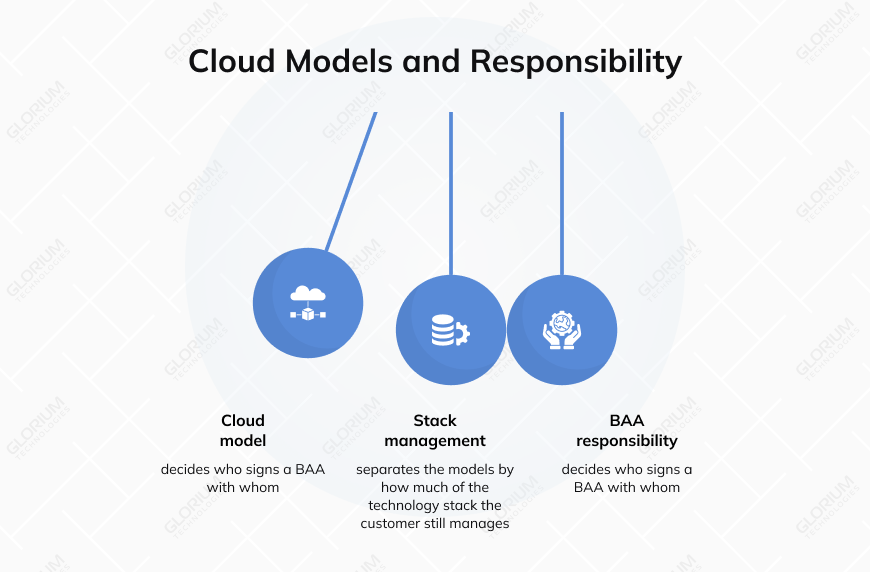
NIST separates the three cloud models by how much of the technology stack the customer still manages. IaaS (infrastructure as a service) rents servers, storage, and networking. PaaS (platform as a service) adds a managed environment for running your own applications, and SaaS delivers a finished application.
The model also decides who signs a BAA with whom. This matters for every model, because according to HHS guidance, a cloud provider that stores electronic patient data is a business associate even if it cannot read the encrypted data.
|
Layer |
IaaS |
PaaS |
SaaS |
|---|---|---|---|
|
Application |
Care organization |
Care organization |
SaaS vendor |
|
Data and user access |
Care organization |
Care organization |
Vendor stores it, organization controls users |
|
Runtime |
Care organization |
Cloud provider |
SaaS vendor |
|
Operating system |
Care organization |
Cloud provider |
SaaS vendor |
|
Servers and network |
Cloud provider |
Cloud provider |
Vendor's cloud provider |
|
BAA |
Organization signs with cloud provider |
Organization signs with cloud provider |
Organization signs with SaaS vendor, vendor signs with its cloud provider |
So a hospital that builds on IaaS keeps most of the security work in-house. A clinic on SaaS mainly reviews the vendor's controls and contracts.
Multi-tenant vs. single-tenant setups
Tenancy describes whether customers share one running copy of the application. In a multi-tenant setup, one application serves every customer, and each organization's records are kept apart logically, usually by a tenant identifier on every record. In a single-tenant setup, each customer gets its own dedicated instance.
The choice trades cost against control. Multi-tenant platforms spread infrastructure costs across all customers and ship one release to everyone at once, so prices stay lower and updates arrive faster. Single-tenant platforms cost more and are upgraded customer by customer. In return, each customer's environment is isolated. That isolation is why large health systems, payers, and organizations with data residency or custom integration needs often require single-tenant deployments.
From CapEx to OpEx
SaaS turns capital expenditure (CapEx: buying servers, licenses, and the IT staff to run them up front) into operating expense (OpEx: a predictable monthly or annual subscription). That makes budgeting easier, especially for growing practices that cannot set aside a large sum for hardware.
Some costs move to the vendor, and some stay with you. Servers, patching, backups, and disaster recovery become the vendor's job. Integrations with existing systems, data migration, staff training and internal administration stay with the buyer.
Total cost of ownership (TCO) comes from all of these costs, not only the subscription. A fair comparison sets five years of subscription fees plus integration, migration, and exit costs against the hardware, licenses, and staff hours of running the system in-house.
Healthcare SaaS market size and growth
The healthcare SaaS market is growing quickly because cloud tools are replacing on-premises systems in both clinical and administrative work. Grand View Research (2026) values the global market at USD 30.0 billion in 2025 and projects USD 131.2 billion by 2033, a 20.3% CAGR from 2026 to 2033. With growth at that pace, buyers will see more vendors to choose from, which makes clear evaluation criteria more useful.
The report names four growth drivers: wider adoption of cloud computing, demand for cost-effective solutions, demand for remote care, and regulatory compliance requirements. It also finds that hybrid deployments held the largest revenue share in 2025. Many organizations keep some data on their own servers and move the rest to the cloud, so vendors that support mixed setups have an advantage.
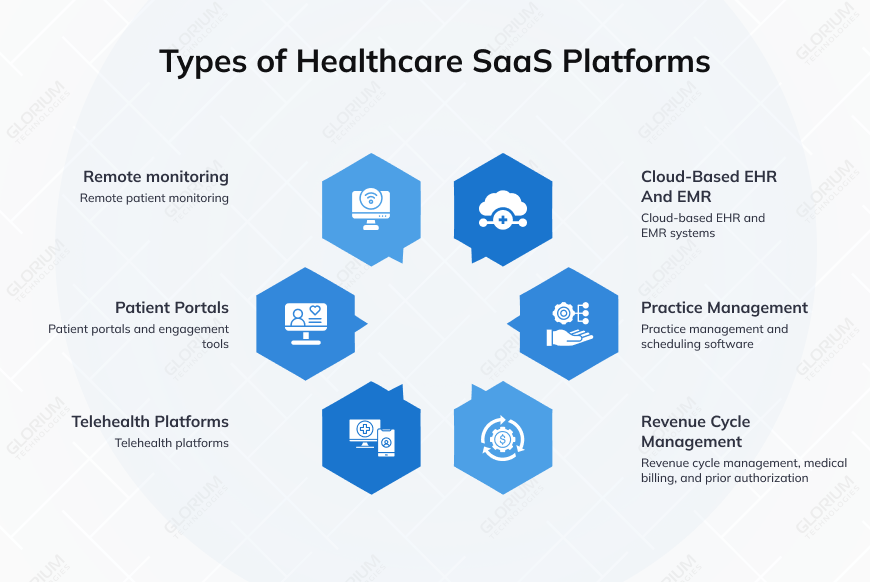
Types of Healthcare SaaS Platforms
Each type of healthcare software depends on its own standards and integrations, so a medical billing tool and a telehealth tool have very different technical requirements. Billing software has to handle payer transaction formats and code sets, while a video visit platform needs secure messaging, real-time media, and a link to the clinical data in the patient’s chart. Most healthcare providers run several of these software solutions side by side, from practice management and revenue cycle management to telehealth and remote patient monitoring, and each one has to exchange data with the others. Knowing which category a healthcare SaaS product belongs to tells you which integrations to check first, and the table at the end of this part lists the standards behind each one.
Cloud-based EHR and EMR systems
A cloud EHR (electronic health record) or EMR (electronic medical record) holds a practice's core clinical data: charting, medication lists, lab and imaging orders, results, and visit history. Every other clinical product connects to it, so it is usually the first system to compare during a migration.
The software keeps a structured patient record. Clinicians document a visit, sign orders, and the system sends them to labs or pharmacies, then files the returned results in the chart. Small- and mid-size practices often use multi-tenant cloud EHRs with standard templates for their specialty. Hospitals need inpatient modules such as bed management and medication administration records, along with hundreds of interfaces, and most run hosted enterprise systems for that reason. Whichever type you choose, check before you sign that the EHR can share data with the other systems a practice runs, since those systems all depend on it.
Practice management and scheduling software
Practice management software runs the front desk: appointments, patient check-in, demographics, insurance eligibility, and the daily schedule. Because billing later works from this same data, clean front-desk data reduces claim rejections later in the billing cycle.
Eligibility checks show how the software works. When a patient books, the system sends a standard HIPAA X12 270 inquiry to the payer and receives a 271 response that confirms coverage, copay, and deductible before the visit. Staff no longer have to call the insurer, and a lapsed policy shows up days ahead instead of at the counter. Practice management usually ships together with the EHR or connects to it closely, so appointment data flows straight into charting and billing.
Revenue cycle management, medical billing, and prior authorization
From a coded visit to a paid claim, revenue cycle management (RCM) software covers charge capture, ICD-10 diagnosis and CPT procedure coding, claim submission, denial management, and payment posting. Every claim depends on it, so it ties software quality directly to cash flow.
The software checks claims against payer rules before submission, tracks each claim's status, and sends denials to work queues with the reason code attached. Prior authorization is still one of the most time-consuming administrative tasks in this area, because staff collect clinical documentation and submit it payer by payer before a procedure can go ahead. To cut this work, the CMS Interoperability and Prior Authorization Final Rule requires affected payers to support FHIR-based prior authorization APIs. RCM vendors that build to these APIs early will need less manual follow-up later.
Telehealth platforms
Telehealth platforms provide video visits, secure messaging, and asynchronous care. In asynchronous, or "store-and-forward," care, patients send photos or questionnaires that a clinician reviews later. A video tool that stands on its own adds little, so integration matters more than call quality.
A well-integrated telehealth platform takes the appointment from the scheduling system, creates an encrypted session, and writes the visit note and duration back to the EHR so billing can code it. Dermatology is a clear example of the asynchronous model: a patient uploads lesion photos with a symptom form, and the dermatologist reviews them between in-person visits and replies through the same secure thread. When you evaluate a telehealth product, check how it handles scheduling and documentation first, then look at video features.
Patient portals and engagement tools
A patient portal gives patients self-service access to records, test results, secure messaging, bill payment, and appointment reminders. It answers routine requests that would otherwise reach the front desk by phone.
A patient portal reads data from the EHR and billing system and sends patient actions, such as a message or a refill request, back into staff work queues. Epic's MyChart is the best-known example, and patients of different health systems use one app there to view results, message their care team, pay statements, and check in for visits. The portal's value depends on how completely it is connected, because patients use it only when it shows current information.
Remote patient monitoring
Remote patient monitoring (RPM) collects readings from connected devices at home, such as blood pressure cuffs, glucose meters, and scales, and shows them to clinicians between visits. Its main use is chronic care management for conditions like hypertension, diabetes, and heart failure.
The platform pulls readings from device APIs, labels each one with a LOINC code (a standard code for clinical observations), and raises an alert when a value crosses a threshold the care team has set. Clinicians work from a dashboard that lists patients by alert, not by appointment time. In RPM solutions built by Glorium Technologies, readings are normalized into FHIR Observation records so they can go into the EHR. Medicare reimburses RPM through dedicated CPT codes, so the platform also has to track the device days and clinician minutes that billing requires.
Other healthcare SaaS products
Beyond these core categories, healthcare SaaS includes products for specific departments and for organizations outside direct care:
- E-prescribing: sends prescriptions to pharmacies using the NCPDP SCRIPT standard
- LIMS: laboratory information management systems that track samples, instruments, and results
- Healthcare analytics and BI: combines clinical, financial, and operational data into dashboards
- Care coordination: manages referrals and transitions between providers
- Clinical research management: tracks trial participants, study visits, and consent forms for research sites and sponsors
- Payer software: handles claims adjudication, enrollment, and member services for insurers
- Healthcare CRM: manages patient relationships and outreach, as Salesforce Health Cloud does on top of the Salesforce platform
The table below brings the main categories together with their buyers and the standards each one relies on:
|
Product type |
Primary buyer |
Standards or integrations it relies on |
|---|---|---|
|
Cloud EHR/EMR |
Practices, hospitals |
HL7 v2, FHIR R4, C-CDA |
|
Practice management |
Practices, clinics |
X12 eligibility transactions, EHR sync |
|
RCM and billing |
Practices, billing companies |
ICD-10, CPT, X12 claims |
|
Telehealth |
Providers, virtual care companies |
Scheduling and EHR integration |
|
Patient portals |
Providers, health systems |
FHIR APIs, payment gateways |
|
RPM |
Chronic care programs |
Device APIs, LOINC, FHIR |
|
E-prescribing |
Prescribers |
NCPDP SCRIPT |
|
LIMS |
Laboratories |
HL7 v2 orders and results, LOINC |
|
Healthcare CRM |
Health systems, payers |
EHR and marketing integrations |
The table works as a starting checklist: the standards listed next to a product type are the integrations to confirm in a demo.
Top Healthcare SaaS Companies by Care Setting
The leading healthcare SaaS vendor depends on the care setting, because hospitals and outpatient practices buy and run software in different ways. The companies below are examples of each segment, not recommendations. For a longer list, see our overview of the biggest healthcare software companies.
Hospital and enterprise systems
More US hospitals use Epic than any other EMR. KLAS data reported by Fierce Healthcare shows Epic held 43.7% of the US acute-care EHR market by hospitals and 56.9% by beds in 2025. Its share by beds is higher because large health systems choose it most often, so a SaaS product sold to hospitals usually has to integrate with Epic first.
Hospitals run Epic in their own data centers or have it hosted as a dedicated instance, which works more like single-tenant hosting than shared SaaS. Oracle Health, formerly Cerner, is Epic's biggest competitor, with 21.9% of hospitals in the same KLAS data. These two vendors determine which EHR integration programs most hospital-facing products join first.
EHR and practice software for independent and mid-size practices
Cloud subscriptions are most common in outpatient care, because a practice with a few providers rarely wants to run its own servers. The vendors below differ mainly by the size and specialty of the practices they serve:
- athenahealth: one shared cloud network for ambulatory practices, with billing services offered alongside the EHR
- eClinicalWorks: an ambulatory EHR used by physician groups and community health centers, available in the cloud
- NextGen Healthcare: ambulatory EHR and practice management with specialty content, including behavioral health
- AdvancedMD: cloud EHR, billing and scheduling aimed at small independent practices
- ModMed: specialty-specific systems for fields such as dermatology, ophthalmology and orthopedics
- Tebra: formed when Kareo merged with PatientPop, combining practice software with patient marketing
A three-provider dermatology clinic and a 40-provider multispecialty group look at different names on this list, so practice size and specialty are the first filters to apply.
Specialty and niche platforms
Some care settings have documentation and billing rules that general EHRs do not model in detail, and specialty platforms build their workflows around those rules:
- PointClickCare: records and care management for long-term and post-acute care
- Healthie: EHR, scheduling and telehealth infrastructure for virtual-first care companies
- Zocdoc: a marketplace where patients find providers and book appointments
- WebPT: documentation and billing for outpatient physical therapy clinics
- Doximity: a professional network for clinicians that also offers telehealth calling tools
- Veeva Systems: cloud CRM and clinical content software for life sciences companies
Skilled nursing facilities are one such setting: they complete the Minimum Data Set (MDS) resident assessments that CMS requires, and PointClickCare structures its records around that process. For a facility like that, built-in rules usually matter more than a broad feature list.
Benefits and Challenges of SaaS in the Healthcare Industry
Many healthcare organizations move from legacy on-premises systems to cloud-based solutions for cost savings and operational efficiency, and for remote access that lets staff work from any location. The same arrangement hands the SaaS provider control over uptime, data security, and data access, so what you gain depends on what you negotiate.
Benefits of SaaS in healthcare
The top benefits are faster rollout and lower upfront cost: a practice buys no hardware, so go-live depends on configuration and training rather than server procurement. Updates work the same way, on the vendor's side rather than yours. When CMS releases ICD-10 code changes, such as its ICD-10-PCS update materials, the vendor loads the new codes for every customer, so claims match payer rules without a local upgrade project.
Because everyone works on one shared platform, growth gets simpler: adding a location or a provider means adding accounts and subscription seats, and per-seat pricing keeps the budget predictable as the team grows. Remote clinicians join the same way, signing in through the same access controls, including multi-factor authentication. Since every site records its work in one system, managers can follow appointment volume, open claims, and automated reminder workflows across all locations.
Challenges to plan for
Most of the challenges are settled in the contract, not the code. Vendor lock-in happens when records can leave only in a proprietary format, and because every clinic runs on the same platform, an outage affects scheduling and charting at all of them at once. Customization is limited in multi-tenant products, since one release serves all customers. Of the work that stays with you, data migration needs the most planning: a practice leaving an on-premise EHR has to map years of patient history into the new system before go-live.
|
Challenge |
Contract term or approach that addresses it |
|---|---|
|
Vendor lock-in and data ownership |
Ownership clause plus export in FHIR or CSV within a set timeline |
|
Downtime |
Uptime SLA with service credits and a downtime procedure |
|
Limited customization |
Configuration options and API access confirmed in the demo |
|
Legacy integration and migration |
Vendor-led migration with HL7/FHIR interface scope |
|
Staff training and adoption |
Role-based training and go-live support in the contract |
Healthcare SaaS Compliance and Security Requirements
Every feature that stores, sends, or displays protected health information adds to a product’s compliance surface, so security requirements shape a healthcare SaaS platform from the first design decision. Healthcare SaaS providers have to meet health data regulations, prove HIPAA compliance to buyers through contracts and independent audits, and back those documents with technical safeguards that reduce real security risks. Which rules apply depends on where your patients are, what your software does, and who it shares data with.
HIPAA, PHI, and Business Associate Agreements
HIPAA’s Privacy Rule controls who may use and disclose protected health information (PHI), meaning any health data linked to an identifiable person, such as a name next to a diagnosis. The Security Rule sets the administrative, physical, and technical safeguards for PHI stored or sent electronically. Every company that touches PHI needs a BAA. The provider signs with the SaaS vendor, and the vendor signs with its cloud infrastructure provider and each subcontractor, down to the SMS service its scheduling tools use for reminders.
HITECH, the 21st Century Cures Act, and ONC certification
The HITECH Act made business associates directly liable under HIPAA and requires breach notification to patients and HHS, and to the media for large breaches. A secure platform therefore needs a tested incident response plan. The 21st Century Cures Act bans information blocking, so a portal that delays a patient’s request to access patient records could break the rule. ONC certification applies only to products that meet its certification criteria, mostly EHRs used in CMS programs.
SOC 2 Type II, HITRUST, ISO 27001, and GDPR
These frameworks give healthcare companies outside proof that a vendor’s controls work. GDPR is the only mandatory one, because it treats health data as a special category of personal data for any platform serving EU patients.
Technical safeguards
Encryption in transit (TLS) and at rest keeps intercepted or stolen data on the cloud platform unreadable. Identity management controls who gets in. Role-based access control gives healthcare professionals only what their job needs, and multi-factor authentication blocks logins made with stolen passwords. Audit logs record who opened which record and when. Data residency, the country where data is physically stored, matters for GDPR and many health system contracts. Our guide to HIPAA-compliant app development shows how these controls are built in from the start.
When healthcare SaaS becomes a medical device
The FDA regulates software by intended use. Clinical decision support that recommends insulin doses may count as Software as a Medical Device (SaMD), while a dashboard that only displays readings usually doesn’t. Healthcare SaaS development that crosses that line follows ISO 13485, the quality standard for medical device software, which Glorium Technologies holds.
Interoperability: How Healthcare SaaS Connects to Existing Systems
A healthcare SaaS product usually has to support two generations of standards at once. Most hospital data still moves in older message formats, while new applications connect through open APIs. An API-only product can serve patient apps but often can’t receive the lab results and admission feeds a hospital already runs. Integrating with existing hospital systems also differs at each site: hospitals configure messages differently, older systems expose only part of their data through FHIR, and interface work waits in the IT team’s queue. Plan mapping and testing separately for every site. Our comparison of FHIR and HL7 v2 explains where the two main exchange standards fit.
|
Standard |
What it is |
Data it moves or codes |
Typical use in a SaaS product |
|---|---|---|---|
|
HL7 v2 |
Event-based messaging through an interface engine |
Admissions, orders, results |
Receiving lab results |
|
FHIR R4 |
API-based exchange of individual records |
Records requested by the app |
Patient app showing medications |
|
App launch standard built on FHIR |
Patient and user context from the EHR |
Risk calculator opened from the chart |
|
|
C-CDA |
Structured clinical document format |
Discharge and referral summaries |
Importing referral summaries |
|
Core data set certified health IT must exchange |
Allergies, medications, problems |
Designing a format-independent data model |
|
|
TEFCA |
Nationwide exchange framework |
Records between health information networks |
Retrieving outside records |
|
Diagnosis code set |
Diagnoses |
Claims and analytics |
|
|
ICD-10-PCS |
Procedure code set |
Inpatient hospital procedures |
Inpatient billing |
|
CPT |
Procedure code set |
Procedures and services physicians bill |
Generating claims |
|
LOINC |
Observation code set |
Lab tests and device readings |
Standardizing lab and RPM data |
|
SNOMED CT |
Clinical terminology |
Findings and conditions in the chart |
Standardizing problem lists |
|
Imaging standard |
Images with patient, modality, and body part |
Teleradiology viewer |
|
|
X12 |
Payer transaction standard |
Claims and eligibility |
Submitting claims through clearinghouses |
Cloud Architecture Behind SaaS Healthcare Platforms
The tenancy model and the cloud provider decide how much of a platform falls within HIPAA scope and how the platform behaves when something fails. Both are hard to change once customers are live, because moving PHI to another cloud or splitting a shared database into per-tenant databases means migrating every existing customer, so teams settle on them before they build the first feature.
HIPAA-eligible cloud services
A cloud provider’s BAA covers only the services it lists as HIPAA-eligible. A platform that sends error logs containing patient names to an uncovered logging tool has moved PHI outside its BAA. All three major providers offer managed services for health data:
- AWS HealthLake: stores and queries clinical data as FHIR R4 records
- Azure Health Data Services: combines FHIR and DICOM services with role-based access
- Google Cloud Healthcare API: handles FHIR, HL7 v2, and DICOM, and can de-identify data for analytics
Eligibility only means a service can be configured for compliance. The team still has to set up encryption, access rules, and logging.
Tenant isolation and microservices
In a multi-tenant platform, the isolation method decides how strictly customers’ data is kept apart:
- Database per tenant: strongest separation and simple export, but higher cost and more upgrade work
- Schema per tenant: separate tables in a shared database, a middle ground for dozens to hundreds of customers
- Row level: a tenant ID on every row, cheapest to run but dependent on every query filtering correctly
Microservices apply the same separation to features. Scheduling, clinical notes, and billing each get their own data store and access rules, which narrows the audit scope to the services that hold PHI. Our SaaS development services include planning this separation at the architecture stage.
Uptime SLAs, backups, and disaster recovery
A 99.9% uptime SLA allows about 8 hours and 46 minutes of downtime a year, enough for a clinic to lose a full day of chart access if it comes at once. Ask whether maintenance windows count toward that total. Frequent automated backups with point-in-time restore keep data loss (RPO) to minutes, and replication to a second region keeps the platform running if a cloud region fails. Test restores on a schedule, because a backup isn’t proven until a restore finishes.
CI/CD in regulated environments
A CI/CD pipeline runs automated tests and security scans on every change before it reaches production. Synthetic patient data replaces real PHI in development and staging. The pipeline also records who approved each change, which tests ran, and when it shipped, and that log serves as ready-made evidence for a SOC 2 Type II audit.
AI in Healthcare SaaS
In healthcare SaaS, AI is being adopted first in administrative work such as documentation, coding, and prior authorization, because these tasks carry less regulatory risk than diagnosis. A clinician or billing specialist reviews each AI output before it is used, which keeps most of these tools outside the SaMD scope covered earlier. This section lists the most common uses and what to plan before you add them.
The most common uses are:
- AI scribes: ambient documentation tools such as Nuance DAX Copilot and Abridge listen to the visit conversation and draft a note that the physician edits and signs
- AI medical coding: models read the signed note and suggest ICD-10 and CPT codes for a coder to confirm
- Prior authorization automation: the system pulls supporting chart data into the payer request, so staff review a prepared package instead of assembling one
- Predictive analytics: appointment and visit history feed machine learning models that flag likely no-shows or readmission risk, and the care team works from that flagged list
- AI chatbots: assistants answer routine patient questions, book visits, and send symptom reports to the right level of care
Glorium Technologies' Virtual Assistant Module for Patient Scheduling uses the chatbot approach, so patients book and reschedule visits through a conversational assistant instead of calling the front desk.
Before you add AI features, plan the data preparation and how you'll measure results. Our guide to implementing AI in healthcare SaaS covers both steps.
How to Build a Healthcare SaaS Product: Build vs. Buy
Building a healthcare SaaS product starts with deciding whether to build at all. So the first question we need to ask is whether you need to get an off-the-shelf solution or build a custom one.
Off-the-shelf software is enough when your workflows follow the market standard. A family practice that charts, schedules, and bills like thousands of others can get a tested product and a vendor BAA for a subscription fee. Custom SaaS application development makes sense when the workflow itself is the product. Examples include a new care model, a niche specialty that no vendor serves, or software you plan to sell to other organizations.
Turtle Health is an example of the custom case: no ready-made platform supported at-home fertility testing, so Glorium Technologies built patient, provider, and admin portals for it. The portals cover online intake, ultrasound and blood-test inputs from home, report generation, and provider review. For longer-term work, Glorium Technologies has been developing an all-in-one platform for HME/DME suppliers, adding modules and integrations as its customer base grew.
Steps to build a healthcare SaaS platform
A healthcare SaaS build follows a fixed order because each step depends on decisions made in the one before:
- Market and compliance research: confirm who buys, which rules apply (HIPAA, GDPR, possible SaMD status), and which EHRs your target customers run
- Architecture: choose the multi-tenant isolation model and define RBAC roles before any screens are designed
- HL7/FHIR integration: build interfaces to the EHRs and labs that your first customers already use
- MVP with BAAs and a HIPAA-ready cloud: sign BAAs with the cloud provider and subcontractors, then release a focused first version on eligible services only
- Security and penetration testing: have outside testers try to break access controls and tenant isolation before real PHI arrives
- Launch: go live with a pilot customer, active monitoring and a tested incident response plan
Healthcare SaaS pricing models
Healthcare SaaS pricing works best when it bills for the unit your customer already tracks, such as clinicians, enrolled patients, or visits. Our guide to SaaS pricing models covers the general framework, and the healthcare versions look like this:
|
Pricing model |
How it bills |
Best fit |
What to watch for |
|---|---|---|---|
|
Per provider per month |
Fixed fee per clinician seat |
EHR, practice management |
Part-time providers raising cost |
|
Per patient |
Fee per enrolled or active patient |
RPM, care management |
How "active" is defined |
|
Tiered |
Feature bundles by organization size |
Products serving clinics and groups |
Security features locked in top tiers |
|
Usage-based |
Per visit, claim, or API call |
Telehealth, RCM |
Unpredictable monthly bills |
Cost and timeline drivers
Budget and schedule depend on scope more than on screen count, and five factors drive the work behind each feature:
- Compliance scope: preparing for HITRUST or SOC 2 adds controls and evidence collection
- Number of integrations: each EHR site needs its own mapping and testing
- Tenancy model: single-tenant deployments add infrastructure and upgrade work
- AI features: these require data preparation and clinician review workflows
- User roles: every role adds permission rules and test cases
A focused MVP with one integration ships much sooner than a platform with several EHR interfaces and audit-ready controls. Because these factors set the size of the work, Glorium Technologies fixes the scope during discovery and then gives a timeline estimate.
Build Your Healthcare SaaS Platform with Glorium Technologies
A healthcare SaaS product earns the trust of providers and investors long before its feature list grows, through the compliance and integration choices made at the very start. Those choices go faster with a development partner that has already made them in production.
Glorium Technologies brings 15+ years of experience in software development and digital transformation to this work. Our healthcare software development and SaaS development services cover the full path from discovery to launch: mapping the BAA chain, designing HIPAA-ready architecture on eligible cloud services, and building the HL7 and FHIR integrations your first customers will expect. Once the platform is live, the same team stays on to add locations, user roles, and AI-assisted workflows as your customer base grows. If you’re ready to turn your healthcare SaaS idea into a platform hospitals can approve, book an intro call with Glorium Technologies or estimate the cost of your healthcare SaaS platform.
FAQs
Does Glorium Technologies sign a BAA when building a healthcare SaaS platform?
Glorium Technologies signs a BAA before work starts whenever the engagement gives our team access to PHI. That includes data migration, production support, and troubleshooting live issues. The agreement states which PHI the team may handle, which safeguards apply to it, including workforce training on PHI handling, and how a security incident is reported to you. Most of the build itself doesn’t need real patient data, because development and test environments run on synthetic or de-identified records. PHI therefore stays in production, where your access controls and audit logs cover it.
Can Glorium Technologies take over a healthcare SaaS product another vendor started?
When Glorium Technologies takes over a product, our development services start with a code audit of what has been built so far. The audit covers code quality, architecture, test coverage, and how PHI moves through the system, so the next steps are based on what the codebase actually contains. A stabilization phase follows: critical defects are fixed, the deployment pipeline is set up, and monitoring is added before any new features are built. The compliance review then checks encryption, access roles, audit logging, and the BAA chain with the cloud provider and subcontractors, and its findings become the first items on the roadmap. New features then follow in agile development cycles, with customer feedback setting their priority.
Who owns the code and patient data when an outsourced team builds a healthcare SaaS app?
The client owns the code when the development contract includes an IP assignment clause, which transfers all source code, designs, and documentation to you as the work is delivered. Ownership is easier to prove when the code repository and the cloud accounts are registered in your company’s name from the first day, because the outsourced team then works inside them through access you can revoke. This also makes a later vendor change simpler for healthcare businesses. Patient data is a different matter, because PHI belongs to the covered entity, meaning the provider or health plan that collected it while delivering or paying for healthcare services. The development team acts only as a business associate under a BAA.
How do I get a healthcare SaaS app listed in the Epic or athenahealth marketplace?
To get listed, you join the EHR vendor’s developer program, which is Epic Showroom for Epic and the athenahealth Marketplace for athenahealth, and then pass its technical and security review. Both programs expect the app to connect through the vendor’s FHIR APIs. Apps opened from inside the chart also need SMART on FHIR launch support, so they fit into the EHR workflow management clinicians already rely on for patient care. The review usually includes a security questionnaire, integration testing in the vendor’s test environment, and a check of how the app handles patient data. Program terms and fees differ between vendors, so read the current requirements before you finalize the architecture, which helps the integration pass review the first time, and factor any program fees into your subscription-based pricing models.
Can one healthcare SaaS platform serve both US and EU patients?
One healthcare SaaS platform can serve both regions when a single codebase is deployed separately in a US cloud region and an EU cloud region, so each region’s patient data stays where its rules require. In the US deployment, HIPAA applies, along with BAAs with the cloud provider and subcontractors. The EU deployment runs under GDPR instead, which requires a lawful basis for each purpose of processing health data, from treatment to population health research on patient outcomes, as well as data processing agreements with each processor and a data protection impact assessment. Consent records and data deletion requests work best as configurable data management settings for each region, so you don’t have to maintain separate builds. Running one codebase also improves overall operational efficiency and keeps maintenance costs lower, which supports competitive subscription plans in both markets.
What do investors check in a healthcare SaaS product during technical due diligence?
During technical due diligence, investors in the healthcare sector check whether the product can pass hospital security reviews and grow without a rebuild. They usually ask for security attestations, such as a SOC 2 Type II report or a dated plan to get one, along with recent penetration test results and signed BAAs. Scalability reviews look at the tenancy model, at how infrastructure costs per customer change as the product grows, since those costs set the margin for creating competitive subscription plans, and at how backups and recovery are set up. Investors also judge integration readiness by which EHRs the product already connects to through HL7 v2 or FHIR, along with any billing or inventory management systems it depends on. They review code quality and documentation, confirm IP ownership through contractor assignment agreements and open-source license records, and, for clinical products, may ask for evidence that the product can improve patient outcomes and patient satisfaction.
About Hanna Reshetniak