








Generative AI in Software Testing: What Changes for QA Teams
Updated September 17, 2026

 Summarize in ChatGPT
 Summarize in ChatGPT
Nearly nine in ten organizations are now piloting or deploying generative AI in quality engineering, and only 15% have scaled it across the enterprise, according to the World Quality Report 2025 from Capgemini, OpenText, and Sogeti. That distance between trying generative AI in software testing and running it in production is where most QA teams now operate. What separates the two groups is less about tool choice than about which testing work they hand to a model and which they keep.
That split between what AI generates and what a QA team verifies shapes most of what follows: where AI can generate test cases worth keeping, how self-healing test automation cuts test maintenance, what synthetic test data generation solves under GDPR and HIPAA, and which parts of QA still belong to human testers.
Content
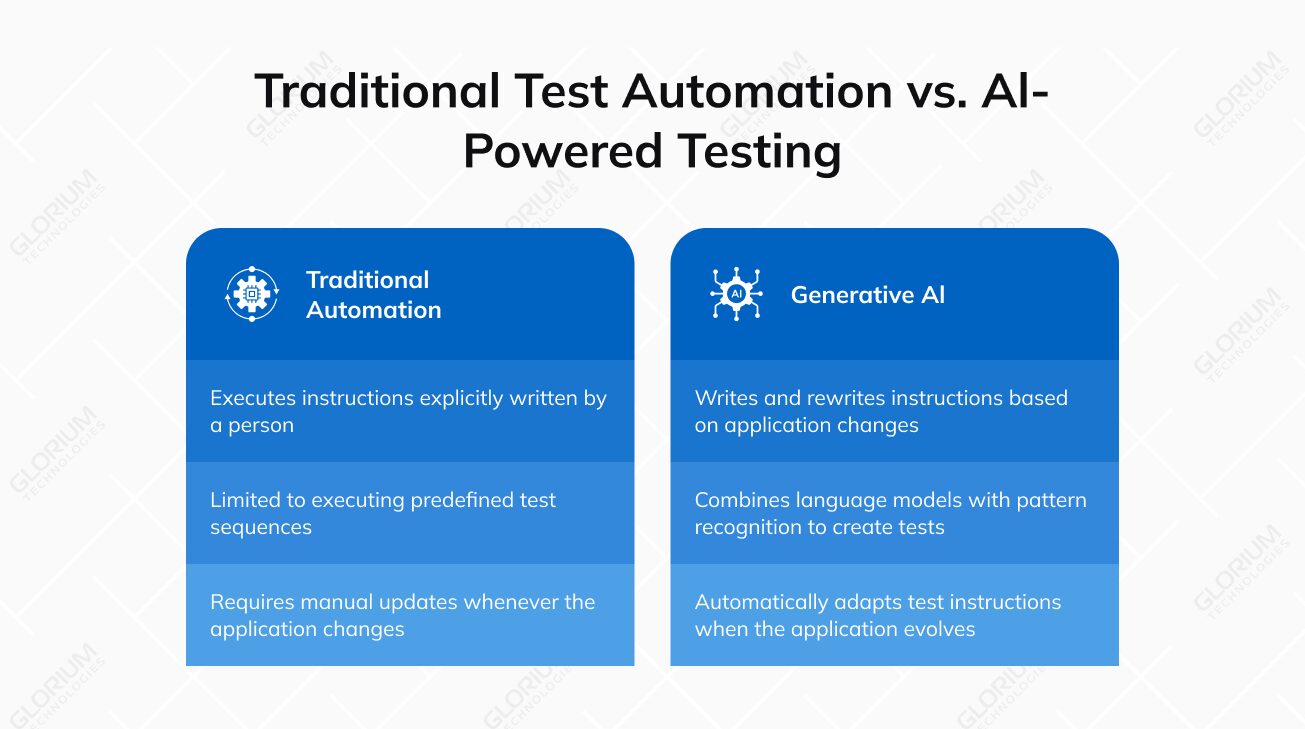
Traditional test automation executes instructions a person wrote. Generative AI writes those instructions, then rewrites them when the application changes. That distinction may seem small on paper, but it changes the economics of a test suite. Machine learning has supported software testing for years through defect prediction and test prioritization, and generative models add authorship: they write test cases rather than only ranking them.
The technology pairs large language models with those older machine learning techniques. Natural language processing reads user stories, acceptance criteria, and API specifications, then turns them into test cases. At the same time, pattern recognition models study historical test data to predict which areas break next.
Scripted automation stays useful for stable, high-value flows. AI-powered testing fits where the cost of writing and repairing test scripts outweighs the value of running them.
| Dimension | Traditional test automation | AI-powered testing |
| Test creation | Engineers write test scripts by hand | AI can generate test cases from natural language requirements, user stories, or recorded sessions |
| Reaction to UI changes | Locators break, automated tests fail, someone fixes them | Self-healing test automation re-maps elements and keeps the tests running |
| Test coverage decisions | Based on team knowledge and available time | Based on code changes, usage patterns, and historical defect data |
| Test data | Manually prepared or copied from production | Synthetic test data generated on demand, free of real customer records |
| Maintenance load | Grows with every release | Falls as AI models absorb recurring change patterns |
| Skills required | Programming knowledge for most tasks | Natural language authoring opens test creation to manual testers and product managers |
Generative models handle authoring. Classical machine learning handles judgment: which tests to run first, which test failures look like real defects, which look like flaky tests.
A mature software testing setup uses both. The generative layer produces test cases and test code. The predictive layer ranks the regression suite so the riskiest checks execute in the first ten minutes of the pipeline, and machine learning trained on historical data sharpens that ranking as test results accumulate.
Several model families stand behind the label, and QA teams meet different ones depending on the task.
| Model type | Role in software testing |
| Large language models | Read requirements and user stories, then generate test cases and test code |
| Multimodal models | Interpret screens as well as text, which powers visual and UI testing |
| Generative adversarial networks | Produce synthetic test data realistic enough for performance and security testing |
| Diffusion models | Generate large datasets holding the statistical patterns of production data |
| Reinforcement learning | Trains an agent to explore an application and improve its path with each run |
Commercial testing tools combine several of these behind one interface, so the capability matters more than the model type.
Crossing from pilot to production happens one use case at a time. The applications below are where QA teams start, roughly in the order they repay the setup effort.
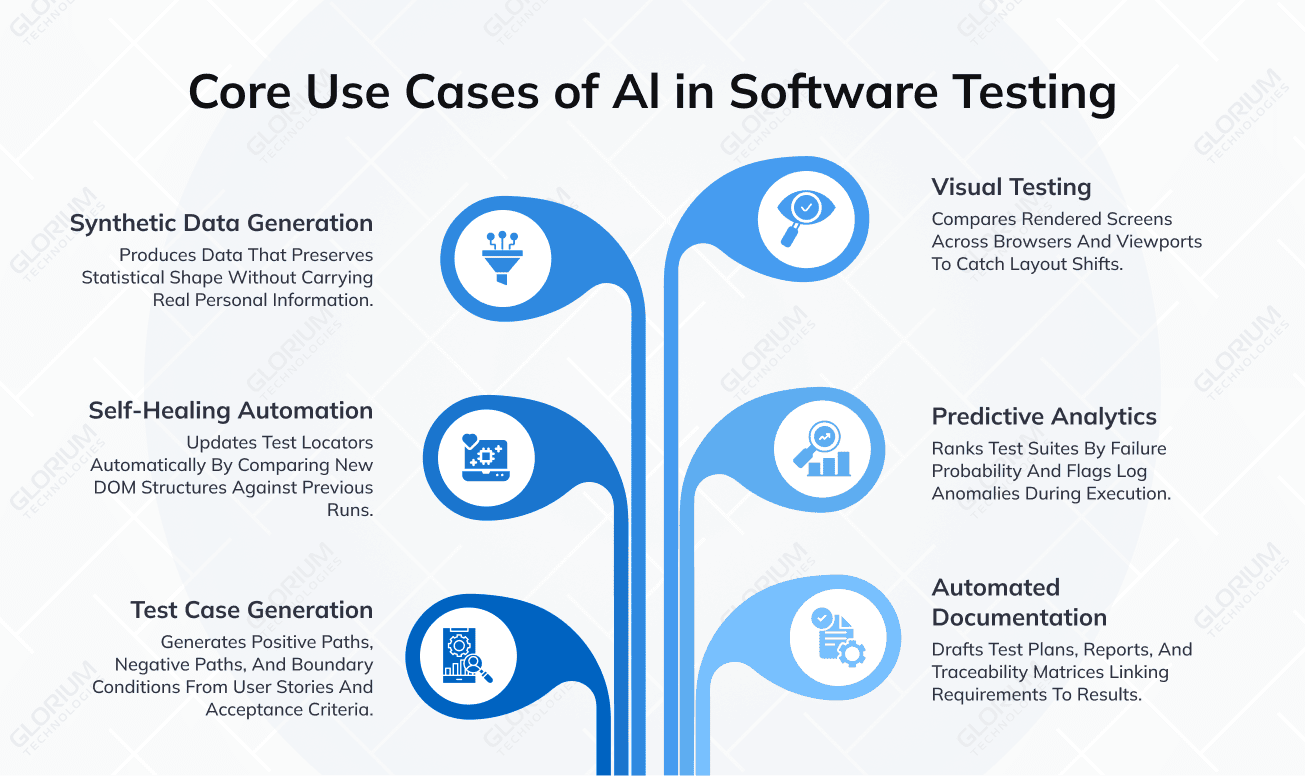
Given a user story with acceptance criteria, a model returns a first draft of positive paths, negative paths, and boundary conditions in minutes. QA teams generate test cases this way for unit tests, API testing, and UI testing of new features, where no legacy tests exist.
The output is a draft, not a deliverable. A QA engineer reviews whether the generated tests match real business logic before anything joins the regression suite. Teams generating test cases at volume also need a review queue; otherwise, the suite fills with near-duplicate test cases nobody trusts.
When a developer renames a button or restructures a component, conventional automated tests fail on a missing selector. Self-healing tests compare the new DOM against previous runs, identify the element by its context, and update the locator automatically.
The result is fewer false failures and less test maintenance. QA teams running large UI testing suites often name this as the change that made nightly runs trustworthy again.
Realistic data has always been the awkward part of software testing. Copying production records into a test environment creates compliance exposure under GDPR and HIPAA, and scrubbed data loses the edge cases that matter.
AI can produce synthetic test data that preserves statistical shape without carrying real personal information. The World Quality Report found synthetic data use in testing rose from 14% in 2024 to 25% in 2025, the top-ranked generative AI use case in quality engineering.
Visual testing models compare rendered screens across browsers and viewports, catching layout shifts a DOM-based assertion never notices. The mechanism is a baseline: an approved screenshot becomes the reference, and later runs are diffed against it.
Baseline management is where QA teams stall, since one redesign invalidates hundreds of baselines at once. AI models group the differences into layout, color, and content changes, so a reviewer approves a category rather than every individual screen.
Predictive analytics uses historical test data to answer a question every release manager asks: which tests run when only twenty minutes are available? Models rank test suites by the probability that a change breaks a given area, so the first tests to execute are the ones most likely to catch something. The same layer flags log anomalies during test execution, shortening the path from a failed build to a root cause.
Prioritization matters most on a wide regression surface. Glorium Technologies built an HME/DME platform covering intake, billing, inventory, and delivery in one system, where a change to billing rules touches every module downstream and running the full suite on every commit stops being realistic.
Generative AI drafts test plans, runs reports, and the traceability matrix linking requirements to test cases to results. That matrix changes with every release, and auditors read it closely. Generating it is low-risk, since the underlying evidence stays the same and only the assembly is automated.
Vendor claims overlap, so ask which job a tool was built for. Most run on top of Selenium or Playwright rather than replacing them.
| Job | Tools commonly used |
| Test case generation | GitHub Copilot, ACCELQ, Katalon |
| Self-healing automation | Healenium, Testim, mabl |
| Visual testing | Applitools, BrowserStack Percy |
| Risk-based prioritization | Tricentis Tosca, Tricentis qTest |
The gains from AI-powered testing cluster around speed, test coverage, and who gets to participate in quality work.
Cost reduction follows from these gains: when repetitive testing tasks stop consuming QA capacity, the same team covers more surface area without new headcount. AI can also generate tests faster than a QA team can review them, so review capacity becomes the new constraint.
Enthusiasm outpaces readiness, and the friction points repeat from team to team. Data handling and output reliability lead, and both are solvable with process rather than with a different tool.
AI models need volume and labeling to perform well. Feeding them production data creates regulatory exposure, and poorly labeled internal data produces output that reads authoritatively but is wrong. A scoped, non-production corpus plus synthetic test data is what usually clears an internal security review.
The same prompt can yield different test code on different days. QA teams that treat generated tests as final artifacts usually learn this through a suite that passes while real defects reach production.
When an AI testing tool decides a failure is not worth reporting, engineers want to know why. Limited explainability slows trust, particularly in regulated products where auditors ask how a decision was reached.
An AI testing tool that cannot read your test management system or trigger from your CI pipeline creates a parallel process nobody maintains. The World Quality Report found 58% of organizations citing difficulties adopting AI-powered tools, and 60% struggling with secure, scalable test data.
Licensing for AI tools, compute, and the ramp-up period are real costs. Generative AI now ranks as the top skill requirement for quality engineers at 63%, ahead of core quality engineering skills, which is where training budgets should be pointed.
A staged rollout beats a platform migration. The sequence below is how QA teams reach production use rather than a permanent pilot.
QA teams that skip step three pay for it in production. Generated tests that pass while missing real behavior create false confidence, which is more expensive than the manual testing they replaced.
“The idea here is not to completely remove the testers but enable them… These tools will help you get a framework or get a broad list, and then from there you can see what is relevant, what you want to keep, or if there are any gaps you can go ahead and add more test cases.”
Manish Verma, Generative AI for Software Testers, Software Testing Mentor
Gartner’s Market Guide for AI-Augmented Software Testing Tools projects 80% of enterprises will have integrated AI-augmented testing tools into their software engineering toolchain by 2027, up from roughly one in seven enterprises in early 2023.
Several shifts drive that forecast:
None of this points toward replacing testers. Software testing AI removes repetitive tasks, and what remains is the work that needs critical thinking all along: deciding what software quality means for this product, questioning requirements that do not make sense, and judging whether a defect matters to the people using the software. Manual testing keeps its place where automated tests fit poorly, such as new interfaces and ambiguous workflows.
AI in software testing rarely fails on tooling. Programs stall where someone decides which test cases can be generated safely, which need human authorship, and how to prove both at the next audit. In healthcare and real estate products, that decision carries regulatory weight, and QA teams make it while the release calendar keeps moving.
Glorium Technologies has been working in custom software development since 2010, delivering 150+ projects across healthcare, real estate, and other regulated sectors. Our software testing services cover functional, regression, performance, security, integration, and usability testing, and our AI software development team works on the model side of the same problem.
Bring your suite runtime and maintenance hours to a free call with our experts, and we will map out what a staged rollout looks like for your product.
Budget for three items: licensing, usually charged per user or per test execution; engineering time to connect the tool to your CI pipeline and test management system; and a ramp-up of one to two sprints before output stabilizes. QA teams already running mature test automation see returns sooner. Glorium Technologies scopes this in a discovery session, so the license decision follows the integration estimate rather than preceding it.
Four questions separate the useful tools from the demos:
Vague answers on export deserve a second look.
Yes, with documented review. Auditors care about traceability, so keep the generated draft, the reviewer’s changes, and the approval record. Healthcare teams use generative AI for the first draft and treat human review as the controlled step in their quality management system. Glorium Technologies works to ISO 9001, ISO 13485, and ISO 27001 processes, where that evidence trail gets defined.
Self-healing layers exist as add-ons for Selenium and Playwright suites, so QA teams can add AI capability to existing automated tests without rewriting them. This is the lowest-risk entry point, and the one Glorium Technologies recommends when a client already has a working suite. Small teams without a dedicated QA engineer usually start here too, with a part-time QA lead, in-house or through outstaffing, reviewing what the tool produces.