






Predictive Analytics in Healthcare: Turning Patient Data into Earlier Decisions
Updated August 12, 2026

 Summarize in ChatGPT
 Summarize in ChatGPT
Most health systems already collect far more data than they ever put to use, and what matters is whether any of it can warn a care team in time to change what happens next. That is exactly what predictive analytics in healthcare is built to do, reading patterns in past and current patient information to estimate what is coming, from who might be readmitted to which units will run short on beds by Friday. Used well, predictive analytics moves care teams from reacting after the fact toward heading trouble off early, which is where most of the gains in patient outcomes and cost tend to show up.
Hospitals have largely stopped asking whether prediction works and started asking which model to trust. In 2024, 71% of US hospitals reported using predictive AI built into their electronic health record, up from 66% a year earlier, according to a federal analysis of American Hospital Association survey data. The most common use was forecasting risks and health trajectories for admitted patients, which is the same job clinicians have always done by intuition and chart review.
What separates a useful model from an expensive dashboard is what happens after the score appears: whether a nurse, a scheduler, or a care manager sees it in time and knows what to do next. This guide covers how these models are built, where they change patient care and hospital operations, what named health systems have measured, and the obstacles worth budgeting for before the first model goes live.
Content
Predictive analytics in healthcare uses historical data, statistical modeling, and machine learning to forecast future medical events and operational needs. Instead of describing what already happened, predictive models estimate what is likely to happen next for a specific patient, unit, or population. That shift from hindsight to foresight explains why analytics work has moved out of the monthly reporting cycle and into the tools clinicians open during a shift.
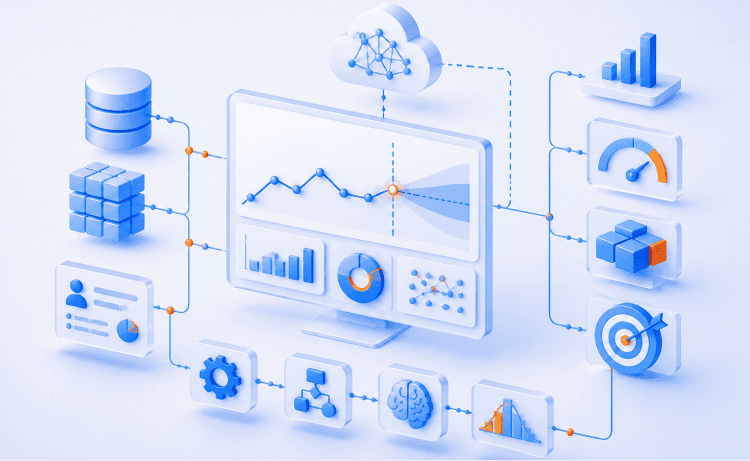
Predictive models learn patterns from large volumes of patient data and then score new cases against those patterns. The raw material usually comes from several sources at once:
A model applies statistical modeling and machine learning to that input, and streaming real-time data keeps its predictions current as a patient’s condition shifts. Techniques range from regression and data mining to deep learning, which handles the scale and nonlinearity that traditional statistical methods cannot. The output is a score: a patient’s readmission risk, likely length of stay, or probability of a complication. Healthcare organizations then route those predictions into a workflow, so the forecast becomes an action rather than a dashboard number.
Descriptive analytics reports the past, showing how many patients were readmitted last quarter. Predictive analytics estimates the future, flagging which current patients are most likely to return. Prescriptive analytics recommends what to do about it, such as scheduling a follow-up call within 48 hours of discharge. Most healthcare providers start with descriptive reporting of healthcare data and grow into predictive and prescriptive use over time, as data quality and clinician trust improve. Real-time data analysis turns those static reports into live guidance that keeps pace with a changing patient.
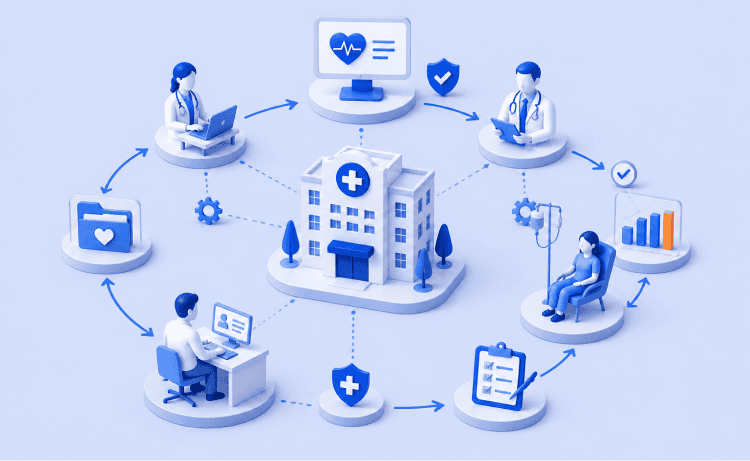
The clearest wins show up in direct care, where an earlier signal gives clinicians room to act. Three uses carry most of the value today: surfacing risk before symptoms declare themselves, matching a therapy to the patient most likely to respond, and keeping recently discharged people from coming back. Each one depends on the same thing: a score that reaches a clinician while there is still time to change the plan.
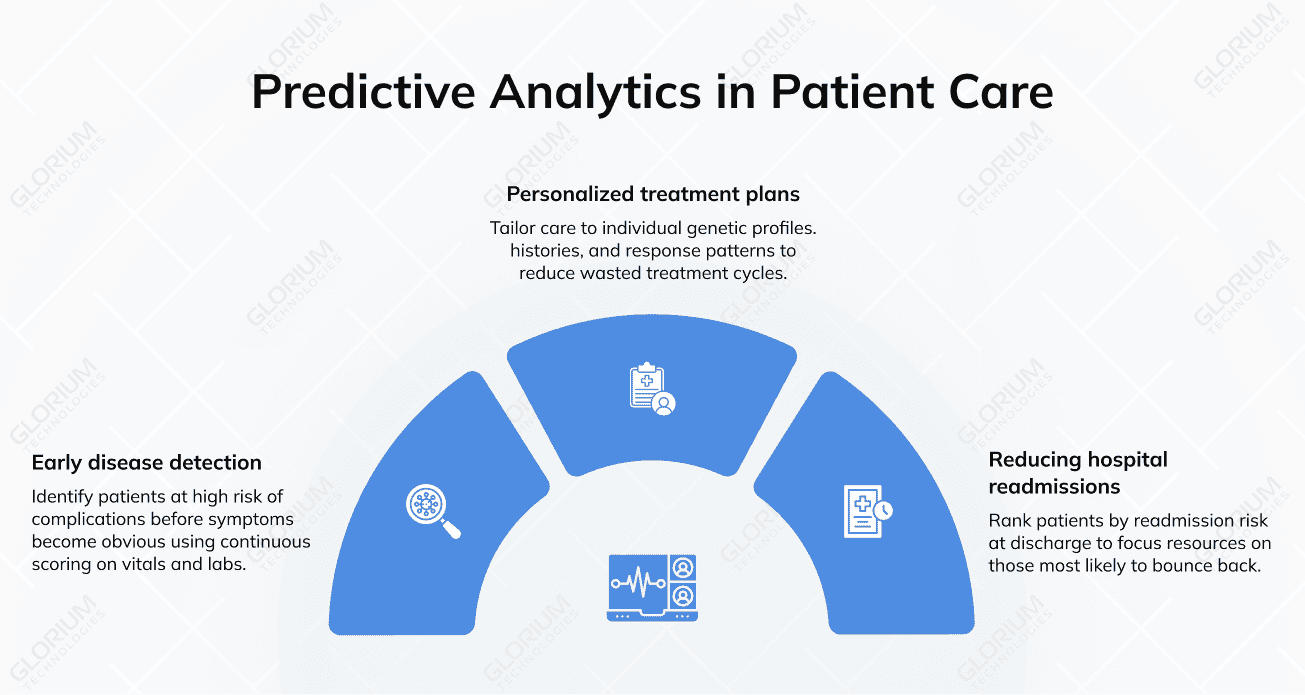
Predictive models can identify patients at high risk of complications before symptoms become obvious. Continuous scoring on vitals and labs helps identify early signs of sepsis, cardiac events, or respiratory decline, giving care teams a head start. The same predictive analytics tool weighs risk factors such as age, comorbidities, and prior admissions to identify high-risk patients who need closer watching. For chronic disease management, that scoring catches people whose diabetes or heart failure is drifting toward crisis, often weeks before an admission would have happened. The practical gain is time: a phone call, a medication change, or an earlier appointment instead of an ambulance.
Predictive analytics tailors care to individual genetic profiles, histories, and response patterns, which is the core promise of personalized medicine. Rather than working through options by trial and error, clinicians use predictive models that estimate how individual patients are likely to respond to a specific therapy. That reduces wasted treatment cycles and helps build personalized treatment plans grounded in each patient’s medical history. In oncology and rare disease, where the wrong first-line choice costs precious time, models that weigh a patient’s medical history against genetic data help clinicians reach effective treatment plans and better clinical outcomes sooner. Glorium Technologies applied this idea directly in a data-driven diagnostic and predictive app for improving infant outcomes, where analytics help clinicians act on patterns in preterm infant data earlier in care.
Readmissions are a persistent cost and quality problem that predictive analytics targets directly. The national 30-day all-cause readmission rate sits around 14.5%, according to AHRQ. Close to one in five Medicare patients is back within a month. Predictive models rank patients by readmission risk at discharge, so scarce patient care resources, home visits, medication reconciliation, and check-in calls go to the people most likely to bounce back. The result is fewer preventable returns, improved patient outcomes, and a discharge process that reflects real risk rather than a one-size template.
Predictive analytics stops being abstract once you see what health systems have published. The results below come from named organizations and vary by setting, so read them as evidence of what is achievable rather than as guarantees.
Zuckerberg San Francisco General Hospital wired readmission risk scores into an EHR-based discharge checklist and routed the highest-risk heart failure patients to a dedicated multidisciplinary team. Readmission rates for that group fell from 27.9% to 23.9%, a readmission gap affecting Black patients closed, and the hospital retained $7.2 million of at-risk pay-for-performance funding against a $1 million build cost, according to the evaluation published in The American Journal of Managed Care in 2025. Two details are worth copying. Every score was tied to a referral a clinician could place, because the team found that surfacing a prediction without a recommended action changed nothing. And clinician use of the tool sat below 1% until design workshops and monthly orientations lifted it to between 56% and 75%.
RWJBarnabas Health put an AI early warning score in front of clinicians at 11 New Jersey hospitals, recalculating every inpatient’s risk every 15 minutes and paging rapid response teams automatically once a patient crossed the highest threshold. Among 23,132 high-risk patients, deaths dropped from 23.1% to 18.6%, an 18% reduction in the risk-adjusted odds of dying in the hospital, according to Rutgers, which published the evaluation with the health system in NEJM AI in July 2026. Rapid response calls rose while ICU transfers held steady, which is what earlier recognition looks like in daily practice.
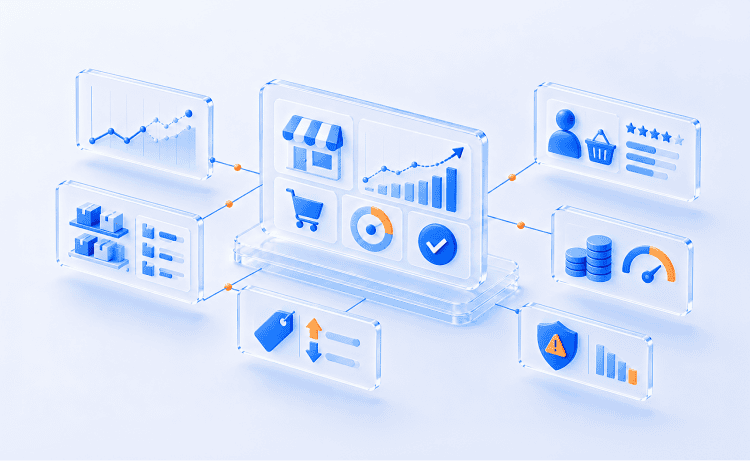
Operational gains from predictive analytics matter just as much as clinical ones. Health systems have used predictive analytics to make better use of their exam rooms and cut appointment no-shows. Freeing up existing rooms means more patients seen without new construction, a direct win for healthcare operations and for reducing costs.
Predictive analytics also prepares health systems for pressure they have not seen yet. Official outbreak declarations lag badly behind the evidence. Across 2025, BlueDot measured a median 79-day gap between the point an outbreak became detectable and the point a major health agency declared it, against a median of three days on its own surveillance platform, and nearly 30% of chikungunya outbreaks were never formally declared at all.
Watching those signals rather than waiting for the announcement is what lets hospitals use real-time data to allocate beds, ventilators, and staff before demand spikes. The same predictive work reaches into research. Only 6.7% of drugs entering phase 1 trials now reach approval, down from 10.4% a decade earlier, and phase 2 remains the sharpest cut with a 28% pass rate, according to Citeline’s analysis of ten years of phase-transition data. Predictive models help researchers screen candidates earlier and design trials around the patients most likely to respond.
Beyond individual patients, predictive analytics helps healthcare organizations run the building. Forecasting demand, staffing, and flow lets managers plan instead of scrambling, and that planning is where a lot of waste and cost quietly disappears.
Hospitals can anticipate admission rates, forecast patient length of stay, and match staffing to predicted patient demand rather than yesterday’s guess. Predicting a surge two days out gives nurse managers time to adjust rosters and open capacity in an orderly way. Glorium Technologies built a solution for managing patient flow and hospital beds that gives clinical teams a live view of bed availability and movement, the kind of operational backbone that real-time data and predictive scheduling depend on.
Most of the savings come from replacing guesswork about demand with a forecast. Models can identify patients likely to miss appointments, so schedulers can double-book or send reminders and cut the revenue lost to no-shows. Studying patient behavior this way also lifts patient engagement, since the people most likely to drop off get outreach first. Supply and pharmacy forecasting trims overstock and shortages. Each gain is modest on its own, and together they add up to real reductions in cost across a large system.
The same tools support population health management, where the unit of analysis is a whole patient panel rather than one person. Predictive models identify trends across a population, such as a rising share of patients with chronic conditions like poorly controlled diabetes, or a small group of high utilizers who could benefit from case management. Health systems use those insights to steer care resources toward the groups that will move the numbers most, which is where value-based contracts and tight margins make prediction pay for itself.
The table below shows how the same operational questions look under a reactive approach versus a predictive one.
| Operational question | Reactive approach | Predictive approach | Typical data inputs |
| How many beds will we need tomorrow? | Wait and react to arrivals | Forecast admissions and discharges 24 to 72 hours out | Historical healthcare data, seasonality, ED volume |
| Which patients will miss appointments? | Absorb no-shows as they happen | Score patients by no-show risk and prompt outreach | Prior attendance, distance, appointment type |
| Who is likely to be readmitted? | Standard discharge for everyone | Rank discharge risk and target follow-up | EHR history, comorbidities, prior readmissions |
| How should we staff next week? | Copy last week’s roster | Match staffing to predicted patient demand | Census trends, acuity, local events |
Clinicians who have lived inside this problem tend to state it plainly. Dr. Phil Wells, a hematologist and Chair of the Department of Medicine at the University of Ottawa, built the widely used Wells models for diagnosing blood clots. Speaking about predictive analytics, he summed up the opportunity in a single line:
“Synchronous calls are the silent killers of scalability. When service A waits for service B, you create a chain of potential failure.”
Dr. Phil Wells, TEDxKanata
Predictive analytics rewards preparation, and most failed projects trip over the same few obstacles. Naming them early makes budgeting and expectations realistic for any healthcare organization adopting predictive analytics in healthcare.
A predictive model is only as good as the clinical data behind it. Healthcare data is notoriously fragmented across EHRs, lab systems, and departmental tools that were never designed to talk to each other. Integrating those sources, cleaning them, and keeping them current is often the largest line item in a predictive analytics project, well before any modeling begins. Strong data engineering and analytics groundwork usually decides whether a model ever reaches production. A predictive analytics tool is limited by the data it was trained on, so gaps and bias in historical healthcare data carry straight into its predictions.
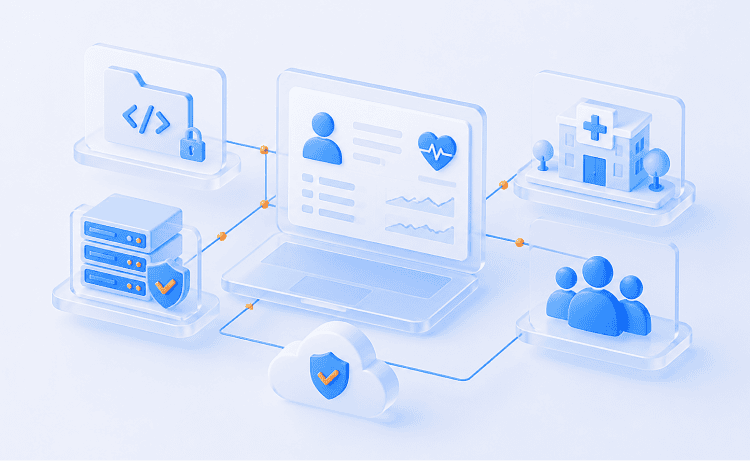
Patient health data is sensitive and heavily regulated. Healthcare providers must store and process it in line with HIPAA, which shapes everything from hosting choices to access controls and audit logging. Predictive systems add their own wrinkle, since training data and model outputs both count as protected information. Building compliance in from the first design session is far cheaper than retrofitting it after a security review.
A model trained on skewed data will produce skewed predictions, and in healthcare that can widen existing disparities. Teams need to test predictive analytics models across patient groups and watch for bias in who gets flagged and who gets missed. That check is still the exception: among US hospitals using predictive models, only 44% evaluated them for bias against their own patient data, according to a Health Affairs analysis. Clinicians also want to understand why a model made a call, which is why explainable AI and clear confidence signals matter as much as raw accuracy. A prediction a physician cannot interpret is one a physician will not trust or use, and accurate predictions only help when they lead to the right clinical decision in time.
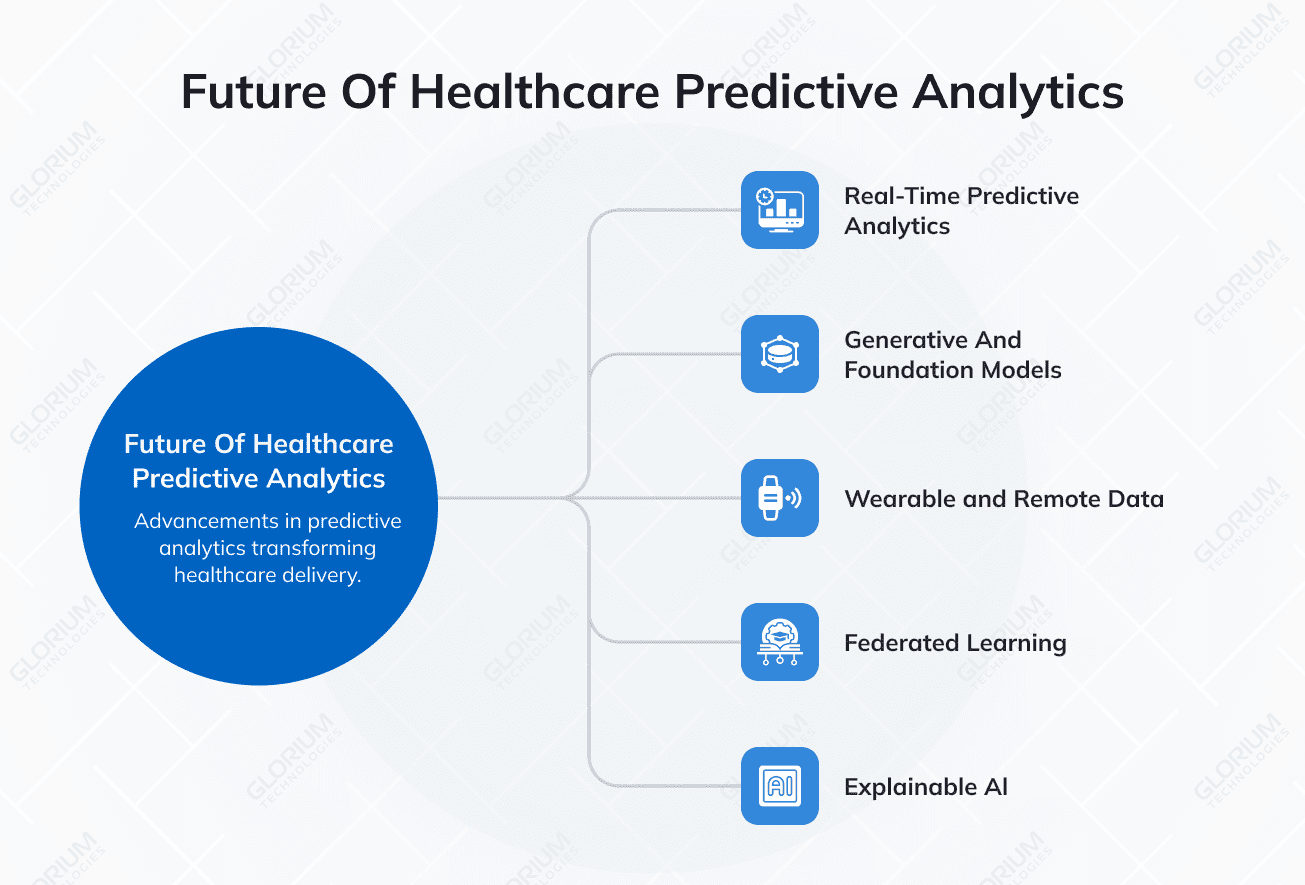
The direction of travel is toward faster, more personal, and more transparent prediction. Several shifts are already moving from pilot to practice across healthcare organizations:
Maturity varies a lot across that list. Real-time scoring and explainability are already running in production systems, while federated learning and foundation models are still mostly research projects looking for a first clinical home.
Prediction has moved into daily clinical work, and the accuracy question is largely settled. What decides the return now is whether you rebuild the work around the score and keep the model honest after go-live. The health systems pulling ahead changed one process at a time — discharge planning or escalation — then measured the result before adding the next model.
Glorium Technologies has built regulated healthcare software since 2010, backed by ISO 13485 and ISO 27001 certification and HIPAA-aligned delivery. The infant-outcomes diagnostic app and the bed-management platform described earlier came out of that team. Depending on where your product sits today, the same engineers can stand up an MVP for an early-stage HealthTech idea, take on project-based development for something already in clinical use, or join your team as dedicated developers to close a data science gap.
If you are weighing a predictive analytics project, the fastest first step is a conversation about your data, your workflows, and the outcome you want to move. Contact us to book a consultation and map out a practical plan for leveraging predictive analytics in healthcare within your own organization.
Timelines depend far more on data readiness than on modeling. When source systems are accessible and reasonably clean, a focused use case such as readmission risk can reach a validated pilot in a few months. Fragmented data or heavy integration work can push that to a year or more, so a discovery phase to assess data first usually saves time overall.
There is no single threshold, but models need enough labeled examples to cover the range of cases they will score, including rarer outcomes. A high-volume event like general admissions may need only a year or two of records, while predicting an uncommon complication can require far more history or data pooled across sites. A data assessment early on gives a straight answer for your specific target.
Yes. Most projects connect to major EHR platforms through standards such as HL7 and FHIR, or through vendor APIs where available. The integration layer is where a lot of the engineering effort lands, so it belongs in the plan and budget from the start rather than as an afterthought.
Health systems with a mature data team and clear priorities sometimes build in-house. Many choose a partner to move faster, cover HIPAA and integration expertise, and avoid hiring a full specialist team for one project. A hybrid model is common, where an external team stands up the platform and trains internal staff to run it. Glorium Technologies works in both modes, as a project team and as dedicated developers inside an existing one. The healthcare side of that work is backed by ISO 13485 and ISO 27001 certification, recognition on IAOP’s Global Outsourcing 100 and the Inc. 5000, and delivered products such as the diagnostic and predictive app for improving infant outcomes.
Tie the model to a metric the organization already tracks, such as 30-day readmission rate, no-show rate, average length of stay, or overtime hours. Measure that metric before launch, then compare after the model drives real decisions. A prediction that never reaches a workflow shows no return, so adoption is part of the measurement.
Predictive analytics supports clinical judgment rather than replacing it. Used well, a model surfaces risk and evidence for a clinician to weigh, with human review on any action that affects care. Validation across patient groups, monitoring for drift, and clear explanations are what keep that support safe and trusted over time.