







Interoperability in Healthcare: How Connected Data Improves Patient Care
Updated August 13, 2026

 Summarize in ChatGPT
 Summarize in ChatGPT
Your bank can tell you every place you spent money last year, while your hospital, in 2026, may still be assembling your medical history out of faxes, printouts, and a phone call to a clinic across town. The data exists in both cases, and what separates them is whether anyone connected the systems holding it.
Interoperability in healthcare describes the work of closing that distance, covering whether separate systems can hand patient data to each other securely and in a form the receiving clinician can actually use. Hospitals, labs, imaging platforms, and pharmacies each hold a fragment of any record, and a fragment that cannot travel is worth very little at 3 a.m.
Real progress and a real gap show up in the same national numbers, since ONC’s decade review found 70% of U.S. hospitals finding, sending, receiving, and integrating patient data by 2023, up from 23% in 2014. Asking how routinely they manage it shifts the picture: among hospitals that exchange data routinely, 92% had the outside clinical information they needed at the point of care, compared with 33% of those doing it only sometimes.
The money is following that gap, with analysts putting the healthcare interoperability solutions market at $4.66 billion in 2025 and heading toward $16.82 billion by 2033, which means more connectors, more middleware, and a longer queue of vendors promising to clear your integration backlog. Let’s look at what interoperability can and cannot solve, and what it takes to get the value it promises.
Content
A lab result created in one system should reach another with its meaning intact, ready to act on without anyone retyping a value. What separates interoperability from a plain file transfer is usability at the receiving end: two systems can move data all day and still leave a clinician squinting at a PDF.
A working example of that difference runs at national scale. Epic reports that organizations on its Care Everywhere network exchange over 20 million patient records a day, with around half of those exchanges reaching organizations running a different EHR. Those numbers rest on hospital-side work: each participating site exposes its records as standardized C-CDA documents, tunes its patient matching, and decides where an incoming outside record lands in the local chart. The network carries the traffic, and the integration built at each site is what turns an arriving document into something a clinician can read in context. Reaching that point is a project of its own, and the same project sits in front of any organization that wants its records to travel this way.
Healthcare generates more data than almost any industry, and much of it stays locked inside individual applications. Connected data changes that: a physician holding a complete record decides without waiting on callbacks, the patient stops repeating their history for every new provider, and medication errors drop, along with the harm caused by missing records.
The physician side lags well behind. In the same ONC analysis, 38% of family physicians found outside clinical information easy to use when it came from a practice running the same EHR, while only 8% said so when it came from a practice on a different one.
The Healthcare Information and Management Systems Society (HIMSS) defines four levels of interoperability, each building on the one before. They help teams set realistic goals, because sending a file and sharing meaning carry separate price tags.
| Level | What it does | Everyday example |
| Foundational | Secure data transfer with no interpretation required | A lab sends a PDF report a hospital can store |
| Structural | Standardized format for healthcare data | A vitals feed maps cleanly into the right EHR fields |
| Semantic | Shared meaning across interoperable systems | A coded diagnosis means the same thing everywhere |
| Organizational | Governance and policy that permit safe exchange | Two health systems agree on rules to share records |
Systems cooperate only when they agree on how data should look and travel. Several standards operate at once, some governing how data moves and others what it means once it lands.
HL7 (Health Level Seven) gave hospitals a common messaging format in 1987, and its v2 messages still feed many lab interfaces and pharmacy systems. The specification was loose enough that every hospital implemented it slightly differently, and the v3 revision that tried to fix that proved too complex to adopt widely. The standard that stuck, Fast Healthcare Interoperability Resources (FHIR), arrived in the early 2010s with an API-first design built on JSON, XML, HTTP, and REST. FHIR now dominates new electronic health records integrations, and certified systems must expose FHIR APIs covering the data classes defined by the United States Core Data for Interoperability (USCDI).
Healthcare interoperability standards also have to make systems speak the same clinical language:
Standards settle how data looks in transit. A second decision settles where the data lives: whether one central platform becomes the reference copy of a patient record, or every system keeps its own copy and talks to the others through translation. Most programs land somewhere between the two, and naming the direction early keeps the budget and the governance work honest.
| Approach | How it works | Fits best when | Trade-offs |
| Single source of truth | A central platform ingests records from every system and stores them in one standardized format that downstream applications read from | Many systems feed one record, and analytics or AI will run on top of the data | Higher upfront cost, a longer migration, and governance rules deciding which system wins when two records disagree |
| Point-to-point integration | A translation layer maps data between two systems on demand, and each source system stays the owner of its own records | A small number of systems exchange a defined set of data and stay in place | Connections multiply with every new system, and each vendor API change adds maintenance |
Hybrids are common in production: an integration engine handles day-to-day message traffic between systems, while a central repository holds the standardized copy that reporting, analytics, and machine learning read from.
Modern data exchange leans on RESTful APIs and cloud platforms that connect legacy systems without replacing them. AI increasingly helps interpret the unstructured records that standards alone cannot reach. Storage specifications such as OpenEHR govern how a system organizes clinical data internally, while HL7 and FHIR govern how it looks on the way out.
Gains from reliable data exchange show up on both the clinical and the financial ledger, and they compound: better patient information at one step improves the quality of the next.
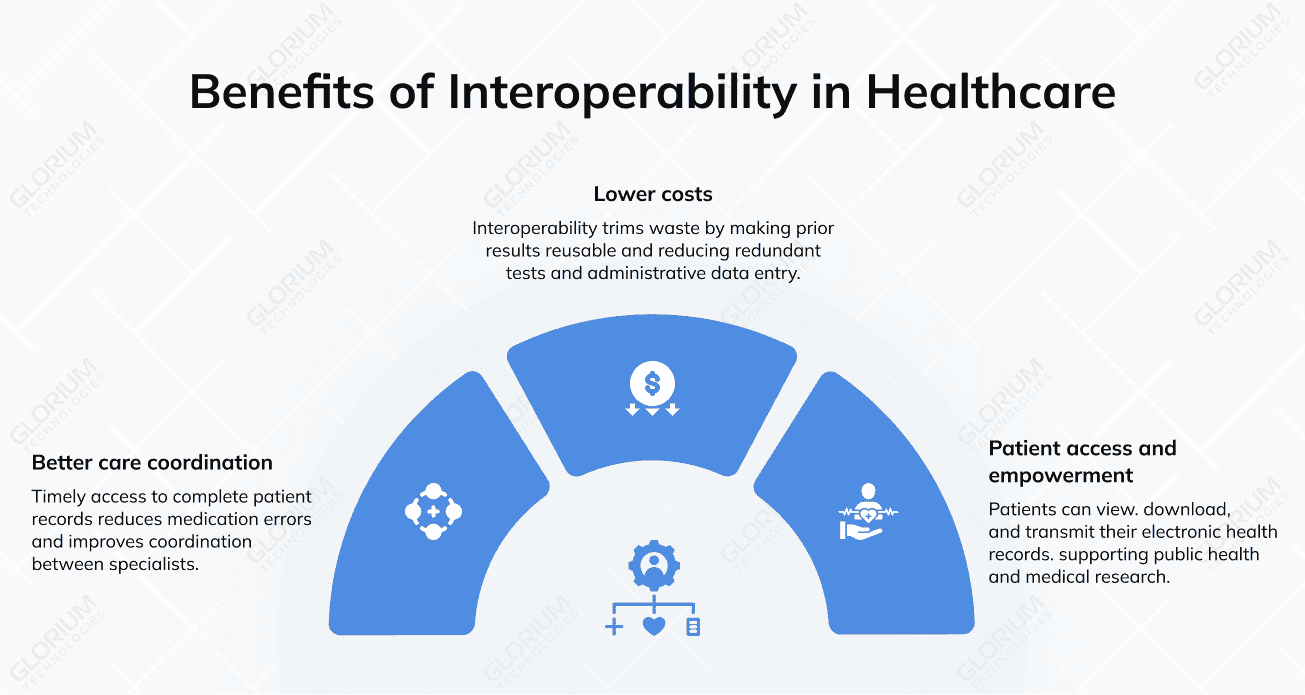
Timely access to a complete record reduces medication errors and the number of lab results that go missing. Providers coordinate across specialists without waiting on faxes, and a patient moving from an emergency department to primary care arrives with their history in place.
That single-record view is what Glorium Technologies built for ITR Software, a German provider whose web application handles hospital bed requests across wards. The existing frontend had aged past usefulness, and the client wanted a rebuild that would also serve visually impaired staff. Work started with national regulations covering bed assignment, then moved into a responsive Angular interface.
The rebuilt application keeps bed status, room location, and patient details such as insurance and next of kin inside one live record. Staff stopped counting beds by hand, turnover improved, and the interface now follows a patient from admission through discharge.
Redundant tests and repeated data entry drain budgets, as do the longer stays that follow a record nobody could find. Interoperability in healthcare trims that waste by making prior results visible at the moment a clinician needs them. Savings concentrate in four places:
Patients increasingly hold their own health data. 99% of hospitals let patients view their health information electronically in 2024, 96% supported downloads, and 84% supported transmitting records to a third party. API-based access is close behind, with 81% enabling app access and 70% supporting FHIR-based apps.
Patient-mediated exchange, where the patient moves their own record between organizations, lets people arrive at an appointment already informed about their own results. Aggregated, de-identified data also supports public health work and gives researchers larger populations to study.
Several obstacles still slow healthcare interoperability, most tracing back to old technology and thin budgets.
Older software stores healthcare data in proprietary formats that resist exchange. Replacing those systems outright is expensive and risky, so the practical path runs through APIs and integration layers that pull data out of them. Legacy modernization lets organizations keep what works while opening their silos to wider sharing.
Opening a closed platform without rebuilding it from zero is what the Forward Advantage project came down to. The client needed its document delivery platform moved off Microsoft Silverlight before that technology lost support, with lab results for hundreds of hospitals running through it daily. Our team rebuilt the application in Angular and C#, using reverse engineering so the fax functionality migrated intact, while backward compatibility kept both versions usable through the transition.
Two systems can both use HL7 or FHIR and still implement them differently. Optional fields go unpopulated, local code sets creep in, and identifiers get formatted three ways. Mismatches like this break semantic interoperability quietly, and completeness suffers before anyone notices. Shared implementation guides and terminology mappings keep data meaningful in transit.
Sharing patient data raises the bar on security. HIPAA and GDPR both shape how exchange must be designed, and four controls carry most of the weight:
The United States has no national patient identifier, so matching records to the right person falls to probabilistic algorithms comparing names, dates of birth, and addresses. Match rates drop as soon as data crosses organizational lines, producing duplicate charts inside one hospital and mismatched records between two. The technology answer to this is an Enterprise Master Patient Index (EMPI), a service holding one golden record per patient and linking every local medical record number that points at that person. An EMPI gives matching logic, survivorship rules, and duplicate resolution a single place to live instead of spreading them across each connected system. Standardized demographic capture at registration still fixes more of this than any matching engine, so the two belong in the same project.
By the 2010s, the standards and the roadmap already existed. What moved the industry was money and enforcement, as Dr. Siddharth Ramesh, founder of MedBlocks, puts it in his explainer on healthcare interoperability:
“All of these standards existed. The roadmap was there. But standards alone don’t change behavior, and nobody was going to overhaul their systems unless it was mandated.”
Dr. Siddharth Ramesh, MedBlocks
Two U.S. laws opened the funding. The HITECH Act put billions of dollars of subsidy behind EHR adoption in 2009, and the Affordable Care Act tied hospital payment to quality of care a year later, which gave providers a financial reason to share data rather than hold it.
The 21st Century Cures Act made information blocking illegal and required EHR vendors to open their systems through standardized APIs. Once a competitive tactic, the practice became a compliance risk, and the Office of the National Coordinator for Health Information Technology (ONC) defined which behaviors count. Penalties reach developers and providers alike.
Later rules from ONC and the Centers for Medicare and Medicaid Services (CMS) set hard deadlines with real penalties. The Trusted Exchange Framework and Common Agreement (TEFCA) then linked regional health information exchanges into a national structure under one set of participation rules. That shifted the question from whether to share health data toward how quickly providers comply. Close to one in three hospitals still exchanges data rarely or never, so the enforcement arc has further to run.
| Framework | In force since | What it requires | Who it binds |
| 21st Century Cures Act | 2016 | End to information blocking, standardized API access | Developers, providers, networks |
| ONC Cures Act Final Rule | 2020, blocking rules 2021 | FHIR APIs covering USCDI data classes | Certified health IT developers |
| CMS Interoperability and Patient Access Rule | 2020, APIs 2021 | Patient access and provider directory APIs | Medicare Advantage, Medicaid, CHIP, ACA plans |
| TEFCA | Agreement 2022, first networks 2023 | Common terms for exchange between networks | Networks, voluntary |
The next decade points toward health data that follows the patient across systems. Several trends converge to make that workable.
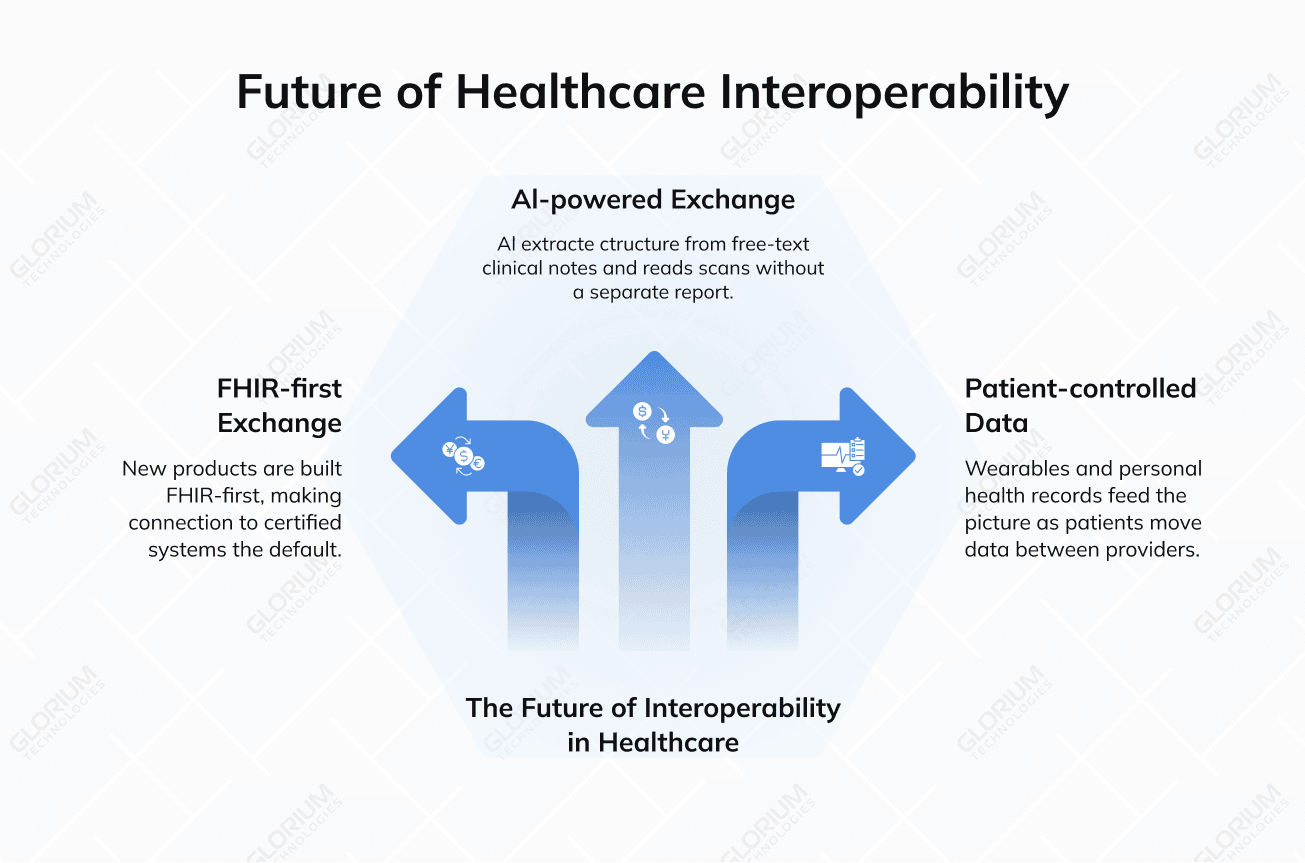
New products are built FHIR-first, which turns connection to certified systems into a default rather than a project. Health information exchange becomes a design assumption, and interoperable records stop working as a selling point because buyers expect them.
AI is starting to handle the work that standards cannot reach alone. Natural language processing pulls diagnoses, medications, and problem lists out of free-text notes and maps them into structured FHIR resources. Imaging models flag findings directly from a scan, unlocking data that has sat unused inside documents for years. Named standards already carry this work into live systems. CDS Hooks lets an EHR call an external decision support service at a defined point in a clinician’s workflow and show the response inside the chart, which is how most AI recommendations reach the bedside without a second login. FHIR Bulk Data Access moves whole populations out of a FHIR server in one export, the starting point for model training and population analytics.
Wearables and personal health records now feed the same picture. Australia, the United Kingdom, and India are converging on shared standards, which matters as medical travel grows and payers expose data back to members. The patient is becoming the thread tying an otherwise scattered record together.
FHIR-first products, AI pulling structure out of clinical notes, patients carrying their own records across borders: every trend above points toward a record that travels with the person it describes. That future gets built one integration at a time, inside the systems an organization already runs.
If your systems cannot share a patient’s record cleanly, your team already carries the cost: the manual re-entry, the lab result arriving as a PDF nobody can act on, the history that disappears when a patient changes provider.
Glorium Technologies has built healthcare software since 2010 across HL7 and FHIR integration, EHR and EMR development, DICOM imaging, and health information exchange, with HIPAA and GDPR designed in from the first sprint. That work runs from the Forward Advantage rebuild, where a lab result delivery platform moved off Silverlight with its fax workflows intact, to bed management systems holding patient status, location, and insurance in one record.
Whether you need FHIR support added to a product in production or a platform modernized because it outgrew its foundation, the target is the same: your records stop slipping between systems, and your clinical teams get those hours back for patient care. Ready to connect your systems? Contact us, and we’ll map an integration roadmap around your current setup.
In most cases, yes. A FHIR API layer can sit on top of an existing system, translating internal healthcare data into standardized resources. This preserves current workflows while exposing the data to certified systems and patient apps, usually at far less cost than a full replacement.
Timelines depend on scope and the condition of the source systems. A focused API integration might take a few months, while a multi-system exchange platform with compliance testing runs closer to a year. An early discovery phase mapping sources and standards tends to shorten the build.
Health information exchanges move data among a defined set of participants, often regional. TEFCA is a national framework linking those networks under one set of rules, letting participants in different exchanges share records through a single trusted structure.
Increasingly, yes. Patient-facing apps connecting to certified systems through SMART on FHIR fall under the same expectations for standardized access. Data from consumer medical devices is regulated less tightly, though the trend points toward folding these newer sources into the record.
Useful metrics include the share of patient records available at the point of care, reductions in duplicate tests, time saved on manual entry, and data completeness scores for incoming records. Tying these to clinical and financial outcomes demonstrates the return.
Timelines depend on scope and the condition of the source systems, and most projects move through the same five phases. Discovery and assessment usually takes two to six weeks, covering an inventory of source systems, data classes, and standards in play, plus a check on what the vendor APIs actually expose. Architecture and standards mapping follows over three to eight weeks, when the team settles the choice between a central data platform and point-to-point translation, maps terminology, and fixes the security model. The build itself runs two to six months across interfaces, FHIR resources or message pipelines, patient matching, and error handling. Testing and compliance validation adds another four to ten weeks of end-to-end runs at real record volumes, HIPAA and GDPR review, and certification checks where they apply. Rollout and optimization continues past go-live, with phased releases by department or site, monitoring of failed messages, and tuning of match rates.
A focused API integration compresses that sequence into a few months. A multi-system exchange platform for a hospital group runs 12 to 24 months, and discovery done properly at the front pays for itself during the build.
Budgets for a single organization usually land between $40,000 and $400,000, and five drivers set where a given project falls in that range. The core systems in scope weigh heaviest: how many EHR, lab, imaging, and billing platforms have to connect, and whether their APIs are documented. Middleware comes next, since licensing or building an integration engine carries a different price than writing direct connections between two systems. Security and compliance work covers encryption, consent management, audit logging, and the review cycles HIPAA or GDPR require, while cloud and infrastructure spending pays for hosting, monitoring, and the storage a longitudinal record needs. Training and change management closes the list, funding clinical workflow updates and the support clinicians need through go-live.
A single FHIR interface on a modern, well-documented system sits near the low end. A multi-site exchange platform pulling legacy data out of proprietary formats sits at the high end, with maintenance running as an annual share of the build.