







Blockchain in Healthcare: Use Cases, Benefits, and What Adoption Takes
Updated August 17, 2026

 Summarize in ChatGPT
 Summarize in ChatGPT
In February 2024, pharmacists across the United States lost the ability to check whether a patient’s insurance would cover the prescription sitting on the counter. Ransomware had taken down Change Healthcare, one of the largest claims clearinghouses in the country, and healthcare providers absorbed the fallout for months. The same attack exposed the protected health information of about 193 million people, still the largest loss of patient data on record.
Breach volume has climbed since: the HHS Office for Civil Rights breach portal logged 772 large healthcare data breaches in 2025, the highest annual total since reporting began. Healthcare breaches also cost more than those in any other sector: IBM’s 2025 Cost of a Data Breach Report puts the healthcare average at $7.42 million per incident, and organizations take an average of 279 days to identify and contain one.
Blockchain technology comes up in almost every board-level conversation about fixing healthcare data security. The technology has a real role in the healthcare industry, though a narrower one than the 2018 wave of pilots promised. This guide covers where distributed ledgers earn their keep in production today, what blockchain-based medical records actually look like once patient data is involved, and how to tell early whether your use case justifies the overhead.
Content
Blockchain is a shared, append-only record that several organizations maintain together, with no single owner holding the master copy. Every entry carries a cryptographic hash of the one before it, so if the chain is tampered with, every participant can see that the break happened. That property is the draw for healthcare. Decentralization on its own is beside the point.
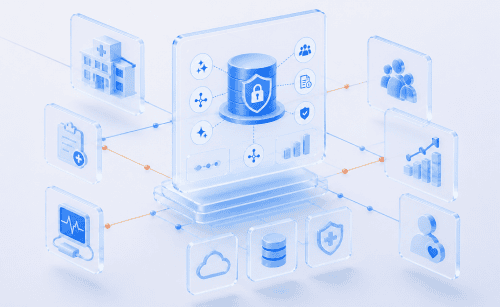
Patient records themselves rarely live on the chain. Medical images, clinical notes, and lab results stay in existing systems or in encrypted off-chain storage, while the ledger holds hashes, pointers, and permission events. The chain becomes a tamper-evident index of who accessed what, when, and under whose authorization, so a hospital can prove that medical records have not been altered since a given timestamp without publishing the record itself. Sensitive information never leaves the system that already holds it.
The split usually looks like this:
| Data type | Where it lives | What the ledger stores | Why the split |
| Imaging studies, clinical notes, lab results | Existing EHR, PACS, or encrypted object storage | Hash of the file, plus a pointer to its location | Volume makes on-chain storage impossible |
| Patient consent decisions | On-chain | The full signed transaction | Small, high-value, must be provable |
| Access and disclosure events | On-chain | Identity, timestamp, scope of access | This is the audit trail regulators ask for |
| Shipment and custody handoffs | On-chain | Serial number, party, timestamp | Multiple companies need the same version |
| Patient identifiers and demographics | Off-chain, mutable storage | Nothing directly identifying | GDPR erasure has to remain possible |
Separating the data this way makes ledger-based healthcare data management workable. Zero-knowledge proofs extend the idea further: a participant can prove a fact about a record, such as a patient meeting an eligibility threshold, without revealing the underlying figure.
Blockchain technology in its public form lets anyone read and validate transactions. No HIPAA-covered entity can work that way, so most healthcare organizations use permissioned designs where a known consortium of hospitals, payers, or manufacturers runs the validating nodes. Membership is vetted, throughput is predictable, and governance sits with a group regulators can hold accountable. In practice, distributed ledger technology in healthcare means a vetted membership group with cryptographic bookkeeping.
Three platforms carry most of the production work, and the choice between them shapes a blockchain-based project more than any other technical decision.
| Platform | Privacy model | Governance style | Typical healthcare fit |
| Hyperledger Fabric | Private channels and separate collections, so members see only the transactions they belong to | Consortium members define membership rules through a shared configuration | Consent registries and multi-hospital record indexes |
| R3 Corda | Point-to-point messaging, where data reaches only the parties to a transaction | Notary services run by agreed operators | Payer and provider workflows with strict bilateral confidentiality |
| Permissioned EVM networks | Shared state with access controls layered on top, plus optional private transactions | Smart contracts encode the rules, which suits open industry consortia | Supply chain and traceability networks spanning many companies |
“When used appropriately, blockchain technology improves security, data interchange, interoperability, integrity, real-time updating, and accessibility. It has the potential to revolutionize the healthcare industry, making it more efficient and accessible to all.”
The Knowledge Academy | Blockchain in Healthcare | Applications of Blockchain in Healthcare
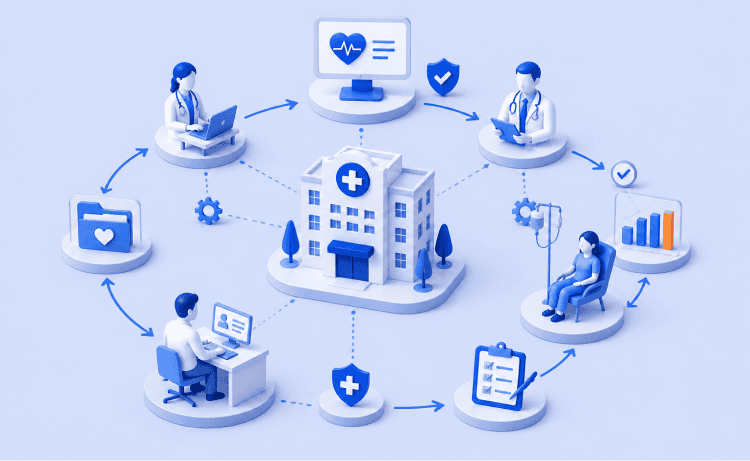
Five application areas have moved past the pilot stage. Each shares a trait worth noticing: multiple parties who do not fully trust each other need to agree on the same record, and none of them can be appointed sole keeper of it. Shared data with no single owner is the pattern underneath all five.
The benefits of blockchain in healthcare land differently depending on where you sit:
The same shared record does two jobs: it removes the reconciliation step and creates the audit trail disclosure accounting requires. Blockchain technology pays for itself only where several of those groups sit at the same table.
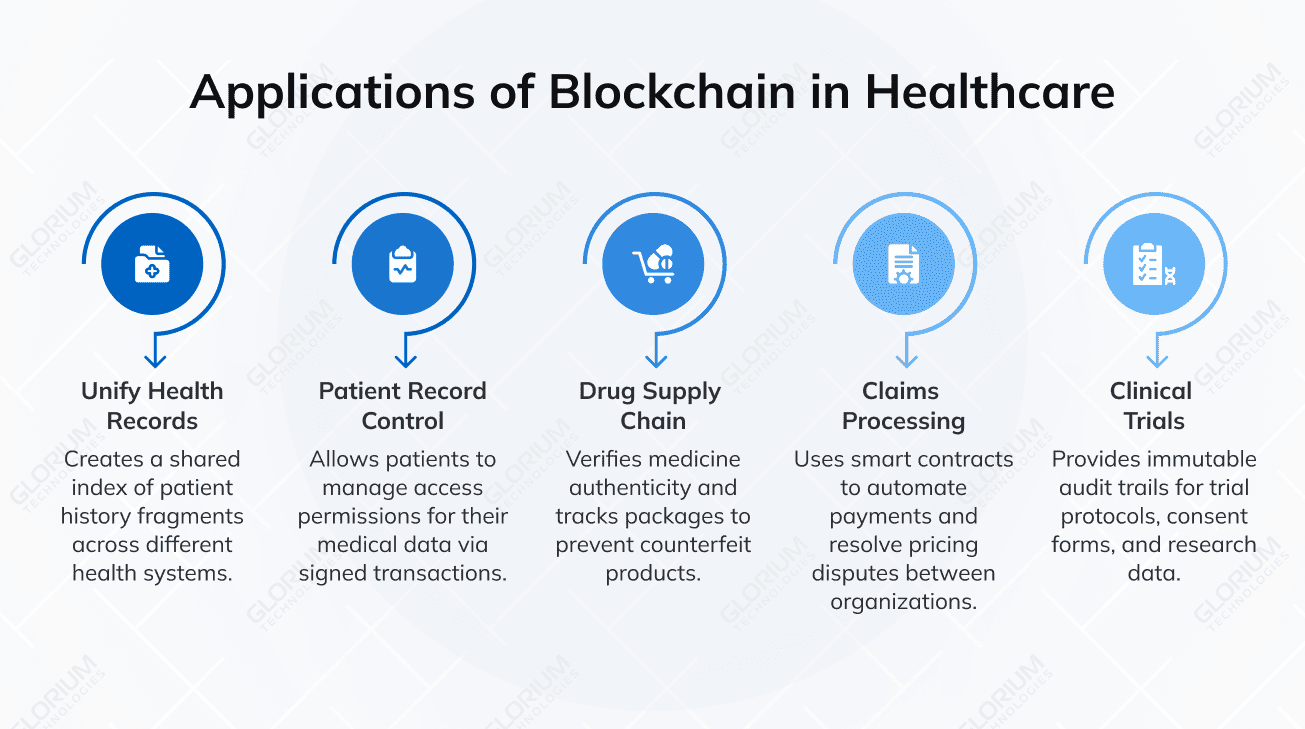
Patient histories fragment across primary care, specialists, labs, and health systems. Each holds a partial view, and reconciling them is slow enough that clinicians often order duplicate tests instead of chasing the original results. Medical errors follow the same gaps.
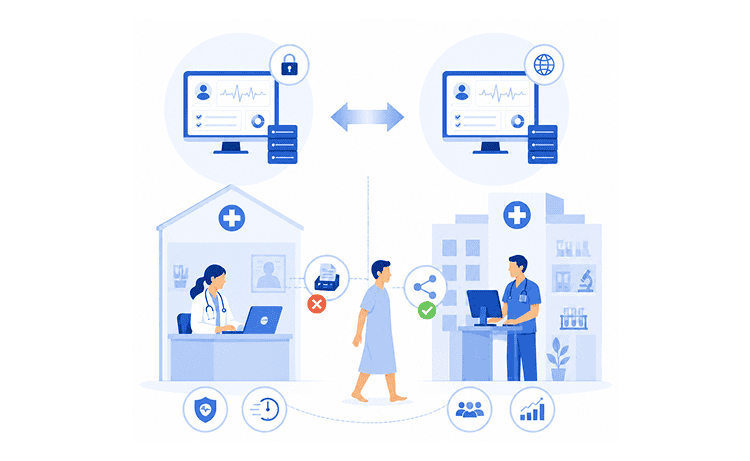
A blockchain layer above existing electronic health records creates a shared index of where every fragment lives and which version is current. Healthcare providers keep their own EHR platforms and gain a reliable map of the whole patient history, plus an immutable record of every read and write.
Avaneer Health is the clearest working example in the United States. The network, founded by payers and providers including CVS Health, Cleveland Clinic, and Elevance Health, runs a permissioned peer-to-peer network for real-time data exchange between member healthcare organizations. A network like that works only once enough of the healthcare ecosystem joins it.
The clinical payoff shows up when critical medical information is missing. An emergency physician who can confirm a current medication list in seconds prescribes with more confidence than one working from a family member’s account, and care coordination across a healthcare system improves for the same reason.
Consent is where blockchain in healthcare fits most naturally, because medical information is only useful when the right clinician can reach it. A patient grants a cardiologist access to two years of imaging, revokes access for a former employer’s occupational health provider, and shares de-identified patient information with a research registry. Each decision becomes a signed transaction, timestamped and impossible to backdate, and patient privacy stays under the patient’s own control.
That permission model is what Glorium Technologies built for Softhread, a US company developing an AI and blockchain-powered health data platform. The patient-centric platform with QR-code access lets patients or their proxies record intubation, resuscitation, and organ donation decisions once, then grant clinicians view, edit, or re-share rights individually. Every change traces back to the person who made it, and an emergency physician reaches the full picture by scanning a code at the bedside. Sensitive patient information never leaves its encrypted store, and only the permission trail sits on the chain.
The pharmaceutical supply chain gave blockchain its clearest business case. Under the US Drug Supply Chain Security Act, trading partners must trace prescription medicines electronically at the package level. The FDA’s staggered exemptions expired for manufacturers in May 2025, distributors in August 2025, and larger dispensers in November 2025.
Manufacturers, distributors, and pharmacies must therefore verify each other’s data without exposing commercial relationships to competitors. The MediLedger Network, an industry consortium whose founding participants included Pfizer, Genentech, McKesson, and AmerisourceBergen (now Cencora), solved that for saleable returns verification, with cryptographic proofs replacing manual reconciliation between trading partners. A 2020 FDA pilot showed a permissioned chain could carry package-level tracing at industry throughput while keeping each party’s transaction details private.
Counterfeit medicines surface where a serial number fails to match its recorded history. Pharmaceutical companies apply the same drug supply chain approach to medical devices, where recall accuracy depends on knowing exactly which units shipped where.
Smart contracts execute automatically when conditions are met, which suits the rule-driven parts of revenue cycle work. Once eligibility is confirmed and prior authorization is on file, the contract releases payment without a human touching the claim.
The prize here is administrative and well documented. The 2025 CAQH Index puts the remaining savings from fully automating manual and partially manual transactions at $21 billion a year. Shared data beats reconciled data: payers and healthcare providers work from one authoritative version instead of maintaining two, and claims processing speeds up as a direct result. Erin Weber, chief policy and research officer at CAQH, makes a related point: the returns arrive when new technology sits on standardized digital workflows, not when it patches broken manual ones.
Pharmaceutical chargebacks have proved a stronger early use case than claims adjudication. Manufacturers, distributors, and group purchasing organizations dispute pricing constantly, and a shared contract record settles most of those disputes before they become invoices.
Trial protocols, consent forms, and interim results written to a ledger cannot be quietly revised after the fact. Sponsors gain defensible provenance for every data point, and participants who consent electronically can verify that the terms have not changed.
Regulators are the reason this matters commercially. FDA 21 CFR Part 11 requires a secure, computer-generated, time-stamped audit trail that records every create, modify, and delete action on an electronic record. ICH E6(R3), the revised good clinical practice guideline adopted in January 2025, advances traceability across the data lifecycle. Clinical research teams reading those requirements recognize that they describe a permissioned ledger.
Several other blockchain applications appear constantly in vendor material. Most are blockchain-based pilots rather than production networks.
| Use case | What the ledger adds | Maturity |
| Clinician credential verification | Licenses and work history verified once and reusable across employers | Regional pilots, no dominant network |
| Patient identity management | A decentralized identifier linked to records, with only hashes held on-chain | Standards work active, few production deployments |
| Remote patient monitoring | Provenance for readings streamed from connected medical devices into machine learning models | Early, usually bundled inside a device vendor’s platform |
| Telemedicine | Immutable logs of consultations, prescriptions, and identity checks | Niche, mostly single-vendor implementations |
| Personalized medicine and genomics | Consent and compensation tracking when individuals share sequence data with researchers | Consumer platforms, limited clinical use |
A conventional database wins on speed and cost whenever one organization owns the data, and everyone else accepts that ownership.
| Dimension | Centralized database | Permissioned blockchain |
| Data ownership | Single organization controls the master copy | Shared across consortium members |
| Tamper evidence | Depends on internal logging and access controls | Built-in; altering history breaks the chain |
| Point of failure | Central server or cloud tenant | Distributed across nodes, with no single point to attack |
| Cross-organization trust | Requires contracts and periodic reconciliation | Enforced by protocol and consensus |
| Patient consent | Managed per system, hard to revoke everywhere | Signed transactions, revocable and traceable |
| Write speed and cost | High throughput, low cost per transaction | Lower throughput, higher engineering overhead |
| Data deletion | Straightforward | Difficult by design, needs off-chain workarounds |
Two motives send most teams looking at a ledger: data security and cross-organization data sharing. The comparison above is also where many of them decide a hardened database with strong access logging already covers the risk.
Adoption across the healthcare industry has moved slower than early forecasts assumed, and the obstacles are budgetary, legal, and operational. Analysts disagree wildly on the size of the healthcare sector opportunity: Grand View Research valued it at $11.3 billion in 2024, while Mordor Intelligence put 2025 at $5.5 billion. That spread shows how young the production market still is.
Data security obligations under HIPAA start with the duty to control access and account for disclosures, both of which a ledger handles well. GDPR introduces a harder conflict, because Article 17 gives individuals a right to erasure, and an immutable chain resists deletion by design. GDPR assumes patient data can be removed on request, and a growing number of US state privacy laws do the same.
The workable answer is crypto-shredding. Personal data sits off-chain in encrypted storage, the ledger carries only hashes and pointers, and an erasure request is satisfied by destroying the encryption key. The ciphertext becomes permanently unreadable, and the audit trail survives intact. Maintaining privacy for the individual and keeping that trail intact are compatible goals once the data layers are separated this way.
European privacy reviews increasingly ask which key is destroyed, who holds it, and how key destruction is itself logged, so blockchain solutions built for healthcare need answers to all three before they reach a data protection officer.
A single CT study runs between 250 MB and 1 GB, and a mid-sized hospital produces thousands a month. A permissioned network handling a few thousand transactions per second can absorb consent events and shipment handoffs comfortably. That same network cannot absorb a stream of 500 MB imaging studies, which is why those stay off-chain.
Engineering answers exist, and each moves the ceiling rather than removing it:
None of these makes on-chain imaging storage sensible, so the off-chain split described earlier remains the design that works.
A ledger inherits the data security of the code written on top of it. Smart contracts are permanent once deployed, and contracts touching payment logic or access rights are attractive targets, so an independent audit before launch and a re-audit after every protocol change belong in the plan from day one. Review work on a blockchain project is mostly contract review, because the patient data itself never touches the chain.
Immutability creates a second, quieter risk. A wrong patient identifier, diagnosis code, or dosage written to the chain stays there, and medical errors recorded that way are permanent. Production blockchain systems validate data before committing it, require human approval for critical writes, and keep anything correctable in off-chain storage where a fix is a normal database operation.
Someone has to decide who joins the network, who pays for nodes, and what happens when a member leaves. Consortium agreements often take longer to negotiate than the software takes to build.
Clinical adoption is the other soft obstacle. Many healthcare professionals still associate blockchain with cryptocurrency, and patients hesitate to hear that their health records live on a chain. Teams that involve healthcare professionals in workflow design early and explain the architecture through permissions and audit trails rather than tokens meet far less resistance at rollout.
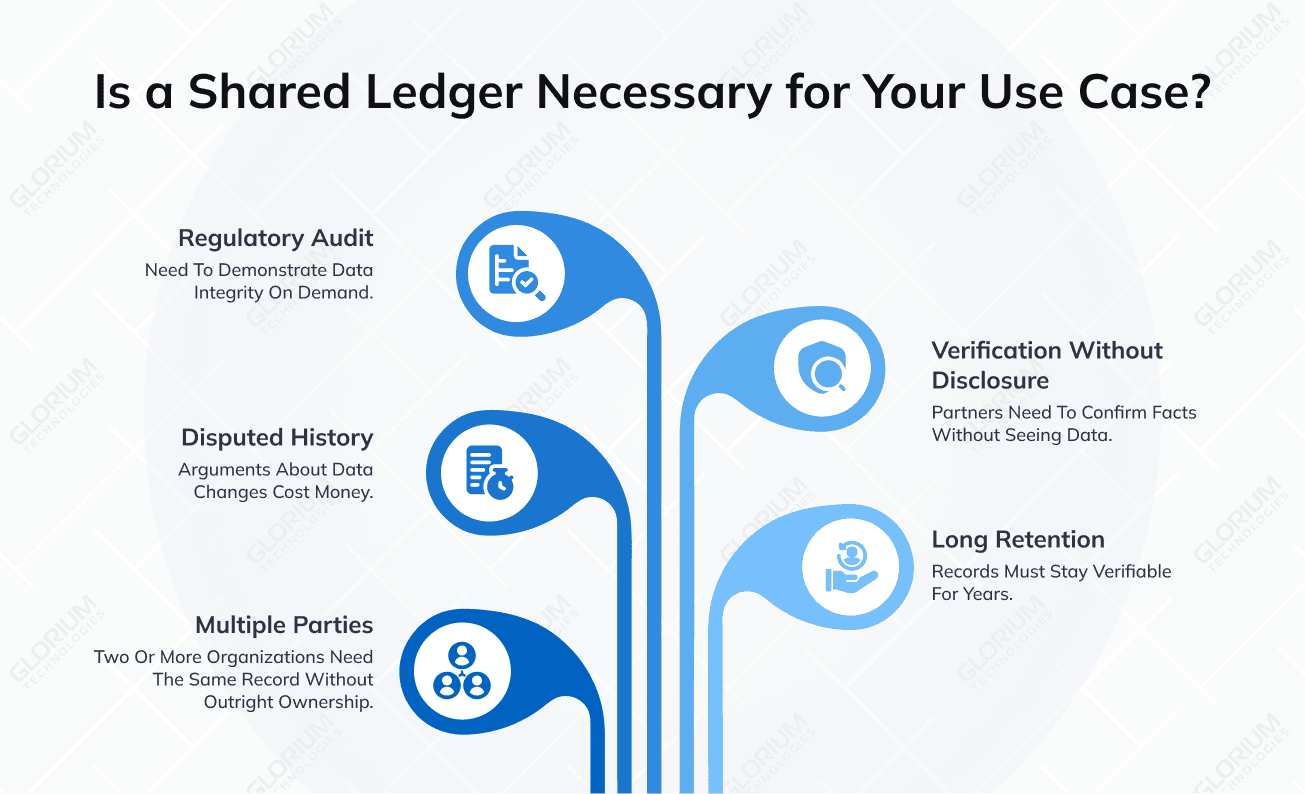
Test your use case against the conditions that make a shared ledger worth its overhead:
If fewer than three apply, a well-designed database with strong access logging will serve you better and ship far sooner.
Most healthcare organizations do not need to stand up a consortium. Supply chain participants can join an established traceability network through an API, leaving node operation and governance to the operator. That path takes months rather than years, skips the membership recruitment problem, and plugs you into a healthcare ecosystem that already runs.
Building makes sense when no network covers your workflow, when the consortium needs partners nobody has convened before, or when the ledger sits inside a digital health product you intend to sell.
Ledger development is rarely the largest line. The drivers that surprise teams are:
Three threads will decide how much of this technology reaches everyday patient care before the decade closes. Each depends less on cryptography than on whether institutions agree to share a record.
Artificial intelligence and blockchain technology are converging around provenance. Models trained on clinical data need verifiable lineage for every input, for regulatory review and reproducibility alike, and a ledger supplies that trail without centralizing the data. Machine learning teams already field procurement questionnaires about training data provenance, and those questions will only get sharper.
The European Health Data Space Regulation entered into force on 26 March 2025 and arrives in phases. A cross-border infrastructure connecting member states will carry patient data for treatment, with the priority categories of health data exchangeable in March 2029 and clinical trial and human genetic data following in March 2031. Every EHR system placed on the EU market must first be certified as interoperable and secure, and penalties for the most serious violations reach €20 million or 4% of global turnover. HealthData@EU, the infrastructure behind secondary use, connects a health data access body in each member state instead of pooling records centrally. A decentralized design where no single government hosts the registry is the shape blockchain architectures already take.
Licensing and credentialing remain slow enough that health systems lose weeks of clinician availability to paperwork. A verified credential a physician carries between employers solves a narrow, expensive problem, which is exactly the profile of the use cases that reached production first.
Every one of those shifts depends on the unglamorous layer underneath: permissions that match how clinicians actually work, integrations that survive contact with a live HL7 feed, and a data model a regulator will accept. That layer decides whether a healthcare blockchain project reaches production or stalls at pilot, and it is where our engineers spend their time.
Glorium Technologies has been building healthcare software since 2010, with more than 150 products delivered and ISO 9001, 13485, and 27001 certifications. Our portfolio spans patient platforms, electronic health records and EMR systems, medical imaging, health information exchange, and the consent layers that protect patient data inside blockchain projects.
Estimate your project cost in a few minutes, or contact us to book a call about your blockchain use case.
A proof of concept covering a single workflow, such as consent capture or shipment verification, typically takes 8 to 16 weeks with a small team. Production rollout takes far longer, and the delay is usually due to consortium agreement and integration testing rather than ledger development. If you are scoping a pilot, book a call with Glorium Technologies, and we will walk through a realistic roadmap and timeline for your workflow.
Plan for three roles: a smart contract engineer who reviews and deploys changes, an integration developer who owns the HL7 and FHIR connections, and a DevOps engineer comfortable running node infrastructure. Many organizations keep the first on retainer with a vendor and staff the other two internally. Glorium Technologies covers all three roles, so you can add the skills you are missing to your own team without hiring for them permanently.
This belongs in the consortium agreement from the first draft. Clinical data stays off-chain in each member’s own systems, so patient records survive the network. What you lose is the shared verification layer, which is why the agreement should specify export formats and a wind-down period. Glorium Technologies builds those export and migration paths into the architecture from the start, so members keep working records if a network winds down.
FHIR standardizes how one healthcare system describes and transmits medical data to another; blockchain governs who may access it and proves the history was not altered. The two are often deployed together, with FHIR carrying the payload and the ledger recording authorization. Glorium Technologies builds both layers, so the FHIR interfaces and the ledger permissions are designed together rather than bolted on later.
No. A ledger layer indexes, verifies, and governs access to medical records that stay in Epic, Oracle Health, or a custom system. Projects that try to replace the clinical record itself run into data volume limits and clinician resistance almost immediately. Glorium Technologies connects the ledger layer to the EHR you already run, and you can book a call to review how that integration would work in your environment.