







Digital Transformation in Healthcare: What Works and Where to Begin
Updated August 14, 2026

 Summarize in ChatGPT
 Summarize in ChatGPT
Digital transformation in healthcare comes down to a simple test: can a clinician see everything they need to know about a patient without asking anyone for it, and can leadership see what is happening across every site without making a phone call? Most health systems fail that test today, and not for lack of software.
The technology is largely bought already. EHR adoption is close to universal, portals are live, and most organizations hold a telehealth license they under-use. What is missing is the connective work between them: the interfaces, the shared data standards, and the workflow redesign that turn separate products into one system. That work rarely makes a keynote, and that is where the returns come from.
Those returns are specific enough to plan against. Documentation is done before the end of the day. Duplicate tests fall away once a care team can see what someone else already ordered, and a live capacity view replaces the phone calls that currently locate a free bed. The rest of this article works through that in order, from the definitions that get muddled most often to the arithmetic behind a first project you can defend to a board.
Content
These three words get used interchangeably in vendor decks, and the confusion costs money. A board approves a transformation budget and receives a document scanner. Seen side by side, the distinction is straightforward.
| Stage | What actually changes | Healthcare example | What you get |
| Digitization | Paper becomes a file | A paper chart is scanned into a PDF and stored | A searchable archive; the workflow is unchanged |
| Digitalization | One process runs on that data | Labs are ordered through the EHR instead of a paper requisition | Fewer transcription errors, faster turnaround |
| Digital transformation | The operating model changes | Lab, pharmacy, and home device data flow into one record that triggers alerts and follows the patient | Earlier intervention, less duplicate testing, complete information |
Most organizations sit between digitalization and true transformation. The jump that matters is the last one, because only that stage moves clinical outcomes; the earlier two move administrative effort.
Most successful digital transformation programs move on several fronts at once, and skipping any one of them stalls the rest:
Most healthcare leaders do not need a technology tour. They need to know which of these changes something in their clinic next quarter and which can wait a year. The eight below are doing real clinical and operational work in 2026. Some, such as EHR integration, are table stakes. Others sit in narrower niches and pay off decisively where they fit, and the returns compound when they share data.
Artificial intelligence has moved from pilot decks to daily operations. McKinsey’s late-2025 survey of U.S. healthcare leaders found that generative AI adoption climbed from 25% in 2023 to 47% in 2024 and reached 50% by the end of 2025, with 82% of leaders expecting a positive return. Predictive analytics tools now flag deterioration early and help clinicians treat high-risk patients before a crisis, and they can identify at-risk patients across a whole panel. Others read medical images in seconds, giving healthcare providers a faster answer on urgent cases, supporting clinical decision-making and lifting the quality of patient care.
Virtual visits and connected devices extend care beyond the clinic wall. Wearables track vital signs continuously, so care teams can adjust personalized treatment plans without an office visit. The gains have held since the early pandemic surge settled: the American Hospital Association reports more than 12.6% of Medicare beneficiaries received a telehealth service in the last quarter of 2023, and a 2025 review found satisfaction stayed high among rural and underserved groups. Where clinicians are scarce, telemedicine is often the most practical route to timely care. Building these platforms well means connecting wearables and video calls into one experience, the focus of Glorium Technologies’ telemedicine software development and remote patient monitoring practices.
Every other clinical system in a hospital connects back to the electronic health record, and adoption is now close to universal. According to ONC, 91% of office-based physicians and more than 99% of non-federal acute care hospitals used a certified EHR in 2024. Their value depends on interoperability: exchanging patient data with labs and outside providers without manual re-entry. Standards such as HL7 and FHIR make that exchange possible, and building to them is now a baseline requirement across the healthcare industry.
Cloud computing gives health systems the storage and compute they need to run data analytics and connect devices across sites. Moving from on-premises servers to secure cloud infrastructure also simplifies updates and disaster recovery, and it lowers the entry cost for smaller providers who cannot fund a server room.
Connected hardware extends monitoring into the building and into the home. U.S. hospitals now run an average of 10 to 15 connected devices per bed, from infusion pumps to smart beds, and the value appears when those feeds drive decisions instead of sitting in a device silo. A pump that writes straight to the EHR removes a transcription step, along with the dosing error that can follow. Asset tags cut the time nurses spend hunting for equipment. On the patient side, Medicare reimburses remote monitoring under CPT codes 99453 through 99458, one reason roughly 46% of U.S. hospitals now run an RPM program. Glorium Technologies builds these integrations through its IoT healthcare practice.
Blockchain earns its place where several organizations that do not fully trust each other need one shared, tamper-evident record. The drug supply chain is the clearest case. Since the Drug Supply Chain Security Act reached full enforcement in November 2024, trading partners must verify serialized products at the package level. The MediLedger Network runs that verification on a permissioned ledger for 27 manufacturers representing roughly 80% of U.S. prescription drug volume, plus 18 wholesale distributors. Clinician credentialing follows the same pattern: a shared verified record replaces the phone-and-fax cycle every hospital repeats on its own. Patient records on a public chain remain a poor fit, so treat permissioned ledgers between known parties as the realistic option.
Surgery is where these three moved past the demo. Augmedics’ xvision, the first FDA-cleared AR navigation system, overlays a patient’s 3D spinal anatomy onto the surgeon’s field of view so instruments go in without looking away to a screen. Surgeons have used it in over 13,000 patients and 71,500 pedicle screw placements across 26 states, with published accuracy of 97% to 100%. VR sits alongside it for surgical rehearsal and for managing pain and anxiety during procedures. 3D printing has quietly become routine: more than 100 U.S. hospitals now run in-house printing labs producing patient-specific models and surgical guides, with over 175,000 SLS-printed guides deployed worldwide since 2023. Printing a cutting guide before a complex reconstruction shortens operating room time, the metric that carries a hospital business case.
The table below maps each technology to the smallest project that proves it, and to the thing most likely to complicate delivery.
| Technology | Sensible first project | Where value shows up first | Main integration risk |
| AI and predictive analytics | Ambient documentation in one specialty | Clinician hours per day | Model drift and clinician trust |
| Telemedicine and RPM | One chronic-condition cohort | Avoided admissions, billable RPM codes | Device data quality and patient onboarding |
| EHR and interoperability | An HL7/FHIR interface to one external lab | Fewer re-entries, faster results | Vendor interface fees and version mismatches |
| Cloud platforms | Analytics and backup workloads off-premises | Disaster recovery and reporting speed | Data residency and BAA coverage |
| IoT and connected devices | Pump integration or asset tracking on one floor | Nursing time and medication safety | Device firmware and network segmentation |
| Blockchain | DSCSA verification or credentialing | Compliance effort avoided | Value depends on partner participation |
| AR and VR | Navigation in a single surgical service line | Operating room time and placement accuracy | Capital cost and surgeon training time |
| 3D printing | Anatomical models for pre-surgical planning | Operating time on complex cases | Point-of-care device documentation |
Two payoffs of digital transformation in healthcare stand out for the healthcare industry: how care teams coordinate, and how patients take part in their own care. Both rely on digital technologies that move patient data to the right place at the right moment.
Unified records and predictive models change when a care team learns something is wrong. A risk score that updates as labs and vitals arrive moves the conversation hours earlier than a handover would. Predictions are only as good as the data feeding them, which is why interoperability work usually has to come first.
This payoff is clearest in early-stage care, where timing matters most. Glorium Technologies developed a data-driven diagnostic and predictive app aimed at improving infant outcomes for Astarte Medical, built with Angular and .NET Core on PostgreSQL and integrated with Epic so clinical data landed in one place. The evidence underneath it is substantial: Astarte Medical’s multi-center research identified six distinct gut community types across nearly 300 preterm infants born under 34 weeks gestation, and that dataset drives the feeding suggestions clinicians see at the bedside. Clinicians log each infant’s parameters, and the platform tracks protocol compliance to standardize and optimize nutrition.
When specialists, labs, and community pharmacies read from one record, the second order for a test someone already ran never gets placed. Shared records improve care coordination, cutting the duplicate testing and slow handoffs that follow when care teams work from different information. Every avoided test is also an avoided delay.
Portals and mobile health apps move routine questions out of the clinic. ONC survey data shows 77% of individuals were offered online access to their health information in 2024, up from 73% in 2022. Access alone changes little. What improves medication adherence between visits is a portal that shows results with context and lets people act on them.
Automating scheduling, billing, and documentation removes the errors that come with manual handoffs and returns hours to clinical work. Ambient documentation is the current frontrunner here, though returned hours only become savings if they go somewhere specific: an extra visit slot, a shorter clinic day, or a physician who stays.
Real-time bed and staff coordination shortens the gap between a discharge and the next admission, which raises throughput without adding beds. Administrators also get a live view of occupancy across sites instead of phoning around for a free one.
Bed management shows where these gains add up. Working with ITR Software, a German healthcare software provider, Glorium Technologies rebuilt the frontend of a hospital bed-management platform in Angular and moved it off a legacy MySQL setup. The team added customizable dashboards, a scheduling calendar for bed requests, and accessibility features for visually impaired staff. Bed status now updates in real time, so teams skip manual counting and improve turnover, which helped management meet hospital performance targets.
Digital transformation initiatives fail often across the healthcare industry, and the reasons are predictable.
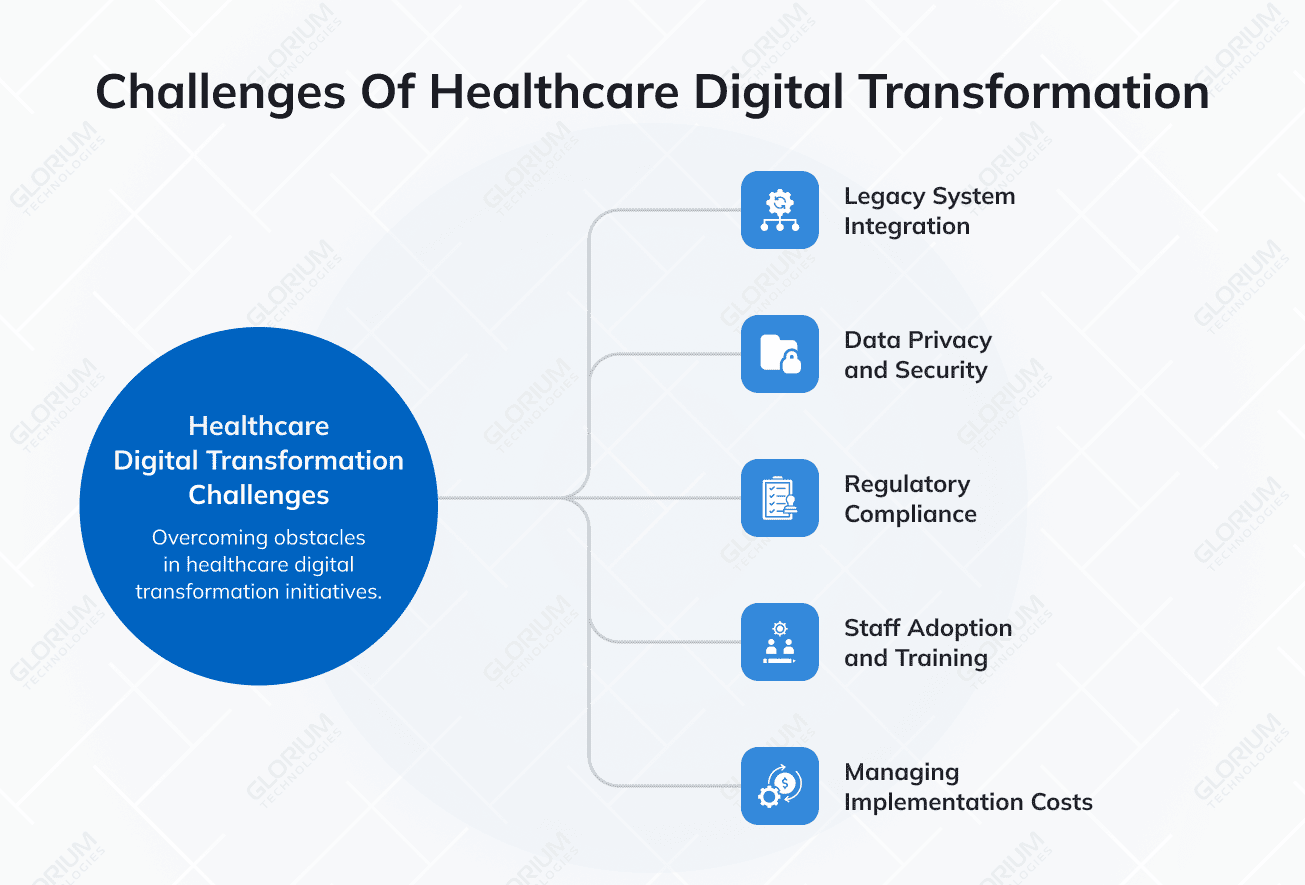
Most healthcare organizations run a patchwork of older applications that were never designed to talk to each other. Connecting new digital tools to these systems, without ripping everything out at once, is the hardest part of any program. Legacy modernization done in stages keeps care running while the foundation improves.
Sensitive patient data makes the healthcare sector a prime target. According to the HIPAA Journal’s analysis of HHS Office for Civil Rights data, 663 large breaches in 2024 exposed the health information of roughly 243 million individuals, with hacking behind about 81% of them. Security accordingly tops the investment list: the 2024 CHIME Digital Health Most Wired survey found cybersecurity was providers’ leading priority that year, ahead of cloud and patient-engagement tools. Every new system widens the attack surface, so data privacy belongs in the design phase.
HIPAA in the United States and GDPR in Europe shape what teams can build, alongside a growing set of AI disclosure rules for patient data privacy and healthcare data integrity. Compliance runs through the architecture itself, from secure access controls to audit trails, and it holds up only when teams treat it as ongoing work.
Healthcare professionals resist tools that add clicks or interrupt their judgment, and a poorly rolled-out system can slow a whole department down.
“When you enter into a regulated, conservative industry, you’d better bring a technology that is ten times better. If it’s just 10% better, forget it.”
Dan Vahdat, CEO and founder of Huma
Ambitious digital transformation efforts can outrun their budgets, and McKinsey’s 2025 analysis found that only 1% of healthcare organizations describe their AI adoption as fully mature, with many stuck in expensive pilots. Scoping tightly and proving value on a small footprint before scaling keeps spending tied to results.
No single blueprint fits every healthcare organization, though health systems that succeed at digital transformation in healthcare tend to follow a similar path.
Pick one workflow with a clear pain point and a measurable outcome, such as discharge coordination or remote monitoring for a chronic condition. A working pilot builds trust and surfaces integration issues early, giving leadership the evidence it needs before a larger commitment. For an early-stage product or a new digital service, an MVP build tests the idea with real users at a controlled cost.
Design every new component to share data through common standards from the start. Retrofitting interoperability later costs far more than planning for it, and early design is what keeps a system from turning into another silo.
How you staff a digital transformation project shapes the result. Three models cover most situations, and many health systems combine them:
Glorium Technologies delivers all three through its digital transformation services and broader healthcare software development practice, with the compliance and integration experience these projects demand.
Several trends will define the next phase of digital transformation in healthcare, and each of them assumes a cloud-based, interoperable foundation is already in place.
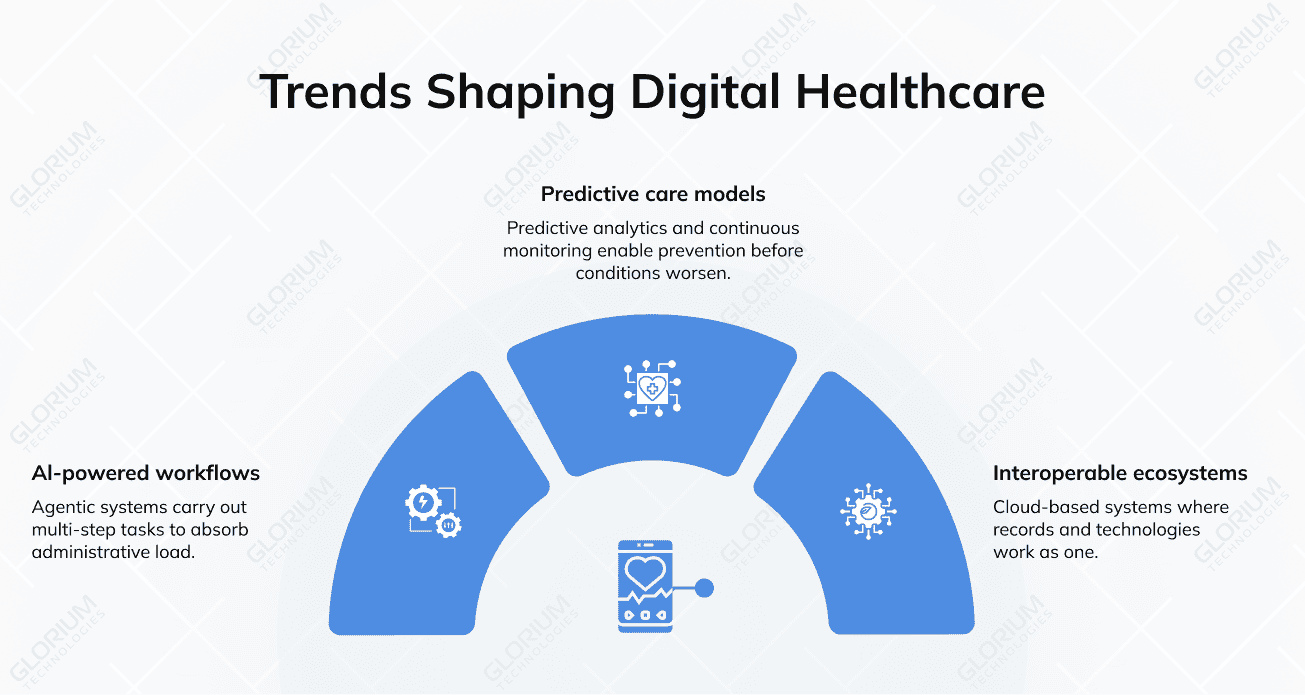
Generative artificial intelligence is giving way to agentic systems that carry out multi-step tasks, from drafting clinical documentation to coordinating referrals. As these digital technologies mature, they will absorb more of the administrative load that pulls healthcare professionals away from patient care across the healthcare industry.
Care is shifting toward prevention. Predictive analytics and continuous monitoring let healthcare providers act before a condition worsens, and telehealth platforms turn the app into the patient’s front door to care.
The endpoint many health systems are building toward is a cloud-based, interoperable ecosystem where records and other digital technologies finally work as one system. That foundation supports personalized medicine and health equity efforts, with emerging technologies such as autonomous workflows still on the horizon.
Digital transformation in healthcare has no completion date. The work runs from a single HL7 interface that stops a lab result being retyped, through to predictive models and bedside devices feeding one record that follows the patient between sites. The health systems getting the most out of it treat each phase as a working agreement between IT, clinical informatics, and the nurses and physicians who live with the result every shift.
Want to get more out of the systems you already own before buying another one? Glorium Technologies builds the connective layer that makes that possible. We have 15+ years in healthcare software and an ISO 27001-certified process, and we know Epic and Oracle Health integrations, HL7 and FHIR mapping, and the audit trails a HIPAA review actually asks for.
Book a free intro call to walk through what a first phase would look like at your organization.
Timelines depend on scope. A single integration or a focused MVP can ship in a few months, while a full platform with EHR integration and remote monitoring often runs closer to a year. Phased delivery puts value into healthcare professionals’ hands within the first few months, well before the whole platform is finished.
Start with one workflow and one number you can defend. Take a hypothetical mid-size practice, 25 physicians adopting ambient AI documentation. Published research puts the savings at 30 minutes per physician per day, which, across 220 clinic days, returns 110 hours each, or 2,750 hours for the group. Valued at the AMGA 2025 survey’s median primary care compensation of $329,780, which works out to about $159 an hour across 2,080 hours, that is roughly $437,000 a year, set against a year-one cost near $135,000 for licensing and EHR integration. Payback lands inside four months. Those are illustrative figures, not client results, so swap in your own headcount and rates before taking the case anywhere. Returned hours also only become money if they go somewhere specific: an extra visit slot, a shorter clinic day, or a physician who stays.
In-house teams give you long-term control but take time to hire and train, especially for compliance and integration skills that are hard to find. A partner brings that experience immediately and can flex up or down. Many health systems keep strategy internal while outstaffing specialized engineering. Glorium Technologies has worked in regulated industries since 2010 and has appeared on the Inc. 5000 list for 2020 through 2023, with Inc. Regionals recognition in 2021, 2022, and 2024.
Take it in stages. Integration layers and APIs let new digital tools exchange data with older systems, so departments keep working while you replace components piece by piece. This approach limits downtime and gives healthcare professionals time to adjust.
Compliance goes beyond a checkbox at the end. Compliant projects build in encryption, role-based access, audit logging, and secure storage from the first design decision, and they document how protected health information moves through the system. Signed business associate agreements and regular security testing round it out. Glorium Technologies holds ISO 27001 certification and builds to HIPAA, HL7/FHIR, and GDPR requirements as standard.
Adoption is near universal; full maturity is still rare. In one 2024 benchmark, every surveyed hospital either offered virtual care or planned to by year’s end, yet only about a third described their program as mature. Most health systems sit mid-journey, with core systems such as electronic health records in place while advanced analytics and AI keep scaling. That gap between basic adoption and real maturity is where most digital transformation budgets go next.