








Open-Source EHR Platforms: A Practical Guide for Healthcare Leaders
Updated September 17, 2026

 Summarize in ChatGPT
 Summarize in ChatGPT
Most organizations start looking at open-source EHRs for practical reasons. A renewal quote comes in higher than the budget allows, or the current vendor declines a workflow change that clinical staff keeps asking for.
An open-source EHR publishes its source code under a license that lets you read it, change it, and run it on your own servers, without paying per seat. OpenEMR, OpenMRS, Bahmni, and GNU Health are the four platforms that show up on most shortlists.
As of 2024, 91% of office-based physicians and more than 99% of non-federal acute care hospitals used a certified EHR, and three developers supply over 80% of U.S. hospitals. When a vendor market is heavily concentrated, your leverage shrinks. It dictates everything from whether a vendor will build custom workflow tweaks to how much it costs just to move your data elsewhere.
So let’s look at the four platforms one by one, what open source really costs compared with a proprietary system, where support and certification get complicated, and how to tell if any of this makes sense for your organization.
Content
Open source describes the license attached to the core code. The invoice price is a different conversation altogether. Any organization can download the software, inspect how patient data moves through it, rewrite modules, and deploy the result. That freedom is what separates these systems from proprietary EMRs, which are closed-source products owned by a vendor and altered only within vendor-approved configurations.
Free access to a download follows from the license as a side effect. The license grants something broader: the right to read and change the code. Several proprietary vendors offer free tiers too, but their source code stays closed, and your configuration cannot leave.
Open source EHR projects publish under different licenses with different obligations. OpenEMR uses the GNU General Public License, OpenMRS uses MPL 2.0 with a healthcare disclaimer, and Bahmni releases its own components under AGPL 3.0. Read the licensing terms before sinking engineering budget into a custom fork.
Eliminating licensing fees reallocates expenditure rather than reducing overall project cost. Realistic budget lines include:
These platforms were built for different settings, so a single shortlist rarely fits them all. They run on different technology stacks and carry different support ecosystems.
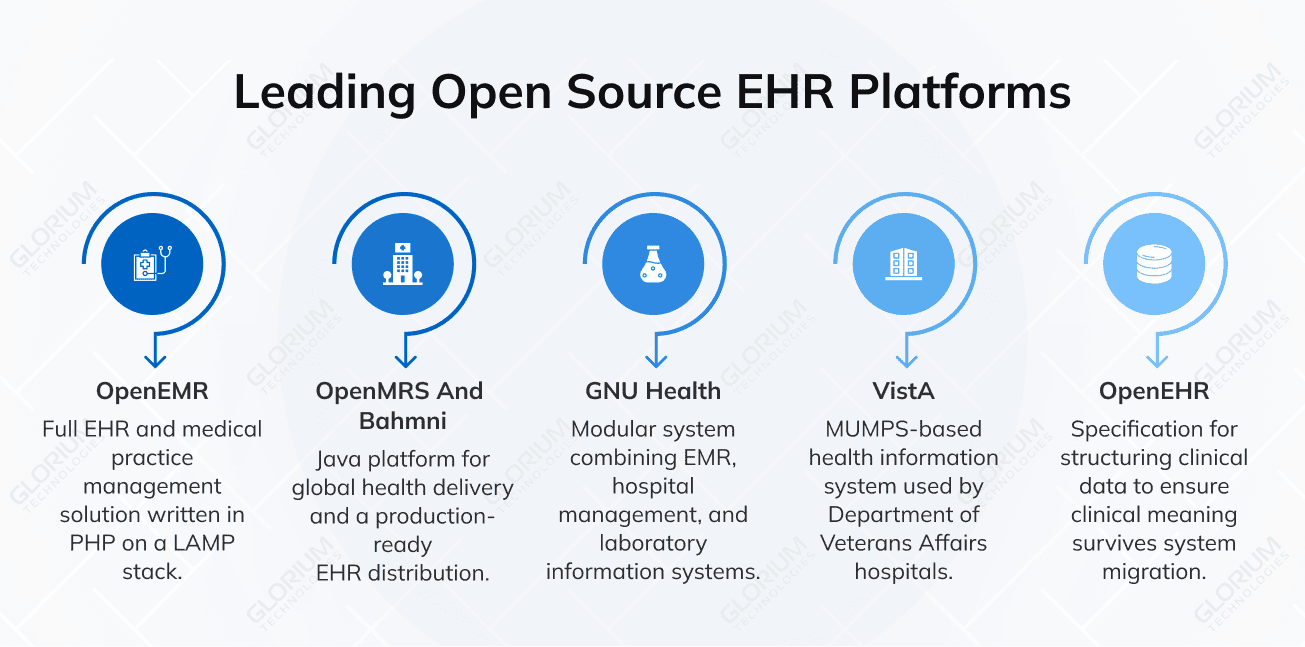
OpenEMR is a full EHR and medical practice management solution written in PHP and running on a LAMP stack. Key features include patient charting, scheduling, e-prescribing, electronic billing, a patient portal, and reporting that staff can generate in a few clicks. Lab orders and results flow back into the chart automatically.
The project supports more than 30 languages and runs on Windows, Linux, and Mac OS X. OpenEMR’s own figures put deployment at more than 15,000 healthcare facilities worldwide. A volunteer community maintains the codebase and prioritizes requests from the practices running it.
OpenMRS is a Java platform designed for global health delivery (not a finished product). Its concept dictionary lets implementers define what a medical record contains. Thus, a tuberculosis program in Peru and a maternity hospital in Iraq can run the same core with different data models. The community spans over 80 countries, and funding partner Madiro puts adoption at 8,100 facilities serving more than 16 million patients.
Bahmni packages OpenMRS into a production-ready EHR for hospitals. The distribution integrates OpenMRS for clinical data, OpenELIS for the lab, Odoo for billing and inventory, and dcm4chee for PACS imaging.
Introduced in 2008 and built on Python and the Tryton framework, GNU Health combines an EMR, a hospital management information system, and a laboratory information system. Its modular architecture ships more than 40 packages covering primary care, obstetrics, surgery, genetics, and imaging, plus Tryton modules for finance, stock, and human resources. GNU Health targets public health programs and ministries of health.
VistA powers most Veterans Affairs hospitals and remains the largest open-source EHR deployment in the United States. The platform is MUMPS-based with a small and aging developer community. The VA is now migrating away from it, and as of mid-2026, the replacement ran at 14 of 170 sites, with full transition projected as late as 2031. Derivatives such as OpenVistA and OSEHRA VistA exist, but new civilian deployments are rare.
openEHR is a framework for structuring clinical data, not a package you download and install. Teams building custom electronic health records use it to define archetypes and templates so that clinical meaning survives migration between systems.
| Platform | Technology base | Strongest fit | Certification and support |
| OpenEMR | PHP, MySQL/MariaDB | Solo and small-to-mid ambulatory practices, billing-heavy workflows | ONC-certified releases; forums plus paid vendor support |
| OpenMRS | Java, modular platform | Custom record systems, research and public health programs | No U.S. certification; global implementer community |
| Bahmni | OpenMRS, OpenELIS, Odoo, dcm4chee | Hospitals needing EMR, lab, imaging, and billing together | Implementation partners; no U.S. certification |
| GNU Health | Python, Tryton, PostgreSQL | Public health networks, labs, government programs | GNU Solidario and partner support |
| VistA | MUMPS | Legacy VA-derived environments | Narrow contractor pool, shrinking community |
openEHR stays out of the table because teams adopt it alongside one of these platforms rather than instead of them.
“Open-source hospital management systems have been running real clinical operations for decades. OpenMRS is deployed in low-resource settings worldwide, and VistA, built by the US Department of Veterans Affairs, covers everything from pharmacy to radiology. Alongside smaller tools aimed at independent practices, there’s a credible option at almost every scale.”
7 Best Open Source Web-Based Hospital Management Systems, We Suggest Software
Six advantages come up consistently in evaluations, and most of them compound over a five-to-ten-year ownership horizon.
The same evaluation deserves an equally specific look at what these platforms ask in return.
Regulators apply the same rules whether your EHR is free or licensed. The obligations attached to protected health information are identical, and the burden of proof falls on you.
Downloading a platform doesn’t make it compliant out of the box. Your deployment carries responsibility for encryption at rest and in transit, audit logging, and access roles mapped to real job functions. Most production implementations wire user authentication into LDAP or Active Directory so that clinical accounts follow the same lifecycle as every other corporate identity. Business associate agreements with hosting and support vendors close the remaining gap.
Certification is where the “open source is free and easy” pitch breaks down, and where careful planning pays off. OpenEMR does hold certification: version 8.0.0 was certified on January 30, 2026, meeting the same criteria commercial vendors face, and the certification of version 7 retired the following month.
Reaching that milestone required a community-wide campaign to raise roughly $200,000 to cover the development, testing, and submission costs demanded by ONC HTI-1 rules. Certification attaches to a specific version, so practices that depend on certified status for MIPS or other quality programs have to stay current.
Two practical consequences follow. Heavy customization of a certified build can move you outside the certified configuration, and platforms such as OpenMRS and Bahmni were never designed against U.S. certification criteria at all.
Interoperability is where open source makes its strongest case. Because the code and the database are open, connecting an open-source EHR to a lab, a pharmacy, or a health information exchange rarely requires a vendor ticket.
The standards that matter in practice:
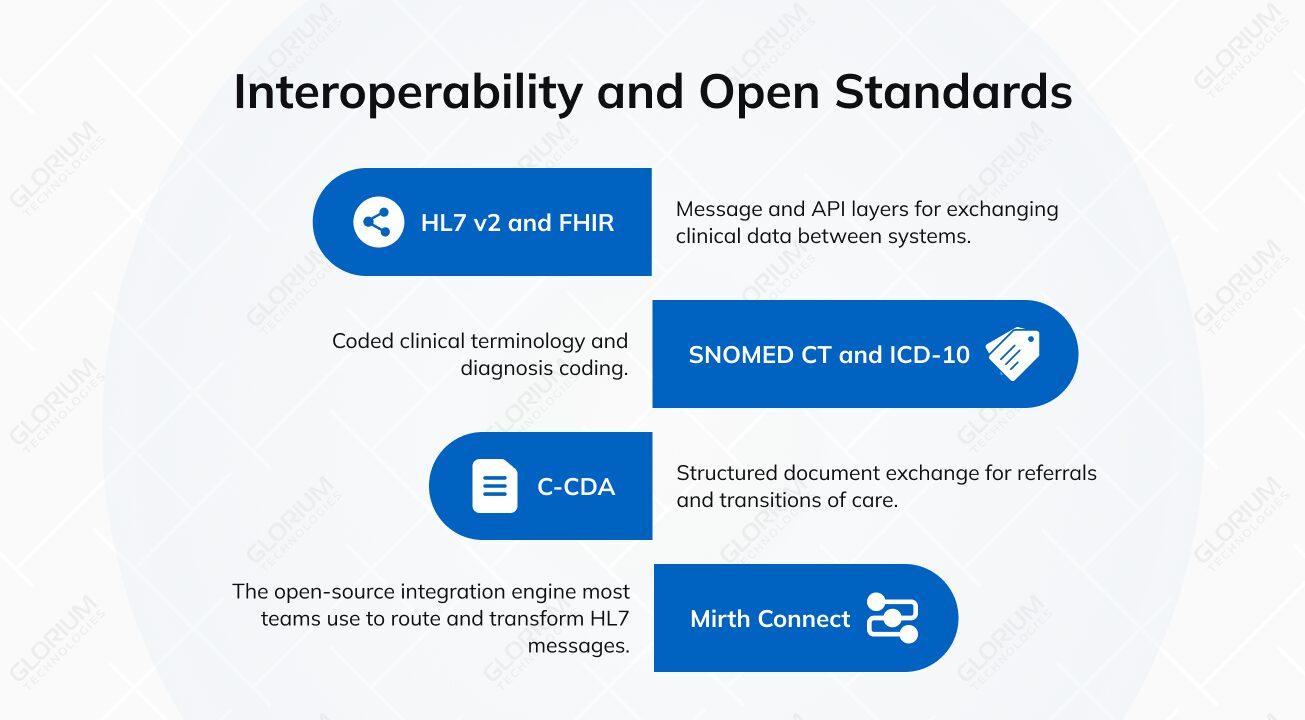
Our guide to interoperability in healthcare breaks down how a FHIR layer can wrap a system already in production.
The answer depends on four variables: your size, your budget structure, your technical capacity, and how unusual your workflows are.
Picture a six-provider multi-specialty practice paying per-seat licensing fees, with a single in-house developer and a critical referral workflow the vendor has already refused to build twice. That practice lands squarely in open source territory. Remove the developer, and the calculation shifts.
A middle path works for many organizations: run an open source core and buy commercial support, hosting, and integration from a partner. That arrangement keeps the code freedom while transferring the operational risk.
Adopting an open-source platform follows the same discipline as any EHR implementation: audit the current workflows, map the data, pilot with one department, then scale. Two parts deserve extra attention.
Historical patient records rarely map cleanly. Field-level mapping, duplicate resolution, and validation against the source system should start months before go-live rather than during the cutover weekend. Glorium Technologies worked through that consolidation for ITR Software, building a hospital bed management solution that pulled patient status, location, and insurance into a single record.
A medical information system that cannot talk to your lab, PACS, and billing stack creates more manual work than it removes. For Forward Advantage, our team rebuilt an auto-faxing platform off an obsolete Silverlight foundation while keeping the fax workflows clinicians relied on intact.
Most healthcare organizations reaching this point have the same need. They want the customization freedom and data ownership an open source platform offers, but they cannot handle the maintenance, compliance, and integration load with their current staff. They need a partner who implements, customizes, hosts, and supports the platform rather than one who proposes building a new EHR from scratch.
Glorium Technologies has built healthcare software since 2010, with ISO 9001, 13485, and 27001 certifications and HIPAA and GDPR designed in from the first sprint. Our teams work across EHR and EMR development, HL7 and FHIR integration, patient portals, and hospital management systems, which covers every layer an open-source deployment touches.
Bring us the platform you are evaluating and the systems it has to connect to. Contact us for a commitment-free discussion, and we will map an implementation path around what you already run.
Yes, though the effort depends on what your current vendor will export. Ask for a full structured extract rather than a PDF archive, and confirm in writing what the export includes. C-CDA documents cover clinical summaries well but often drop scanned attachments, custom fields, and billing history, so plan a separate path for those. Glorium Technologies runs field-level mapping and validation against the source system before cutover, which is where most migration problems appear.
Your organization. Open source licenses disclaim warranty, and no upstream project accepts liability for a deployment it does not operate. Under HIPAA, the covered entity carries the obligation, and any hosting or support vendor you engage should sign a business associate agreement covering their portion. Glorium Technologies works under NDAs and builds on HIPAA-, GDPR-, and HITRUST-aligned infrastructure, so the compliance boundary is defined before development starts.
E-prescribing is a standard feature, but EPCS requires certified two-factor authentication and a connection to a certified transmission network, usually through a commercial e-prescribing service. Budget for that subscription separately from the platform itself. The Glorium Technologies healthcare team handles that integration routinely.
A single clinic on a hosted OpenEMR instance can operate with a part-time administrator and a support vendor on call. A multi-site hospital running a customized Bahmni deployment realistically needs one or two developers plus DevOps coverage. Organizations that prefer to keep headcount flat cover those roles through team extension with Glorium Technologies, adding healthcare engineers who work inside the existing IT department.
Yes, and that is a design goal for OpenMRS and Bahmni in particular. Both support offline-capable clients that sync when a connection returns, and OpenEMR runs on a local LAMP stack on a single laptop. Uninterruptible power and a tested backup routine matter more than server specifications in these settings.
The code stays yours, which is the practical value of the license. Before selecting a platform, check commit frequency, release cadence, and the number of active contributors in its repository. A project with a broad contributor base and several commercial support vendors carries far less continuity risk than one maintained by a few people. When an upstream project does stall, Glorium Technologies takes over maintenance of the fork, the same way our legacy modernization teams keep aging healthcare platforms running and secure.