







Healthcare Data Warehouse: The Foundation for Data-Driven Care
Updated August 21, 2026

 Summarize in ChatGPT
 Summarize in ChatGPT
Patient histories, lab results, imaging, prescriptions, and billing records pile up every day across a dozen applications never designed to work together. The difficulty is pulling all of it into a form that a clinician or an analyst can actually trust and use, and that difficulty is exactly what a healthcare data warehouse was created to remove.
Bringing information from every source into a single, structured repository turns scattered records into one reliable version of events. A question no single application could settle, such as which patients are trending toward a complication or where quality is slipping across a whole population, now has one place to go for an answer. The value of that shift is large and growing, with Grand View Research putting the global healthcare analytics market at $65.6 billion in 2025 and on track for an estimated $81.9 billion in 2026.
This guide is for anyone weighing a warehouse build. By the end, you should be able to tell which model fits the systems you already run and what the integration and compliance work will ask of your team. The budget question gets a straight answer too, since that is usually what decides whether a project starts at all.
Content
A healthcare data warehouse is a system that consolidates data from many source systems and stores it for reporting and advanced analytics. Hospitals, payers, and digital health companies use it to answer questions that no single application can, from readmission rates to population health trends.
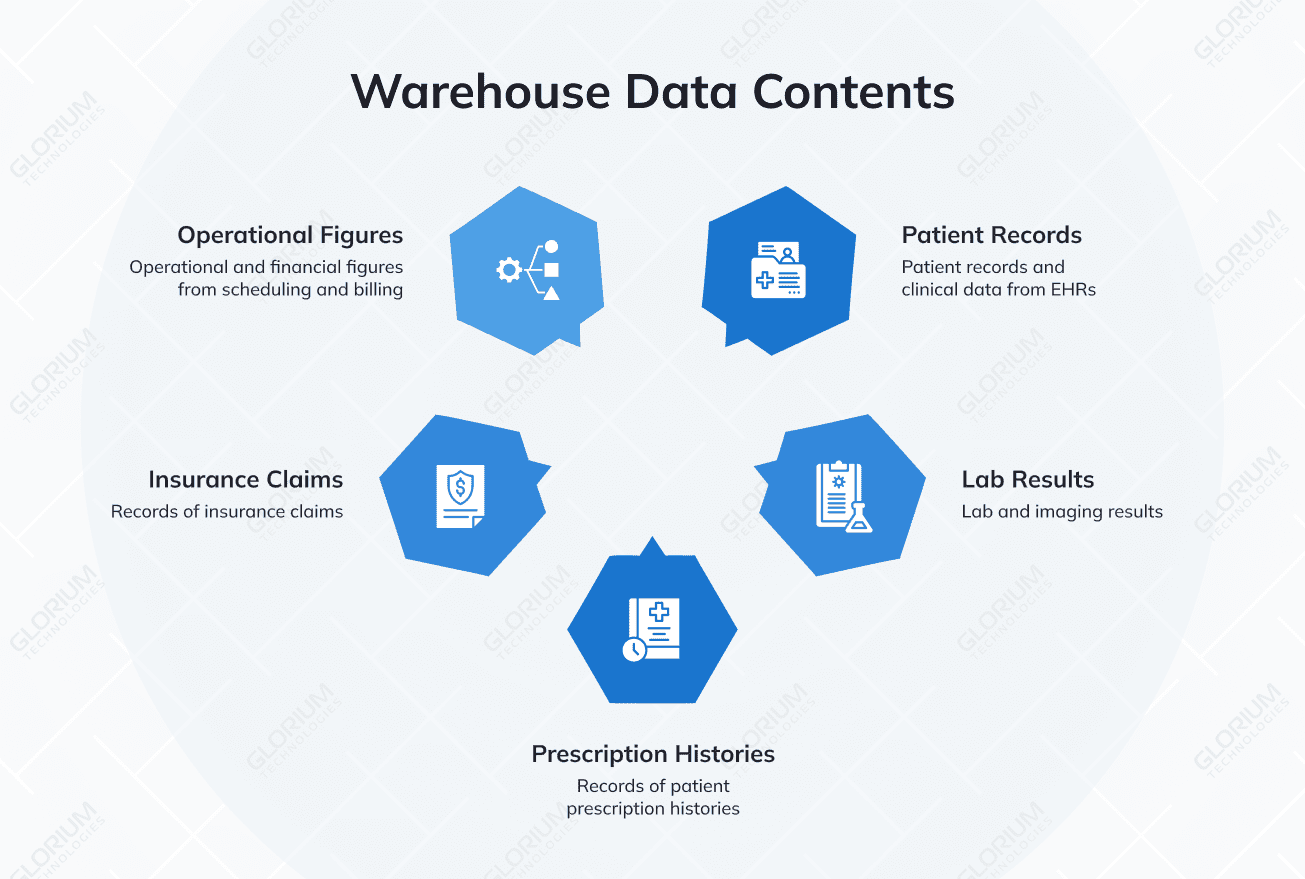
The data stored inside spans more than clinical notes. A typical warehouse holds patient records and clinical data from EHRs, lab and imaging results, prescription histories, insurance claims, and operational and financial figures from scheduling and billing. Pooling that range into one centralized repository is what lets an analyst connect a treatment decision to its cost and its outcome in a single query.
The difference between a database and a data warehouse comes down to purpose. A database records live transactions through online transactional processing, or OLTP. A data warehouse organizes historical data for online analytical processing, or OLAP, so large queries run fast without slowing the systems clinicians rely on every minute.
“A database is going to be used for recording transactions, [whereas] a data warehouse is going to be used for analytics and reporting.”
Alex Freberg, Alex The Analyst
Clinical data warehouses are positioned between the operational database and the data lake. Databases hold current, detailed patient records. A data lake stores raw data of any type, including images, scans, and free text, which suits machine learning work. A data warehouse holds cleaned, structured data that is ready for reliable analysis.
| Aspect | Database | Data warehouse | Data lake |
| Primary purpose | Recording live transactions (OLTP) | Analytics and reporting (OLAP) | Storing raw data for exploration and ML |
| Data type | Current, detailed records | Cleaned, structured, historical | Structured, semi-structured, unstructured |
| Schema | Flexible, changes as needed | Rigid, planned in advance | Schema-on-read, applied later |
| Healthcare example | Live EHR entries and orders | Cross-system quality and cost reporting | Imaging archives feeding AI models |
Many health systems run all three together, and each one handles the job it does best.
A fourth option, the lakehouse, sits in the middle of that spread by combining raw storage with warehouse-style structure in one platform, and choosing between the two comes down to the work you need done. A warehouse earns its keep when reporting is standardized and repeated: quality measures, regulatory submissions, month-end financials, anything where the same query has to return the same number every time and hold up in an audit. A lakehouse suits teams training AI and machine learning models against messy inputs, where imaging files, clinical notes, and device streams stay in their original form until a model decides what matters in them. Health systems doing both often land on a hybrid, keeping governed warehouse tables for reporting and a lakehouse zone for research and model training.
Whatever model an organization picks, the internals follow the same path. Data moves through four layers, and knowing which layer a problem lives in usually cuts troubleshooting time in half.
Most of the build effort lands in the staging layer, since that is where inconsistent inputs turn into numbers a clinician will act on.
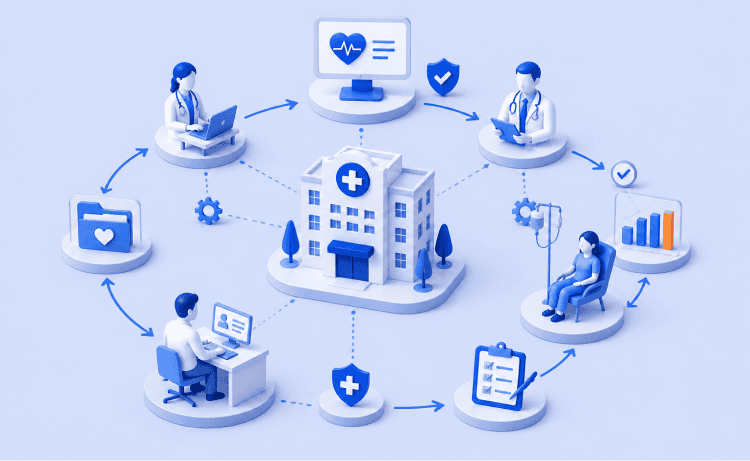
The payoff of a healthcare data warehouse shows up in the clinic and the back office at the same time. When patient data from every department flows into one place, teams stop debating which number is correct and start acting on it.
A shared warehouse also strengthens collaboration across healthcare entities. When a hospital network, an imaging center, and a specialty clinic draw from the same standardized data, referrals and care transitions stop losing information at the handoff. Timely access to trustworthy data lifts operational efficiency and trims operating costs at the same time, since staff spend less time reconciling spreadsheets and more time with patients.
Glorium Technologies saw this pattern with Astarte Medical, a precision-nutrition company focused on preterm infants. The task was to build a forecasting and tracking web application for infant treatment plans from scratch, one that could standardize feeding and quantify gut health from data scattered across protocols and clinical notes. The build synchronized Astarte Medical’s proprietary dataset of feeding protocols, microbiome profiles, and clinical records with an app that turns those inputs into a decision tree of feeding suggestions based on clinical indicators, growth speed, and each infant’s history. With the underlying data unified, the platform could track protocol compliance and surface AI-based recommendations from previous cases, helping neonatal teams reach the highest-risk newborns sooner.
There is no single blueprint for a healthcare data warehouse. The right structure depends on how many departments feed it, how fast teams need answers, and how much central control the organization wants. Four healthcare data warehouse models cover most real projects.
The enterprise data model takes a top-down approach, with architects designing the full model first and then loading every source into a central store that all departments query. This delivers strong consistency and a single version of the truth, though it asks for heavy planning before the first report appears.
Independent data marts flip that order, letting each team, such as cardiology or finance, build its own store around the questions it asks most. The approach produces quick wins, yet stores built in isolation drift apart over time and recreate the integration problems the warehouse was meant to solve.
A hybrid model keeps a central data layer while giving teams their own marts on top. This balances enterprise data consistency with local flexibility, which is why many mid-size hospitals choose it.
The late-binding approach delays rigid modeling until a question needs answering. Analysts bind data to a structure at query time, which shortens setup and suits fast-changing clinical research. Structured data still anchors every result, so the analysis stays reliable.
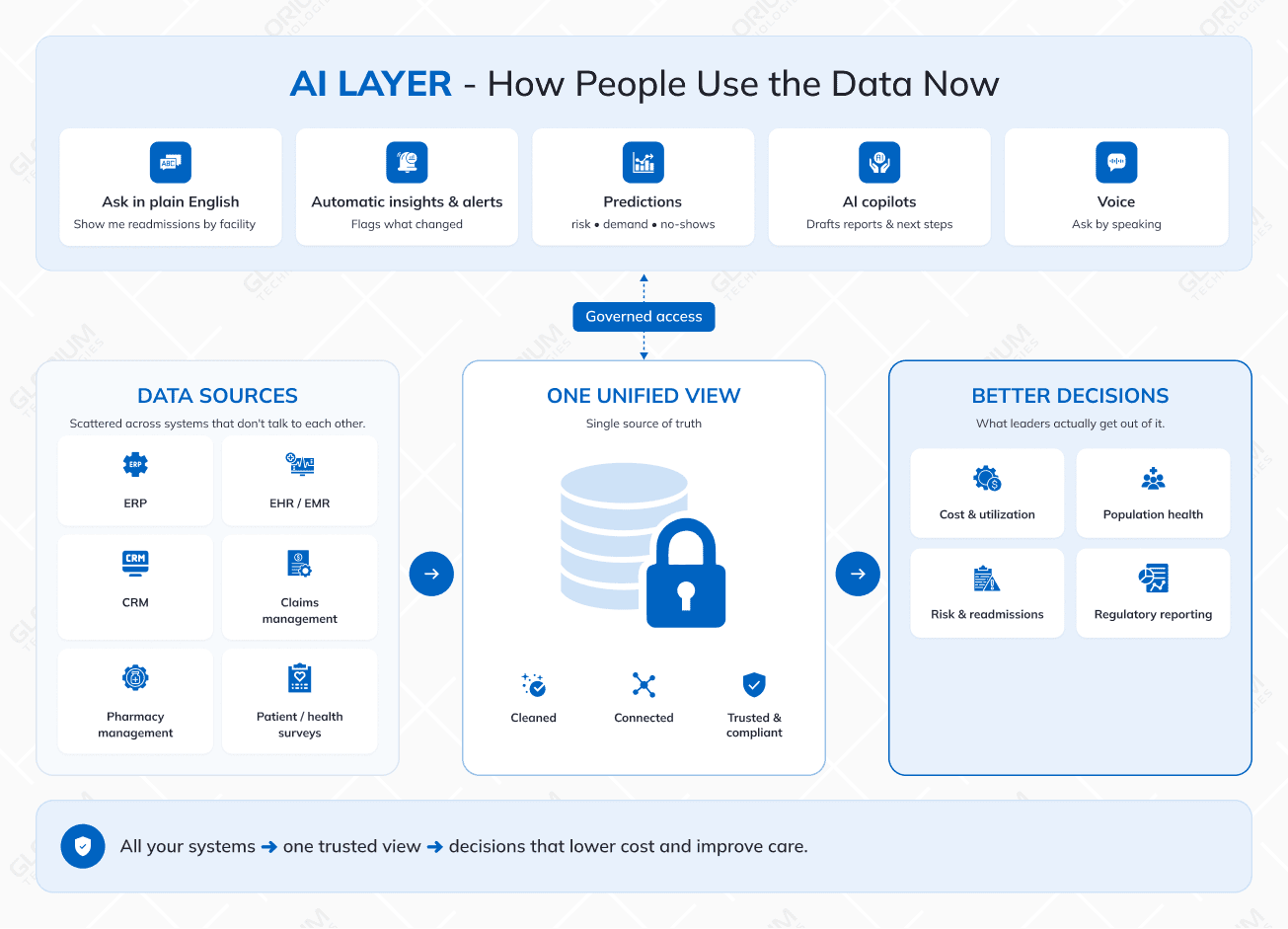
Healthcare data rarely arrives in a tidy format, since one warehouse might ingest electronic health records, lab feeds, imaging metadata, insurance claims, and streaming data from monitoring devices. Each source speaks a slightly different language, and reconciling them is where most projects stall.
| Platform | Strongest fit in healthcare | PHI and compliance notes |
| Snowflake | Payer analytics, population health reporting, and secure data sharing between separate healthcare organizations | Supports HIPAA and HITRUST; the BAA applies from the Business Critical tier upward |
| Databricks | Machine learning on imaging, clinical notes, and genomics, where raw and modeled data sit in one lakehouse | HITRUST CSF certified and FedRAMP Moderate, with a BAA available |
| Google BigQuery | Serverless analytics for research and population-scale datasets, fed by FHIR exports from the Cloud Healthcare API | Covered by a Google Cloud BAA, with strong uptake among academic medical centers |
| Amazon Redshift | Reporting for organizations already standardized on AWS, usually loaded from HealthLake exports through S3 | HIPAA-eligible under an AWS BAA, alongside HealthLake and Athena |
| Azure Synapse Analytics and Microsoft Fabric | Provider organizations running Epic and Power BI, with Azure Health Data Services handling FHIR and DICOM | Supports HIPAA and HITRUST under a Microsoft BAA |
One distinction saves teams from an expensive detour. AWS HealthLake, Azure Health Data Services, and the Google Cloud Healthcare API are FHIR-native services that store, validate, and serve FHIR resources the way a clinical system expects. Snowflake, Databricks, and BigQuery take FHIR in as structured data to be modeled for analysis. Most current architectures use both layers, keeping a FHIR service at the interoperability edge and the warehouse behind it for reporting and machine learning.
Platform decisions also carry a shelf life. Azure Synapse Analytics is still supported, though Microsoft has shifted new feature investment to Microsoft Fabric, which passed a $2 billion annual revenue run rate and 31,000 customers by early 2026. Teams starting fresh on the Microsoft stack now tend to build on Fabric and treat Synapse as an inherited system with a migration path.
For most health systems, the cloud contract already signed settles the question faster than any feature comparison, with the BI tools clinicians open every day serving as the tiebreaker. A roadmap weighted toward standardized reporting points to a warehouse platform, while heavy model training on unstructured records points to a lakehouse.
Few health systems build warehouse infrastructure from the ground up anymore. The shortlist has settled around five cloud platforms: Snowflake, Databricks, Google BigQuery, Amazon Redshift, and Microsoft’s pairing of Azure Synapse Analytics and Microsoft Fabric. Each one signs a Business Associate Agreement and supports HIPAA controls, so the choice turns on workload type, existing cloud contracts, and the skills your team already has.
Data integration complexity grows from four recurring problems:
Identity resolution is where consolidation projects most often stall. Deterministic matching links records through a shared unique identifier such as a medical record number or a member ID, which works cleanly whenever that identifier exists and was entered correctly. Probabilistic matching covers everything else, weighing name, date of birth, address, and similar attributes to score how likely two records describe the same person.
Even a well-tuned setup leaves a residue. Somewhere between 5 and 10 percent of records typically land in an uncertain band that a person has to judge, so the sensible plan is a permanent stewardship queue with named owners, budgeted as an ongoing process rather than a cleanup that finishes before launch.
Teams solve this with an ETL or ELT pipeline that extracts data from each system, standardizes it against shared vocabularies, and loads accurate data into the warehouse. Much of that load rides on shared exchange standards, which is why HL7 and FHIR integration work stays at the center of most builds. Done well, this transformation process is what turns raw data scattered across a dozen applications into the valuable insights that clinical data warehouses are built to produce.
Glorium Technologies handled a version of this challenge on an auto-faxing and information exchange platform for healthcare organizations. The problem was modernization: the app ran on Microsoft Silverlight, a technology nearing end of support, which put secure document exchange between providers at risk. Glorium Technologies rebuilt the interface on current web technologies and reworked how organizations create, send, and track faxed deliverables and their statuses, while stripping out the legacy dependencies that threatened data security. That cleared the disruptions behind lost-in-transit reports and duplicate prints, so record exchange stayed accurate, and clinicians could focus on diagnosis and treatment.
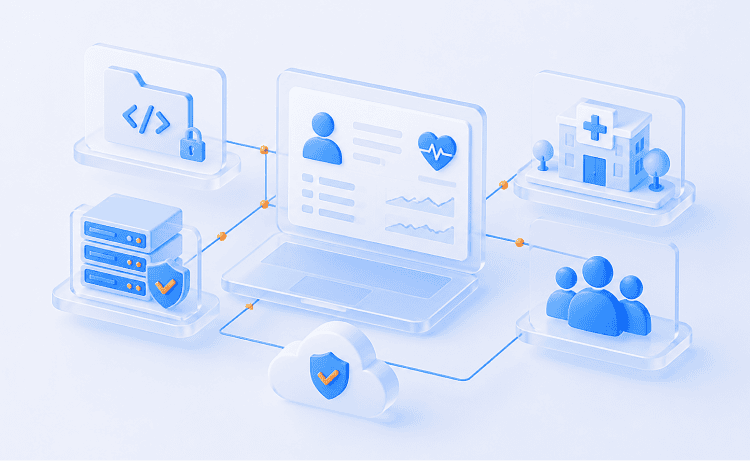
A healthcare data warehouse concentrates sensitive patient data in one place, which makes it powerful and, at the same time, a prime target for cyberattacks. In the US, the Health Insurance Portability and Accountability Act sets the floor for how that data is stored, shared, and audited, so protection has to be designed into every layer, from the storage layer to user access.
Two of those decisions cause the most rework when they surface late. The first is how far to strip patient data before analysts touch it: for model training and most retrospective studies, a de-identified dataset is enough, and paying for full anonymization buys protection the project never needed. The second is how far down the vendor chain your paperwork reaches. A signed agreement with the cloud provider says nothing about the BI vendor, the transcription service, or the contractor writing your pipelines, and each of them needs one of its own.
These safeguards reduce the risk of data breaches while keeping auditors satisfied. Data privacy is not a one-time checkbox either. As new source systems join the warehouse and staff change roles, permissions and audit logs need continuous review so that a well-protected system on launch day stays that way a year later.
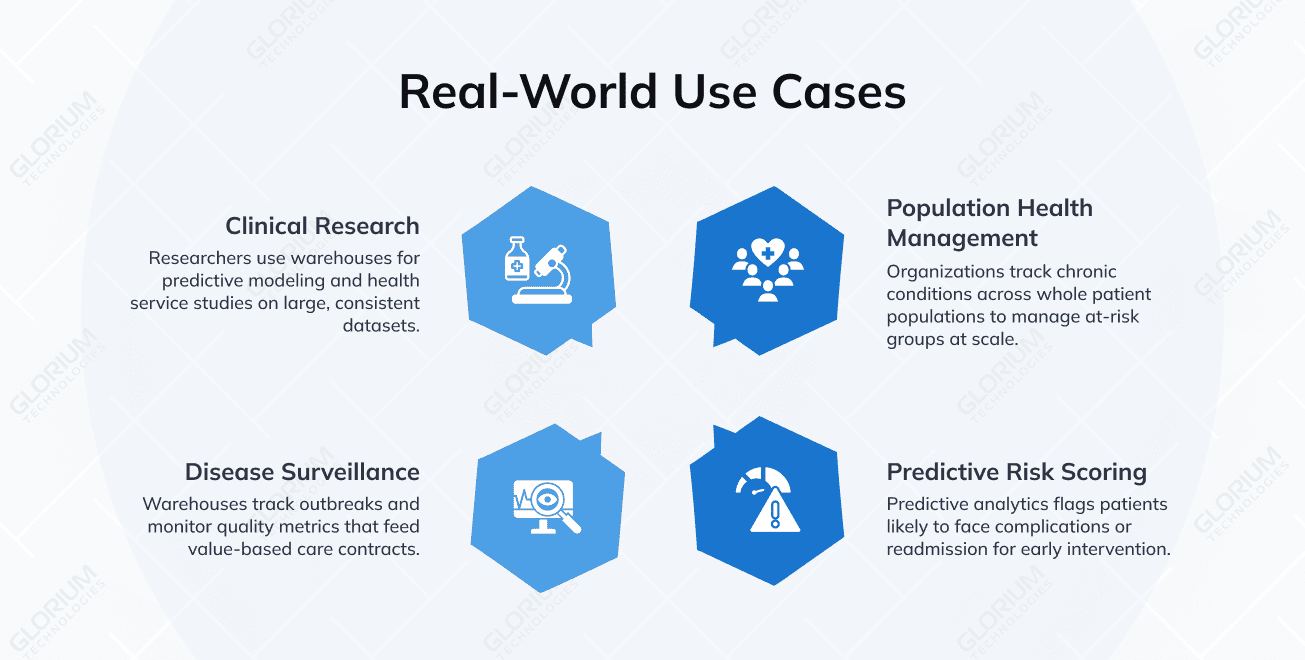
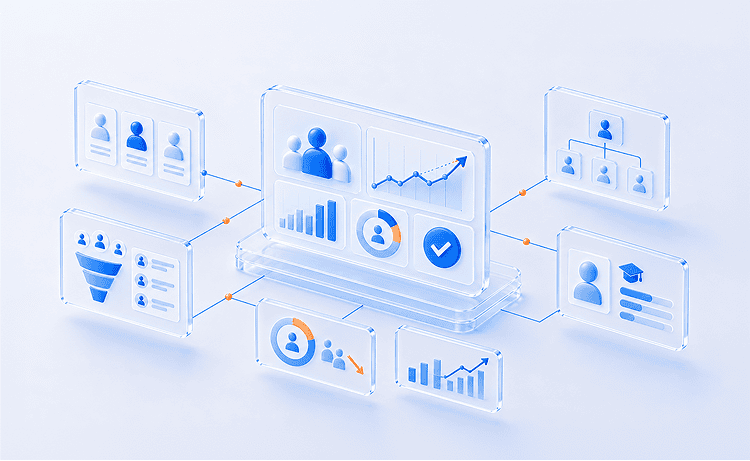
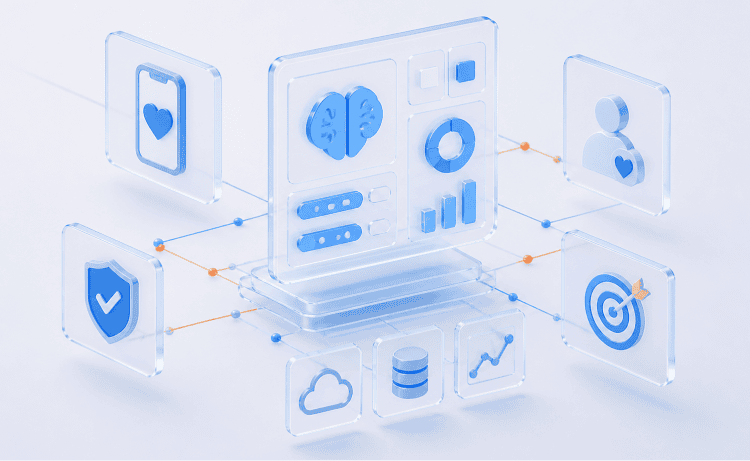
Once data is unified and clean, a healthcare data warehouse becomes an engine for advanced analytics. This is where the investment starts paying dividends beyond faster reports.
The size of the market reflects that demand: Grand View Research put the global healthcare predictive analytics market at $14.58 billion in 2023, with growth to $67.26 billion projected by 2030 at a 24% CAGR. Real-time data analysis is turning these tools into decision support that works during the visit itself, and this ability to surface big data and analytics at the bedside is what separates a modern platform from a static report.
Technology alone does not keep a healthcare data warehouse trustworthy. Data governance is the set of rules and roles that keeps data accurate, secure, and usable as the system grows.
A strong governance framework defines who owns each dataset, who may change it, and how quality gets measured. Clear ownership standardizes data across multiple sources and improves both accessibility and security. Without governance, even the best architecture drifts back toward the silos it replaced. Practical governance also settles the small decisions that cause big headaches later, such as which system is the authoritative source when two records disagree and how long historical data is retained.
Budget planning belongs in the same conversation, and as a rough range, a healthcare data warehouse build tends to fall between $70,000 for a focused departmental system and $1 million for an enterprise deployment with deep integration and compliance scope. Scope, source count, and regulatory requirements drive most of that spread, so the most reliable figure comes from mapping your own systems.
Building a healthcare data warehouse is as much about sidestepping known pitfalls as it is about architecture, so the choice of partner matters. Glorium Technologies has delivered data-heavy healthcare software since 2010, from predictive infant-outcome tools to health information exchange platforms, which means the integration, security, and compliance hurdles described above are familiar territory rather than surprises waiting mid-project.
Compliance is where that track record pays off most directly. A healthcare data warehouse only earns trust when it protects patient data and holds up to regulators, so a team certified to ISO 27001 and ISO 13485, audited to SOC 2, and practiced in HIPAA-compliant delivery takes a major source of risk off the table before the first line of code. On that foundation, a build can take whatever shape an organization needs, from a full project-based engagement to an MVP for a digital health startup to dedicated engineers who slot into an existing in-house team.
The clearest next step is to see what a build would involve for your setup. Contact us to map your source systems and scope with the healthcare team and talk through the options.
A focused departmental warehouse can go live in a few months, while an enterprise build that spans many source systems and compliance reviews often runs six to twelve months. Cloud deployments tend to move faster than on-premises ones, since there is no hardware to provision.
Cloud platforms scale storage on demand and shorten setup, which suits growing data volumes and heavier analytics workloads. On-premises systems give tighter physical control that some organizations prefer for their most sensitive patient data. Many teams settle on a hybrid split by data type. At Glorium Technologies, we build on both, and the split usually follows where the most regulated records have to live, with everything else fitted around that.
Yes, and a common path starts with independent data marts for quick wins, then introduces a central layer that ties them into a hybrid model. Planning shared vocabularies early makes that later migration far smoother.
A lakehouse keeps raw and modeled data in one platform, which removes the copying that a separate lake and warehouse require. The trade-off is engineering maturity, since lakehouse tooling moves quickly and needs people to keep up with it. A small analytics team often gets more out of a well-modeled warehouse than out of a platform nobody has time to tune.
A working setup usually pairs data engineers who build the pipelines with a data architect who owns the model, plus analysts and a governance lead who guards quality and compliance. Smaller organizations often fill these roles through an outstaffing partner.
Track a mix of clinical and financial signals: report turnaround time, readmission rates, denied-claim recovery, and hours saved on manual reconciliation. Tying each metric to a baseline before launch makes the gains visible to leadership.