







How AI in E-Commerce Drives Revenue for Online Stores
Updated August 12, 2026

 Summarize in ChatGPT
 Summarize in ChatGPT
Picture a store’s best-selling product slipping off page one of a marketplace overnight. The trigger was a stockout: two disconnected systems held conflicting stock counts, the item sold out unnoticed, and the ranking algorithm did the rest. That kind of quiet, costly failure happens somewhere every day, and the root cause is usually the same. A modern store collects more customer data than ever, yet very little of it flows back into the decisions that run the business.
AI in e-commerce exists to close that loop. Applied with intent, it converts customer data into sharper product recommendations, smoother support, and inventory that stays a step ahead of customer demand. Done well, that means fewer expensive surprises and a customer experience that feels personal at scale.
Content
Plenty of retailers call their store AI-powered when all they have really added is a chat widget in the corner of the homepage. The real payoff comes when an AI system is built underneath the store and shapes how it operates, from the first product a shopper sees to a reorder that goes out before anyone notices the stock is low.
The stores pulling ahead connect customer behavior, purchase history, and inventory into one flow, so each AI system feeds the next. One builder who deploys full AI stacks for online retailers put the mindset shift plainly:
McKinsey’s State of AI 2025 survey found that nearly nine in ten organizations now use AI regularly, with 71% using generative AI in at least one business function, up from 65% a year earlier. In the same survey, nearly half of respondents reported gains in customer satisfaction and competitive differentiation from AI.
“The brands that are pulling ahead right now are not adding AI to their existing process. They are rebuilding the process around AI.”
This Is What a Real AI-Powered E-Commerce Stack Actually Looks Like
Under the marketing language, artificial intelligence in e-commerce leans on a few core AI technologies that do the heavy lifting in online retail:
Most useful e-commerce features combine several of these AI technologies. A recommendation engine uses machine learning on browsing history, while a design assistant layers generative AI on top of it. Under the hood, AI algorithms train on historical data, and the same machine learning models improve as they process more of it. Connected, these AI technologies behave like one system. The market reflects the momentum: Precedence Research values the global AI in e-commerce market at about $9 billion in 2025, projected to reach roughly $75 billion by 2035.
Most stores meet these technologies through software they already pay for. Shopify built its assistant, Sidekick, straight into the merchant admin, where it writes product descriptions, sets up automations, and answers questions about store data in plain language.
Personalization typically comes from a vendor. Mastercard’s Dynamic Yield, named a Leader in the 2026 Gartner Magic Quadrant for Personalization Engines for the eighth year running, drives the recommendations and on-site testing that many mid-market retailers rely on without a data science team.
The analytics layer works much the same way. Triple Whale pulls forecasting and attribution together over ad and sales data, and Omnisend brings similar modeling to email and SMS timing. A working e-commerce AI stack usually comes down to native platform features plus two or three specialist tools.
The best e-commerce AI setups follow the customer journey one step at a time, using real-time data to sharpen the customer experience at each stage. The right AI tools connect those moments into one continuous flow, and the table below maps the most common use cases to the outcomes they drive.
| Store function | What AI does | Business impact |
| Product discovery | Personalized product recommendations from browsing history and past purchases | Higher average order value and cross-selling |
| Search | AI-powered e-commerce search across text, image, and voice | Fewer dead-end sessions, lower bounce |
| Customer service | Chatbots and virtual assistants handling routine tasks | 24/7 coverage, faster response times |
| Inventory | Demand forecasting and automated low-stock alerts | Fewer stockouts, optimized inventory management |
| Pricing | Dynamic pricing tuned to customer demand and market trends | Protected margins, timely markdowns |
| Marketing | Generative AI for content creation and product descriptions | Faster campaigns, consistent messaging |
| Trust and safety | Fraud detection that flags anomalies in user behavior | Lower chargebacks and fraud losses |
Machine learning algorithms analyze customer interactions, past purchases, and real-time browsing to predict which products a shopper is likely to buy next. By analyzing customer data across sessions, e-commerce AI shapes a customer experience that adapts to each buyer, and AI-powered personalization sharpens as more data arrives. Instead of showing everyone the same catalog, AI algorithms group buyers into fine customer segments and tailor what each visitor sees. That relevance drives customer engagement and builds customer loyalty over time because shoppers keep returning when personalized shopping experiences stay tied to their customer needs.
The same models power cross-selling. When a shopper buys a camera, the recommendation engine can surface the right lens and memory card rather than a random accessory. Applied to online shopping at scale, personalized product recommendations lift revenue without adding staff.
Traditional keyword search fails the moment a customer describes what they want in plain words. AI search closes that gap. Natural language lets shoppers type “lightweight running shoes for wide feet” and get relevant results, while AI-powered visual search lets them upload a photo and find close matches. Voice adds another channel for hands-free online shopping, and visual search gives shoppers a fast, intuitive way to find products from a single photo.
Smart search does more than surface products. Strong search matches shopper intent and reduces the friction that sends people to a competitor. For a large catalog, that difference shows up directly in conversion, and visual search is among the fastest AI capabilities to deploy.
AI customer service has matured well past scripted FAQ bots. Modern e-commerce customer service tools handle order status, shipping questions, and returns instantly, then escalate to a human with full context when a conversation gets complex. AI-powered chatbots and virtual assistants cover the routine tasks around the clock, which is how lean teams enhance customer service and stay consistent across all customer interactions without adding headcount. Glorium Technologies builds AI chatbots for e-commerce and AI customer support agents that keep tone and knowledge consistent across web, social, and messaging, so the customer experience holds together wherever a shopper reaches out.
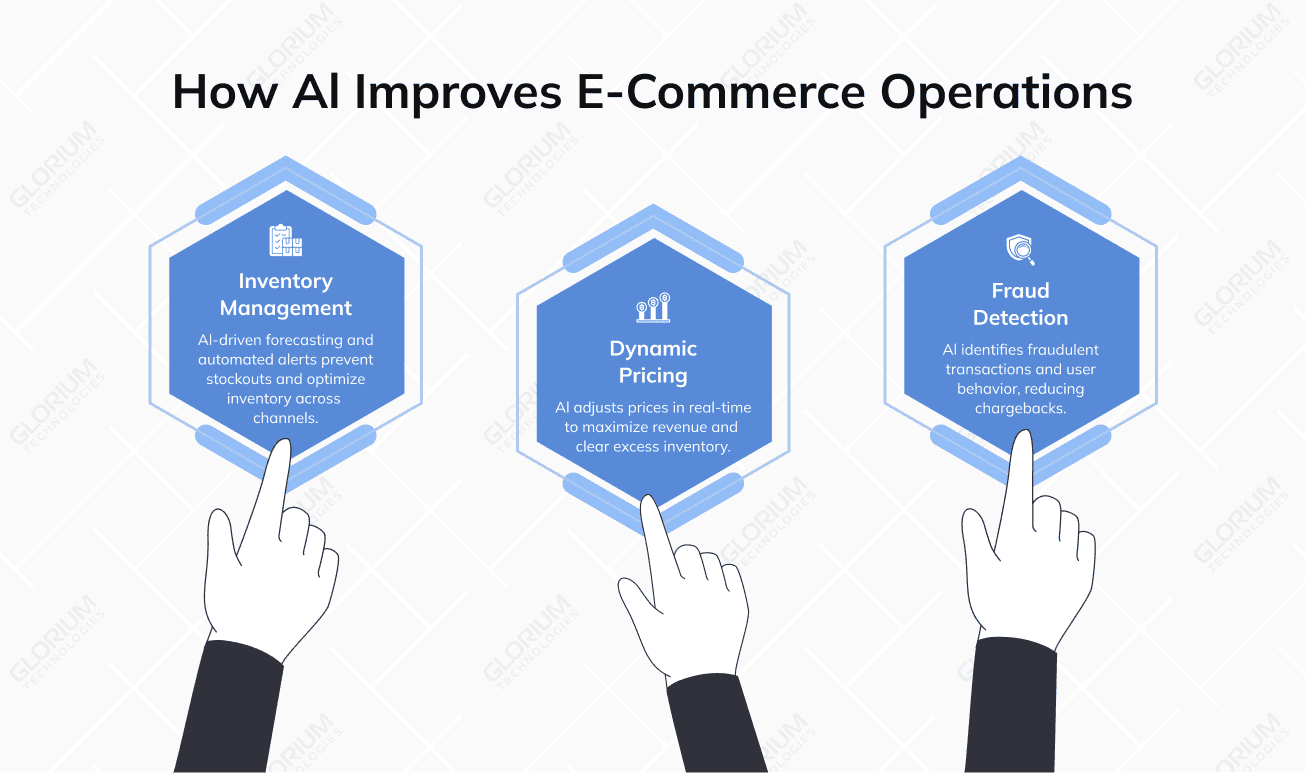
The customer-facing wins get the attention, but the operations layer is where AI often pays for itself first through operational efficiency. Well-built AI systems keep the storefront honest and free staff from manual, repetitive work, so AI for e-commerce operations quietly protects the customer experience.
Inventory is where guesswork gets expensive. AI-driven demand forecasting analyzes historical data, seasonality, and promotion calendars to predict what will sell and when, so replenishment stops relying on intuition. Automated alerts flag low stock per channel before a bestseller runs dry, which protects marketplace rankings and helps teams optimize inventory management across every channel. Paired with supply chain management and smart logistics, predictive analytics turns raw product data into actionable insights.
Dynamic pricing lets a store adjust prices in real time based on live demand, inventory levels, and competitor activity. The model can lift revenue on high-demand items and clear slow movers through well-timed discounts. AI algorithms read market trends and reprice automatically, while guardrails keep every change inside the margins and brand rules a business sets up front.
Fraud quietly erodes margins, and fraud detection is a natural fit for machine learning. Models learn normal patterns in user behavior and transactions, then identify patterns and anomalies a rules engine would miss. Machine learning algorithms also automate repetitive tasks in manual review queues and flag unusual customer behavior, helping teams identify patterns of fraud faster. The same approach powers risk work well beyond retail. Glorium Technologies built an AI risk-evaluation platform for a global insurer that cut risk evaluation time by 40%, using the anomaly-detection foundations that also protect an online checkout. For e-commerce businesses, stronger fraud detection means fewer chargebacks and less friction for legitimate customers.
McKinsey’s 2025 State of AI survey backs up the payoff: 61% of respondents reported cost reductions from generative AI in supply chain and inventory management. BCG research points the same way, reporting that AI leaders now generate 62% of AI’s value in core business processes rather than in support functions. Automating repetitive tasks frees the team for the judgment calls that still need a human.
ASOS pairs Style Match visual search with a Fit Assistant that reads a shopper’s purchase and return history to head off sizing mistakes. The retailer went further in 2026, adding a hybrid virtual try-on and ASOS Stylist, a shoppable styling app that lives inside ChatGPT.
eBay runs visual search at marketplace scale: a convolutional neural network turns an uploaded photo into a vector and ranks listings by how closely they match. Warby Parker uses Apple’s TrueDepth camera to show how a pair of frames actually sits.
Amazon’s pricing engine reprices millions of listings a day, tracking competitor moves, demand swings, and stock levels. Every one of these programs began with a single measurable use case and grew from there.
Pulling the threads together, the benefits of AI in e-commerce fall into buckets most founders care about. From single-brand shops to large e-commerce businesses, the same AI tools that sharpen the customer experience also cut costs. Artificial intelligence rewards e-commerce brands that treat it as a system rather than a gadget, and a connected e-commerce AI stack turns these gains into a compounding advantage.
Relevant product recommendations, sharper search, and responsive service each nudge conversion upward. Together they compound, turning more browsers into buyers across online shopping journeys and lifting average order value. For many e-commerce brands, a better customer experience becomes a real competitive advantage, because rivals still show every visitor the same static catalog.
AI tools handle routine tasks at a scale no team can match, from answering repetitive questions to reconciling stock across channels. That operational efficiency lets a lean team run a larger operation, which matters most for startups and small e-commerce businesses watching every dollar of runway. The gains show up across marketing automation, support, and back-office work.
Faster answers, fewer out-of-stock disappointments, and shopping that feels tailored all improve customer satisfaction and lift the overall customer experience. Improving customer satisfaction over time turns a one-time sale into customer loyalty, and steps that enhance customer service keep acquisition costs from spiraling. Enhanced customer satisfaction, sustained across seasons, plus a steady focus on improving customer satisfaction, make retention affordable.
Getting AI in e-commerce right comes down to planning and good groundwork. Three challenges show up on nearly every e-commerce AI project, and preparing for them early keeps a build on track.
Every e-commerce AI model is only as good as the data behind it. Scattered or messy customer data leads to weak predictions, so cleaning and connecting the sources usually comes before any model gets built. Analyzing customer data responsibly matters just as much, which means clear consent, strong governance, and transparency about how personalization uses customer purchase history.
Most stores already run on established e-commerce platforms, so new AI tools have to fit the stack a business already has. Bidirectional sync with the storefront, marketplace, and back office is where projects tend to stall. This is worth scoping with a partner who has done multi-channel e-commerce and retail development before.
Custom AI needs specialized skills that are hard to hire quickly. Some companies build in-house, while others extend capacity through a dedicated development team or tech outstaffing to fill the gap without a long recruiting cycle. Early-stage founders often start smaller, validating one AI use case through MVP development before committing a full budget.
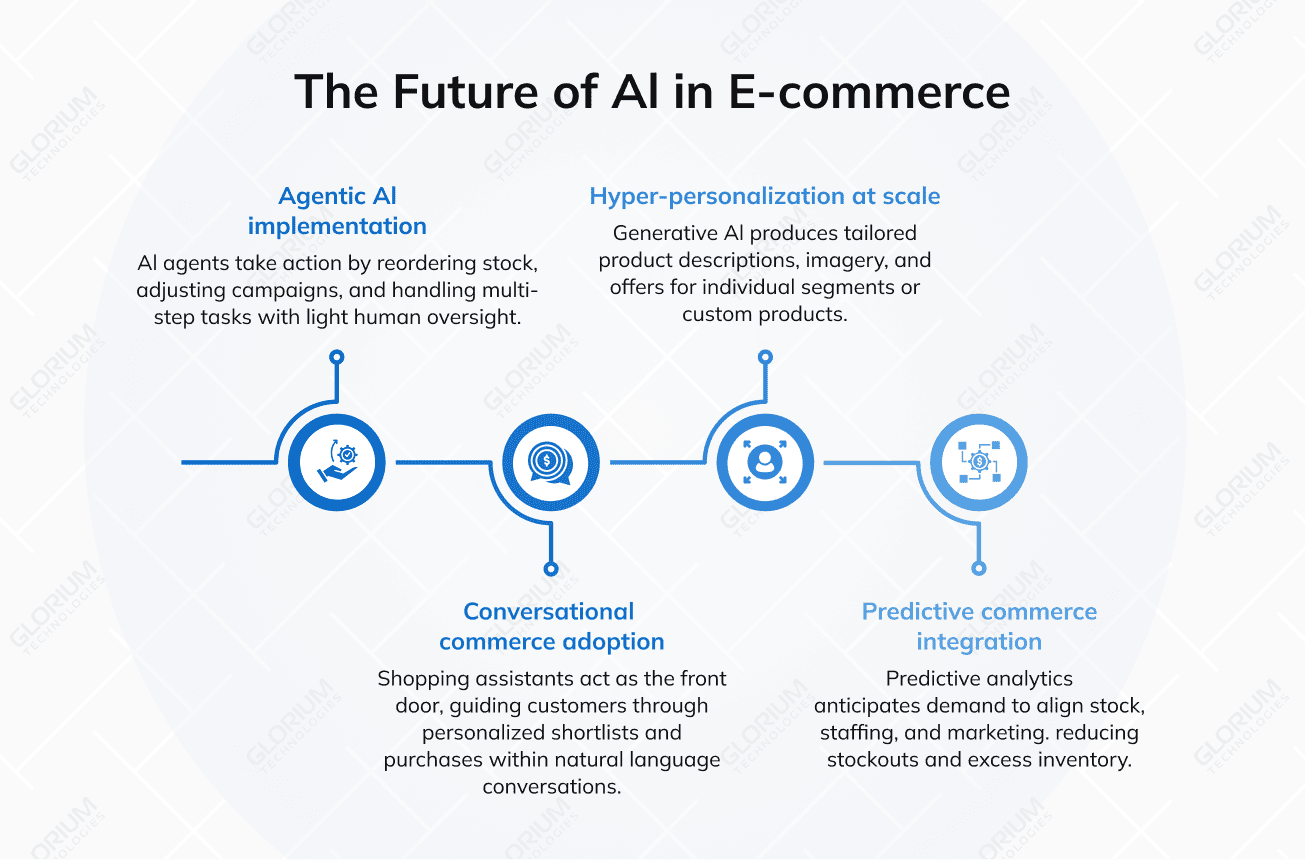
The direction of travel is clear, even if timelines vary by niche and execution. Several trends in AI for e-commerce are worth watching closely, and each one raises the bar for the customer experience. E-commerce AI is shifting from isolated features toward systems that plan, act, and learn, so the gap between early-adopter e-commerce brands and everyone else keeps widening.
The next wave moves from AI tools that answer questions to AI agents that take action: reordering stock, adjusting campaigns, and handling multi-step tasks with light human oversight. Autonomous online stores, where routine operations run themselves, stop being a thought experiment as these AI agents mature.
Shopping assistants are becoming the front door of the store. A customer describes a need in natural language and gets a guided, personalized shortlist, then completes the purchase inside the same conversation. Conversational commerce moves online shopping onto the channels where customers already spend time.
Personalization is heading toward a segment of one. Generative AI can produce tailored product descriptions, imagery, and offers for individual customer segments at a scale no copywriting team could reach. The same AI capabilities let customers co-create custom products through guided design.
Predictive commerce flips the model from reacting to demand to anticipating it. Predictive analytics forecasts what customers will want, when, and where, so stock, staffing, and marketing line up before the orders arrive. Paired with AI-driven supply chain management and smart logistics, this trend shrinks both stockouts and the working capital tied up in excess inventory.
Glorium Technologies has engineered digital products since 2010, helping startups and growing e-commerce brands turn ideas into working software. The Digital Products team covers the full path, from validating an idea with MVP development to project-based builds and scaling capacity through dedicated developers. On the AI side, Glorium Technologies delivers AI for e-commerce through AI software development, custom AI agents, and machine learning services built to fit an existing stack rather than replace it.
The smartest first step is a clear plan and a realistic view of scope. Contact the Glorium Technologies team to book a consultation, map the highest-impact AI use cases for your store, and get a project estimate.
Cost depends on scope. A single feature like a recommendation engine or a support chatbot is far cheaper than rearchitecting the operations layer. The highest cost is usually hidden in data cleanup and integration. A short discovery phase gives a realistic budget range before any commitment.
Yes, and most should. Pick one high-impact use case, prove it, then layer the next. Support automation and inventory alerts are common starting points because they show returns quickly and generate data that improves later systems.
Narrow features like chatbots or search upgrades can show impact within weeks of launch. Operations projects that unify channels and add demand forecasting typically run three to four months, and the compounding benefits grow after go-live as the models train on more data. McKinsey research on AI-powered customer experience reports gains of 15 to 20% in customer satisfaction and 5 to 8% in revenue once these systems mature, so the biggest returns tend to arrive well after the initial launch.
Both models work. Building in-house makes sense when AI is core to a long-term product. Many e-commerce businesses instead extend their team with dedicated developers or outstaffing to move faster and avoid a lengthy hiring cycle, then bring skills in-house later.
Start where the pain is measurable. If lost sales come from stockouts, forecasting and inventory alerts pay back fastest, since AI-driven demand forecasting improves inventory accuracy and smart logistics tools track real-time stock levels across every channel. If support costs are high, customer service automation wins. The best AI for e-commerce roadmap sequences use cases by measurable payback, so match the first project to the number that hurts most.
For most stores, yes. McKinsey’s personalization research finds that personalization typically lifts revenue by 5 to 15%, and that faster-growing companies derive about 40% more of their revenue from personalization than slower-growing peers. Personalized product recommendations are usually the highest-leverage place to start, because they raise average order value without extra ad spend.
Accuracy depends on fresh, connected data. Recommendation and search models should sync with the live catalog and retrain on recent customer behavior, so new products and price changes flow through automatically. Regular monitoring catches drift before it reaches shoppers.