








How to Hire a Dedicated Development Team in 2026: From First Call to First Sprint
Updated September 8, 2026

 Summarize in ChatGPT
 Summarize in ChatGPT
Picture Monday, a founder opens her sprint board to find a feature that was “almost done” now blocking three others, a backend engineer who just gave notice, and an investor email asking when the next release ships. Her in-house team is already maxed out. Posting the role alone rarely closes the capacity gap. HR.com’s 2025 recruitment technology survey found that senior-level roles take the longest to fill, with 30% taking more than 90 days and another 31% taking 61–90 days. For engineering roles specifically, Gem’s 2025 benchmarks put average days to hire at 53. By the time interviews, offer acceptance, onboarding, and ramp-up are done, a quarter can easily be gone.
This is the exact moment the dedicated development team model was built for. Deloitte’s 2024 Global Outsourcing Survey shows that outsourcing is no longer just a cost-control move: 80% of executives plan to maintain or increase their investment in third-party outsourcing, with skilled talent and agility now among the key drivers. The hiring pressure is just as visible in technical roles. The Linux Foundation’s 2024 State of Tech Talent Report found that organizations spend 5.4 months on average filling a technical position, while front-end and back-end developer roles take 5.5 months on average. So instead of waiting through a hiring cycle that can slow the roadmap for half a year, companies bring in a dedicated development team: vetted engineers, QA specialists, and a project manager who can plug into active work faster than a full in-house hiring process.
But here’s the catch: hiring a dedicated team is easy to mess up. Pick the wrong partner, the wrong engagement model, or skip the groundwork, and you can burn through runway before a single feature ships. This guide walks you through doing it right — what a dedicated development team actually is, when it’s the right call (and when it isn’t), what it costs across regions in 2026, how to hire in six clear steps, and the mistakes that quietly sink projects so you can sidestep every one.
Content
A dedicated software development team is a group of skilled professionals — software developers, QA engineers, DevOps engineers, and a dedicated project manager — that a vendor assembles to work exclusively on one client’s product over an extended period. Unlike traditional outsourcing, where a vendor delivers a fixed scope and walks away, dedicated teams work exclusively for one client, sit inside that client’s sprints, and follow the client’s roadmap.
The key distinction: they’re employed by the vendor, but in practice, they’re your team members. You set priorities, approve who joins, and evaluate performance. The vendor handles payroll, taxes, benefits, hardware, and HR. According to Statista, the global IT outsourcing market is projected to top $806.55 billion by 2030, and the dedicated development team model is now the preferred option for companies building complex digital products — because modern development teams stay embedded sprint after sprint, building the deep understanding of your codebase that short-term contractors never reach.
The dedicated project team structure is organized around the work that needs to be done. Common roles on dedicated software development teams include:
A full dedicated app development team can include all of these; smaller development teams might be three software engineers and a tech lead. Team composition and team size flex with project scope.
Building an in-house team is slow and expensive — once you add up salaries, benefits, office space, recruitment, and training, and then factor in the months it takes to fill senior technical roles, the true cost climbs fast. Still, in-house hiring isn’t always wrong: for a small project needing deep institutional knowledge, an in-house team beats any external partner on context. The trade-off is speed and flexibility.
| Dimension | Dedicated Development Team | In-House Team |
| Time to staff | 2–6 weeks to first sprint | 5+ months for senior roles |
| Talent pool | Global talent pool, specialized skills | Local market only |
| Total cost | 30–50% lower TCO in most regions | Salary + benefits + office + recruiting |
| Scalability | Flex up or down in weeks | Hiring or layoffs |
| Admin load | Vendor handles HR and payroll | Your problem |
Most product companies in 2026 run a hybrid — a small internal team in-house plus a dedicated remote team handling active development capacity.
The decision to hire a dedicated development team should follow the shape of the work, not the shape of hiring panic. The best results come when companies treat the dedicated team model as a deliberate choice tied to specific business goals. It tends to fit for:
A dedicated team is the wrong tool for short, well-scoped one-off project demands. For smaller projects, you can use IT staff augmentation or team extension services. For medium projects with fixed specs (Time & Materials is leaner), and for work that requires proprietary context that can’t leave your office.
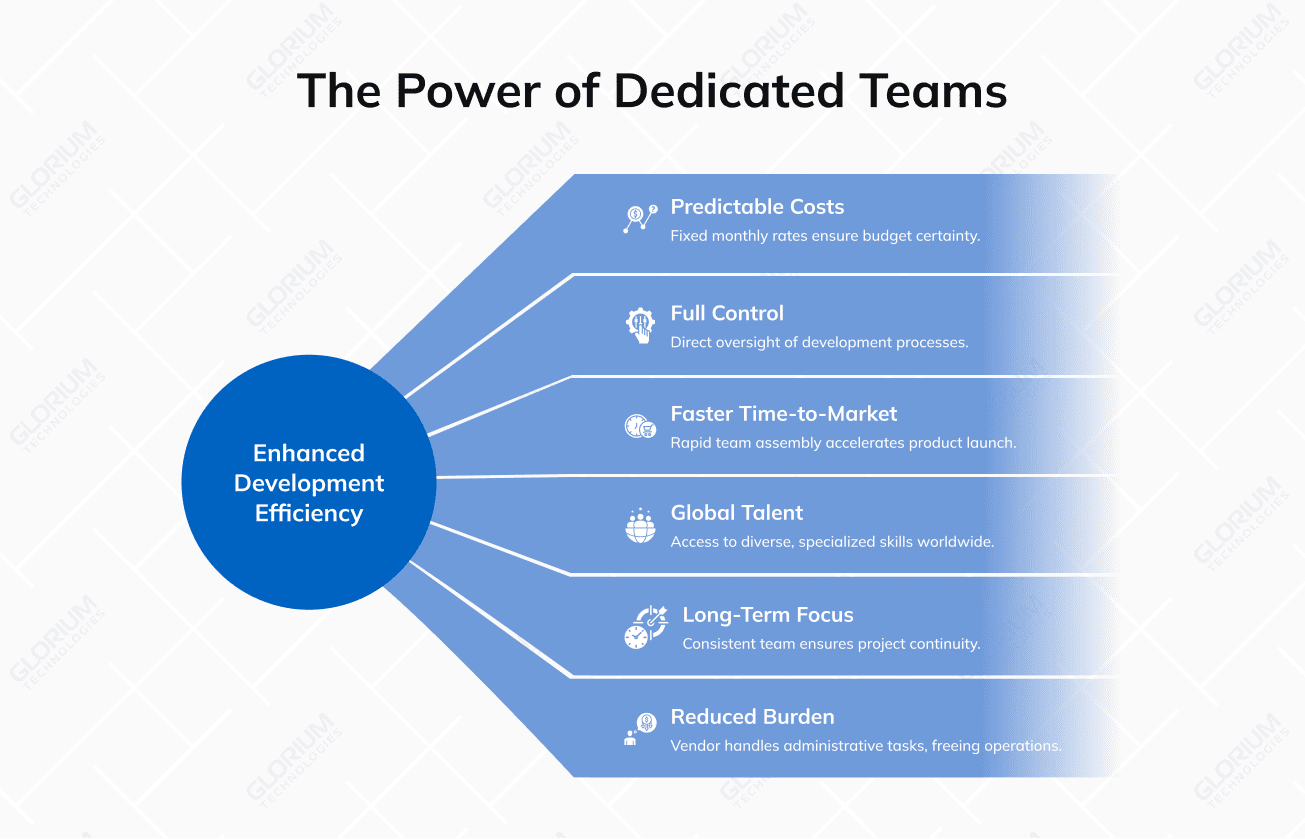
The real appeal of a dedicated development team is how its advantages compound: cost predictability, full control, and a global talent pool — without the hiring overhead. Here’s what that looks like in practice:
Not every dedicated team engagement model is identical. Match the model to your phase:
The right cooperation model depends on where you are in your product journey. If your MVP is live and needs ongoing support, Maintenance is the right fit. If you’re building from scratch, Full-Service gives you end-to-end coverage. And if you have a team but need to fill specific technical or domain gaps, On-Demand lets you scale with exactly the right specialists.
Anna VoznaAccount Executive, Glorium Technologies
Get the order right — clarify what you need before you start evaluating partners, vet rigorously before you sign, and set up management before the first sprint — and most of the risk disappears. Here’s the six-step process we recommend with early-stage teams:
Write a one-page brief covering product vision, must-have v1 functionality, target technology stack, team size, start date, and budget. “Build the MVP” isn’t specific; “ship an iOS app with onboarding, payments, and three core flows by Q3” is. Clear project goals are the single best predictor of a project’s success.
Match it to your phase: full-service for building from scratch, on-demand for filling a specific gap, maintenance for a live product. A common mistake is defaulting to a full team when an on-demand specialist would be cheaper and faster.
Use Clutch, GoodFirms, TopDevelopers, and The Manifest to build a shortlist of 5–8 partners. Filter on years in business (5+ is a useful floor), industry experience, average project length, reviews, and case studies in your vertical. Reputable software development companies will share portfolios and reference clients.
Evaluate the software development company and the specific team members they’ll assign. Interview every person before they join, test technical skills with a focused live exercise, and spend equal time on soft skills. Bring an independent engineer to technical screens if your team is non-technical.
Cover services, deliverables, payment cadence, IP assignment, termination, replacement guarantees, data security, and compliance requirements (HIPAA, GDPR, SOC 2, PCI), and SLAs. Sign an NDA before sharing specs, and have an IT-literate attorney review the contract.
Pick a methodology — Waterfall for fixed scope, Agile/Scrum for evolving backlogs, Kanban for support work. Choose your project management tools and communication stack before kickoff, and have project managers on both sides agree on KPIs early: sprint velocity, code-review turnaround, bug-escape rate, and deployment frequency.
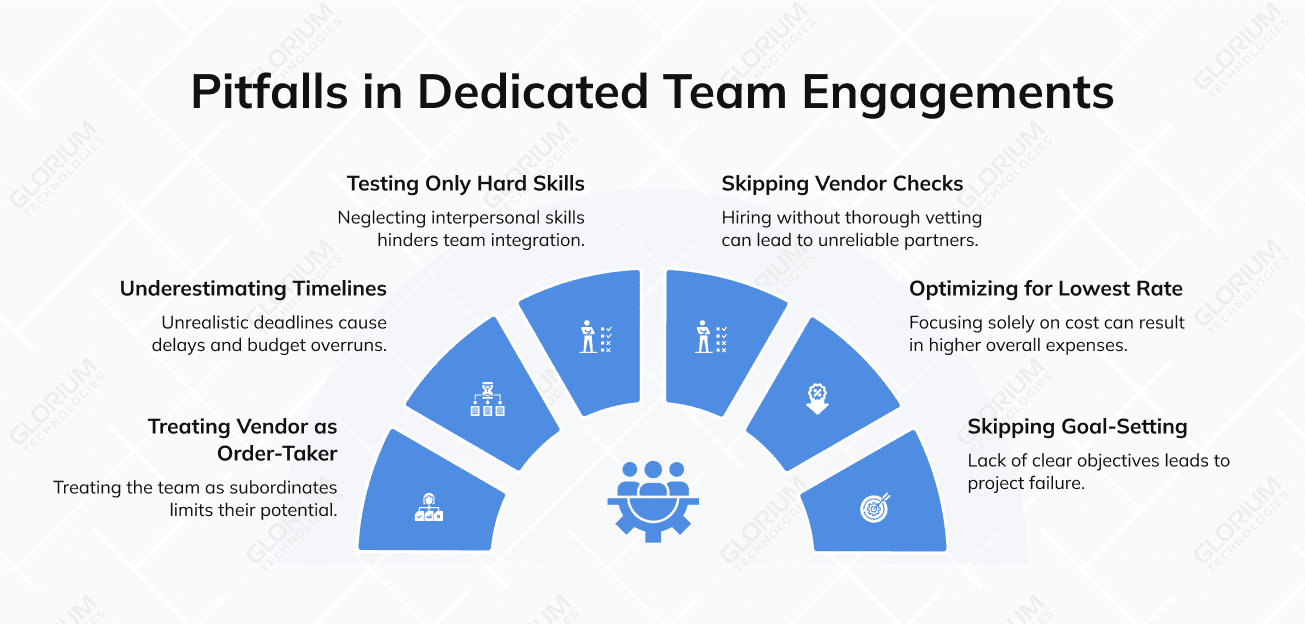
Most failed engagements don’t collapse over code quality — they unravel over avoidable setup and management errors. Here are the six that derail dedicated teams most often, and how to sidestep each one.
Most dedicated development teams are hired through one of two channels. The right one depends on how long the work will run and how much risk you can absorb.
| Criteria | Freelance Platforms | Offshore & Nearshore Companies |
| Examples | Upwork, Toptal, Arc | Clutch / GoodFirms-listed vendors |
| Best for | Short, well-scoped tasks | Long-term dedicated team development |
| Talent | Individual software developers | Vetted senior engineers + full team |
| Setup | Hire per task | Contracts, NDAs, replacement guarantees |
| Project management | You manage it | Built in |
| Rates | Lowest, competitive | Modest premium |
| Main trade-off | No exclusivity, weaker IP protection | Language and time zone differences (easily managed) |
For anything long-term, the software development company model wins almost every time — the modest premium over freelancer rates buys continuity, legal protection, and a team that stays with your product.
The companies that win with a dedicated development team treat it as a deliberate operating choice — scope defined, model matched to the project phase, and the team integrated as a genuine extension of their own. Get those fundamentals right, and the model delivers exactly what it promises: speed, specialized skills, and a team that grows with your product. The biggest lever isn’t the developers themselves; it’s how thoughtfully the engagement is set up and run.
That’s the part Glorium Technologies handles. Building software since 2010, we assemble dedicated development teams hand-picked for your stack, your domain, and your roadmap — software engineers, QA engineers, DevOps, and a project manager who operate as one unit under your direction. You keep full control of priorities and the development process; we take on hiring, onboarding, retention, and the administrative weight so your team can stay focused on shipping.
Whether you’re a startup racing to an MVP, a scale-up adding parallel development capacity, or an enterprise modernizing a legacy tech stack, the same people who help you scope the team carry that context all the way into delivery — so nothing gets lost between the plan and the code.
Ready to stop waiting on a nine-month hiring cycle? Reach out to Glorium Technologies, and we’ll map out a dedicated development team built around your scope, your timeline, and your
With a reputable vendor, the contract assigns all intellectual property, source code, and documentation to the client, usually backed by an NDA signed before any specs are shared. This is one of the clearest advantages of hiring through an established software development company over a freelancer — ownership and confidentiality are spelled out in writing rather than left to assumption. Always confirm the IP-assignment clause is explicit before you sign.
Continuity is built into the model. Most vendors offer replacement guarantees and absorb the cost of ramping up a new team member, so a single departure doesn’t stall delivery the way it would on a small in-house team. The bigger protection is process: because dedicated development teams document decisions and share context across the group, knowledge lives in the team rather than in one person’s head. Ask any prospective partner how they handle handovers and knowledge transfer.
Yes, this flexibility is a core reason companies choose the dedicated team model. You can add software engineers when a release pushes your roadmap, or scale back to a lean maintenance crew once a product stabilizes, typically with a few weeks’ notice. Compare that to in-house hiring, where scaling up means months of recruiting and scaling down means layoffs. Clarify the notice period and any minimum-commitment terms in your contract.