







AI Medical Diagnosis: Evidence, Real Use Cases, and What Clinicians Should Expect
Updated July 31, 2026

 Summarize in ChatGPT
 Summarize in ChatGPT
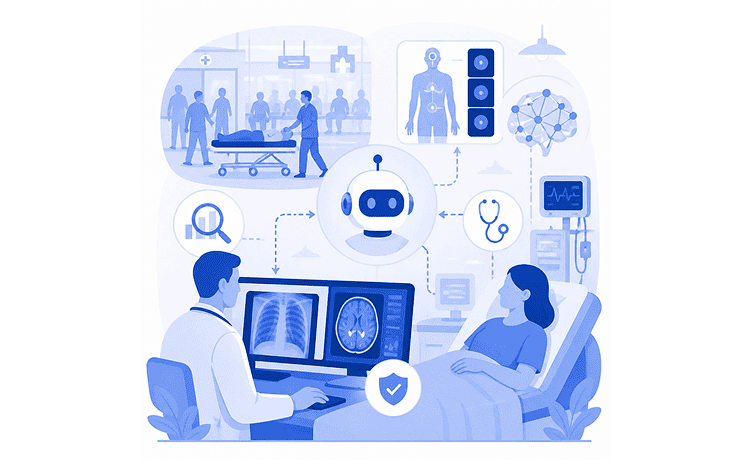
A patient arrives in a crowded emergency department with vague symptoms and a thin medical history. The attending physician has minutes to decide what to rule out first. In a growing number of hospitals, a second set of eyes now reviews that same case in parallel: a diagnostic model trained on millions of records. In 2024, Stanford researchers tested this exact setup and found that ChatGPT-4, working alone on complex patient cases, scored a median of about 92, the equivalent of an A grade, according to Stanford HAI.
That result explains why AI medical diagnosis has moved from conference demos into serious clinical conversations. The global market for AI in diagnostics was valued at roughly $1.2 billion in 2023 and is projected to reach $5.4 billion by 2030, growing at about 24.6% a year, per Grand View Research. Within the broader health care AI market, MarketsandMarkets projects the diagnosis and early detection segment to grow faster than any other, at close to 40% a year through 2030. This guide walks through what the technology does, where the evidence is strong, where the risks sit, and what comes next for clinicians, health systems, and the teams building these tools.
Content
Medical diagnostics has always been a data problem. A doctor gathers symptoms, imaging, lab values, and history, then reasons toward the most probable explanation. Modern AI systems approach the same task by learning statistical patterns from large volumes of medical data, which lets them flag findings a rushed human eye might miss.
Early diagnostic software relied on hand-coded rules: if a value crossed a threshold, the program raised a flag. Those systems were rigid and struggled with the messy, incomplete data of real practice. The shift came with machine learning, where models infer patterns from examples rather than fixed instructions.
Deep learning pushed this further. By stacking many layers of computation, deep learning models can read a chest X-ray, segment a tumor, or grade tissue slides with a level of consistency that reduces the variability between individual readers.
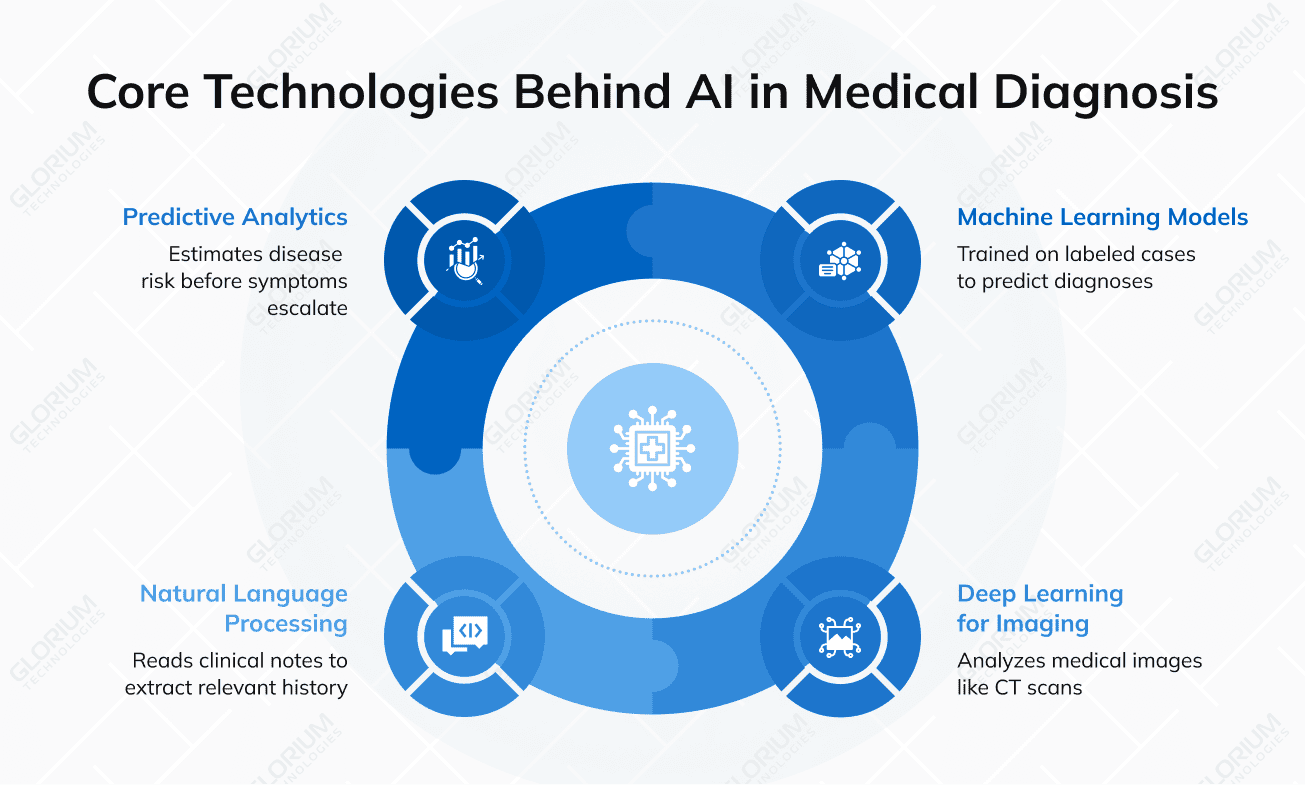
A working diagnostic tool usually combines several methods. The most common building blocks include:
Taken together, these AI-powered tools turn scattered inputs into a ranked set of diagnostic possibilities for a physician to review and confirm.
The strongest evidence for AI in diagnosis comes from fields rich in imaging data and structured records, and regulators have taken note. Through September 2025, the U.S. FDA had authorized more than 1,300 AI-enabled medical devices, with radiology making up roughly three-quarters of them, according to The Imaging Wire.
Deep learning models detect suspicious nodules on CT scans, triage head bleeds so urgent cases jump the queue, and read mammograms alongside radiologists. A 2025 narrative review found that in radiology and pathology, AI improved accuracy while cutting diagnostic time by roughly 90% or more in the studies examined, as reported in this PMC review.
The same imaging data that powers diagnosis also drives surgical planning. Glorium Technologies built software for BIOMODEX that segments a patient’s MRI, CT, or ultrasound scans and reconstructs the anatomy into print-ready 3D models in about 30 minutes end-to-end.
Digital pathology follows the same pattern. Algorithms scan tissue slides at high magnification, quantify cell features, and highlight regions a pathologist should examine closely. The result is faster reads and fewer overlooked details, which supports earlier, more accurate diagnoses.
Beyond images, AI improves diagnostic accuracy by watching trends in the record. Predictive analytics models track vital signs, lab trajectories, and prior conditions to warn of sepsis, kidney injury, or cardiac events hours before a clinician would otherwise act. Early detection of this kind directly improves outcomes, since many conditions respond far better when caught early. Natural language processing adds another layer, reading unstructured notes across electronic health records to surface a buried allergy, a prior imaging result, or a family history that changes the differential. Together these methods widen the picture a physician works from without adding to the reading load.
A 2024 study from Stanford showed that physicians who added ChatGPT to their workflow did not always improve their accuracy, yet they finished each case more than a minute faster on average. Broader work is more emphatic. Stanford’s 2026 AI Index reports that multi-agent AI frameworks have delivered diagnostic accuracy gains ranging from 7% to more than 60% over single-agent baselines.
“AI will serve as an integral member of healthcare teams.”
Cornelius James, MD,Preparing Clinicians for Diagnostic Artificial Intelligence, UCSF Grand Rounds
The practical takeaway for health systems is that raw model skill is only half the equation. How a clinician interacts with the tool, and whether they know when to trust or question it, decides whether that skill reaches the patient.
The table below summarizes where the technology stands across major use cases.
| Application area | What AI does | Evidence and impact | Maturity |
| Radiology imaging | Detects and triages findings on CT, MRI, X-ray | Majority of FDA-authorized AI devices; large time savings | High |
| Pathology | Grades tissue slides, quantifies cell features | Faster reads, more consistent scoring | Growing |
| Predictive analytics | Flags deterioration and disease risk early | Earlier intervention, better patient outcomes | Growing |
| Clinical decision support | Suggests differentials and next steps | Faster case turnaround; accuracy depends on clinician use | Emerging |
| Rare disease matching | Links symptom patterns to uncommon conditions | Shorter diagnostic odyssey for patients | Early |
AI’s ability to compare one patient against millions helps most where human experience runs thin. For rare diseases, pattern matching across genomic and clinical data can shorten a diagnostic journey that often takes years. That same capability feeds personalized medicine, where treatment is tuned to a patient’s biology, and supports drug discovery by narrowing millions of compounds to a promising few.
Strong results come with real limitations. Any health system adopting AI medical diagnosis has to plan for the following risks rather than assume the technology handles them.
Diagnostic models feed on sensitive medical data, which raises the stakes for privacy and security. Every deployment has to respect HIPAA and GDPR, encrypt records in transit and at rest, and limit access to the minimum needed. Data quality is the quieter risk. A model trained on narrow or messy data will produce confident answers that fail on real patients.
Models learn the patterns in their training data, including the gaps. An algorithm validated mostly on one population can be less accurate for another, which threatens fairness and patient safety. A second concern is automation bias, the tendency of clinicians to defer to a machine’s suggestion. Studies of AI-assisted diagnostic reasoning show that erroneous model output can pull a physician’s judgment off course, which is why on-demand use and clear override paths matter.
Explainability of AI decisions is central to trust. A clinician who cannot see why a model concluded has little basis to accept or challenge it. Clinical validation is thinner than many assume. One 2025 analysis found that fewer than 30% of FDA-authorized radiology AI devices had undergone clinical testing, as covered by Radiology Business. Integration adds a further hurdle, since a tool that does not connect cleanly to electronic health records creates friction that erodes adoption.
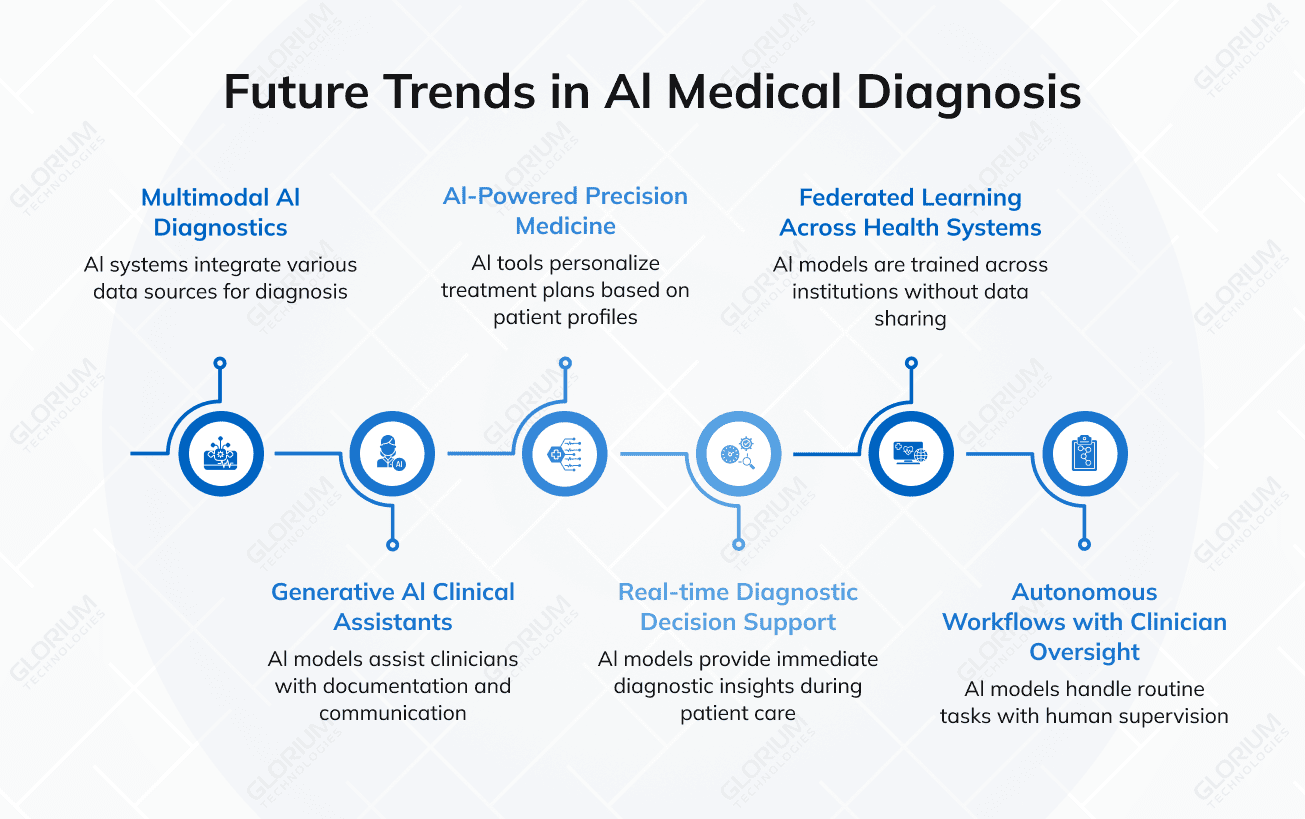
The next wave of diagnostic technology is already visible in research pipelines and early products. Several directions stand out for teams planning the next few years.
Single-input models are giving way to multimodal systems that read images, notes, labs, and genomics together, closer to how a physician actually reasons. Pulling these signals into one model surfaces patterns that any single data stream would miss, which sharpens diagnostic accuracy in complex cases where the answer sits across several sources.
Generative models now draft differentials, summarize a chart, and answer follow-up questions in plain language. Used as an assistant rather than an oracle, this cuts documentation time and lets clinicians spend more of their attention on the parts of care that need a human.
The next step ties AI diagnosis to treatment. By matching a patient’s genetic and clinical profile against large datasets, AI-powered tools help select the therapy most likely to work, moving toward personalized patient care.
Diagnostic support is moving into live workflows. Models that read streaming vital signs and imaging data as they arrive can flag a deteriorating patient or a missed finding in the moment, enabling faster intervention when minutes decide the outcome.
Patient data rarely leaves a hospital without friction. Federated learning trains shared models across institutions without moving raw records, which protects data privacy while widening the training set and improving reliability for smaller sites with limited data of their own.
Routine triage and screening will likely see more autonomy before anything else. Models can take on the high-volume, low-complexity reads and flag the exceptions for a person, easing the diagnostic workload while clinicians stay in control of the final call.
Each trend points toward the same balance. AI takes on volume and pattern detection, while clinicians keep authority over the diagnosis and the plan.
Turning new capabilities into a compliant, dependable product is a software challenge as much as a clinical one. Glorium Technologies has worked in healthcare software development since 2010, building HIPAA- and GDPR-compliant systems across EHR and EMR platforms, medical imaging, radiology workflow, and IoT-connected devices.
We meet founders and health systems wherever they are on the path. For an early-stage idea, our MVP development for startups validates a concept with real users in about twelve weeks. When a project has a defined scope, our engineers deliver it end-to-end. And when a hospital or healthtech company needs to fill a specific skill gap, dedicated developers integrate directly into the in-house team.
Building AI into diagnosis is easier with a partner who knows healthcare. Contact Glorium Technologies to discuss your project and see how our team can help you build it right.
A focused MVP that proves a single diagnostic use case can reach real users in roughly twelve weeks. Full clinical validation takes longer, since prospective testing and any regulatory submission run on their own timelines. Planning both tracks from day one keeps the technical build and the evidence build moving in parallel.
Liability usually stays with the clinician and the institution, since most tools are cleared as decision support rather than autonomous diagnosis. Clear documentation of how a recommendation was reviewed, and an easy path to override the model, protects both patients and providers. Legal counsel should shape these workflows early.
Yes, with the right integration layer. Standards such as HL7, FHIR, and DICOM let a new model exchange data with electronic health records and imaging archives. The practical challenge is mapping fields and matching identifiers cleanly, which is where an experienced healthcare engineering partner saves months of rework.
Volume matters less than representativeness. A model needs enough labeled cases to cover the range of patients it will serve, including edge cases and underrepresented groups. Poorly labeled or narrow datasets create hidden bias, so complex data curation and expert annotation often consume more effort than the modeling itself.
Coverage is still catching up to clearance. While regulators have authorized well over a thousand AI-enabled devices, payers reimburse only a small subset today. Teams building diagnostic products should map the reimbursement pathway alongside the regulatory one, since a tool that is cleared but not paid for will struggle to reach scale.
Adoption tracks trust, and trust depends on transparency. Clinicians accept a recommendation faster when they can see the features that drove it, such as the region of an image or the lab trend behind a risk score. Designing that visibility into the interface, rather than adding it later, tends to lift real-world use.
In everyday practice, the clearest gains show up as speed and consistency. An AI model can pre-read CT scans in seconds, run routine image quality checks, and surface findings that support faster decision-making without adding to physicians’ reading load. Peer-reviewed findings suggest these benefits are largest for high-volume screening, where the time saved frees clinicians for complex cases and surgery planning. The same tools can enhance patient outcomes by catching problems earlier and by widening access to specialist-level review in health care settings that lack a subspecialist on site. The one caveat is oversight, since a poorly validated model can cause harm when a clinician defers to it without checking; the value comes from pairing machine speed with human judgment.