







AI Regulatory Compliance: How to Meet Global Requirements
Updated July 1, 2026

 Summarize in ChatGPT
 Summarize in ChatGPT
AI regulatory compliance has become a board-level priority as AI increasingly influences hiring, lending, medical triage, fraud detection, and other critical business decisions. In response, regulators across the EU, the US, and Asia have introduced rules governing how AI systems are developed, deployed, monitored, and overseen. With significant financial penalties for non-compliance, organizations that treat AI governance as an afterthought face growing regulatory and audit risks.
A Deloitte survey found that 78% of enterprise respondents believe stronger global AI regulation is needed. As expectations tighten, organizations that build governance into AI programs from the start usually spend far less time redesigning data pipelines, documentation, and oversight after deployment.
Content
AI regulatory compliance refers to the legal, technical, and organizational requirements that govern how AI systems are designed and trained, then deployed and maintained throughout their lifecycle. That spans the entire AI lifecycle, from collecting training data to explaining model outputs to end users.
Several factors have made AI compliance a business priority. New regulations introduce legal obligations, customers increasingly expect responsible AI practices, and procurement teams often ask vendors to demonstrate governance before signing contracts. As a result, AI oversight is becoming part of day-to-day operations instead of an annual compliance exercise.
AI is now subject to binding regulations rather than voluntary guidelines. Following the EU’s introduction of the first comprehensive AI law in 2024, other jurisdictions have introduced similar frameworks. Organizations must now support AI software development with documented risk assessments, governance, and human oversight.
Depending on where an AI system is developed, deployed, or used, businesses may need to comply with AI-specific legislation, privacy laws, consumer protection rules, and industry-specific requirements simultaneously. Understanding which frameworks apply is the first step toward building an effective compliance program.
The table below summarizes the regulations most likely to affect AI systems, their scope, and the potential consequences of noncompliance.
| Regulation | Scope | Penalty for noncompliance |
| EU AI Act | Risk-based rules for AI placed on the EU market, with strict obligations on high-risk systems | Fines up to €35 million for serious violations |
| GDPR | Personal data processing, including data used to train and run AI models | Up to €20 million or 4% of global turnover |
| China’s generative AI rules | Generative AI services offered to the public in China | Service suspension and administrative penalties |
| US FTC enforcement | Unfair or deceptive AI practices affecting consumers | Consent orders, civil penalties, and algorithm deletion |
The EU AI Act established the first comprehensive legal framework for AI. It takes a risk-based approach, meaning that obligations increase as the potential impact of an AI system grows. Organizations that build or deploy high-risk AI face stricter obligations. They must implement risk management processes, maintain technical documentation, ensure data quality, provide human oversight, and monitor systems after deployment.
AI systems often process large volumes of personal data, making privacy regulations an essential part of compliance. Under laws such as the GDPR, organizations must establish a lawful basis for processing personal data, protect that data throughout the AI lifecycle, and meet transparency requirements for automated decision-making where applicable. In many cases, GDPR obligations apply alongside AI-specific legislation, so organizations need to satisfy both sets of requirements.
AI regulation is expanding well beyond Europe. China has introduced rules for public generative AI services that cover areas such as security assessments, content management, and provider responsibilities. In the United States, regulators, including the Federal Trade Commission, enforce existing consumer protection laws against unfair or deceptive AI practices, such as misleading claims about AI capabilities or harmful automated decision-making.
For organizations operating across multiple markets, AI compliance rarely means following a single regulation. A single AI application may be subject to AI-specific rules, privacy legislation, and sector-specific requirements at the same time, making a coordinated governance approach essential.
“Security has to become part of it every step of the way. It’s not something you test at the end of the day; it has to become part of the DNA.”
Santosh Cavedi, Founder and CEO of ProArch
Most compliance issues are easier to address during development than late in the release cycle. Companies with mature AI governance usually embed compliance activities into engineering workflows instead of treating them as a final review step.
The framework should require teams to evaluate the potential impact of each AI system before deployment, classify it by risk, and assign corresponding controls. A loan-approval model needs tighter scrutiny than an internal text summarizer, and a good framework makes that distinction explicit rather than leaving it to judgment in the moment.
Good data governance makes it easier to show where training data came from and whether it was used appropriately. Mapping data sources lets you verify where training data came from and whether it was collected and used lawfully. Many organizations still struggle with this. IBM reports that 63% lack proper data management practices for AI compliance, making it difficult to demonstrate where training data originated.
Organizations should document how AI models work, including training data and model development, because regulators and auditors will ask for evidence. Explainability and audit trails help show how decisions are made and prove that systems behaved as intended.
Human oversight is especially important when AI influences decisions about employment, healthcare, lending, or other high-impact areas. Review processes should focus on decisions where errors could have legal, financial, or ethical consequences. Combined with regular bias assessments and continuous model monitoring, human oversight helps systems remain compliant as conditions change.
Projects in regulated industries make these requirements very tangible. We saw this firsthand while developing an AI-powered ophthalmological measurement system for remote patient assessments. The solution combined advanced computer vision models with AI-generated synthetic training data to deliver more accurate measurements than Google FaceMesh, while enabling patients to complete assessments from home. Because it processed sensitive medical data, privacy, validation, and regulatory requirements shaped the project from data preparation through deployment.
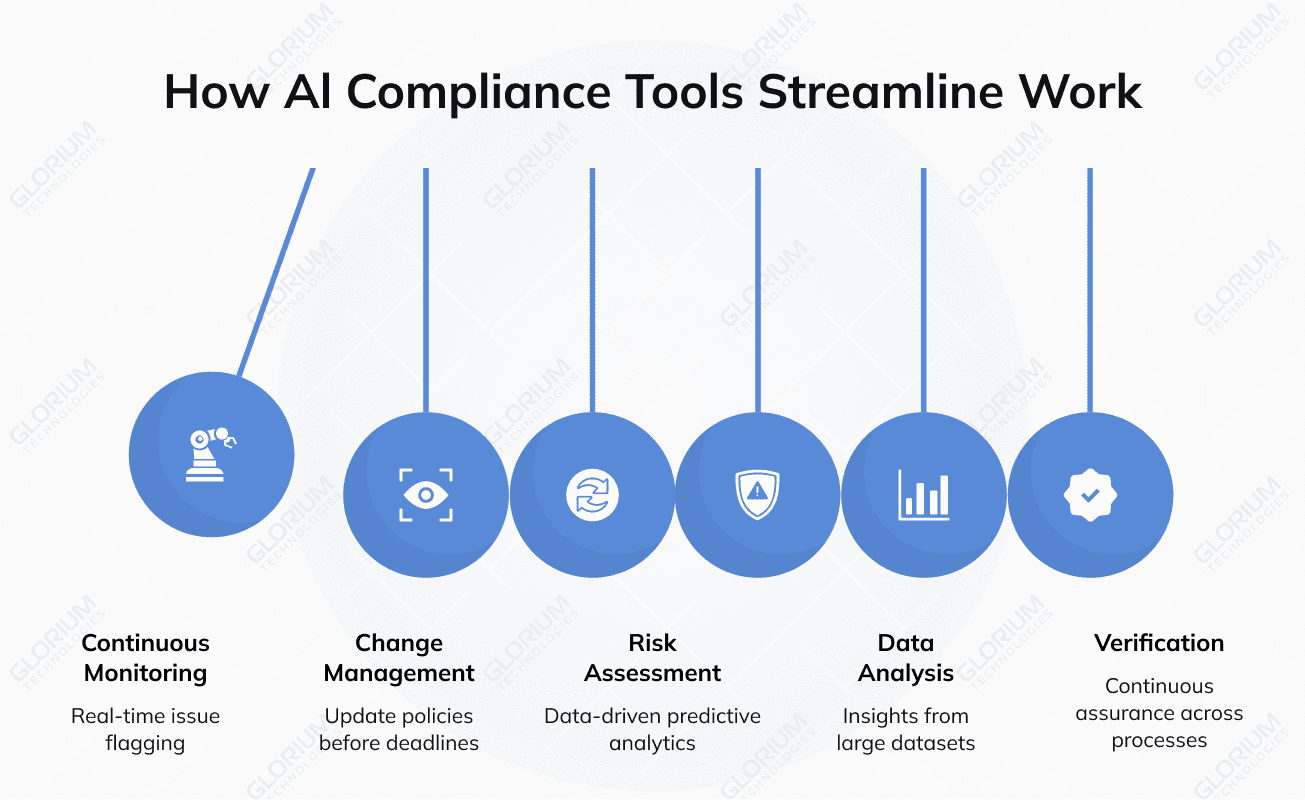
Compliance teams increasingly rely on AI themselves to manage growing regulatory workloads. Tasks such as monitoring controls, reviewing documentation, and tracking regulatory updates are becoming difficult to handle manually.
AI compliance platforms typically provide the greatest value in repetitive, high-volume tasks where manual reviews become difficult to maintain:
Continuous monitoring reduces manual effort and the errors that come with it. It also makes it easier to keep pace with changing regulations.
Governments continue to issue new guidance and refine existing AI regulations, which means compliance requirements keep changing. AI-powered compliance tools help organizations keep pace by analyzing new regulatory requirements, mapping them to existing controls, and highlighting where policies or processes need to change. This reduces the manual effort involved in tracking regulatory updates and helps compliance teams respond more quickly as requirements evolve.
Financial services illustrate this shift well. Banks already rely on AI to detect fraud and prioritize suspicious transactions. Many now use similar technology to monitor internal compliance processes and regulatory reporting
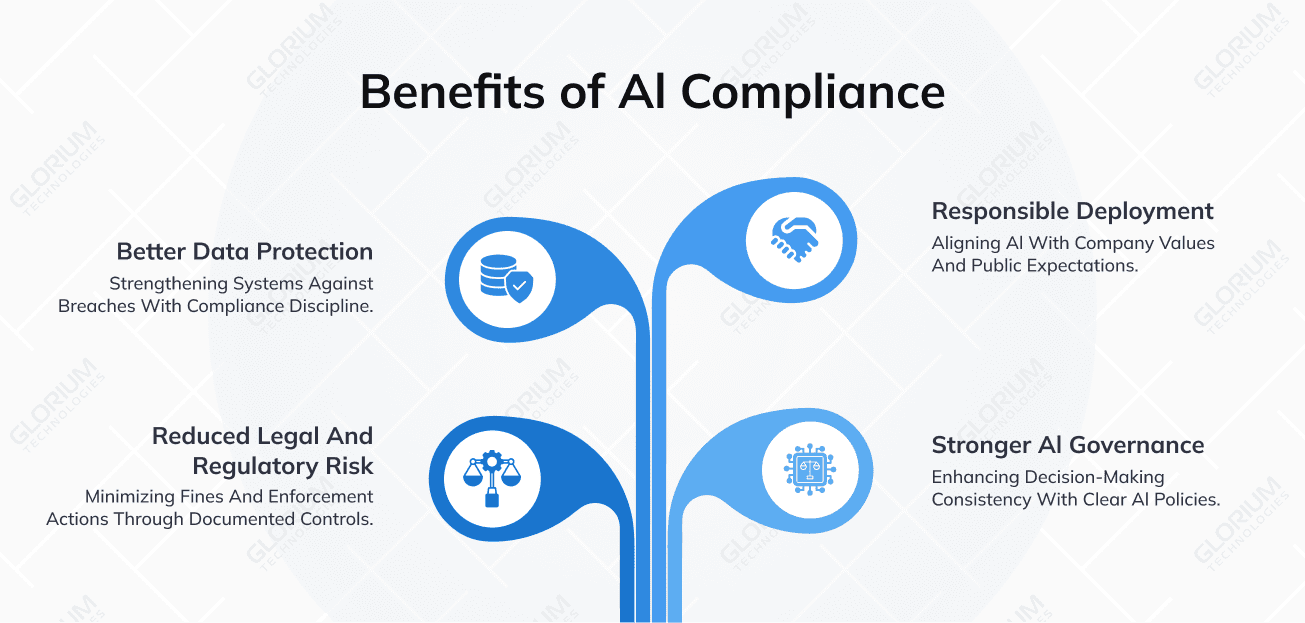
Organizations that build governance into AI projects early usually spend less time responding to audits, adapting to new regulations, or redesigning systems after deployment.
Deloitte found that 88% of executives say their organizations are taking measures to communicate the ethical use of AI to their workforces, which shows that responsible AI has become a leadership commitment rather than a compliance team’s lonely burden.
Even mature compliance programs struggle to keep pace with AI. Regulations evolve quickly, AI models can be difficult to explain, and requirements differ across jurisdictions.
These challenges often require expertise across software engineering, data governance, and regulatory compliance. When we built an AI-powered decision tree for Astarte Medical, the work involved structuring sensitive infant health data so the model could deliver personalized nutrition guidance while staying inside clinical and privacy boundaries. Pairing AI expertise with deep compliance knowledge is what made that possible.
Although individual regulations differ across regions, several long-term trends are already emerging:
Glorium Technologies has spent over 15 years building software in regulated industries where compliance is a requirement, not a finishing touch. We work in healthcare, fintech, and other sectors where HIPAA, GDPR, and emerging AI rules shape every technical decision, and we hold ISO 27001 certification for information security management.
We help engineering teams design AI systems that satisfy regulatory requirements without slowing delivery. That includes documenting data provenance, defining governance processes, supporting risk assessments, and preparing systems for external audits. Whether you need AI software development, machine learning expertise, or AI consulting to map your first initiative, we combine technical expertise with experience building software for regulated industries.
Need help building AI that meets regulatory requirements? Contact us, and we will map the compliance path alongside the product.
It depends on how the system was built. A model with clean data provenance and existing documentation can often be brought into line in a few weeks of governance work. One with no data lineage, no audit trail, and no human-review checkpoints may need months, because the gaps have to be filled before the system is defensible. A discovery phase that audits your current state is the fastest way to get a realistic timeline.
Responsibility is shared, which is part of why it gets dropped. Compliance officers own the regulatory interpretation, AI and data teams own the technical controls, and leadership owns the policy and budget. The most reliable approach assigns clear accountability to one owner, often within an AI governance group, while keeping the cross-functional collaboration that compliance actually requires.
Yes, and sometimes more than large firms. The EU AI Act and GDPR apply based on where your users are and what your system does, not on company size. A startup selling an AI hiring tool in Europe faces the same high-risk obligations as an enterprise. Building compliance early is far cheaper than retrofitting it after a product gains traction.
An auditor typically asks for documentation of how the model works, where its training data came from, what risk assessments were performed, and how human oversight is applied. They look for evidence, which is why audit trails and records of model training matter so much. Systems without that paper trail tend to fail not because they behave badly, but because there is no way to prove they behave well.
No, and treating them that way creates risk. AI compliance tools handle volume and speed: monitoring, change tracking, and first-pass risk scoring. The interpretation of ambiguous rules, the judgment calls on edge cases, and the accountability for decisions stay with people. In practice, the most effective compliance strategies combine automation with human review.