







10 Top AI Software Development Companies Redefining How Software Gets Built
Updated August 12, 2026

 Summarize in ChatGPT
 Summarize in ChatGPT
Every CTO, founder, and product leader interested in AI development is right now asking the same question: Who can do this well? Not who can pitch it, but who can do the job.
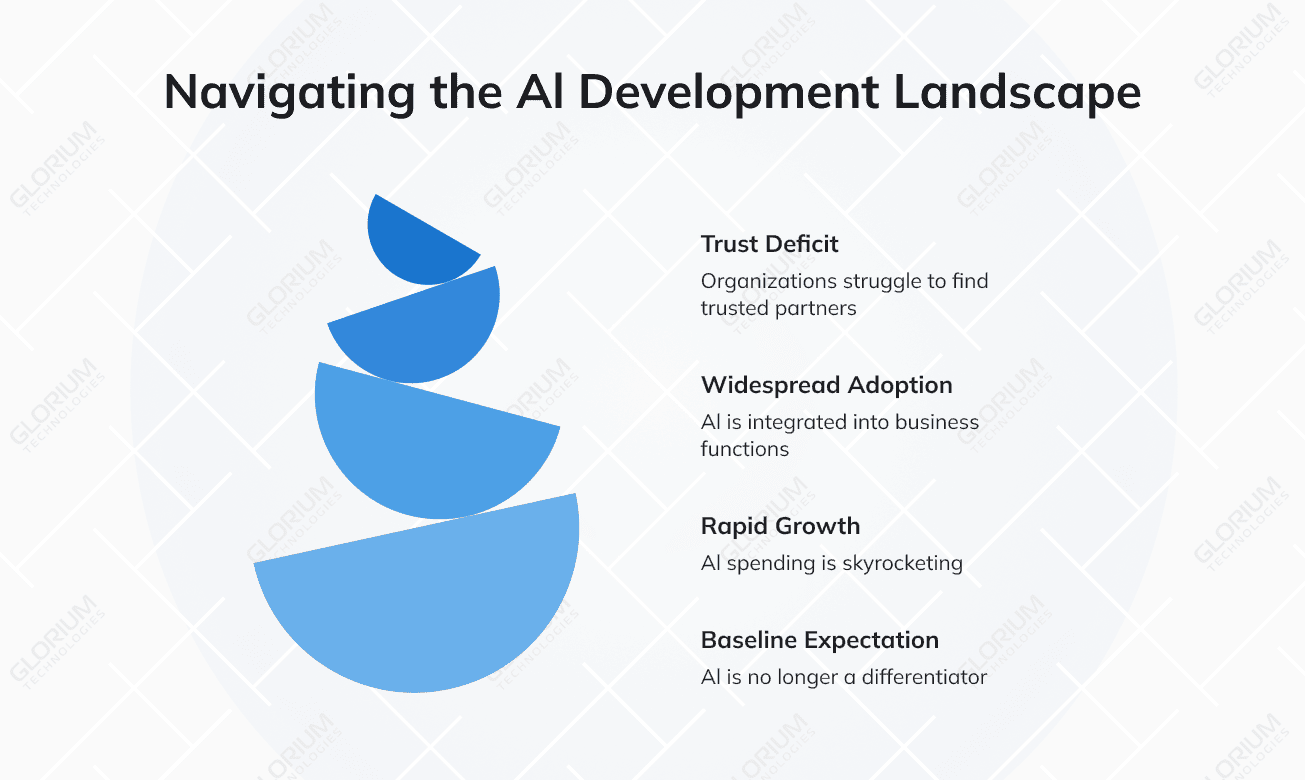
In 2026, artificial intelligence has moved from a competitive differentiator to a baseline expectation. It is the foundation of how products are conceived, built, tested, and deployed. Gartner predicts global AI spending will reach $2.59 trillion by the end of this year, up 47% from the same time last year. And McKinsey’s State of AI says that in 2025, 88% of companies used AI in at least one business function, up from 78% in 2024.
New names appear every quarter, offering out-of-this-world AI-powered products and software development services. Yet, most organizations are stuck somewhere in the middle of figuring out who to build with. Who can be a partner you can trust to turn your investment into something that works in production? That is what this list is built for.
Below, you’ll find 10 of the top AI software development companies worth considering in 2026. Each of them is profiled by who they serve best and where they genuinely stand out.
Content
Not every company with “AI” in its pitch deck has the depth to back it up. Before looking at the list, you should know what distinguishes companies that produce real outcomes from those that produce impressive demos.
When evaluating an AI software development partner, focus on the following:
This list is not pay-to-play, and it is not ranked. We built the shortlist by combining four inputs, then wrote up each company by the audience it fits best. After all, a forced 1-through-10 ranking would imply the Fortune 500 pick beats the seed-stage MVP pick, but it doesn’t. They serve different buyers.
Here is what went into the shortlist:
“Digital transformation” has become a buzzword and a motto for many companies. The Deloitte State of AI in the Enterprise 2026 report found that 83% of companies see AI as a key to their strategic planning. However, only 34% of organizations are using AI to deeply transform their business. The rest are either optimizing existing processes or still running surface-level experiments. The difference often comes down to who is building the system. Here are 10 AI software development companies that are doing it at a level worth your attention.
Location: New Jersey, New York (USA), with global delivery teams
Best for: Startups, mid-market companies, and enterprises in healthcare, fintech, and real estate
The company was founded in 2010. Its team size ranges from 50 to 249 employees across four locations (Houston, TX headquarters, plus Kyiv, Pafos, and Kraków delivery centers). It’s rated 4.8 out of 5 on Clutch across 29 verified reviews (“Premier Verified” status), with a 4.7/5 cost sub-rating.
Glorium Technologies has been developing custom software solutions for 16+ years and in recent years has focused on developing its AI and machine learning capabilities across high-compliance industries. The company is ISO 9001, ISO 13485, and ISO 27001-certified, and operates at the intersection of engineering discipline and regulatory rigor. This combination is a boon for any organization building AI-powered products in healthcare or finance.
The team brings strong technical expertise across the full AI development lifecycle, from strategy consulting and architecture through to deployment and long-term support. The company’s data science and engineering teams, in particular, are working on computer vision solutions and intelligent automation.
Core AI services:
Glorium Technologies is an AWS Select Tier Services Partner, which means the platform itself has validated its cloud computing capability. The company is a go-to for mobile app development, web app development, and custom AI development across diverse industries.
On Clutch, Glorium engagements typically start at a $25,000+ minimum project size, with a 50–99 / hour rate range. AI-specific consulting and generative AI engagements may run into the seven figures for the largest builds. For a scoped estimate rather than a range, use our project cost calculator.
Location: San Francisco, CA (USA)
Best for: Enterprises and startups exploring generative AI and emerging tech stacks
The company was founded in 2007. Team size: roughly 180–250 employees. It is rooted in San Francisco, with primary delivery from India. LeewayHertz was acquired by The Hackett Group in September 2024.
LeewayHertz has emerged as one of the most cited entities in the enterprise AI development space, especially for its work in AI agents and large language model (LLM) applications. The company develops custom LLM solutions, AI systems for multi-step autonomous workflows, and AI platforms for clients in finance, healthcare, and logistics.
Core AI services:
LeewayHertz has depth in next-generation AI architecture. It is known for being early movers in the AI agents space, which gives them practical production experience in a domain.
Location: Newtown, PA (USA), with global delivery centers
Best for: Fortune 500 enterprises requiring end-to-end digital transformation and large-scale AI programs
It was founded in 1993. Team size: ~62,000–66,000 employees across the US, Hungary, Germany, the UK, Ukraine, Armenia, China, and various other international locations.
EPAM has built a serious reputation in software engineering, and its AI capabilities reflect that. The company has put real weight behind AI work across cloud and automation, making it a go-to for organizations that need to modernize their infrastructure. Its teams handle enterprise-scale AI engagements and infrastructure overhauls from the start. A big chunk of their client base sits in the Fortune 500.
Core AI services:
Location: Austin, TX (USA), with global delivery teams
Best for: Enterprises in healthcare, financial services, energy, and manufacturing seeking production-ready AI
Founded in 1993 in Lviv, Ukraine, SoftServe now runs its US headquarters out of Austin, TX, and employs more than 10,000 people. NVIDIA has named SoftServe its Partner of the Year for four years running, most recently in 2026.
SoftServe has been in the digital engineering space for a couple of decades, with a laser focus on AI, data, and cloud. Its teams are experts at both the research side of AI and the practical engineering delivery, so they know the ins and outs of what AI can do and what it takes to make it hold up in production.
A 2026 MIT Technology Review report commissioned by SoftServe found that 98% of respondents expect AI agents to skyrocket software delivery within two years. That kind of research reflects where SoftServe’s focus sits — ahead of the curve, not catching up to it.
Core AI services:
Location: Luxembourg, with global studios including San Francisco and New York
Best for: Consumer-facing brands in media, retail, and finance building intuitive AI-powered products
Globant started in 2003 in Buenos Aires and has since grown into a Luxembourg-headquartered public company (NYSE: GLOB), with somewhere between 24,000 and 29,000 employees and 2025 revenue near $2.46 billion
Globant brings together AI engineering and creative product design in a way that’s less common in the industry. Its teams are set up to combine solid software development with genuine product thinking. This makes them a strong fit for brands building AI experiences that real users interact with, not just back-office automation running quietly in the background.
The company’s client work spans media, retail, and finance, and its AI practice leans heavily into consumer-facing products. The focus isn’t just on whether something works technically but on whether it feels right to the person using it.
Core AI services:
Location: Pune, Maharashtra, India, with global delivery
Best for: Mid-to-large enterprises in banking, insurance, and healthcare needing AI at scale
Persistent Systems dates to 1990 and today employs around 24,000 people, trading publicly on India’s BSE and NSE, with FY2025 revenue of roughly $1.2 billion.
Enterprise AI sounds straightforward until you’re dealing with data scattered across a dozen legacy systems that were never meant to talk to each other. That’s exactly where Persistent Systems has carved out its niche. Their teams specialize in connecting AI models to messy, distributed enterprise data environments, which happens to be one of the harder problems in production AI. If your data infrastructure is complex, they’ve likely seen worse.
Core AI services:
“Major AI labs are expanding into the coding market with products like Anthropic’s Claude Code and OpenAI’s Codeex.”
Location: McKinney, TX (USA), with a global team
Best for: Organizations in healthcare, finance, and retail needing secure, compliant custom software development
Founded in 1989, ScienceSoft is one of the oldest firms on this list, and its 750-plus in-house experts reflect steady rather than explosive growth. The reviews back that reputation up: 4.8 on Clutch and 4.6 on G2, each across dozens of entries. It also holds ISO 9001, 27001, and 13485 certifications.
Three decades in software development gives you a certain kind of pattern recognition — especially around industries where a wrong move has real consequences. ScienceSoft has channeled that experience into a focused AI practice built around compliance-heavy environments. Healthcare is a core strength: EHR systems, patient portals, medical billing platforms, and enterprise analytics. These aren’t areas where you cut corners on data security or regulatory requirements, and ScienceSoft’s teams know that well.
Core AI services:
Location: United States
Best for: Growth-stage companies building focused, production-grade AI software
The company was founded in 2015 and has grown to roughly 50 AI engineers ever since. It carries a perfect 5.0 on Clutch, yet the rating rests on just 12 verified reviews, a strong but narrow sample.
Markovate is a US-based AI development boutique with a proven track record of mid-market work. Its approach homes in on engineering-led product development. This can be useful for organizations that have a clear AI use case and need a team that can move from design to deployment without an extensive runway.
Core AI services:
Location: Atlanta, GA (USA), with European engineering teams
Best for: Companies interested in AI-powered mobile and web products
MobiDev has been building since 2009 and now fields around 250 staff and 400-plus engineers across its offices. The ratings are as clean as they come: a perfect 5.0 on Clutch, a matching 5.0 on G2 across 10 reviews, and a self-reported 9.1 NPS.
MobiDev’s engineers think in products first, which shapes how they approach AI work. Whether it’s computer vision, machine learning, or custom AI features wired directly into a mobile or web app, the focus stays on what the end user actually experiences.
Core AI services:
Location: New York, NY (USA), with global delivery
Best for: Mid-to-large organizations
Intellectsoft was founded in 2007. It now runs a team of roughly 200 to 255 people and holds a 4.9 on Clutch across 43 verified reviews.
Intellectsoft provides end-to-end software development with AI, IoT, and cloud capabilities ingrained in their delivery model. Its teams develop everything from AI-powered enterprise applications to mobile solutions, making it a flexible choice for organizations that require both AI development and adjacent software engineering capabilities from a single engagement.
Core AI services:
AI features don’t always get to be a separate workstream. Sometimes they have to grow alongside everything else that’s being built. That’s the kind of environment Intellectsoft is set up for.
Use this table to match your specific needs to the right type of partner before requesting a proposal.
| Company | Founded | Team Size | Third-Party Rating | Best For | Key AI Strengths |
| Glorium Technologies | 2010 | 50–249 | 4.8 Clutch | Healthcare, fintech, startups | Full-cycle AI, compliance, custom software, AI agents |
| LeewayHertz | 2007 | ~180–250 | Limited public reviews | Enterprises, agentic AI | LLMs, AI agents, emerging tech |
| EPAM Systems | 1993 | ~62,000+ | Public (NYSE: EPAM) | Fortune 500 enterprises | Scale, cloud, enterprise AI |
| SoftServe | 1993 | ~10,000+ | NVIDIA Partner of the Year | Healthcare, manufacturing | Agentic AI, data science, R&D |
| Globant | 2003 | ~24,000–29,000 | Public (NYSE: GLOB) | Consumer brands | Product design, generative AI |
| Persistent Systems | 1990 | ~24,000 | Public (BSE/NSE); Gartner/Forrester-recognized | Banking, insurance | Data infrastructure, enterprise scale |
| ScienceSoft | 1989 | ~750+ | 4.8 Clutch/ 4.6 G2 | Healthcare, finance | Compliance, computer vision, NLP |
| Markovate | 2015 | ~50 | 5.0 Clutch | Growth-stage companies | LLM builds, ethical AI |
| MobiDev | 2009 | ~250 | 5.0 Clutch/ 5.0 G2 | Mobile/web AI products | Computer vision, NLP, custom AI |
| Intellectsoft | 2007 | ~200–255 | 4.9 Clutch | Mid-to-large enterprises | Full-cycle AI, mobile, cloud |
Before you start vendor conversations, you should decide which capability matters most for your use case. The companies on this list collectively cover the full spectrum of AI software development services. Here is what that looks like in practice:
You can shorten the vendor selection process considerably by knowing what to prioritize before you start. Here is what separates a well-matched engagement from a costly mismatch.
Technical expertise in AI/ML is the baseline. Ask specifically about the team’s experience with machine learning models, generative AI, natural language processing, and data engineering — not just the headline capabilities listed on a website.
Industry experience matters more in AI than in standard software development because data environments, compliance obligations, and edge cases are different across sectors. A team that has shipped AI into healthcare operates very differently from one that has not.
Scalability of solutions refers to whether the architecture your vendor proposes can grow with your product. Many AI projects fail not because the initial build was poor, but because it was not designed to scale.
Security and compliance are non-negotiable in regulated industries. Before signing anything, make sure to check the ISO certifications, HIPAA readiness, GDPR compliance, and the vendor’s approach to AI ethics and ethical AI governance.
Cloud infrastructure capabilities determine how quickly you can get from prototype to production. Validated partnerships on AWS, Azure, or GCP allow vendors to lower risks around operational efficiency to a minimum.
If you’re already running an internal engineering team, you might wonder whether an external AI software development partner is worth the investment. The data suggests it usually is, particularly for organizations at critical AI inflection points.
The Deloitte 2026 Software Industry Outlook projects that AI could drive productivity gains of 30% to 35% across the software development lifecycle. However, those gains are unevenly distributed. The teams that benefit most are those that restructure their workflows around AI capabilities, meaning inserting AI into existing processes may not bring you the same result.
Working with a specialist AI development company gives you:
You shouldn’t treat an AI software development partner as just a vendor, as they literally become an extension of your product team.
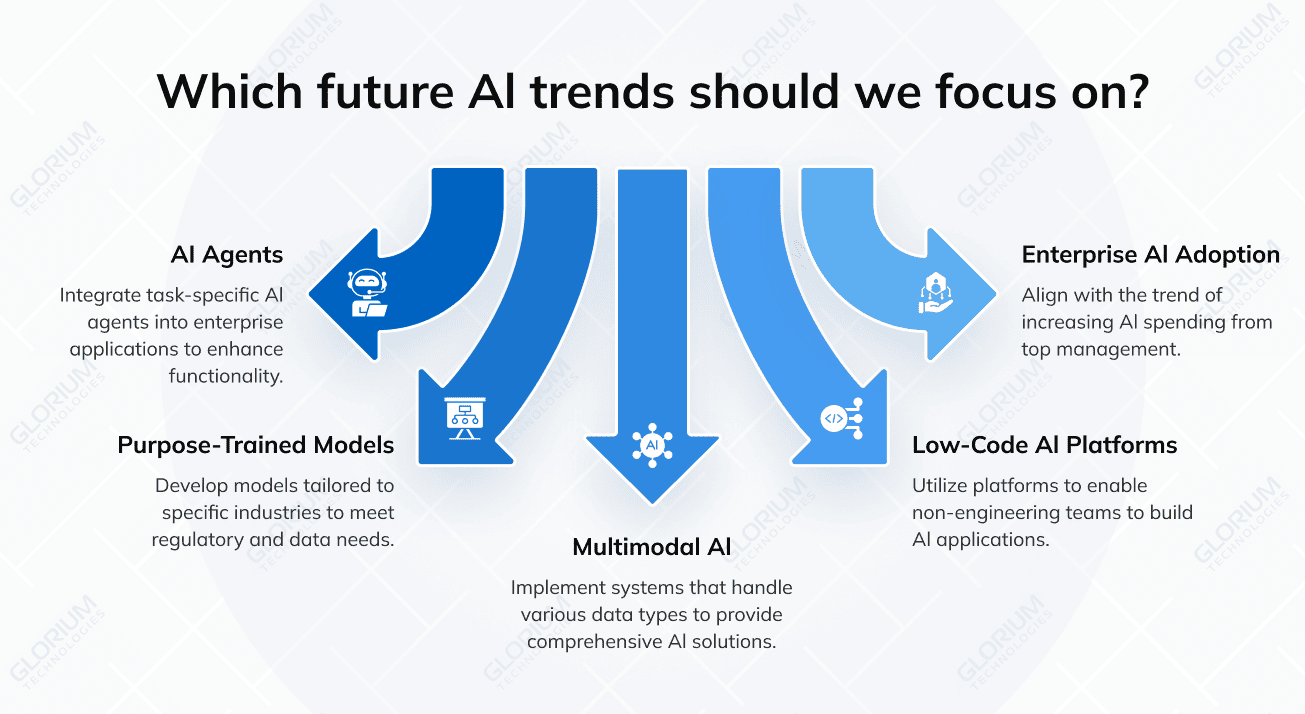
AI agents and autonomous systems are moving from experimental to mainstream. According to Gartner (August 2025), 40% of enterprise applications will be integrated with task-specific AI agents by the end of 2026, up from less than 5% in 2025. The companies on this list are already building production systems around multi-agent architectures.
General-purpose AI models are losing ground in high-stakes industries. Healthcare, finance, and legal are moving toward purpose-trained models that reflect their own data environments and regulatory constraints, because generic models simply don’t cut it there.
Multimodal AI — systems that handle text, images, audio, and structured data together — is becoming a standard engineering capability, not something reserved for research labs.
Low-code AI platforms are opening up development to non-engineering teams. Product managers and operations leads can now build on top of AI infrastructure without writing a single line of code.
And enterprise AI adoption is increasingly coming from the top. The Deloitte State of AI in the Enterprise 2026 report found that 84% of organizations plan to increase AI spending in the next fiscal year. That shifts AI from a tech team conversation to something boards are weighing on the balance sheet.
The AI software development market in 2026 is large, competitive, and — if you know what to look for — navigable. The artificial intelligence companies on this list represent a range of sizes, specializations, and delivery models. Each one has a context where they perform best, and each brings a different combination of advanced technologies, domain expertise, and delivery discipline to the table.
Picking the right AI company comes down to your specific problem, timeline, and how much risk you’re comfortable carrying. The best AI development partners don’t just integrate AI into your product and move on. They help you build for scale, improve operational efficiency, and deliver customized AI solutions that keep producing results long after launch day.
If you’re building AI in a regulated industry, Glorium Technologies is worth a conversation. We hold ISO 9001, ISO 13485, and ISO 27001 certifications, plus AWS Select Tier Services Partner status. With 15+ years of custom software development across healthcare, fintech, and real estate, we know what high-stakes AI development requires, and we have the production track record to back it up.
Our teams cover the full build cycle, from AI strategy and architecture through to deployment, integration, and ongoing support. And if you’re not sure where to start, consider a vibe code health check; it is a good first step toward making your AI project one that ships well.
Start with production evidence. The strongest AI software companies will point you to specific case studies, reference clients, and outcomes they’ve delivered in your industry. Look for teams that invest in AI research, operate as a genuine trusted partner, and are transparent about where their expertise ends. Credentials, certifications, and client tenure all matter more than a polished website.
The scope depends on your starting point, but a full engagement with a serious vendor typically moves through discovery, architecture, development, testing, and deployment. Discovery and scoping usually take two to four weeks. Build cycles range from eight to twenty-four weeks depending on complexity. Reputable development agencies will give you a phased roadmap upfront, with defined milestones tied to measurable business outcomes at each stage, not just a final delivery date.
Custom AI pricing comes down to four things: how complex your data environment is, how many models or integrations are involved, how specialized your use case is, and what kind of support you’ll need after launch. Some vendors charge by sprint; others work on outcome-based or retainer models. Either way, watch out for quotes that leave out artificial intelligence solutions maintenance, infrastructure, or model retraining costs. Those bills tend to show up fast after go-live. Always ask for a line-item breakdown before you sign anything.
Not every AI specialist can build the product infrastructure around their models. If your project involves computer vision systems, complex integrations, or emerging technologies alongside core AI features, you need a team that handles both sides. Ask upfront whether they do full-stack custom software delivery in-house or hand parts off to subcontractors. A reliable partner won’t hedge on that question — and they’ll back it up with examples of end-to-end builds, not just standalone AI modules.