







ERPNext vs. Odoo: Features, Pricing, and Scalability Compared
Updated September 7, 2026

 Summarize in ChatGPT
 Summarize in ChatGPT
When your business is growing, spreadsheets, separate tools, and manual processes can’t keep operations running smoothly. This is when you start looking for a structured ERP solution. In 2026, this need continues to grow—according to Fortune Business Insights, SMEs using ERP are expected to reach 50.57% of the global ERP market. We’ve noticed that small- and medium-sized companies often compare ERPNext and Odoo when driven by the need to implement an ERP into their workflows. Both systems have modular architectures, flexible deployment options, and numerous modules for managing a large business. However, they differ in ecosystem size, customization, cost, and various other aspects that make the decision between ERPNext and Odoo so much more difficult.
To help you assess both systems, we created this guide, where you’ll find a detailed comparison and the answer to your question: Which ERP solution is best for my business?
Content
Odoo is a modular ERP platform that allows businesses to run their operations with a unified set of apps. The platform has about 15 million users worldwide and integrates ERP, CRM, e-Commerce, accounting, inventory, and other industry-specific custom modules into a single system. Odoo has an open-core model, offering a free Odoo Community Edition and a paid Odoo Enterprise Edition with additional features.
Odoo’s app-based architecture is one of its most important features. It allows you to start with a few core industry-specific modules and add more as your business scales. Odoo is a great ERP solution for small businesses and medium-sized companies, including scaling businesses that require a platform that can grow with them.
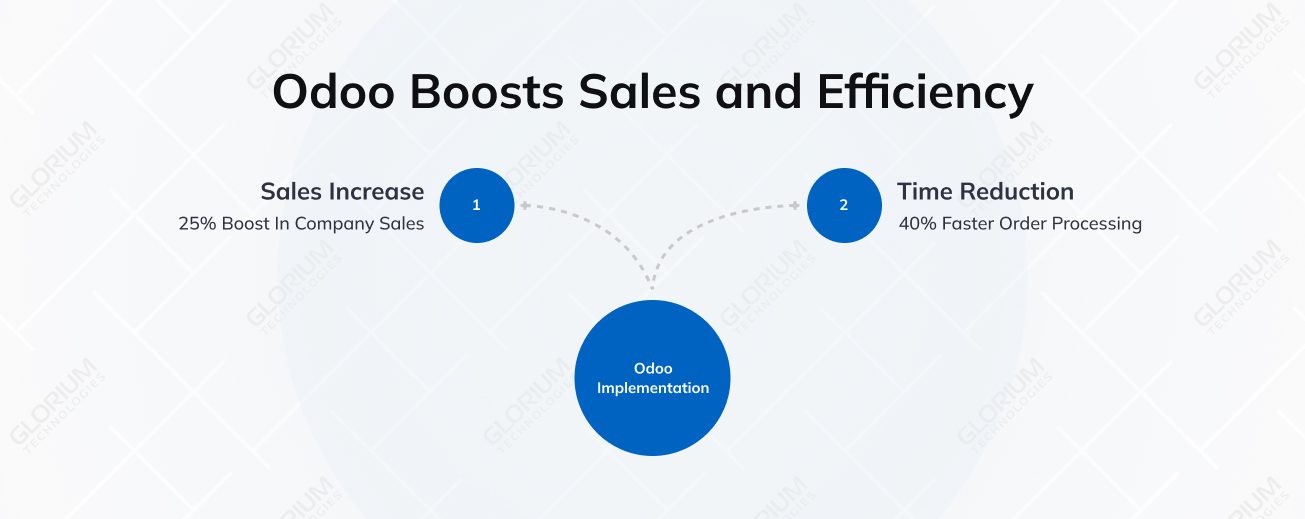
A real-life case shows that Odoo can increase the company’s sales productivity by 25% and reduce order processing time by 40%. A family-owned brewery in Germany gained these results with Odoo, which was implemented and customized with professional support from Odoo partner, Glorium Technologies. The team set up Odoo’s modules, including CRM, Sales, Invoicing, and Inventory, automated the order-to-cash process, and connected data across departments to reduce manual tasks.
Key features
Strengths
Limitations
ERPNext is a free and open-source enterprise resource planning platform—built on the Frappe framework using Python and JavaScript—helping businesses run finance, sales, inventory, and HR, all from one system.
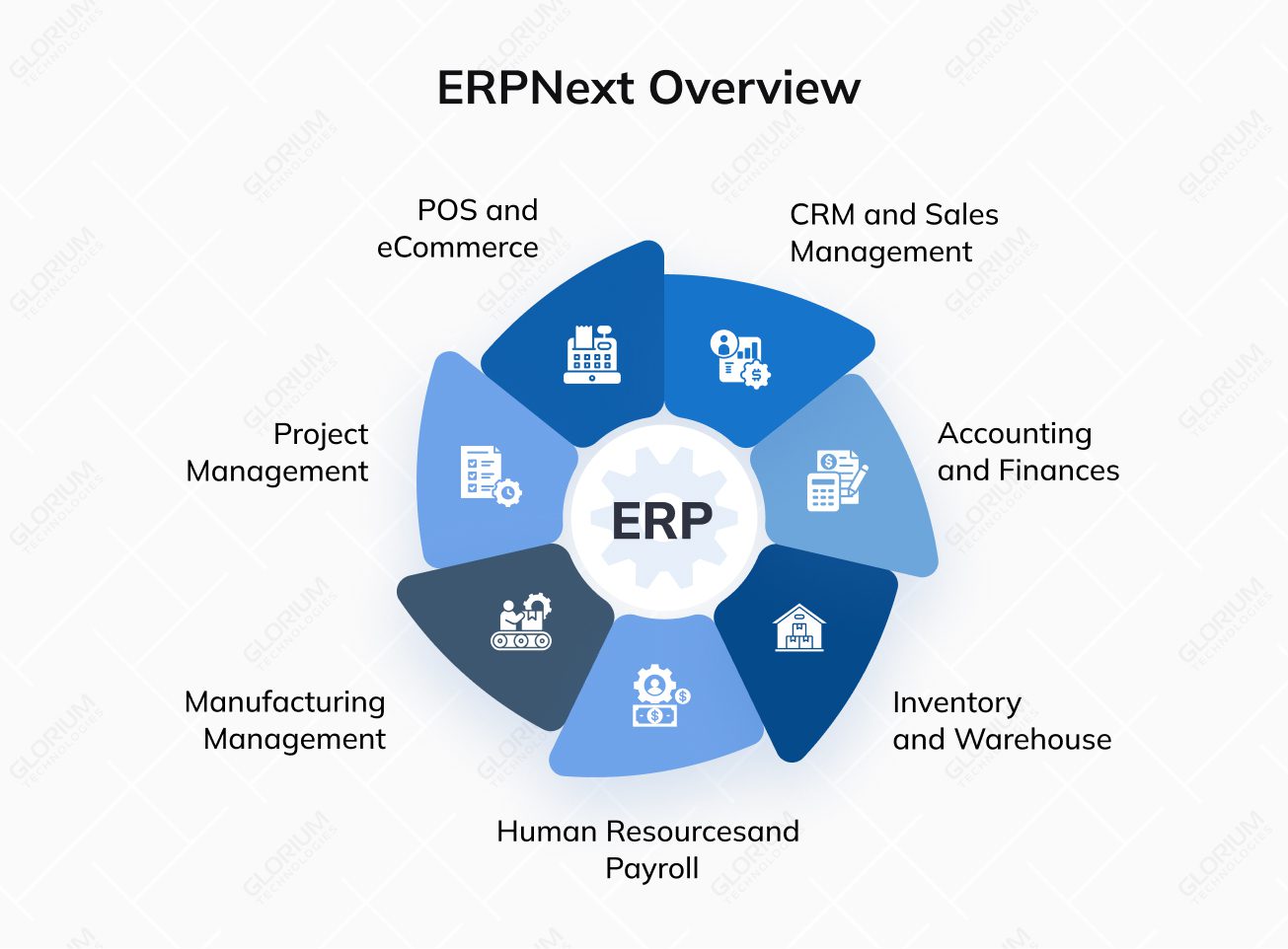
Key features:
Strengths:
Limitations
The open-source ERP market is expected to account for $5.31 billion in 2026, up from $4.84 billion in 2025. By 2031, it is expected to be worth $8.42 billion. The market is growing, and businesses that choose open-source ERPs prioritize customization, AI integration, and cost-effectiveness to scale.
The two ERP solutions, ERPNext and Odoo, offer these opportunities for your business. So, a detailed comparison of each feature will help you to find out which platform fits your business processes, technical needs, and plans for long-term growth better.
ERPNext and Odoo provide all the required ERP features for your daily business operations, such as finance, sales, inventory, and HR. However, the main difference is between breadth and focus. ERPNext offers a set of core integrated modules. Odoo, on the other hand, has a larger ecosystem with many extra apps and extensions from the Odoo App Store.
| Module | ERPNext | Odoo |
| Accounting | Advanced (full accounting cycle, real-time reporting, multi-currency) | Advanced (integrated with AI, connected with other modules, multi-company, and multi-currency) |
| CRM | Moderate (lead management, sales pipeline tracking, integration with accounting) | Advanced (Kanban pipeline management, automation, and lead generation tools) |
| Sales | Advanced (full sales cycle) | Advanced (automation, integration with CRM, inventory, accounting) |
| Purchase | Advanced (end-to-end procurement cycle) | Advanced (managing Requests for Quotation (RfQs), vendor pricelists, and automated replenishment) |
| Inventory | Advanced (multi-warehouse tracking, batch/serial number management, automated reordering) | Advanced (multi-warehouse management, barcode scanning, advanced routes, lot/serial number tracking) |
| Manufacturing | Moderate (multi-level BOM, production planning, shop floor control, and real-time inventory) | Advanced (multi-level BoM, real-time work center planning, automatic MOs, flexible routing, quality control checks) |
| Project Management | Moderate (project templates, Gantt charts, task dependencies, resource management) | Advanced (projects, task management, and team collaboration through Kanban, list, and Gantt view) |
| HR | Advanced (employee database, automated payroll, recruitment tracking) | Advanced (centralized employee records, recruitment pipelines, automated payroll, time-off management) |
| Asset Management | Advanced (automated depreciation, maintenance scheduling) | Advanced (automated depreciation calculation, asset categorization, maintenance management) |
| Website and eCommerce | Advanced (drag-and-drop website builder, multi-channel inventory synchronization, shopping cart, payment gateway integration, and B2B/B2C support services) | Moderate (drag-and-drop store builder, optimized checkout, and integrated payments) |
| Point of Sale (POS) | Advanced (multi-store management, barcode scanning, customizable print formats, promotional schemes, customer loyalty programs) | Advanced (real-time inventory management, integrated accounting, customer loyalty programs) |
Customization is one of the most important factors for business leaders when choosing an ERP system, as it determines how well the platform fits your specific workflows, integrations, and long-term growth needs. See the table below to find the differences and similarities in how ERPNext and Odoo are flexible. These ERP systems differ significantly in how they operate, how easy they are to customize, and how much they depend on technical resources.
| Aspect | ERPNext | Odoo |
| Overall Flexibility | High (fully open-source, deep backend control) | Very high (modular structure + large ecosystem) |
| Customization Approach | Low-Code/No-Code + Custom App (Frappe framework, Python/JS) | Low-code + Standard + Custom Module Development (Odoo Studio, Python, full dev access in Odoo Community) |
| Ease of Customization | Moderate (requires technical expertise) | High (non-developers can customize via UI tools) |
| Low-code / No-Code Tools | Limited | Strong (Odoo Studio drag-and-drop) |
| Developer Flexibility | Advanced (full control over source code) | Advanced (custom apps, APIs, modular extensions) |
| App Ecosystem | Moderate (smaller marketplace) | Very large (over 2,500 free Community Edition apps) |
| Upgrade Impact of Customization | More stable if structured | Can become complex with heavy customization |
| Best Fit | Tech-driven teams with specific workflows | Businesses needing fast, scalable customization |
Integration capabilities show how well an ERP system can work with the tools, data sources, and external platforms you already have. Easy integration is especially important for businesses that use multiple systems, where data needs to flow smoothly between CRM, eCommerce, finance, and analytics tools. The following table compares integration features of ERPNext and Odoo so that you can choose the right ERP system.
| Aspect | ERPNext | Odoo |
| Overall integration capability | Moderate–Advanced (flexible but more manual setup) | Advanced (broad, ready-to-use ecosystem) |
| API support | Moderate (REST API) | Advanced (REST, XML-RPC, JSON-RPC APIs) |
| Third-party integrations | Moderate (100+ integrations via strong community support) | Very high (30,000+ apps and connectors) |
| Integration with eCommerce & payments | Moderate (Shopify, PayPal, and other third-party applications) | Advanced (Amazon, Stripe, Shopify, and more) |
| Ease of Integration | Moderate (often requires development effort) | High (many plug-and-play connectors) |
| Integration Timeline | 3-9 months | 3–6 months (4–6 weeks for single-module projects) |
| Best Fit | Companies with in-house developers and custom integration needs | Businesses needing fast, scalable integrations with many tools |
The customization and integration process of Odoo requires official support from professionals to make the process easier and quicker. Glorium Technologies can help you to integrate and customize Odoo with other tools, such as eCommerce platforms, CRMs, accounting systems, and VoIP solutions. Our structured support reduces your manual work, makes your operations more efficient, and helps you grow with Odoo, which is connected to your existing business processes.
Finally, the price of Odoo vs. ERPNext is among the most important factors when choosing an ERP system. Check the table below to see all details.
| Aspect | ERPNext | Odoo |
| Pricing Model | No license fees (Self-hosted, Frappe cloud, Enterprise hosting) | Per-user subscription model (One App free, Standard, and Custom plans) |
| Base Cost | Free (self-hosted), paid from Managed hosting plan (about $20–$25/month) | Free Community Version (One App) / Paid plans from ~$20–$30/user/month |
| User Pricing | No per-user fees | Charged per user (scales with team size, unlimited number of users) |
| Hosting costs | $10–$500/month (self-hosted or Frappe Cloud) | Included (Odoo Online) or extra (Odoo.sh ~$480/month / self-hosting ~$5-$100/month) |
| Implementation cost | ~$2,000–$100,000 depending on complexity | ~$5,000–$100,000+ depending on scope |
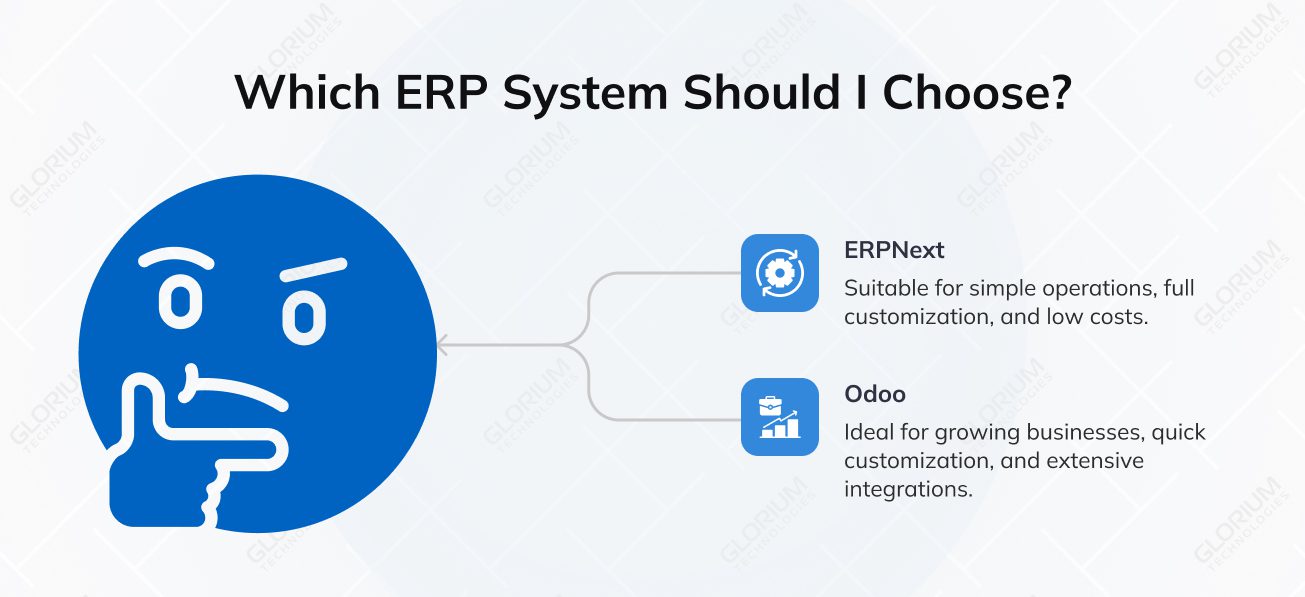
Considering the comparison between ERPNext and Odoo, we understand that choosing the right ERP is not always easy. You need to pay attention to numerous peculiarities and advanced features of each ERP. For that reason, we offer you to use this quick checklist to help you get started.
Define the size and number of processes of your business. ERPNext is usually enough if your operations are simple and centralized. Odoo offers better scalability and structure for businesses that are growing and have many departments, locations, or complicated workflows.
Understand how many of your business processes must be aligned with the ERP. ERPNext allows you to customize the system using the Frappe framework, but requires working with developers to build custom workflows. Odoo also provides high customization possibilities with Odoo Studio, which is a faster and easier way to customize processes quickly with little to no coding. And with Python backing, Odoo can also be customized by professionals to fit specific industry needs.
If you only need a few integrations and can rely on your own technical resources, ERPNext can be a proper option in this case. Odoo is the better choice if your business relies on more than one external platform, such as eCommerce, payment systems, or marketing tools.
ERPNext offers an open-source model with lower initial expenses, while Odoo’s subscription may have higher costs, but it delivers extensive features, scalability, and provides a better total cost of ownership in the long-term.
ERPNext can help you meet your needs quickly if your growth is steady and predictable. Odoo offers medium-sized businesses the ability to scale more easily if you expect fast growth, entering new markets, or your operations to become more complicated.
ERPNext is easier to customize with an in-house technical team that can handle both Frappe and Python frameworks. Additionally, maintenance requires an on-premise expert if you’re not working with an expert team. Odoo, on the other hand, is more user-friendly and intuitive. With its Odoo Studio tool for easy drag-and-drop customization, you don’t need to have an expert in-house, but if you require more complex tailoring, experts like Glorium Technologies can provide you with customization services and user training for change management and software adoption.
If this checklist isn’t enough to help you make the decision, we have a free eBook on the best ERPs for SMEs and a checklist for small- and medium-sized businesses to check their readiness for an ERP.
Our guide should help you understand which ERP software best suits your business. And if you’ve decided to go with Odoo for efficiency, flexibility, and user-friendliness, Glorium Technologies can help you implement Odoo, migrate data from pre-existing systems, integrate your trusty tools with it, and provide post-go-live support. Want to see how Odoo can help you fix your operational issues and improve workflows? Book a customized demo.
Generally, Odoo has more customization options, including Odoo Studio and an easily customizable open-source Python framework. ERPNext also allows you to customize the system; however, Odoo is easier for “quick” changes.
Yes. Odoo benefits human resource management, especially for SMBs and mid-market companies that want to move away from traditional HRM and the need to use five different apps to manage one employee. You can find Recruitment, Onboarding/Offboarding, Appraisal, and other HRM modules in Odoo.
Between Odoo and ERPNext, Odoo is more scalable. Despite both ERPs having a modular structure, ERPNext is more monolithic, which means the changes are correlated with more complexity.
One of the reasons Odoo is so popular among SMBs is its ability to integrate with third-party tools, including Shopify, WooCommerce, and Logiwa WMS. This flexibility allows businesses to bring their old tools into their new ERP environments without having to change too much, and without losing essential data or functionality.