








Odoo ERP Solutions: How They Benefit Your Business
Updated September 7, 2026

 Summarize in ChatGPT
 Summarize in ChatGPT
Sometimes, growing companies don’t go looking for an ERP system. Instead, they land on it after the fifth spreadsheet breaks, inventory data stops matching sales orders, and finance needs three days to build a report everyone already doubts. The pattern is common.
If you’re considering uniting your business operations on a single platform, Odoo is one of the strongest options for small and mid-market companies. It’s an integrated, open-source ERP that brings accounting, CRM, inventory, HR, project management, and other day-to-day processes into one place — so your teams stop trading data between disconnected tools and start working from the same numbers. That flexibility is part of why the platform now serves more than 15 million users worldwide. Understanding what Odoo actually does, where it fits best, and how it compares to alternatives is the first step in deciding whether it’s the right foundation for your next growth stage.
This guide explains how Odoo works, which features matter most, how it compares to other ERP systems, and when working with an experienced Odoo implementation partner makes sense.
Content
Before evaluating any ERP system, leaders should understand the architecture, the licensing model, and the ecosystem behind the platform. The technology choice itself is rarely the bottleneck — the bottleneck is fit, and fit depends on these structural elements. This section breaks down how Odoo is built, who maintains it, and why each design decision matters for long-term adoption across the business.
Odoo’s modular architecture is the platform’s defining characteristic. Rather than shipping a monolithic suite that forces organizations to deploy every business function simultaneously, the modular structure permits companies to install only the modules required for present needs — CRM, accounting, inventory, HR — and add capability as the business expands. A 25-employee distributor may begin with Sales, Inventory, and Accounting, then activate Manufacturing and Quality eighteen months later when production capabilities come online. The same database, the same security model, and the same reporting layer support both stages without forcing a re-implementation.
Odoo is available in two editions: Odoo Community and Odoo Enterprise. Odoo Community is open-source, while Enterprise is the licensed version with additional proprietary features. Odoo states that Community is the core on which Enterprise is built, and companies can switch versions when needed.
| Category | Community Edition | Enterprise Edition |
| Cost | Free open-source edition | Paid plans, including Standard and Custom |
| Modules | Core open-source business apps | Broader access to all Odoo apps |
| Hosting | Usually self-hosted or third-party hosting | Odoo Online, Odoo.sh, or on-premises |
| Support | Community resources and forums | Official support, hosting, and maintenance, depending on the plan |
| Customization | Source code access | Source code access, Odoo Studio, external API, and custom hosting options |
| Best fit | Technical teams with stable needs | Companies that need support, scalability, and deeper configuration |
Odoo Community uses the LGPLv3 license, while Odoo Enterprise adds licensed functionality on top of the open-source core. Odoo also uses PostgreSQL as its database management system, which matters for teams that want a familiar, stable data layer.
Feature lists only tell part of the story. What matters is how those features translate into measurable outcomes — less manual work, faster decisions, fewer reconciliation errors, and the ability to manage growth without re-platforming. The key benefits below represent where Odoo ERP delivers the most quantifiable impact for companies that align the ERP solution to the specific needs of each department.
Odoo integrates departments that have traditionally operated in isolation, such as sales, finance, inventory, HR, manufacturing, and project management, into a single platform that eliminates data silos across business functions and connects business processes that were previously stitched together by hand. When a customer places an order, inventory is reserved, a purchase order is triggered, revenue is recorded, and the relevant team is notified without manual intervention.
The practical impact is visibility. Real-time information flows through connected workflows, so reporting reflects the actual state of operations at any moment rather than a stale month-end snapshot. This supports better decision-making and helps managers make informed decisions based on current conditions. With more than 43,000 modules available and the ability to customize views, dashboards, and workflows, Odoo adapts to specific business needs across manufacturing, distribution, professional services, and retail, rather than forcing the business to adapt to the software. Working with certified Odoo partners during scoping ensures these specific business adaptations remain upgrade-safe and well-documented.
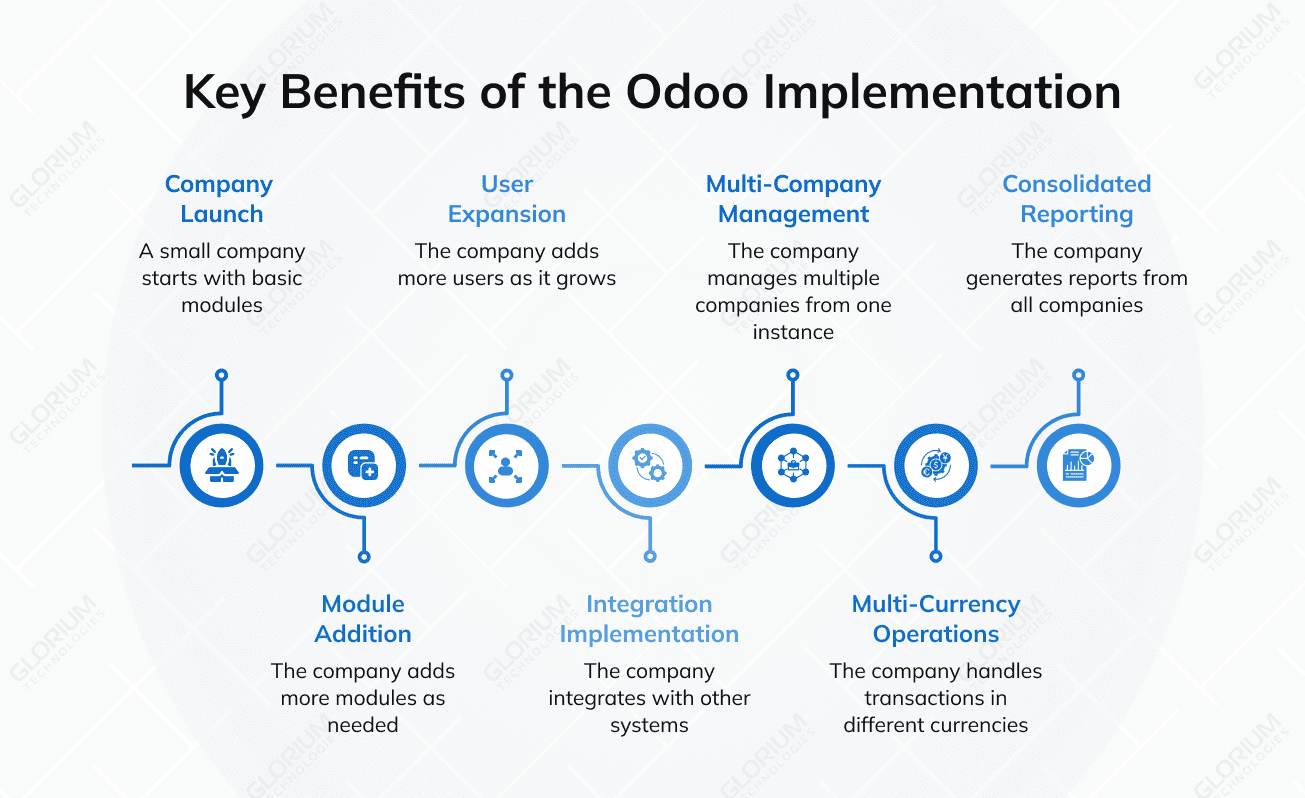
Odoo is engineered to scale alongside the business. Companies can add users, modules, and integrations without overhauling the underlying system — directly supporting growth potential as the organization expands into new geographies or operating models. A 15-person company might launch with CRM, Invoicing, and Accounting, then add Inventory, Purchase, and Manufacturing as needs evolve, all on the same instance without disruptive migrations.
The platform also supports multi-company management, multi-currency operations, and consolidated reporting from a single instance, removing one of the most common reasons mid-market companies are forced into expensive replatforming.
Most businesses don’t struggle because they lack software — they struggle because their software doesn’t talk to each other. Odoo fixes that. With a diverse range of Odoo apps covering every major department, the platform brings everything into one app ecosystem with a shared database, consistent permissions, and a single reporting layer. The result is less time spent chasing data across systems and more time acting on it. Each module below represents a core Odoo feature set built for day-to-day results — and as Odoo evolves, each gains new features with every release cycle.
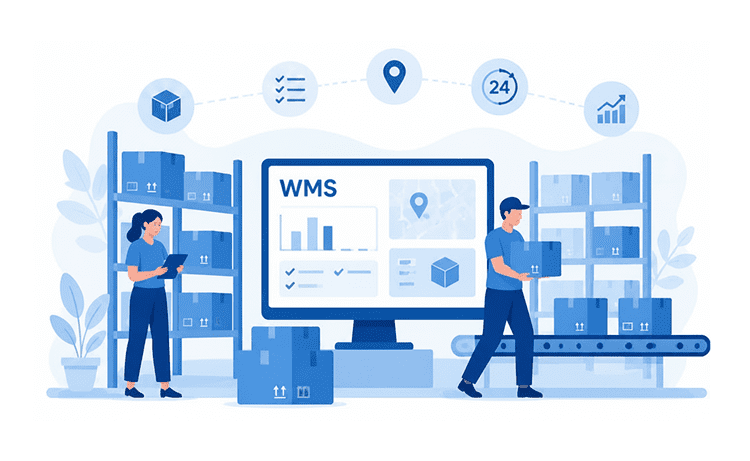
Odoo’s Inventory module goes well beyond stock counts. The module handles the full supply chain lifecycle — from automated stock tracking and multi-location routing to lot and serial number management. Warehouse operations run on barcode scanning and mobile picking interfaces, with configurable putaway strategies that work just as well in a large distribution center as in a single stockroom.
On the production side, manufacturing orders tie directly into raw materials, bills of materials, work-center scheduling, and quality control checkpoints. Purchase orders are handled automatically too: reorder rules kick in when stock dips, low-stock alerts notify the right people, and inter-warehouse transfers are triggered by automated actions — no manual follow-up needed.
Toyota Material Handling France replaced its entire legacy stack — CRM, Sales, Purchase, Manufacturing, Inventory, and Accounting — with Odoo in about six months. For a full ERP rollout, that’s a fast turnaround.
Odoo’s Accounting module covers the essentials: general ledger, AP/AR, multi-currency support, tax compliance across jurisdictions, but where it earns its keep is in the day-to-day time savings. Automated invoicing and dunning workflows take repetitive tasks off the finance team’s plate. Real-time reporting means P&L statements, balance sheets, cash flow analyses, and aged receivables are available on demand.
Bank synchronization connects Odoo directly to bank feeds, pulling in transactions automatically and reconciling them without manual input. For anyone who’s spent hours on bookkeeping, that alone is worth the switch. As Odoo evolves, the Accounting module keeps getting sharper — recent cycles have added AI-assisted transaction categorization, expanded e-invoicing standards, and wider bank synchronization coverage across more countries.
Odoo’s HR suite, Employees, Recruitment, Payroll, Attendances, Time Off, and Appraisals, covers the full employee lifecycle from hire to performance review, including onboarding workflows. Because employee records feed directly into Accounting and the Project module, downstream calculations run automatically.
Project adds Kanban boards, Gantt charts, Timesheets, and task profitability reports, with billable hours flowing directly into client invoicing. Whether the workforce numbers a dozen employees or several hundred, the integration pattern holds across every industry — manufacturing, professional services, retail, and distribution alike.
No two businesses operate identically, and an ERP system that cannot flex around real-world processes becomes a liability within months of go-live. Odoo is highly customizable by design — but the approach taken determines whether the result is a precision tool or a long-term maintenance burden.
Two complementary tracks are available:
Because Odoo is open-source, security audits are transparent, and businesses retain full data ownership. That said, Odoo customization without experienced guidance frequently produces upgrade conflicts and regression bugs. Working with certified Odoo partners who bring deep Odoo experience makes a measurable difference in upgrade cycles, performance, and long-term TCO.
Glorium Technologies delivers Odoo services across manufacturing, retail, healthcare, and professional services — pairing functional analysts with senior developers to map every customization decision to actual business processes. Their advisory services extend through post-launch support, protecting upgrade paths as the business evolves. Customization done right looks invisible to end users and survives every release cycle cleanly.
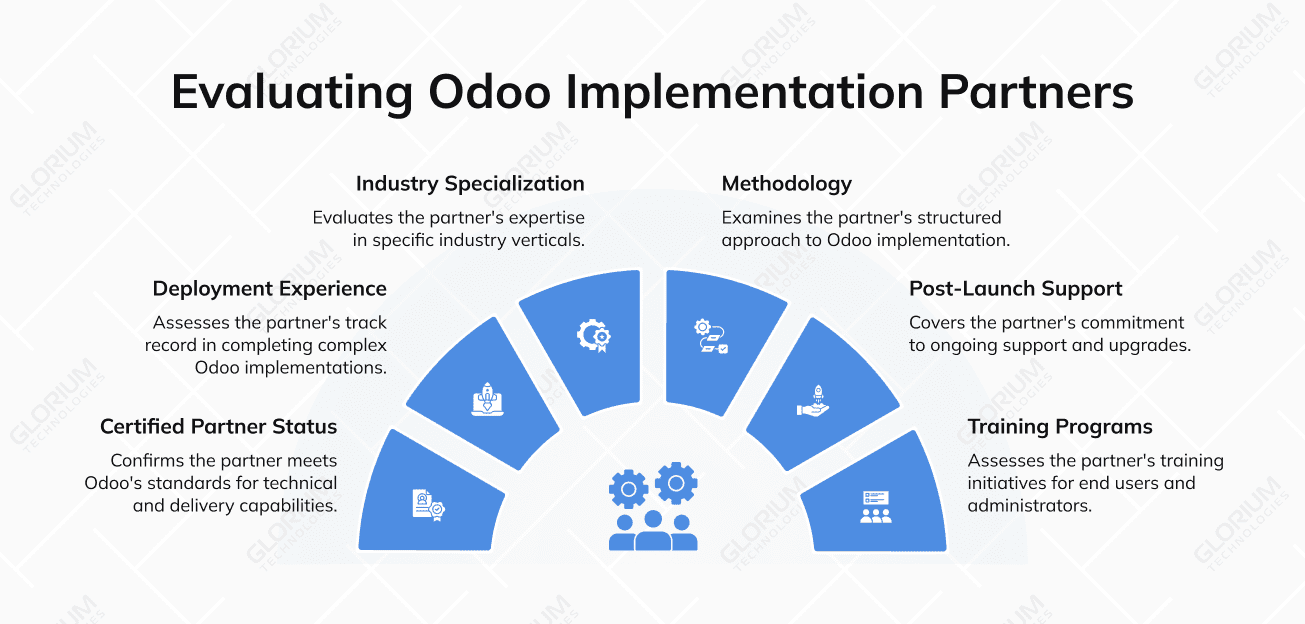
The platform itself is only half the equation. A poorly executed Odoo implementation can negate every advantage the system offers, while the right delivery partner compresses timelines and protects ROI from day one. When evaluating Odoo partners, leaders should examine the following dimensions:
Small businesses frequently underestimate the complexity of an Odoo implementation. Even a “simple” deployment involves data migration from legacy systems, workflow mapping, role-based access configuration, integration testing, user training, and parallel-running periods. The right Odoo partners also help in-house teams manage change beyond go-live, when adoption discipline determines whether the platform delivers the projected returns.
Odoo ERP solutions give businesses a modular, scalable platform that grows alongside their operations without the license overhead of legacy vendors or the rigidity of monolithic suites. But the platform is only as effective as the implementation behind it.
At Glorium Technologies, we’ve helped manufacturing, retail, and services companies deploy Odoo in ways that actually match how their teams work. From edition selection and scoping to customization, integration, and post-launch support, we handle the full implementation lifecycle so your team can focus on running the business.
If you’re evaluating Odoo or looking to fix a stalled rollout, schedule a free consultation with our team. We’ll assess your requirements, compare editions, and build a roadmap that fits your specific business needs.
Yes. Odoo connects to most common business tools through native modules, the Odoo app marketplace, or its REST and XML-RPC APIs, including payment processors (Stripe, PayPal), e-commerce platforms (Shopify, WooCommerce), shipping carriers, and marketing or accounting tools like Mailchimp, QuickBooks, and Xero. For anything outside the marketplace, the open APIs let developers build custom connectors to legacy systems. You rarely have to choose between consolidating on Odoo and keeping a tool your team still depends on.
Yes. Odoo has apps for Accounting, CRM, Marketing, and Project Management that together replace all three of the above solutions and use a single database.
Implementation duration varies with scope and complexity. A focused deployment covering three to five core modules typically completes in two to four months for mid-market organizations. Larger rollouts involving extensive Odoo customization, multi-entity consolidation, or heavy data migration may run six to twelve months.
Yes. Odoo supports multi-warehouse inventory management, bill-of-materials manufacturing, work-center scheduling, purchase order automation, and quality control workflows out of the box. Specific business requirements in regulated manufacturing, pharmaceutical, aerospace, and food processing can be addressed through custom modules and certified vertical solutions available within the broader Odoo ecosystem.
Yes, Odoo Community Edition supports on-premises deployments, while Odoo Enterprise supports both on-premises and cloud deployments. Odoo supports Odoo Online, a managed cloud solution; Odoo.sh, a PaaS solution; and standard on-premises. Choice is driven by IT capacity and data residency.