







Lean Startup Methodology: A Guide to Smarter, Faster Growth
Updated June 5, 2026

 Summarize in ChatGPT
 Summarize in ChatGPT
Every business and every company starts with an idea. Some – with the idea to make money, some – to help people and make this world better. However, the survival rate of new businesses fluctuates from 30% to 50% over the initial five-year period. Without a clear business model, business plan, and vision of what is expected in the end, the chances of succeeding are quite low.
To cover all these aspects, different startup methodologies exist. They enable entrepreneurs to assess market risks, select an effective business model, and optimally streamline all working processes, often using a business model canvas.
Waterfall methodology (often considered to be the traditional one) advocates for a linear, sequential process where all requirements are defined upfront and development proceeds through rigid, non-overlapping phases. Agile methodology, conversely, promotes an iterative and incremental approach, aiming to deliver continuous value through short development cycles and rapid adaptation to change. The Lean Startup methodology guarantees the smoothest and step-by-step transition from a small minimum viable product to something bigger and more meaningful based on the customers’ feedback, not business requirements. This article will focus on the latter, covering its strongest aspects, stages, and comparing it to others.
Content
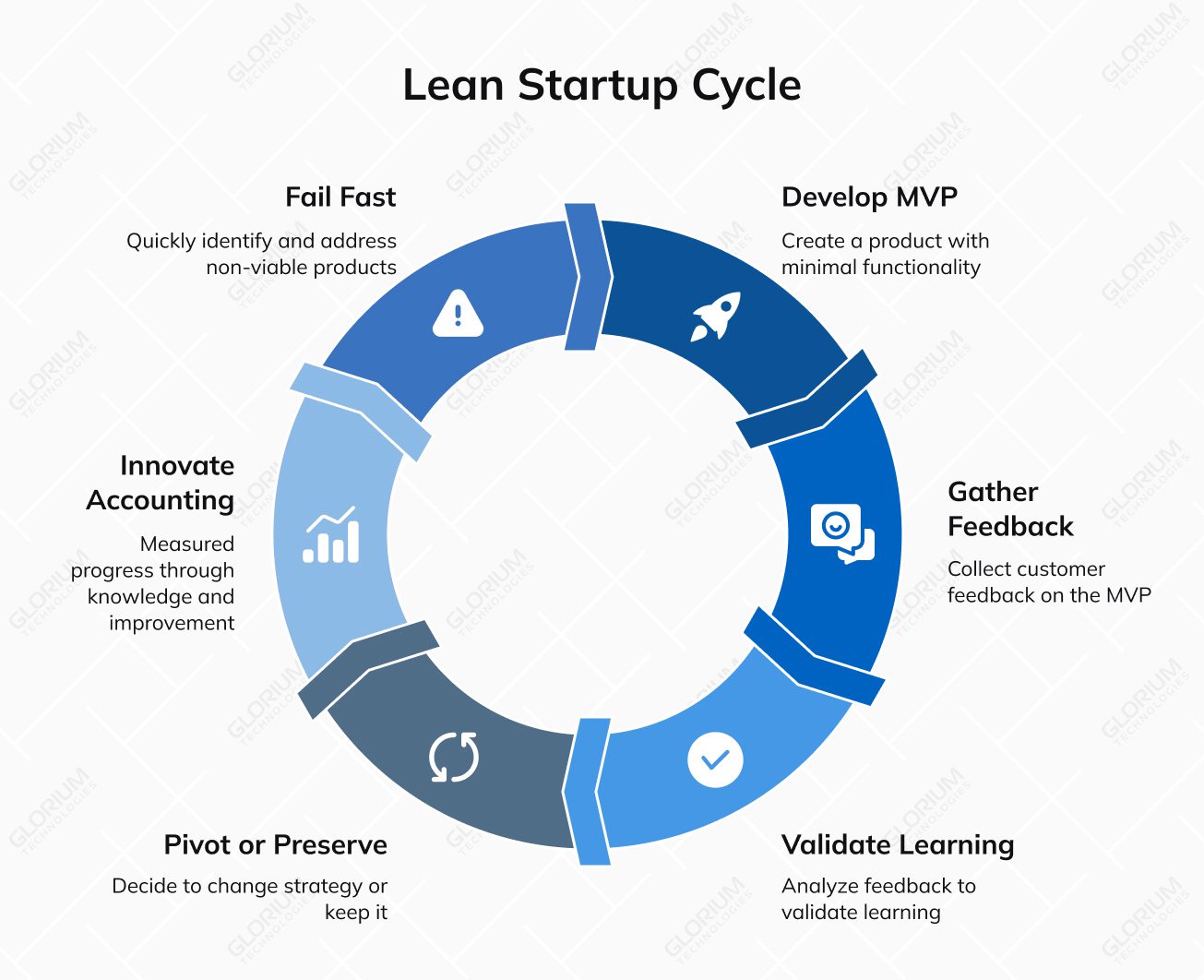
Lean Startup methodology is an approach that focuses on the main question for any business or product: can it be viable and profitable? It can also be called a customer-centric approach, as the development process is reduced to the minimum, and the customer feedback becomes the foundation for further planning and decision-making.
“As you consider building your own minimum viable product, let this simple rule suffice: remove any feature, process, or effort that does not contribute directly to the learning you seek.”
Eric Ries, Talks at Google about Lean Startup
Cornerstones
The Lean Startup method is based on five fundamental principles that enable it to be effective for new and emerging businesses, which are not constrained by large teams and budgets.
The Lean Startup approach, with its main principle,s was first formulated by the entrepreneur Eric Ries in 2008, but its roots are found in the ideas developed by the Toyota company in 1930. Thus, one could say the Lean Startup method has been forged over decades.
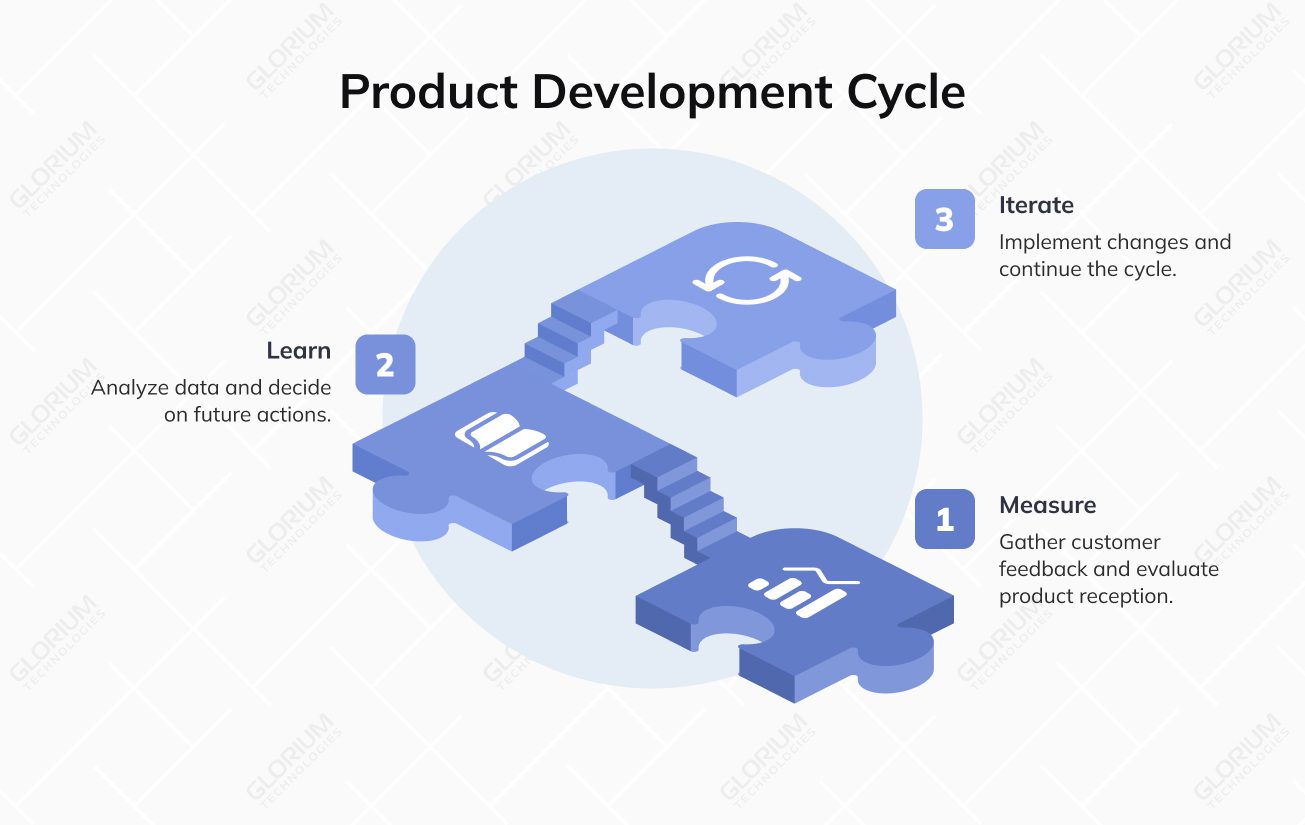
Lean methodology has 3 main stages that allow for achieving maximum efficiency with minimal expenses for the business.
These three stages cycle until the end of the project. The entire process is not simply about creating products but about understanding which products to develop for success.
Companies of any size can use the Lean Startup methodology. It shifts the traditional method, focused on revenue, to a more cognitive approach that eliminates the uncertainty many businesses face by embracing experimentation and learning. Here is a more comprehensive list of benefits you and your business can get if you try it.
In short, the Lean Startup concept puts businesses and customers closer and allows them to communicate more directly. Companies get a chance to adapt to the people’s needs, and customers influence the product development process in a certain sense. In other words, the customer development paradigm is built up.
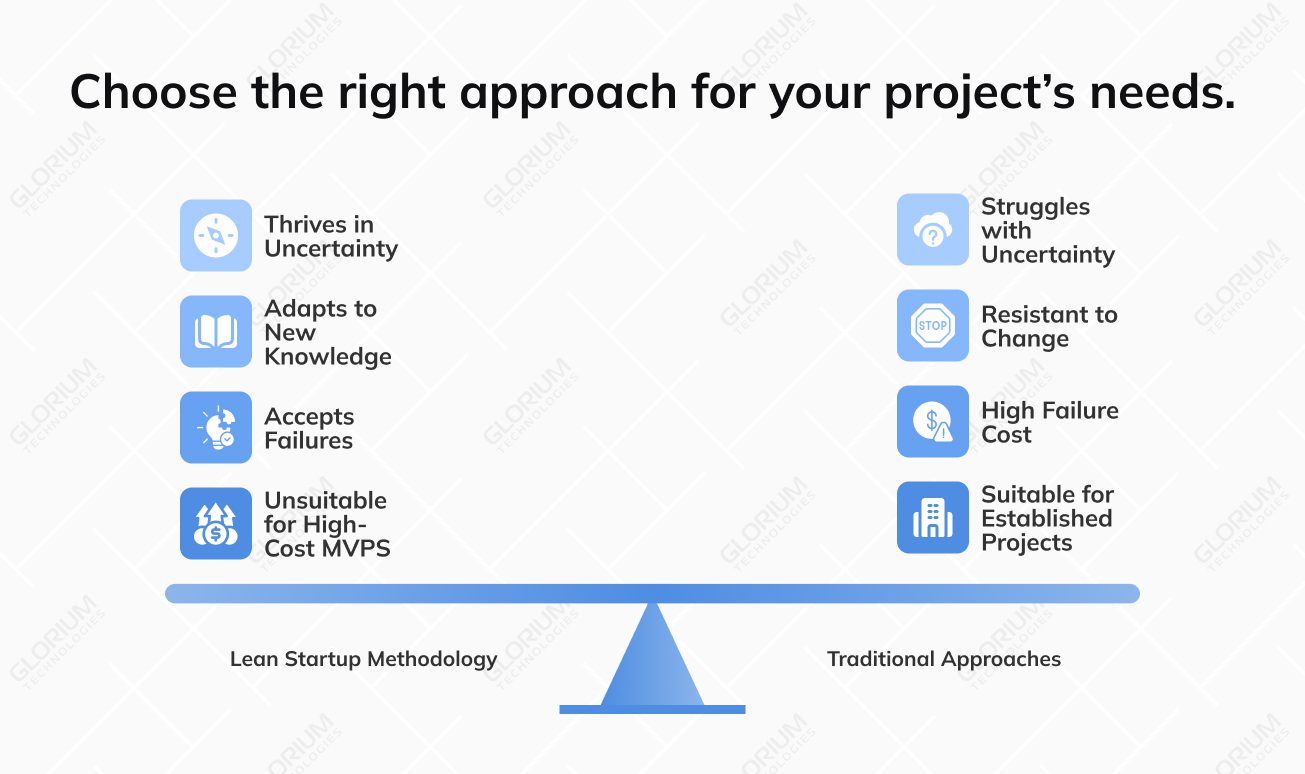
No methodology can suit every business, and Lean Startup is no exception. This is an iterative approach that works at its best in situations of extreme uncertainty. It can involve launching a business in an unfamiliar niche or expanding into new locations to attract more potential customers.
It is also great for testing new business models. This process is often associated with changing something and adapting to the newly acquired knowledge, which can be troublesome in more traditional approaches, chained by formalities and strict financial expectations.
At the same time, it is highly undesirable to work in a Lean approach paradigm with radically successful businesses, where the price of the MVP is exceptionally high. One of the key ideas in the Lean Startup methodology is to accept and learn from failures; however, this approach becomes ineffective when the price of failure becomes too high. Additionally, there is little sense in adhering to it for well-established projects with established processes and clear strategies that have proven to be effective.
| Lean Startup Methodology | Waterfall Methodology | Agile Methodology | |
| Initial goal | To identify the most effective and profitable product in the selected niche based on customer feedback. | To follow the predefined development cycle and produce a product based on the initial expectations and requirements. | To deliver working software or features in predefined intervals. |
| Process structure | A build-measure-learn loop, in which the results of the previous cycle are considered for the new one. | A fixed process structure: create requirements, develop, implement, test, deploy. | Agile development has a cycle structure, where a certain period of time (traditionally, 2-week sprints) is given to develop a certain functionality. |
| Flexibility | Welcomes changes, mainly based on the early customer feedback. Allows for correcting the selected course on the go. | Additional expenses often accompany any changes and are frequently viewed as a failure to commit to the initial goal. | Key activities can be transferred to the next sprints, priorities can also be changed, but only for the future iterations. The current cycle is untouchable. |
| Delivery | The product is delivered in small but frequent releases, each of which is followed by feedback gathering and adaptation. | A single and loud delivery of the entire product at the very end of the development cycle. | Small functionality pieces of the product are delivered at the end of each cycle. |
The word “startup” was once associated with garage-based projects launched by individuals with limited financial resources and skills, but who are driven by their dreams and enthusiasm. Nowadays, it is more akin to traditional business building. It is a human institution designed to address a specific problem and meet particular needs, not to create radically successful businesses with a pre-defined cost structure. Startups are often created by skilled professionals with some savings and, sometimes, even with a small team. Failure to deliver an in-demand product often leads to the closure of such projects.
A new company that follows Lean Startup principles minimizes the risk of failure after delivering the final product, which typically requires massive investments and a significant amount of time. It also allows people to diminish the gap between the business owner’s vision and customers’ expectations by creating a feedback loop.
According to Microsoft, around 50 million startups launch every year, and they must operate in a highly competitive environment. They lack key resources for trial-and-error approaches. The systematic and scientific approach offered by the lean methodology helps startups eliminate wasteful practices, giving them a chance to survive and capitalize on their product or change their strategy and niche if the chances for success turn out to be low and they cannot generate customer interest. In other words, cost efficiency plays the key role in this approach.
There is no indication that the situation will change in the near future. The number of new startups will only grow; new niches are constantly emerging in various industries, so today’s entrepreneurs must adapt to this reality and find ways to thrive. Customer relationships are also growing in importance for any business. This is precisely what the Lean Startup methodology will give them.
Here are some of the projects developed by Glorium Technologies following the Lean startup process that have already proven successful with the MVP, passed the customer validation stage, and are in further development or have already been fully released.
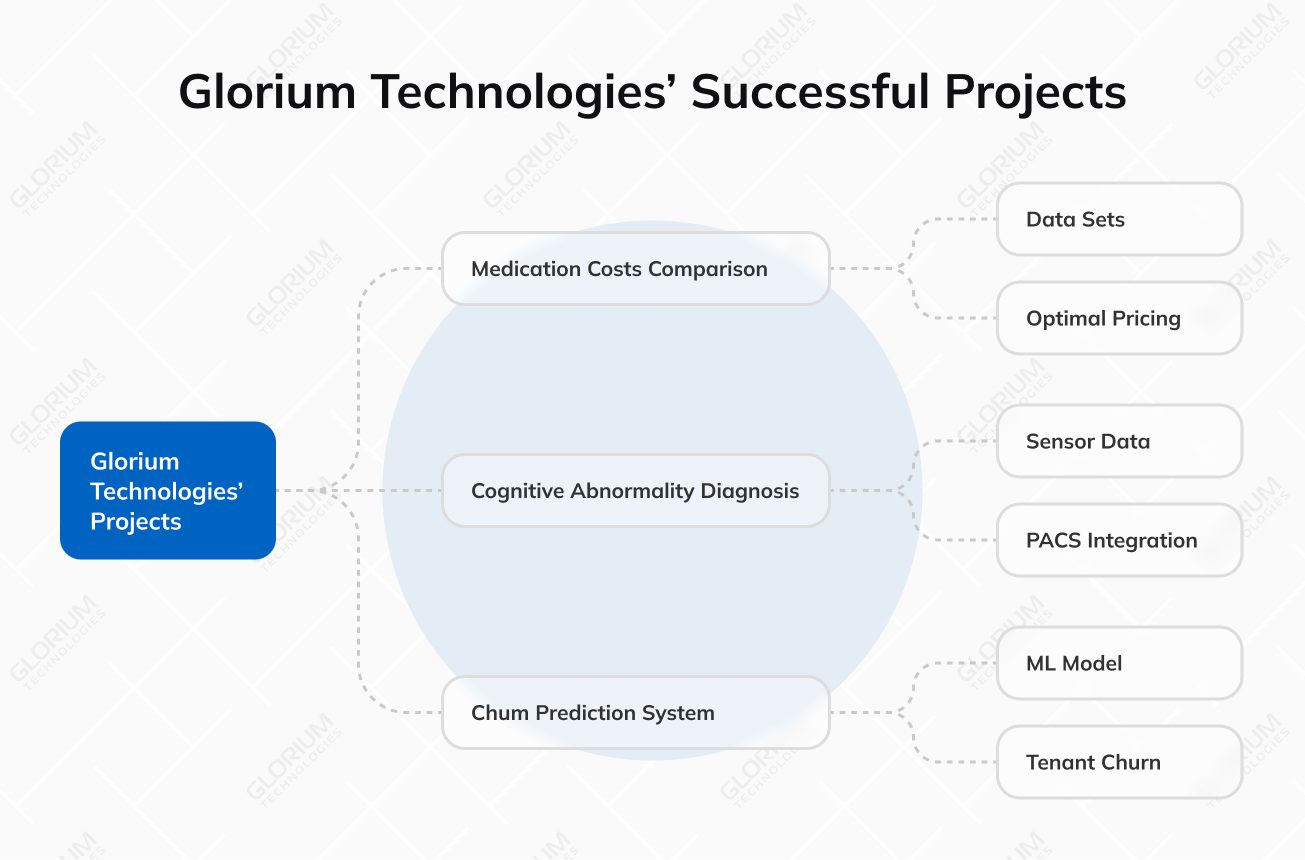
The initial request was to create a web application that would operate with large scales of data from multiple databases and conduct complex calculations in short time spans. As for MVP, an online environment was created that can operate with the data sets uploaded to the system and calculate the optimal pricing for the chosen medicine, which helps medical brokers a lot. It has already received approval from the application users and has moved to the stage of continuous improvement.
An MVP version for a music-related application has been developed, aimed at early diagnosis of dementia and MCI. It is capable of collecting sensor data from the user (finger responses), features visuospatial and motor encoding, and is integrated with PACS archives and VNA compatibility resources for improved diagnosis. The app’s value proposition was accepted and appreciated by users. The next expected step is cooperation with Philips and the creation of a medical device to enhance the app’s performance and function.
The core principles of the Lean methodology were applied to create a pipeline for an American client operating in the real estate sector, utilizing an ML model. Its main aim is to analyze the probability and reasons why tenants can churn from the company and suggest what influences this probability. The MVP was delivered, and after the product was proven to satisfy the chosen customer segments, the team had to deploy the server, finish training the ML model, and develop additional features.
Do you have a vision and need key partners with a clear blueprint? With over 15 years of experience building MVPs and developing various products, Glorium Technologies has become both a development and digital transformation partner for multiple companies.
We help startups build sample products, validate ideas, scale efficiently, and put their products in front of real users, gradually turning them into sustainable businesses.
Ready to scale and start learning about the target audience for your product or service? Book a free intro call with our experts. Ask questions, receive answers, and get a custom quote.
The Glorium Technologies team can help with this. You will receive a detailed analysis based on user feedback and professional opinions to determine whether the suggested product is viable and worth investing time and money in. This becomes possible by developing the minimum required features for field testing and gathering feedback.
A company’s proficiency and effectiveness in the Lean Startup methodology are measured by its ability to follow the build–measure–learn feedback loop, utilizing actionable metrics, thereby minimizing time and resource waste. Glorium Technologies specializes in applying these principles in its collaboration with startups. First, you can validate your ideas with us, and then move to developing an MVP and putting it in front of real customers. By cooperating with us, you are part of a continuous feedback loop, where we receive feedback and gather data to inform further decisions on design and development.
Discovery techniques are crucial for the Lean Startup approach as they substitute conventional product planning with a more effective process focused on validated learning and a scientific approach, often influenced by lean manufacturing principles. We use opportunity solution trees during the Build stage to ensure that progress is measured by effectiveness and direct impact on the business key metrics, not just by completion. Assumption mapping enables us to focus on developing an MVP during the Measure phase and testing the most critical assumptions. Customer journey mapping helps us in the Learn stage to compare current results with expectations and desired outcomes. It allows us to progress gradually to the Build stage of the new cycle.
First of all, it is our reputation and customer-centric approach. We have more than 150 successful products in our portfolio, and we have been honored with numerous awards, including IAO Global Outsourcing 100 in 2023, 2024, and 2025. Secondly, we are certified to ISO 27001, ISO 9001, ISO 13485, HIPAA, and GDPR standards. We provide compliance-focused expertise across various industries, including healthcare, real estate, fintech, and construction. Finally, we stick to modern trends that emphasize continuous innovation. As for today, apart from the mentioned MVP development, we are also developing CogniAgent, an artificial intelligence tool that enables us to integrate the software we create with advanced AI solutions.