







The Complete List of Odoo Modules: Every Module Explained
Updated January 13, 2026

 Summarize in ChatGPT
 Summarize in ChatGPT
Finding a unified platform that adapts to your unique operational needs is essential. The Odoo system is a comprehensive and modular ERP software suite designed to integrate all your business processes seamlessly.
Odoo thrives on flexibility and a collection of core modules, including CRM, Accounting, Inventory, Human Resources, and more. The modules provide the essential framework for managing any business. This foundation is exponentially expanded by the vibrant Odoo community and the extensive Odoo app store, which hosts thousands of specialized applications.
Odoo, although a user-friendly and flexible platform, is complex and has numerous modules, which can confuse first-time users and even complicate things for experienced ones. We have created this article to guide you through all the Odoo modules, their out-of-the-box capabilities, and customization options.
Content
Odoo modules are the specialized, functional building blocks of the ERP system. Each. A module manages a specific area of your business, for example, the Odoo accounting app for finance or marketing modules for campaigns. These integrated modules work together to manage all your sales activities, inventory, projects, HR, and more from a single dashboard. Odoo allows businesses to streamline operations. It helps companies get rid of disparate systems, spreadsheets, legacy software, and scattered documents and collect everything in one single source of truth.
Odoo operates on a dual-license model. The Community Edition is a free and open-source version of the enterprise resource planning platform, with a robust suite of core modules at no cost. For many businesses, this is an excellent starting point.
Odoo Enterprise Edition is a paid subscription that includes advanced features, official support, automated hosting, and a wider range of sophisticated apps. This makes Odoo modules both free and paid, with some companies deciding to start with the free Community version to establish core processes and later adapt Odoo with paid enterprise apps. Additionally, businesses consider Odoo implementation services as their business needs grow in complexity.
In everyday conversation, the terms “Odoo apps” and “Odoo modules” are often used interchangeably by users. However, there is a subtle technical distinction. A module is the fundamental unit of functionality within the Odoo framework—it’s the actual code package that adds features. An app typically refers to a module (or a collection of modules) as it is presented and sold in the Odoo App Store, often with a commercial or user-friendly focus.
| Feature | Odoo Module | Odoo App |
| Primary Context | Technical development and core system. | End-user marketplace and business solution. |
| What it is | A package of code that adds specific features to the Odoo system. | A productized module (or suite) available for installation, often from the Odoo App Store. |
| Scope | Can be a small feature or a large application. | Usually implies a complete, user-ready business application. |
| Association | Developers, system administrators. | Business users, project managers, decision-makers. |
| Example | The account module containing the core accounting logic. | The “Odoo Accounting” app, which bundles the account module with related features for easy installation. |
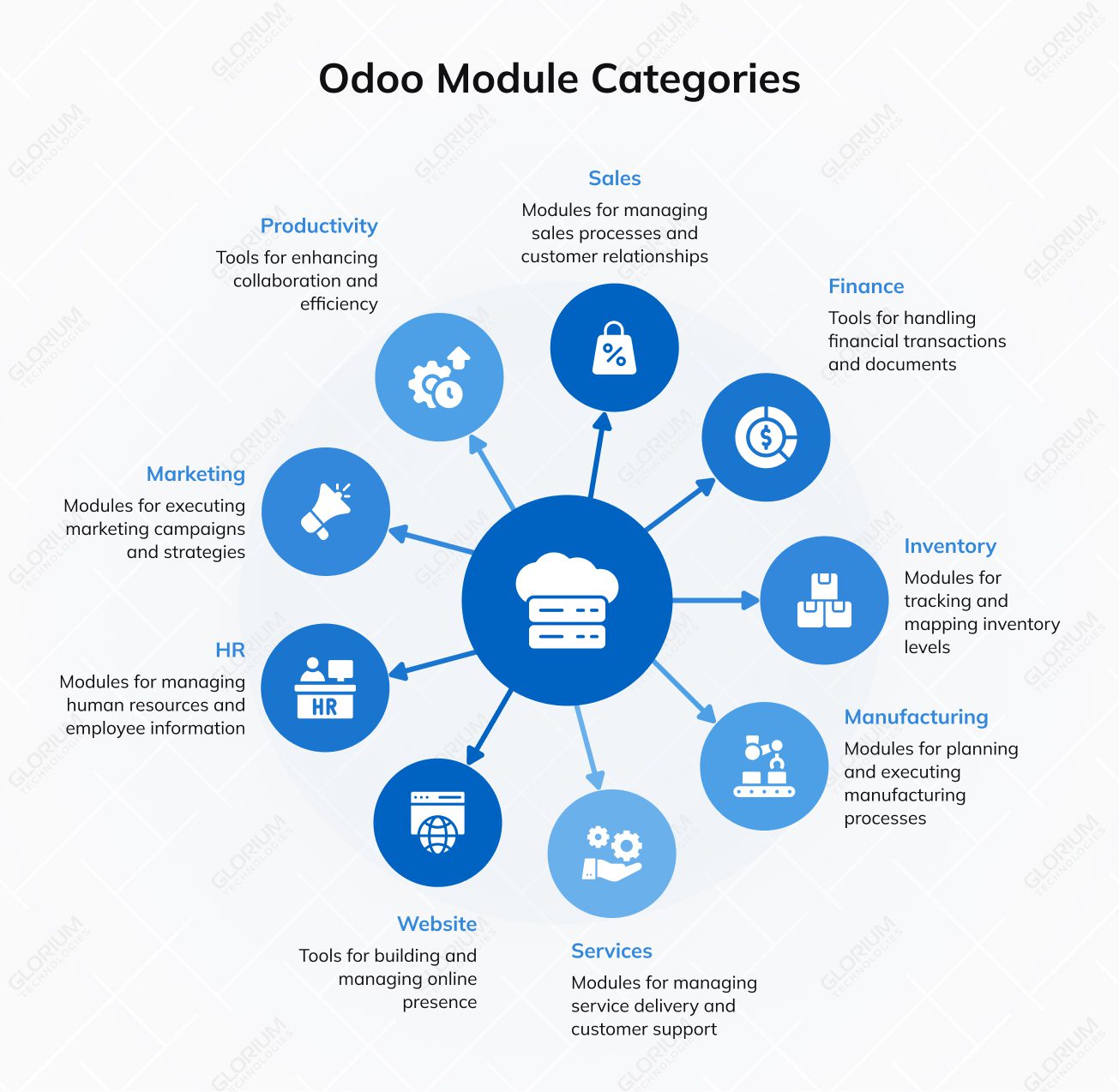
Odoo, as a unified business management software, has a comprehensive suite of modules. These applications form the essential foundation of the platform, designed to integrate and automate your primary business operations—from customer relationship management and sales to inventory, accounting, and human resources. While industry-specific modules offer customizations, these core tools provide the universal functionality needed to streamline any business.
Below, you’ll find a comprehensive list of all Odoo ERP modules.
| Category | Primary Odoo Modules |
| Sales | CRM, Sales, Point of Sale (POS), Subscriptions, Rental |
| Finance | Accounting, Invoicing, Expenses, Documents, Spreadsheets, Sign |
| Inventory | Inventory, Purchase, Barcode, Maintenance, Quality |
| Manufacturing | Manufacturing (MRP), PLM, Shop Floor, Repairs |
| Services | Project, Timesheets, Field Service, Helpdesk, Planning, Appointments |
| Website | Website Builder, eCommerce, Blog, Forum, eLearning, Live Chat |
| HR | Employees, Recruitment, Time Off, Appraisals, Payroll, Fleet |
| Marketing | Email Marketing, Automation, Social Marketing, Events, Surveys |
| Productivity | Discuss (Chat), Knowledge, Approvals, IoT, Calendar |
This suite of modules transforms how you connect with prospects and serve customers. It provides the integrated tools needed to master your sales pipeline, engage buyers across multiple channels, and build lasting loyalty. Odoo ensures every customer interaction is tracked and optimized for growth with the modules below:
Keep your books in perfect order and gain a crystal-clear view of your business’s financial health. This collection of tools automates the essentials, from daily bookkeeping to strategic analysis, saving you time and providing the insights you need to make smarter decisions.
Take control of your stock and the flow of goods from supplier to customer. This set of modules helps you optimize your warehouse, automate purchasing, and ensure operational reliability, all while keeping real-time visibility over your entire supply chain.
Turn raw materials into finished goods with efficiency and control. From planning on the whiteboard to execution on the factory floor, this set of tools manages your entire production cycle, ensuring quality and keeping complex operations perfectly synchronized.
Manage your most important asset—your people. From hiring to reviews and beyond, these modules centralize all your HR tasks to streamline employee management, foster growth, and ensure smooth day-to-day operations.
Connect with your audience and drive growth through targeted, multi-channel marketing campaigns. These tools help you automate customer journeys, engage your leads with personalized content, and measure the impact of your marketing efforts from a single platform.
Deliver projects on time, allocate resources wisely, and provide exceptional service. These tools bring structure and visibility to your operations, ensuring that every task is completed efficiently—whether it’s by your in-house team, on-site technicians, or support staff.
Build your online presence and grow offline and online sales from a unified platform. From creating a professional website to managing your entire digital storefront, these tools provide everything you need to engage customers and drive revenue online.
Boost internal efficiency and empower your team with tools that streamline communication, centralize knowledge, and automate workflows. These modules help you build a connected, self-sufficient organization from the ground up.
While Odoo has an extensive library of core and third-party modules, sometimes customization is unavoidable. Tailoring involves matching the system to your business’s unique workflows and adding capabilities that off-the-shelf solutions cannot address.
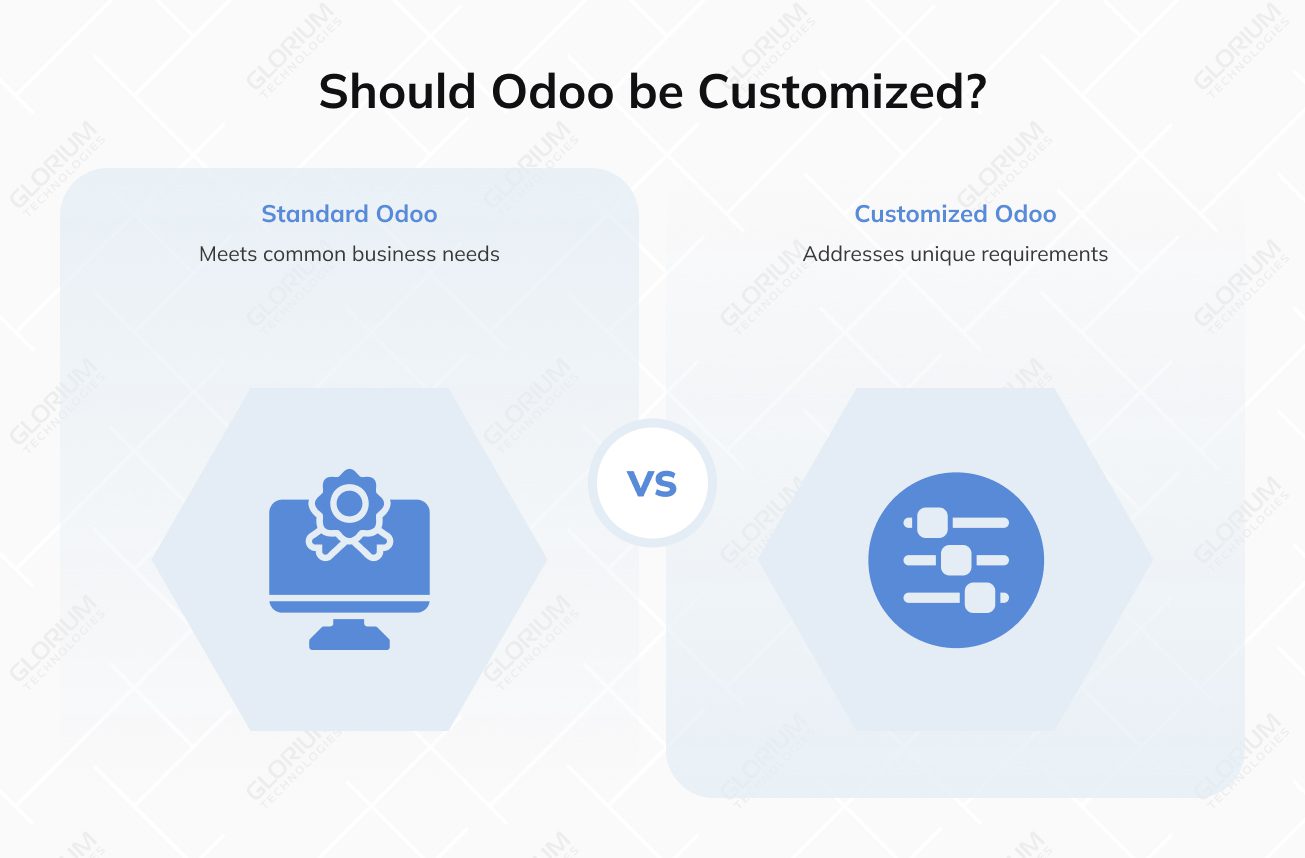
You likely need customization when you must:
Ready to implement Odoo or customize its modules to fit your unique business model? Partner with Glorium Technologies, an experienced Odoo specialist with a proven track record of delivering tailored ERP solutions.
Explore the success stories of our clients, such as our implementation for a Belgian chocolate manufacturer, where we centralized production, inventory, and HR to reduce production costs by 10% and cut weekly administrative time by 50%. Similarly, for a UAE-based perfume retailer, we unified their online and offline sales channels, achieving a 95% reduction in overselling and automating cross-border tax compliance.
To see how our experience can translate into a streamlined, powerful system and custom modules for your organization, we invite you to contact us today to request a personalized demo and start your transformation.
Odoo stands out with its modular architecture. Some ERPs have monolithic systems, which don’t allow you the flexibility. With Odoo, you can start with core apps and add specialized marketing apps, analytics tools, or productivity tools as needed. Odoo’s flexible nature allows an evolving business to adapt as its needs grow.
Not necessarily. The platform is quite user-friendly, but complex customizations are best done with expert support. Leveraging advanced analytics tools or customizing workflows to match unique customer preferences may require some technical expertise.
Yes. Businesses adopt Odoo for this exact reason. Built-in analytics tools and dashboards transform data from sales, inventory, and projects into actionable insights. You can track project timelines and analyze sales performance to make informed strategic choices.
Odoo has an extensive app ecosystem. Beyond core functions, you can find modules for student management and course scheduling for schools, or sophisticated pipeline management and lead tracking for sales teams. You can build a system that feels custom-made specifically for your sector.
The enterprise version has powerful capabilities designed for scaling businesses, including advanced email marketing campaigns with automation, integrated VoIP calls from the CRM, sophisticated document management with electronic signing, and more granular reporting analytics tools for deeper data-driven decision making.