







How to Scale a SaaS Business Without Losing Speed or Stability
Updated January 19, 2026

 Summarize in ChatGPT
 Summarize in ChatGPT
Most teams do not decide to scale a SaaS business overnight. The pressure shows up first: the product slows down during peak usage; releases become stressful, support requests pile up, costs rise, but the reasons are not obvious. SaaS growth is still happening, but it starts to feel fragile. For a SaaS business owner, this is often the point at which the company enters a new stage, and slowing growth becomes a real risk if the foundation cannot keep pace with demand.
Scaling is the work that makes SaaS growth sustainable. It means attracting more happy customers and increasing usage without the product, team, or economics becoming unstable. Performance remains predictable, uptime remains reliable, and delivery remains consistent as the customer base expands.
This article breaks SaaS business scaling into practical steps. It explains what scaling really means, why it matters, and the best practices across architecture, infrastructure, and team workflow that help scale your SaaS business with more control.
Content
In the SaaS industry, scaling means the business can grow without the product, the team, or the economics becoming unstable. More customers should not automatically mean slower performance, more outages, longer release cycles, or a support function that is always in overload.
Scaling usually includes work across product and architecture, infrastructure and reliability, delivery and operations, and unit economics. The company’s product remains maintainable as it expands. The platform handles higher load and recovers well from failures. Releases stay predictable as more people contribute. Costs grow more slowly than revenue over time, which supports efficient product-led growth and protects profit.
“Building a product is actually really, really hard, but building distribution is as hard or maybe even harder. So what you need to figure out is, like, how can I find a way to acquire customers in a profitable way? And this idea of just building a product and the ideal customers will come is probably a wrong idea.”
Amir Salihefendic, founder & CEO of Doist (makers of Todoist and Twist)
These two ideas are often used interchangeably, but they address distinct problems. SaaS growth strategies are designed to drive demand and increase average revenue. They include generating quality leads, converting them, and expanding existing accounts. Scaling is what makes SaaS growth sustainable. It ensures that the product, the team, and the business model can handle higher volumes without compromising quality for paying customers.
| Area | Growth | Scaling |
| Core question | How do we increase demand and revenue? | How do we support more demand sustainably? |
| Main goal | More customers, more usage, more annual recurring revenue (ARR) | Stable performance, predictable delivery, controlled costs while ARR grows |
| Primary focus | Acquisition, activation, monetization, expansion | Reliability, efficiency, repeatable processes, and bottleneck removal |
| Typical initiatives | New channels, higher spend, new customer segments, and more sales team capacity | Performance work, architectural improvements, observability, automation, process standardization |
| What “good” looks like | Top-line increases month over month | Top-line grows while churn, incidents, and cost per customer stay under control |
| Unit economics | Can look fine short-term, even with waste | Designed to improve over time through efficiency and retention |
| Team impact | More workload and more coordination overhead | Clear ownership, fewer emergencies, smoother handoffs |
| Customer impact | More users are coming in | More consistent experience as the user base grows |
| Main risk | Spending to grow a leaky bucket | Overengineering and slowing delivery too early |
| Simple example | Increase pipeline through paid advertising, demand generation, content marketing, new segments, and more sales team capacity | Reduce churn drivers and harden the platform so growth sticks |
Most SaaS companies start thinking about scaling when growth begins to hinder their operations. Pages load slower during busy hours, releases take longer than they used to, support gets noisier, and expenses grow faster than monthly recurring revenue. Scaling is how you address the cracks before they become bigger problems. The goal is consistent growth that stays profitable and does not exhaust the team.
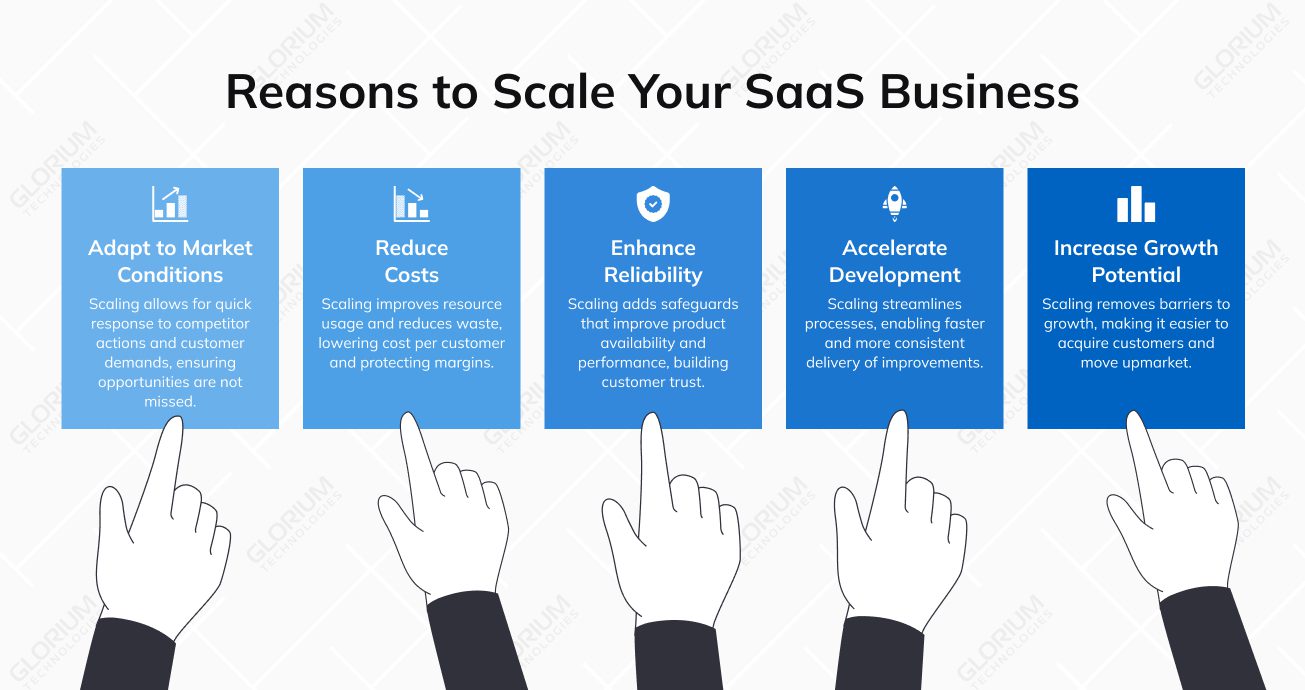
Markets change fast in the SaaS industry. A competitor launches a similar feature. A new segment starts showing interest. Target customers often request integrations, improved reporting, or enhanced security controls. If the product and the team cannot react quickly, opportunities will pass by, and the company’s value proposition will become weaker.
Scaling helps a SaaS business respond with less disruption. A modular product is easier to extend. A stable delivery process makes it easier to ship improvements without breaking production. This is what allows SaaS startups to adjust their direction without resetting the roadmap every time target market dynamics shift.
Scaling implies spending smarter so that profit margins do not collapse as usage increases. Many SaaS businesses grow into cost inefficiencies without noticing. The signs are rising spending, heavy manual labor, and excessive time spent fixing avoidable incidents.
A solid scaling setup enhances resource utilization and minimizes waste. Auto-scaling helps match capacity to demand. Caching reduces repeated database work. Async processing prevents heavy tasks from slowing down the app. Over time, this lowers the cost per customer and supports efficient growth.
As the customer base grows, reliability becomes part of the brand. Users do not care that a team is in a stage of rapid growth. They care that the product is available and performs well, and that it meets customer expectations.
Scaling improves reliability by adding practical safeguards. Load balancing and redundancy reduce single points of failure. Monitoring and alerting help teams catch issues early. Better release practices reduce outages caused by changes. This also supports stronger customer retention, especially when moving upmarket.
Hiring more engineers does not automatically mean faster delivery. In many SaaS companies, speed slows down because the product becomes more complex and coordination becomes more challenging. Teams start stepping on each other. Testing takes longer. Releases feel risky.
Scaling helps keep development moving. Clear module boundaries reduce dependencies. Strong CI/CD and testing practices cut manual effort. Clear ownership reduces confusion during delivery and incidents. This also improves handoffs across customer success, engineering, and product.
Scaling removes the limits that hold growth back. If onboarding is inconsistent, new customers churn early. If performance dips under load, paying customers lose trust. If releases are slow, future development takes too long, and competitors catch up.
When the platform is stable and the team can ship reliably, growth becomes easier to plan and manage. It becomes safer to invest in customer acquisition, whether that comes from a sales team, marketing strategies, content marketing, or referral programs. A stronger customer journey also enhances the ability to retain existing customers and increase revenue from them over time. This is where product-led growth can work in tandem with sales and marketing, rather than competing with them.
Scaling a SaaS business is much easier when the numbers are clear. These key metrics indicate whether their growth strategies work, whether existing customers are retaining their business, and whether the company can afford to continue investing.
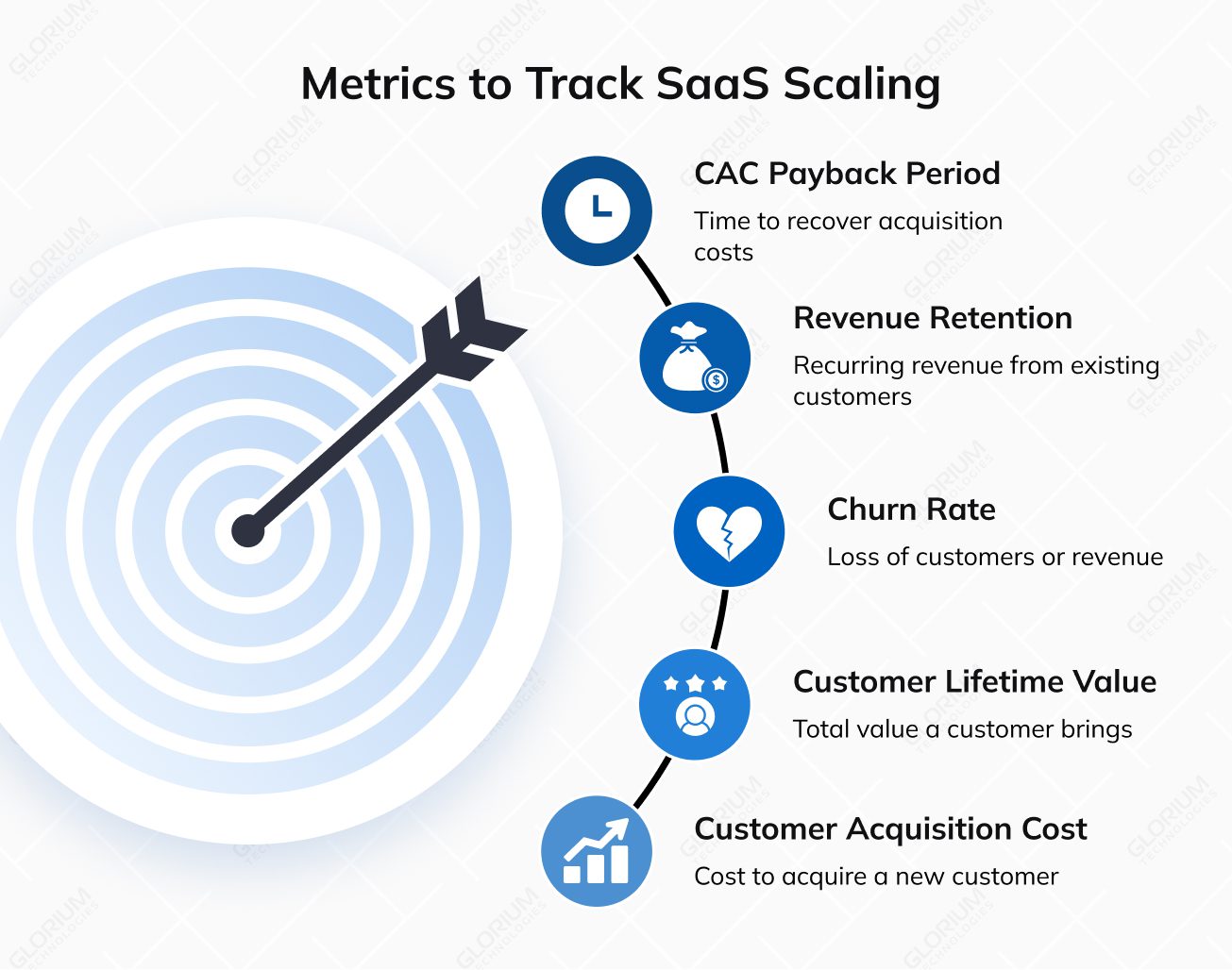
CAC is the cost of acquiring one customer. It helps answer a simple question: are customer acquisition channels still efficient, or are you paying more for the same result? Track customer acquisition cost by channel, segment, and time period, that is where the insight usually hides.
Customer lifetime value estimates the total value a customer brings over their lifetime. It reflects retention, pricing, and expansion. If customer lifetime value remains flat while customer acquisition cost rises, scaling acquisition becomes risky because you are spending more to acquire customers who do not provide a higher return on investment.
Churn indicates the number of customers or the amount of revenue lost over time. For scaling, churn matters because it sets how “leaky” growth is. High churn forces a team to replace customers just to maintain its position, making scaling expensive and unpredictable, and can lead to a slowdown in growth.
Gross retention measures the amount of recurring revenue you retain from existing customers before they expand their business. Net revenue retention encompasses expansion, including upgrades and increased usage of products or services. Together, they show whether the base is stable and whether growth can compound.
The CAC payback period indicates how long it takes to recoup the costs incurred to acquire a customer. If payback stretches out, it can strain cash flow and limit reinvestment. Even with strong revenue growth, slow payback can quietly cap how fast a SaaS business can scale.
“SaaS reacts sharply to small shifts in key variables. That’s why you must identify the few metrics that unlock growth, then manage them deliberately.”
David Skok, General Partner at Matrix
Scaling a SaaS business is what happens after “it works.” Potential customers arrive, usage grows, and suddenly the same product feels slower, releases feel riskier, and costs start creeping up. Scaling is about maintaining a solid experience while the numbers increase, without turning the team into full-time firefighters. Strong growth strategies also depend on company culture, because scaling usually fails when ownership and decision-making become unclear.
Here are strategies that help SaaS companies scale their business in a controlled, practical way:
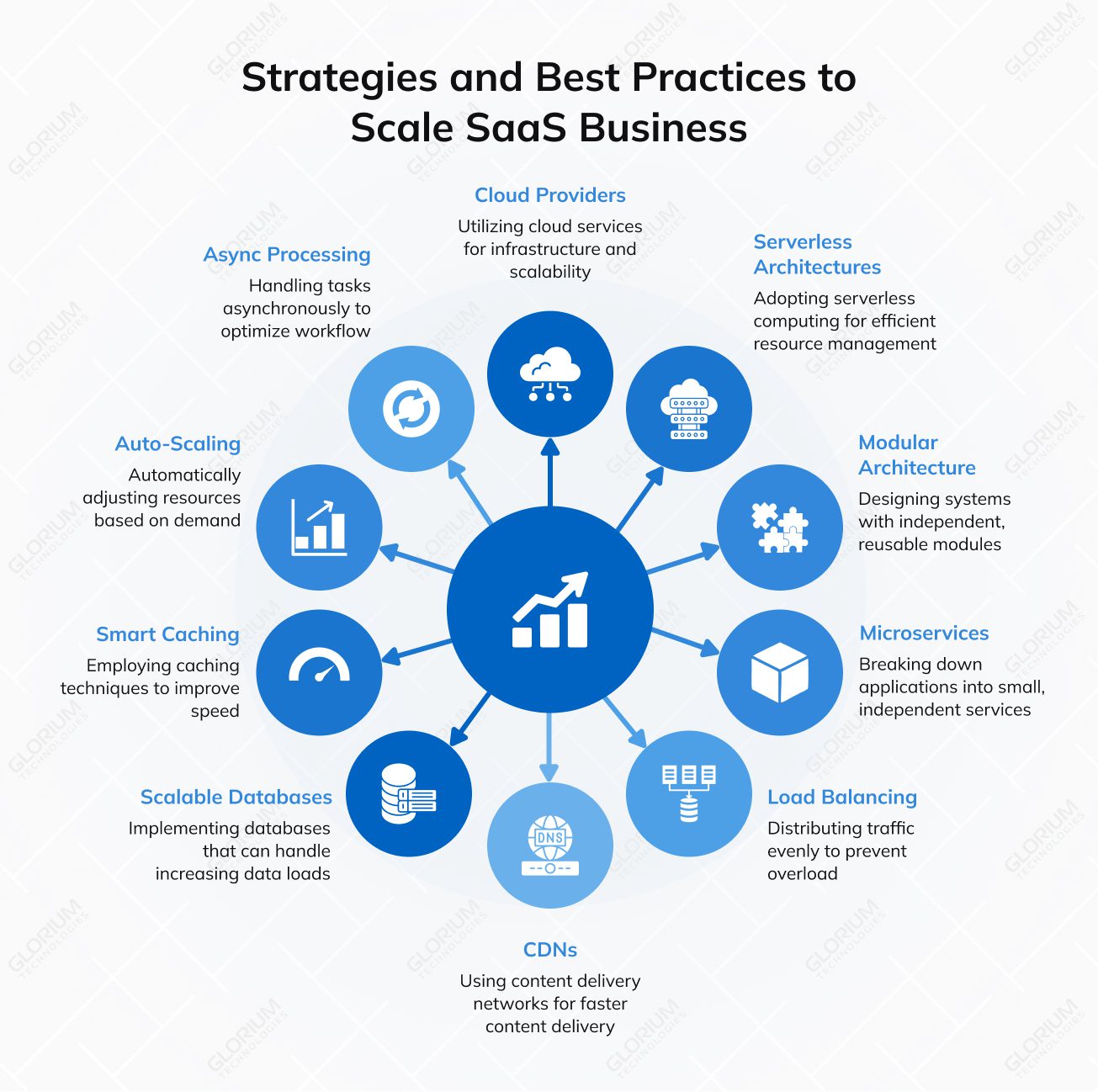
Cloud platforms like AWS, Azure, and Google Cloud offer flexibility that is hard to match with traditional fixed infrastructure. When demand rises, you can add capacity quickly. When it drops, you can scale back instead of paying for unused resources. This helps control infrastructure costs as a SaaS business grows.
Cloud also makes it easier to serve customers in different regions. If users are spread out, running closer to them reduces latency and supports a smoother experience. Managed services can also reduce operational load, allowing teams to focus on product development that enhances customer satisfaction.
Serverless is useful when you want something to scale automatically without managing servers for it. Instead of running a big always-on service, you run functions that trigger when something happens: a file upload, a webhook, a scheduled job, a message in a queue.
For many SaaS teams, serverless is a clean solution for background work and integrations. You usually pay for actual execution time, so it can also be cost-efficient for workloads that come in bursts.
A modular product is easier to grow because changes stay contained. When a platform is divided into distinct components with clear responsibilities, teams can enhance one area without inadvertently impacting the others. This becomes especially important as the codebase grows and more people touch it.
Modularity also helps scale your SaaS org, because teams can take ownership of product areas more clearly and ship with less coordination overhead.
Microservices can be beneficial when parts of the product need to scale differently or when multiple teams need to ship independently. Each service can be deployed and scaled on its own, which can reduce the blast radius of issues.
But microservices also introduce complexity. Service communication, monitoring, deployments, and data consistency are harder. A good rule of thumb is simple: move to microservices when the current setup clearly limits you.
Load balancing spreads traffic across multiple instances. This prevents a single server from becoming a bottleneck and helps maintain stable response times during peak usage.
It also improves reliability. If one instance fails, traffic can be routed to healthy ones. For customers, this often means no visible downtime, just a product that continues to work.
A CDN speeds up the delivery of static content like images, scripts, and stylesheets by caching it closer to users. That makes the product feel faster, especially for users who are far from the main infrastructure.
CDNs also reduce load on core systems. Instead of app servers serving every static file, the CDN handles that part, freeing the backend to focus on business logic and data.
Databases are often where scalability shows up first. The “just upgrade the server” approach works only up to a point. After that, you may need read replicas, better indexing, partitioning, or sharding, depending on the workload.
If you run a multi-tenant SaaS, sharding by tenant or region can help keep performance stable as data grows. Backups, disaster recovery, and migrations are also part of scaling. Those are what protect the SaaS business when growth exposes weaknesses.
Caching helps you avoid hitting the database for the same information over and over. Storing frequently used data in memory, for example, with Redis, can speed up common requests and reduce pressure on the database.
The important part is discipline. Cache what makes sense, set clear expiration rules, and be careful with anything that changes often. Good caching is invisible, while bad caching becomes a support headache.
Auto-scaling adjusts capacity based on demand. When traffic spikes, you scale out. When things calm down, you scale back. This is helpful because SaaS usage rarely grows in a smooth line. You may experience spikes from launches, campaigns, onboarding new customers, or time-of-day patterns.
Auto-scaling helps you stay responsive without constantly running at maximum capacity, which supports better cost control as you scale your SaaS.
Async processing moves heavy tasks into the background, allowing users to avoid waiting. Instead of blocking the app while a report generates or a file processes, you queue the work and let workers handle it.
This keeps the product responsive and gives better control under load. It is beneficial for imports and exports, report generation, billing runs, notifications, and third-party sync. It also reduces operational noise for customer success teams when usage rises quickly.
Scaling works best when it’s treated as a product and delivery discipline. Glorium Technologies supports teams through our minimum viable product development and long-term SaaS development services, with a focus on building platforms that stay fast, stable, and secure as usage grows.
A good example is BodyO, a health monitoring and tracking platform built around a full-body digital scanner and the AiPOD capsule. The SaaS startup came to Glorium Technologies after an earlier vendor failed to deliver, so the system was rebuilt from scratch. The work combined a Unity 3D interface, a cross-device app, and an AWS-based backend, while meeting strict security requirements and supporting HIPAA-aligned compliance. The platform also integrated wearable device syncing, real-time capture of vital health data, and personalized programs driven by collected metrics.
Ready to scale your SaaS without slowing releases or sacrificing reliability? Glorium Technologies can help. Get in touch for an introductory consultation.
Look for a partner who understands how to scale a SaaS business beyond shipping features. The right fit can support SaaS business scaling across reliability, delivery, and the business model, not only code. They should demonstrate proof of long-term stability, effective leadership, and repeatable processes that consistently protect customer satisfaction as they add more clients. With Glorium Technologies, that credibility comes from 150+ delivered products, and multi-year third-party recognition (Inc. 5000, IAOP Global Outsourcing 100, Clutch Top 1000). ISO-backed discipline also helps when the target audience shifts upmarket, and customer expectations rise.
We typically run a structured assessment across three layers. First, product and usage: where the customer journey breaks, what drives churn, and what blocks customer retention for existing customers. Second, infrastructure and data: performance, reliability, observability, and infrastructure costs that can eat profit margins during SaaS growth. Third, operating model: ownership, release cadence, incident routines, and handoffs between engineering, product, and customer success. The key insight is to connect technical constraints to business health, including the stability of monthly recurring revenue and the ability to support sustainable growth.
Yes. Glorium Technologies can transform a broad goal, such as “scale your SaaS,” into a roadmap tied to specific outcomes. That typically includes targets for latency and uptime, as well as business-facing milestones tied to revenue growth, operational efficiency, and the reduction of bottlenecks in delivery. The roadmap also clarifies owners, dependencies, and timelines so teams do not get stuck in project management noise. It becomes easier to align engineering work with sales and marketing plans, especially when customer acquisition ramps up and new customers arrive faster.
Yes. The emphasis is on incremental change, allowing SaaS companies to modernize without freezing future development. Glorium Technologies typically starts by defining module boundaries and stabilizing interfaces, then extracts services only where it reduces real constraints, such as release risk, scaling limits, or operational costs. This supports consistent SaaS growth because the product continues to ship while the architecture improves. It also helps the company’s product evolve toward new product offerings or pricing packages without turning every change into a high-risk deployment.
We bring an enterprise-ready baseline through ISO 27001 (information security) and ISO 9001 (quality management). For regulated domains, we also support compliance expectations, such as HIPAA/HITRUST and GDPR, and hold ISO 13485 certification for the quality management of medical device software. In practice, this translates into security built into delivery: access control, encryption practices, logging/monitoring, secure SDLC routines, and audit-friendly documentation. So you don’t scramble when larger customers start asking hard questions.
We focus on clarity and repeatability. That means clear ownership (who decides what), shared definitions of “done,” release notes, and escalation paths that work during incidents. We also help teams establish a simple operating cadence, including regular planning, reviews, and post-incident learning, so that handoffs don’t depend on specific individuals remembering context. As the organization grows, this is what keeps delivery stable and customers informed.