


Lighting Manufacturer Reached
90% Inventory Accuracy with Odoo 18

Streamlining
client

Client:

Lighting company
Storage

Industry:

Manufacturing
core technologies

Core technologies:

Odoo / Python / Odoo.sh
country

Country:

USA
Client Background

Client Overview

Inside the Operations of a Multi-Channel Lighting Manufacturer

The client produces both standard and custom lighting systems, serving contractors and retail customers. Their business model spans
  • Standard and custom manufacturing projects
  • E-commerce sales of lighting products and accessories
  • Project-based B2B engagements with on-site installations
  • Shipping from two warehouses across different cities
Before partnering with Glorium Technologies, the company relied on Excel for production planning, Outlook for communication, and QuickBooks for accounting. As sales and custom orders grew, this setup created friction and led to costly delays.
Challenge

Challenge

How Department-Level Gaps Created Company-Wide Delays

When Glorium Technologies stepped in, the client was battling inefficiencies across nearly every department:
  • Manual production tracking using spreadsheets led to errors and delays on the shop floor.
  • Customer communications were scattered across email threads with no single source of truth.
  • Warehouse operations were inconsistent and lacked barcode scanning, resulting in inventory mismatches.
  • Shipping processes were slow and required manual label printing.
  • We handled warranty tracking and return management ad hoc.
  • QuickBooks wasn’t integrated with the rest of their tools, requiring double data entry and time-consuming reconciliations.
  • No visibility into the profitability of custom lighting projects.
Startup

Why They Chose Glorium Technologies

Collaboration That Strengthened Operations Across Lighting Projects

At Glorium Technologies, we prioritize methods that enhance project outcomes and align with our clients’ growth goals. The guidance and reliability we bring made the partnership a natural fit, along with:

  • Deep experience in manufacturing and project-driven businesses
  • Phased implementation approach focused on quick wins
  • Expertise in integrating Odoo with existing tools like QuickBooks
  • Commitment to long-term scalability and growth
Solution

The Odoo 18 Implementation That Rebuilt Operations End to End

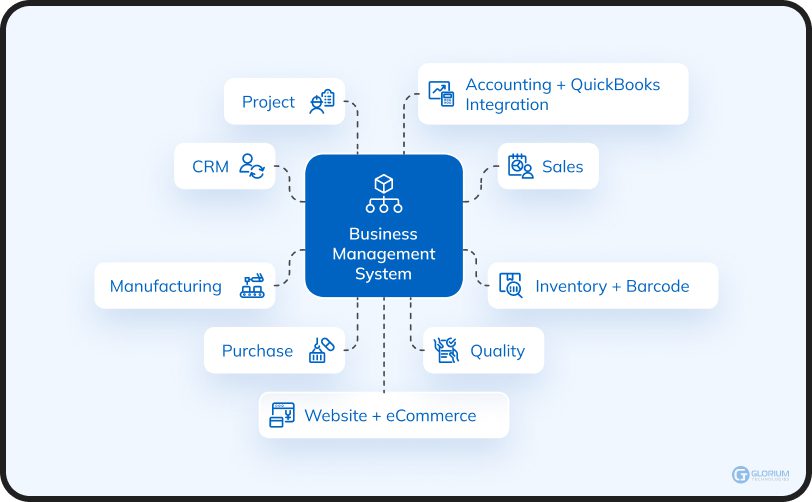
Glorium Technologies implemented Odoo 18 Enterprise, hosted on Odoo.sh, combining manufacturing, sales, inventory, quality control, projects, and finance into one system. Key modules included:

  • CRM & Sales: Full sales pipeline management for B2B and B2C with KPI tracking and commission setup.
  • Manufacturing: Multi-level BoMs, automated work orders, and tracking of scrap and defects.
  • Inventory + Barcode: Real-time visibility across two warehouses with lot/serial number tracking.
  • Quality: Checks tied directly to purchase and work orders.
  • Project: Full cost tracking from quote to installation.
  • Purchase: Smart reordering based on lead times and stock levels.
  • Accounting: Integrated with QuickBooks for seamless financial reporting.
  • Website + eCommerce: A new modern store connected with inventory and customer accounts.
1

Results

What Changed After Moving to a Fully Integrated Odoo 18 Enterprise System

After our partnership, the client achieved impressive results, with key modules implemented that streamlined operations and boosted overall efficiency.

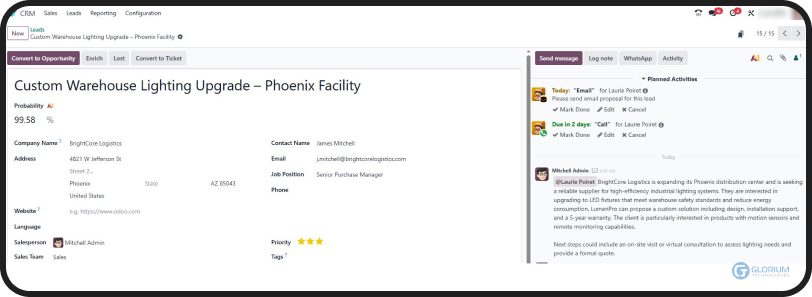
CRM
2

  • Capture leads automatically from emails and the website
  • Store all customer communications in Chatter (no more lost emails)
  • Track the full journey from first contact to successful sale

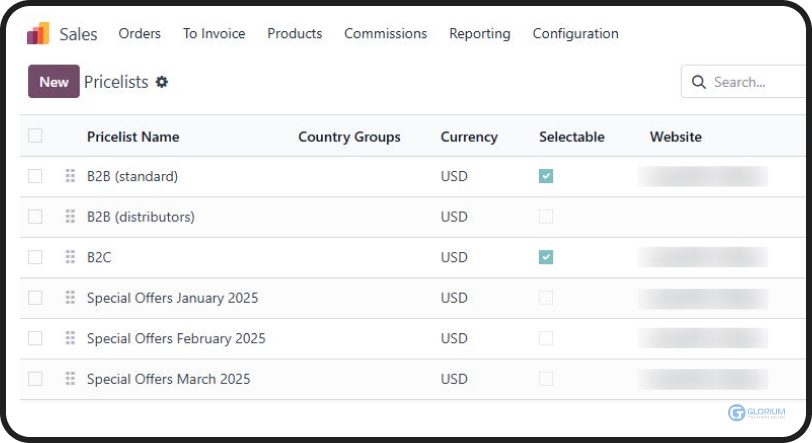
Sales
3

  • Manage B2B and B2C sales, both online and offline
  • Track KPIs by sales manager
  • Set up sales commissions
  • View the full sales pipeline and order history

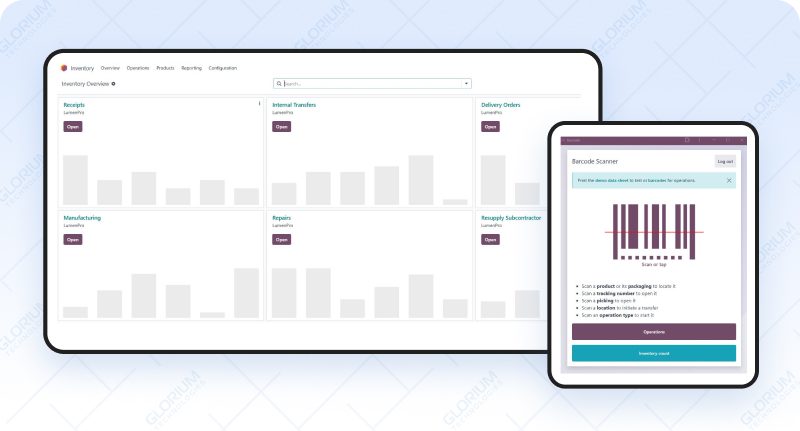
Inventory + Barcode
4

  • Address-based storage across two warehouses
  • Lot and serial number tracking for every component and product
  • Returns management (warranty and non-warranty)
  • Shipping via FedEx, UPS, or in-house delivery
  • Label generation for boxes and pallets
  • Real-time stock updates using barcode scanners

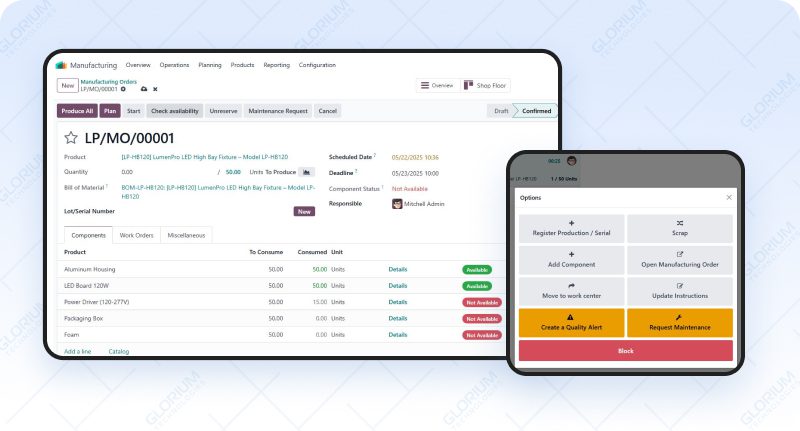
Manufacturing
5

  • Multi-level BoMs
  • Plan and schedule work orders
  • Integrate directly with inventory for material availability
  • Track defects and scrap during production
  • Support both made-to-order and made-to-stock workflows

Purchase
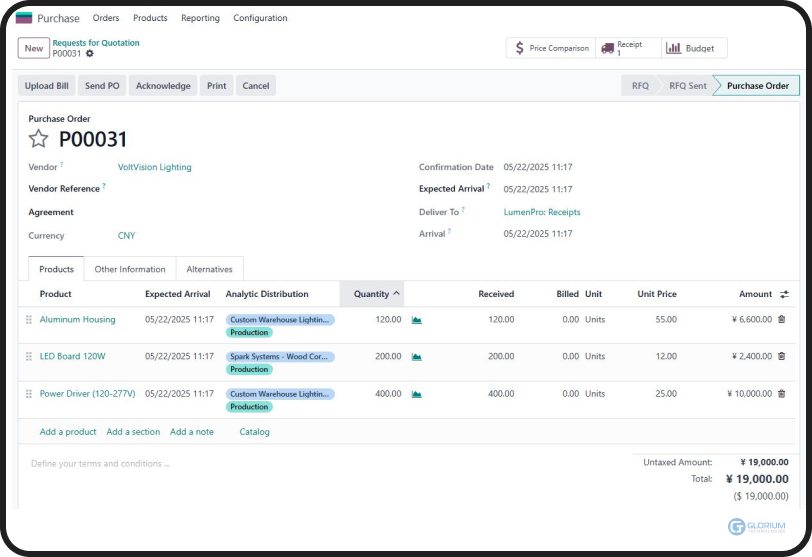
6

  • Set up vendor lead times and automatic reordering
  • Link purchase orders to inventory and quality control
  • Multi-currency support (most supplies come from China)

Quality
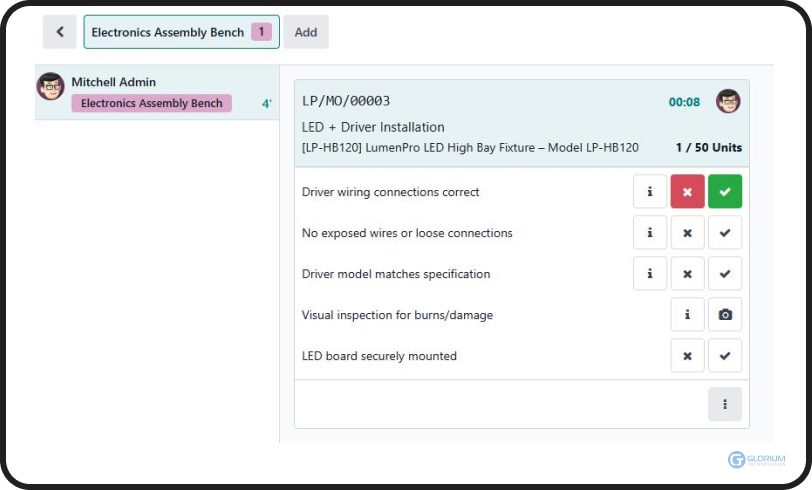
7

  • Quality checks for incoming components and finished products
  • Quality statistics for each component

Project
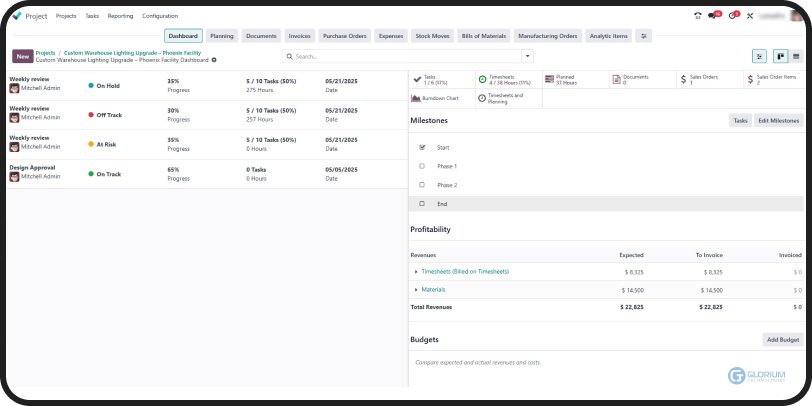
8

  • Manage custom lighting projects from quote to installation
  • Track budgets, planned vs. actual costs, and profitability
  • Assign tasks and track project milestones

Accounting + QuickBooks Integration
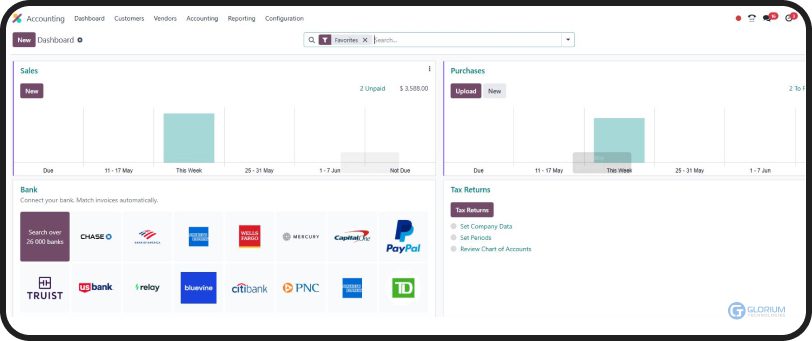
9

  • Sync customer invoices and vendor bills with QuickBooks
  • Use Odoo for cost tracking and analytical reporting
  • Keep financial operations aligned with project and sales data

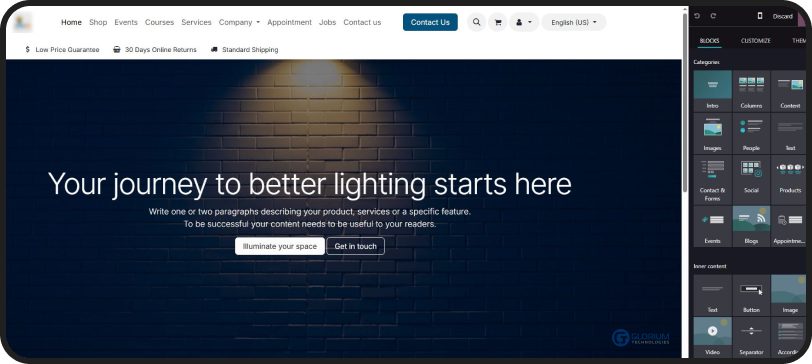
Website + eCommerce
10

  • New modern online store integrated with sales and inventory
  • Accept both B2B and B2C orders
  • Customer portal for order tracking, returns, and invoices
  • Vendor portal for supplier invoices and payments tracking

Future Expansion (Planned for Next Year)

With their core operations now automated and streamlined, the client plans to expand further by implementing

  • PLM (Product Lifecycle Management) for version control of lighting designs
  • Fleet to manage delivery vehicles and internal transport
  • Field Service for on-site installations and service visits
  • Planning for shift scheduling and production staffing
  • Employees, Timesheets, Time Off to handle HR operations
  • Dashboards for real-time performance tracking
  • Marketing Automation to engage customers and leads

This all-in-one solution unifies every department, cuts down manual effort, boosts accuracy, and lays the foundation for future growth—with the flexibility to scale as the business evolves.

Our Implementation Approach

How a Three-Stage Odoo Rollout Delivered Long-Term Stability

MVP Launch (Weeks 1–16)

  • Focus: Core production and supply chain processes
  • Modules: Manufacturing, Quality, Inventory, Purchase
  • Goal: Automate production planning, implement quality checks, organize warehouse operations (including barcode scanning and shipping), and streamline procurement
  • Training: Guidance for sales reps, project managers, and the finance team

Phase 1 (Weeks 16–24)

  • Focus: Sales and customer operations
  • Modules: Sales, CRM, Project + Budgets
  • Goal: Centralize communication, manage B2B/B2C sales, track sales KPIs and commissions, and monitor project profitability
  • Training: Guidance for sales reps, project managers, and finance team

Phase 2 (Weeks 24–32)

  • Focus: Online presence and financial integration
  • Modules: Website + eCommerce, Accounting with QuickBooks integration, Minor Improvements and customizations
  • Goal: Launch new online store, link financials with QuickBooks, polish workflows based on real usage
  • Training: eCommerce admin training and accounting team onboarding

Each phase includes detailed user instructions, training sessions, and review checkpoints to ensure smooth adoption and value realization.

Business Value

Where the Lighting Manufacturer Saw the Biggest Gains

Inventory Accuracy & Warehouse Efficiency
Barcode-driven inventory across two warehouses increased accuracy by over 90%, eliminating 16% a year in stock losses and shipping errors.

Production Agility & Quality Control
Custom and standard workflows now operate side-by-side. Quality checks tied to orders reduced defect rates by 35%, saving rework costs and improving delivery timelines.

Customer Experience & Sales Growth
Centralized CRM and a modern B2C eCommerce store improved responsiveness and increased online sales conversion by 18%.

Shipping Automation
Integrated label printing and multi-carrier support (FedEx, UPS, in-house) now save 20+ hours per month previously spent on manual tasks.

Project Profitability Insights
Each lighting project now has clear visibility into costs, margins, and timelines—fueling better quoting and resource allocation.

Accounting Alignment
Odoo–QuickBooks integration ended double data entry, eliminating monthly reconciliation errors and saving over 15% a year in accounting overhead.


Ready to See These Results for Your Business?
See how we can help you achieve the same results! Start transforming your business today.
Anna Vozna
Account Executive

Awards & recognitions

More achievements
Outsourcing
real leaders
Clutch2024
behemot 2023
excellence award

Inc. 5000

2020
2021
2022
2023

Named among the Inc.5000 (2020, 2021, 2022, 2023) & Regionals (2021, 2022, 2024) fastest-growing private companies in America

Certifications

ISO 9001
ISO 13485
ISO 27001
aws
aws
microsoft

Questions You May Have

How can Odoo support lighting manufacturers with both standard and custom production?

With Odoo Enterprise, you get a real-time view of your materials, timelines, and work centers. Your standard products follow predefined BoMs and routings, while custom luminaires or architectural lighting requests can be configured, priced, and tracked as individual projects. This gives you the flexibility to handle variations, avoid delays, and keep every next project on track without losing visibility into your margins—whether you operate as a commercial lighting manufacturer or a custom lighting manufacturer.

How does Odoo help an emergency lighting manufacturer manage compliance and traceability?

The Odoo ERP software provides you with clearer control over every component and production step, making it far less stressful to stay compliant. You can track serial and lot numbers, connect quality checks to each work order, and keep all required documentation in one place. This transparency helps you meet industry standards, avoid compliance issues, and ensure every emergency lighting unit delivers the level of performance your customers rely on.

Which Odoo modules matter most for a lighting manufacturer?

For most manufacturers in this niche, the core systems start with Manufacturing, Inventory, Quality, and Purchase to keep materials, workflows, and production steps organized. Sales, CRM, and Project help you manage custom designs, installation work, and B2B communication. Accounting and Website + eCommerce round out the setup, giving you full visibility from order to delivery—whether you produce standard fixtures or more design-driven luminaires.

What tools does Odoo offer to support LED lighting manufacturer planning strategies?

Once the ERP system is implemented, you get practical tools to make your day-to-day planning far easier. You can keep materials, timelines, and production steps in sync, rely on automated reordering to avoid shortages, and use real-time inventory updates. Work orders help you manage both standard items and unique designs, while built-in costing, quality checks, and purchasing tools keep everything moving smoothly across your full product range.

How does Odoo help reduce production delays?

When you manage production through Odoo, it becomes easy to prevent delays before they snowball and disrupt your schedule. You get a clear view of material availability, work orders, and timelines in a single space, which helps your team act quickly instead of reacting too late. Automated reordering protects you from last-minute shortages, while real-time inventory keeps everyone aligned across your full range of lighting products—from simple sconces to more design-driven luminaires used in commercial lighting projects. This control is essential for any commercial lighting manufacturer aiming to meet tight deadlines. Quality checks built into each step cut down on rework and help you maintain superior performance without slowing down production.

Can Odoo manage complex specifications required for architectural lighting?

Odoo makes it much easier to work with the detailed specifications that architectural lighting often requires. You can tailor BoMs, routings, and quality checks to match the architecture, features, and color selection of each building, whether the project calls for subtle accents or a stronger visual impact. This setup is ideal for a custom lighting manufacturer needing to stay committed to quality, track previous design changes, and keep full visibility into costs and timelines without losing inspiration and creative intent along the way.