



Pickup Wait Times Down 32%
Contactless check-in and keyless handover removed the counter step for most reservations. Average time from arrival to drive-off fell from roughly 25 minutes to about 17 at the three busiest airport branches.
Since autoscaling replaced constant peak capacity, spending matches rental demand instead of flatlining through off-seasons.
App share more than tripled in four quarters, giving marketing a first-party channel for offers.
Ratings climbed on both iOS and Android stores within six months of the contactless release.
Our client is a mid-size European vehicle rental operator running a 4,200-vehicle fleet across six markets, with airport branches driving most of its volume. The business grew through regional expansion rather than acquisition, so each market added its own branch processes on top of a single reservation core.
A 2016 booking app offered neither digital check-in nor keyless pickup. Renters queued at counters while competitors moved to app-based handover, and the legacy backend made each release slow and expensive to ship across six markets.
Every renter completed paperwork at a desk, adding minutes per transaction and building long lines at peak arrival hours.
Staff handed over physical keys, so pickup and return depended on booth hours, the agents on shift, and when the previous renter returned the car.
A 2.9-star average and 18% booking share pushed loyal customers toward aggregator sites and phone reservations.
Over-provisioned servers ran around the clock in a colocation facility, sized for seasonal peaks and priced the same way through other months.
A monolithic reservation stack turned small feature requests into multi-month projects, and each release carried regression risk.
Charge levels, mileage, and location sat inside separate vendor portals, invisible to renters choosing a car and to branch teams.
Contactless Rental Journey, Rebuilt on AWS
We ran a five-week discovery with operations, IT, and marketing leads before writing code. The roadmap paired a new React Native app with a serverless AWS backend, built in parallel, so the reservation core stayed live. Two engineering pods shipped every two weeks, with branch staff testing each release in one pilot market.
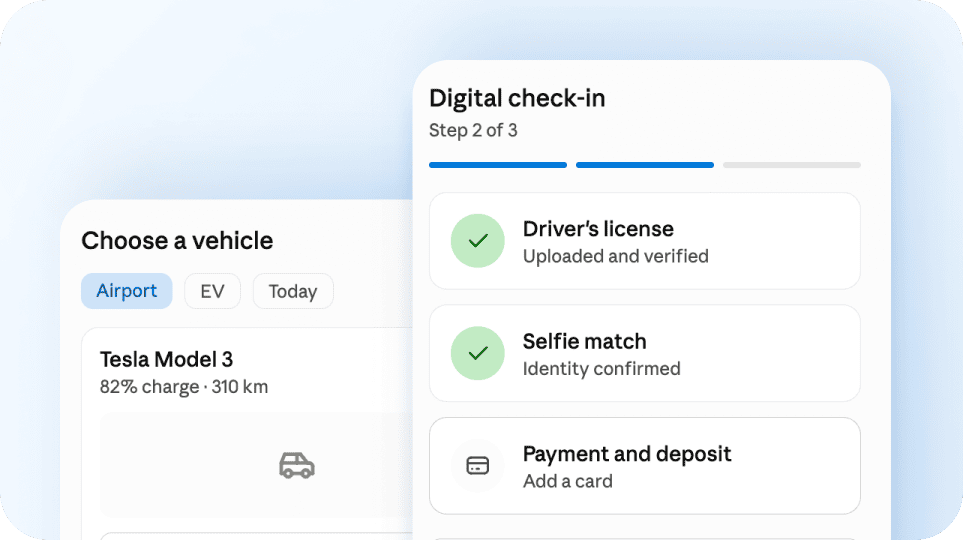
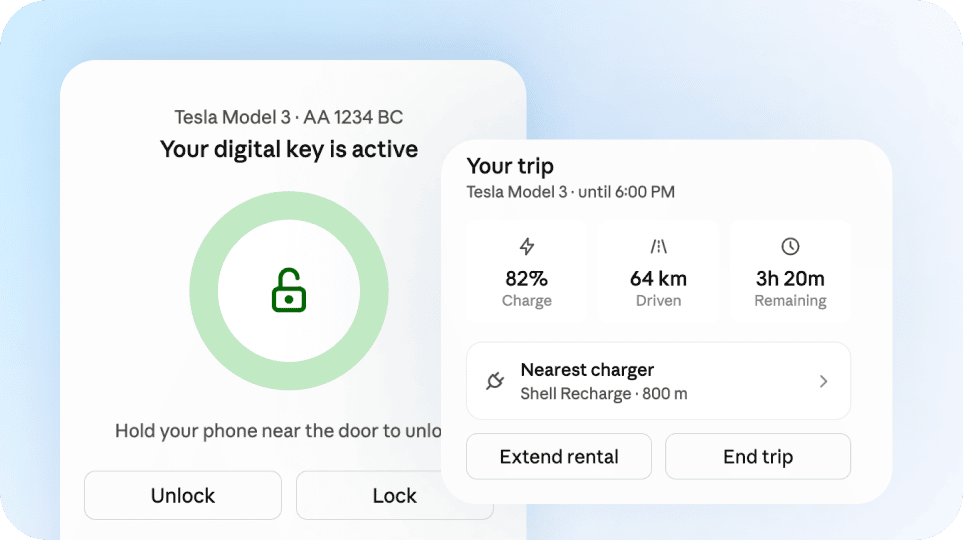
The app handles identity verification, license upload, and payment authorization before arrival, so renters skip the desk entirely. Drivers reserve a vehicle, extend a rental, or begin a return in a few taps. EV listings display live state of charge and nearby charging points. Push notifications confirm each step, which reduced inbound branch calls during the pilot.
We split the booking flow into Lambda-based microservices behind API Gateway, with EventBridge carrying reservation, payment, and fleet events. Cognito manages renter identity and staff roles. DynamoDB and Aurora Serverless separate hot availability lookups from transactional records. The reservation core remains in place and now talks to new services via API.
Right-sizing, autoscaling policies, and Graviton instances replaced fixed capacity, so spend now tracks demand across the rental calendar. Savings Plans cover the steady-state baseline. AWS Budgets and Cost Anomaly Detection alert the platform team before a misconfigured job consumes a month of allowance. Tagging by market gives finance a per-branch view.
Digital key runs on BLE with UWB support on newer handsets, so a door opens only within short range and resists relay attacks. The backend issues and revokes access grants, letting a branch manager release a car remotely or block one after a failed payment. Telematics pushes mileage, fuel, and charge data into the same event stream the app reads.
What Contactless Car Rental Changed in 12 Months
Numbers measured across all six markets in the four quarters after full rollout.
Contactless check-in and keyless handover removed the counter step for most reservations. Average time from arrival to drive-off fell from roughly 25 minutes to about 17 at the three busiest airport branches.
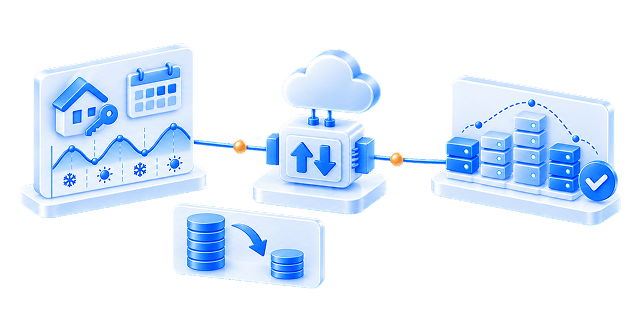
Retiring the colocation footprint and migrating to serverless architecture slashed monthly platform bills. Automatic scaling absorbed seasonal spikes with zero idle capacity, directly funding the telematics phase.
App share climbed from 18% to 61% over four quarters, pulling volume back from aggregator channels. Direct booking lowered commission costs and gave marketing a first-party channel for offers and upsells.
Ratings rose from 2.9 to 4.7 across both stores within six months of the contactless release. Reviews mention the digital key and in-app extension most often, while pickup support tickets fell by nearly half.
Independent services let the team ship features without touching the reservation core. Work that once took a full quarter now reaches production in two weeks, and the platform became the integration point for loyalty.
Contactless Car Rental Creation, Layer by Layer
Each component was chosen for managed operations, EU data residency, and a small platform team.
Swipe or scroll to see more →
| Layer | Technologies | Rationale |
|---|---|---|
| Mobile |    React Native, TypeScript, Detox | One codebase covers iOS and Android, so feature parity holds without funding two separate native teams. |
| Digital key & access |     BLE 5.2, UWB, secure element, MQTT | Short-range app entry resists relay attacks, and offline grants survive weak coverage inside parking garages. |
| Compute & APIs |    AWS Lambda, API Gateway, Step Functions | Serverless removes idle capacity, and functions scale on their own through seasonal booking peaks. |
| Eventing & integration |    Amazon EventBridge, EventBridge Pipes, SQS | Event-driven links keep the reservation core, payments, and telematics loosely coupled and separately deployable. |
| Identity |    Amazon Cognito, OIDC, KYC vendor SDK | Managed identity handles renter sign-in and staff roles, with license checks pushed to a certified provider. |
| Data |    DynamoDB, Aurora Serverless v2, Amazon S3 | Key-value storage serves fast availability lookups; relational storage holds contracts, invoices, and audit history. |
| Payments |    Stripe, Apple Pay, Google Pay, 3-D Secure 2 | Pre-authorization at booking and capture on return, with European SCA rules handled inside the provider flow. |
| Observability & cost |     CloudWatch, X-Ray, AWS Budgets, Cost Anomaly Detection | Traces expose booking latency sources, and budget alarms flag cost spikes within hours instead of at month-end. |
This engagement may ring a bell if you run a fleet, a rental network, or any business where customers still meet a counter before getting what they paid for.
It fits operators with 500 to 10,000 vehicles, subscription and car-sharing startups moving past their MVP, and dealer groups adding mobility services. The same pattern appears in equipment rental, self-storage, and last-mile logistics, where aging booking software, physical handover, and unreviewed cloud bills tend to arrive together.

Keyless Digital Key
Faster Pickups
Contactless Check-In
Serverless AWS Core

App Bookings
Lower Cloud Cost

Digital check-in, keyless handover, and a backend that costs less to run. Tell us about your fleet, and we will scope the build in four to six weeks.