







What Every Hospital Team Should Know About Clinical Decision Support Systems
Updated July 31, 2026

 Summarize in ChatGPT
 Summarize in ChatGPT
Ask a hospital leader what keeps them up at night, and “a polished vendor demo” is rarely the honest answer. What worries them is the gap between what that demo promises and what the software does once it meets a night shift. Strip away the pitch, and what’s usually being sold is a clinical decision support system: software built to hand a clinician a recommendation, an alert, or a diagnosis at the exact moment a decision gets made. The real question is whether the tool holds up once real patients and real shifts get involved.
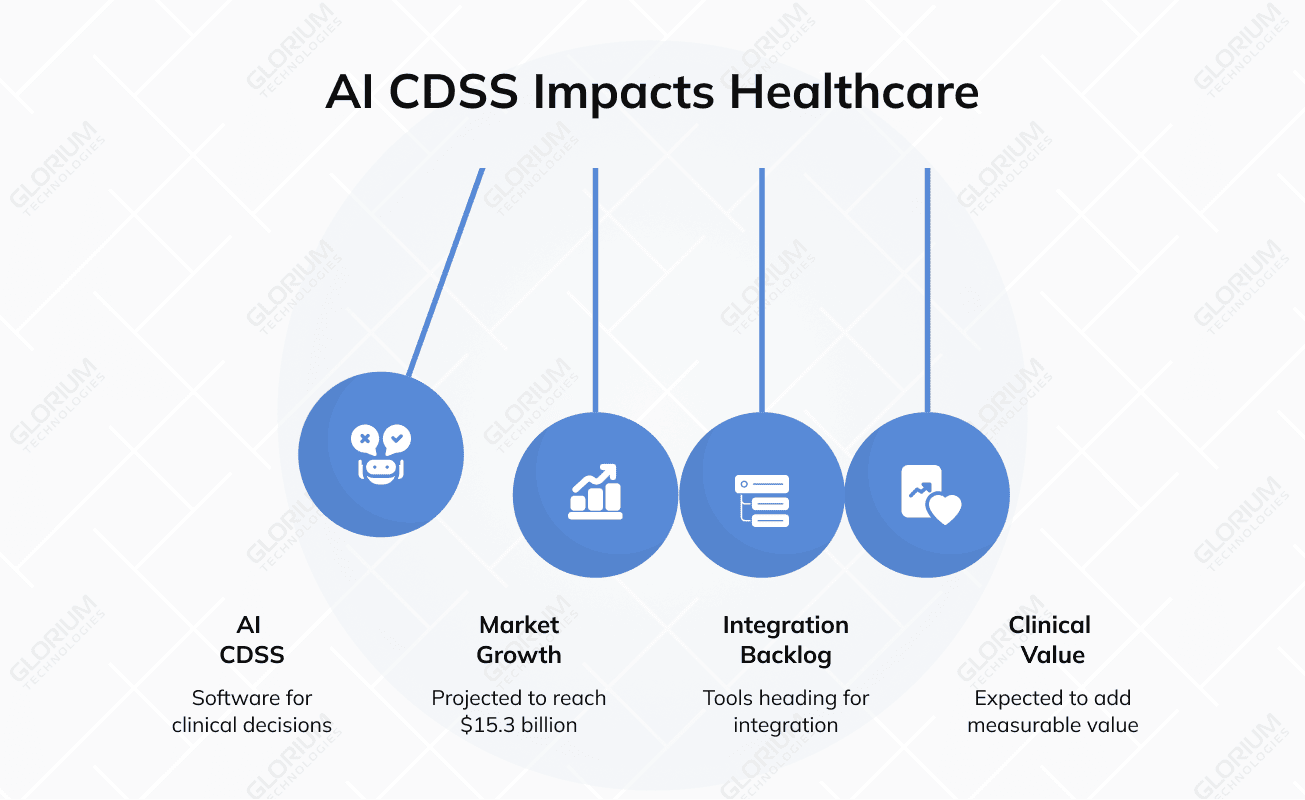
On paper, the outlook is strong: 83% of health system executives now expect generative and agentic AI to add measurable value to clinical functions in 2026. Basic CDSS with drug checks, order sets, and simple alerts has already been part of everyday healthcare delivery inside the modern healthcare system for decades. The AI layer built on top of it is still catching up: only about 30% of health systems run generative AI at scale, and just 2% have it live enterprise-wide.
The AI-enabled slice of the CDSS market alone is projected to grow from $2.8 billion in 2025 to $15.3 billion by 2033. So, the line of tools headed for your integration backlog is only getting longer. Let’s look at what CDSS can and cannot do, and how to make the most of what it promises.
Content
Before your team evaluates a vendor, you should agree on what technology is. The term covers a wide range of tools, from a single pop-up alert to a full decision support system built directly into the electronic health records platform.
The American Medical Informatics Association describes the broader field of clinical decision support as a process for enhancing health-related decisions and actions. In other words, clinical decision support software assists healthcare providers in clinical decision-making by pairing evidence-based medicine with patient-specific data.
In practice, the system pulls information from the electronic medical record, compares it against clinical practice guidelines, and returns a recommendation, a warning, or a reminder without pulling the clinician away from the chart. Early computerized decision support systems from the 1970s and 1980s focused almost entirely on drug checks; today’s platforms do far more.
The people who manage these platforms day-to-day rarely sit in a single department. Understanding who administers clinical decision support systems may help you plan staffing, governance, and training before rollout.
In most hospitals, clinical informatics teams own rule-building and content updates, while IT handles integration, uptime, and security. Pharmacists typically govern medication-related rules, and quality or patient safety officers review outcomes over time. On the receiving end, the tools are built for health care professionals across specialties: physicians ordering tests, nurses handling medications, and specialists reviewing comprehensive assessments of complex cases. They suit health systems with strong data governance and clinicians willing to flag alerts that misfire, since a system without that feedback loop tends to lose trust fast.
Once you get past the marketing language, most platforms share the same basic mechanics that have reshaped clinical practice over the past two decades more than most vendors admit. A short look at the pipeline shows why integration work takes months and why the effort pays off later.
At a basic level, a decision support tool pulls clinical data from the record, checks it against a rule base or a trained model, and returns something actionable inside the clinician workflow. It might be a single alert or a full clinical decision pathway. Please note that not all support systems look alike. The core components generally include:
Some platforms remain stand-alone applications that clinicians open separately, but most hospitals now prefer tools embedded directly into computerized provider order entry. The broader field of decision support has moved well beyond medication alerts.
CDSS tools show up in more corners of a hospital than most teams expect on day one. Here is a look at six use cases your organization is likely already running, actively evaluating, or about to be asked to fund.
Diagnosis is where CDSS earns much of its reputation. Somewhere between 5% and 20% of physician-patient encounters involve some form of diagnostic errors. And most people will experience at least one such error over the lifetime of care.
Diagnostic tools compare a patient’s symptoms, labs, and history against a reference database to suggest a ranked list of possible conditions. They can also flag missing laboratory testing or surface a diagnosis a clinician might not have considered under pressure. These tools do not replace judgment. They aid physicians by widening the differential, catching a pattern a busy shift might miss, and moving the team a step closer to an accurate diagnosis.
Once a diagnosis is in place, the next question is what to do about it. That decision now draws on more data than any one clinician can hold in memory during a twelve-hour shift.
Treatment-focused CDSS tools match a patient’s profile against evidence-based guidelines and recent clinical trials data to suggest a care pathway, a dosage range, or an alternative when a first-line option is contraindicated. AI models increasingly add pattern recognition on top of the rule base, drawing on outcomes from similar patients to refine treatment decisions in real time instead of leaning only on static protocols. At their best, these tools are about enhancing medical decisions, not replacing the person making them.
Medication-related harm remains one of the most preventable categories of patient injury, and it is where CDSS has the longest track record of any use case on this list.
Long before generative AI entered the picture, computerized clinical decision support for drug interactions was already standard in most large hospitals. Modern medication safety modules screen every order for drug interactions, allergy conflicts, and dosing errors before they reach medication administration on the floor. The World Health Organization estimates the global cost of medication errors at roughly $42 billion a year.
Predictive modules use machine learning trained on health data from thousands of past cases to flag patients at rising risk of sepsis, readmission, or deterioration hours before a human would likely notice the pattern. Because these models draw on patient-specific assessments instead of population averages, they can flag risk for an individual patient that a standard checklist would miss. This helps care teams leverage data they already collect. That earlier window gives clinicians more room to intervene before a condition escalates.
Long-term conditions may be where CDSS has the largest population-level payoff, given how much of a hospital’s total workload comes from chronic diseases.
Noncommunicable diseases account for more than 43+ million deaths worldwide. CDSS platforms built for disease management track a patient’s labs, medication adherence, and vitals over time, prompting a care team when an A1C drifts out of range, or a blood pressure reading needs follow-up. Registry-style dashboards also help a practice manage an entire panel of diabetic or cardiac patients, drawing on shared clinical knowledge across the population instead of reacting one visit at a time.
Not every CDSS feature sits inside a diagnosis or a medication check. A large share of the daily value comes from lighter tasks embedded directly in the clinical workflow.
Workflow-focused tools generate order sets, auto-populate clinical documentation, route consult requests, and remind staff about overdue preventive screenings. By June 2025, roughly 63% of hospitals on the Epic EHR had already picked up ambient AI documentation tools, and that number’s only climbing. Basically, the AI listens and drafts the notes, so clinicians can devote time to patient care instead of typing. Tools in this category are built to support clinicians during the busiest parts of a shift, giving health professionals a few extra minutes back.
The case for investing in CDSS usually comes down to a handful of measurable outcomes that finance and clinical leadership both track closely. Here is how the main benefits break down in practice.
| Benefit | What It Looks Like in Practice |
| More accurate diagnosis | Ranked differentials and flagged gaps reduce missed or delayed findings |
| Better patient outcomes | Fewer complications and readmissions tied to earlier intervention |
| Faster clinical decisions | Recommendations appear inside the order screen instead of a separate lookup |
| Reduced medical errors | Real-time checks catch dosing and interaction mistakes before they reach the patient |
| Evidence-based care delivery | Recommendations stay aligned with current best-practice protocols instead of outdated habits |
| Improved clinician efficiency | Less time spent searching references, more time with patients |
A systematic review of chronic disease CDSS platforms found consistent gains in clinical outcomes across cardiovascular and diabetes care. That evidence points to improving clinical practice in both areas. A wider body of randomized controlled trial evidence backs up smaller, targeted interventions such as sepsis alerts. A growing set of systematic literature reviews on AI-enabled CDS shows consistent time savings for clinicians. None of this happens automatically. Improving outcomes depends on how well a tool fits into daily practice rather than how sophisticated its model is.
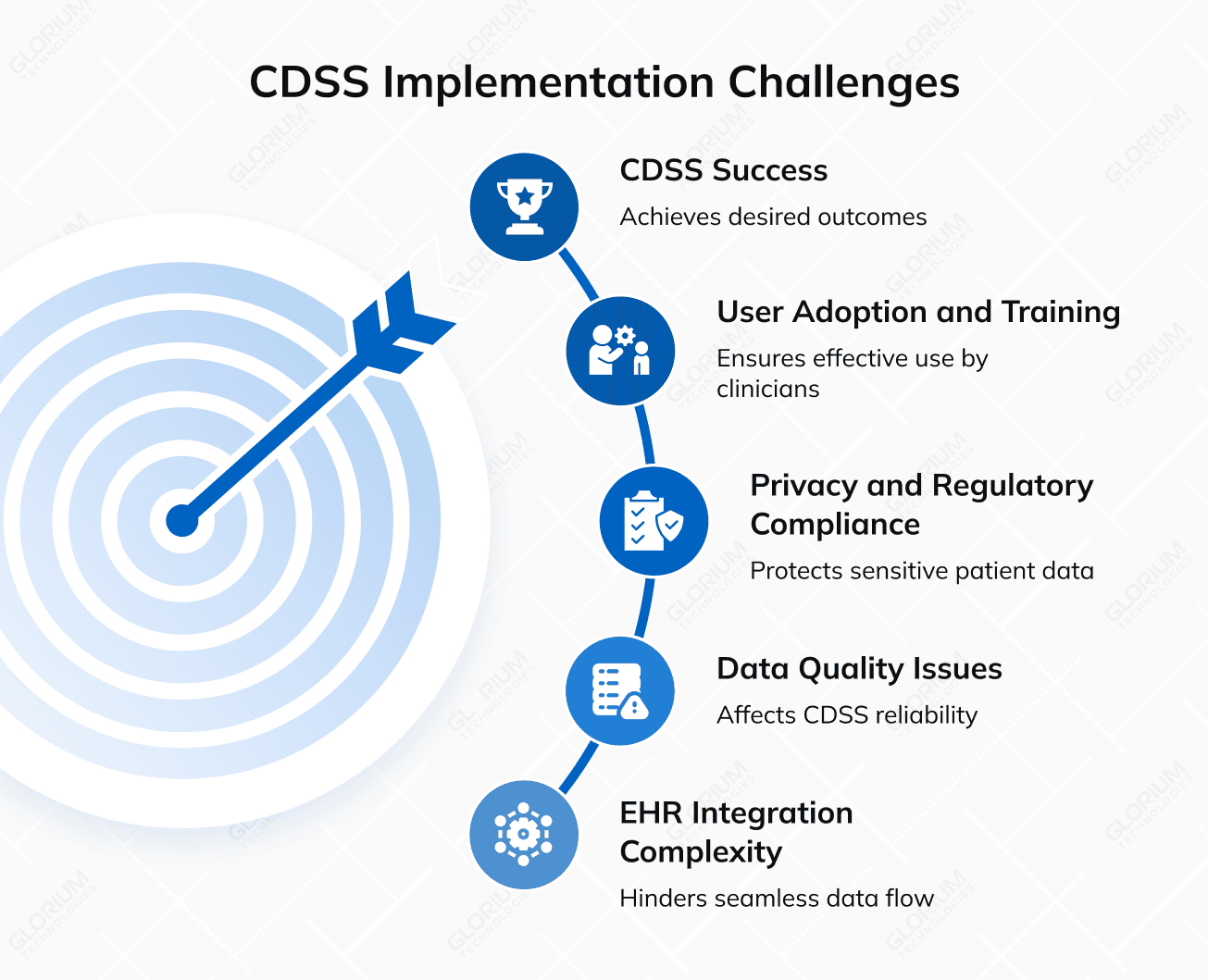
None of the benefits above show up for free, and most of the real work still lands on your desk first. A CDSS rollout tends to surface the same handful of sticking points, whether the hospital is large, small, urban, or rural. These are the five challenges hospital leaders raise most often when a rollout does not go as planned.
Every CDSS is only as useful as its connection to the record it depends on, and that connection is rarely simple to build or maintain. 57% of physicians identify interoperability as their top obstacle to getting more value from health information technology. Vendor lock-in, inconsistent FHIR adoption, and legacy interface engines all add months to a timeline.
Alert fatigue is the challenge every CDSS vendor promises to solve, and few fully do, which makes it worth planning for from the start rather than discovering it after go-live. A Veterans Affairs primary care study found clinicians receiving more than 100 alerts a day. When override rates climb that high, even a genuinely useful warning gets lost in the noise.
A CDSS recommendation is only as reliable as the patient data feeding it, and hospital data is rarely as clean as a vendor demo suggests. Duplicate records, missing fields, and inconsistent coding across departments all degrade model performance quietly, often without an obvious error message anywhere in the chart. Health care providers across a large health care system rely on that data every time they place an order, so it is worth auditing the pipeline before blaming an algorithm.
CDSS platforms touch some of the most sensitive information a hospital holds, which keeps compliance near the top of every hospital’s technology roadmap this year and next. Beyond HIPAA, the FDA updated its Clinical Decision Support Software guidance in January 2026, clarifying how certain AI-driven CDS functions get classified and reviewed. That update raises the bar on documentation, explainability, and the ethical and legal issues tied to how a model reaches its recommendation, especially for tools that influence a diagnosis or a prescription directly.
The best-configured CDSS still fails if the people expected to use it were never part of building it in the first place. Clinicians who were not consulted during rule design tend to override recommendations more often, regardless of how sound the underlying medical knowledge behind them is. Training that treats CDSS as a one-time rollout instead of an ongoing feedback loop between your team and frontline staff tends to see adoption fade within a year of go-live.
The next few years of CDSS development are shaping up in a handful of distinct directions. Most of them trace back to how fast generative AI has moved from pilot programs into daily clinical use across large health systems. A few other shifts are just as worth watching, from real-time alerts to models that can finally explain their own reasoning.
Large language models are moving past chat interfaces and into the record itself, changing what a recommendation looks like on screen. Wolters Kluwer, Elsevier, and Epic have all added generative AI layers to existing CDS products over the past two years, and 82% of early agentic AI adopters in health care are now prioritizing tools that coordinate multiple tasks at once instead of a single alert.
Ambient tools that listen to a visit and draft the note are quickly becoming a default expectation rather than a nice-to-have feature for recruiting new physicians. A large multi-site study of nearly 1,800 clinicians found ambient scribes saved about 16 minutes of documentation time per eight hours of patient care. It is a modest but consistent gain that is pushing adoption beyond outpatient pilots and toward broader use at the point of care.
CDSS is shifting some of its attention upstream, toward preventing an event before it happens instead of reacting only once one is already underway.
Deloitte’s actuarial modeling found that only 38% of health care spending in the US currently goes toward prevention and early detection. This leaves a wide gap for predictive CDSS tools built around disease control and early-warning scoring to close over the next several years.
Population-level guidelines are giving way to recommendations built around one chart at a time instead of one protocol applied to everyone with the same diagnosis. Newer platforms weigh genetics, prior response to treatment, and social factors to shape a recommendation around patient-specific data, drawing on decades of aggregated clinical knowledge. Some organizations are extending recommendations directly into the patient portal, moving the field closer to genuine shared decision-making between clinician and patient.
The lag between lab results and clinical responses keeps shrinking, and hospital leadership expects that trend to continue through the next budget cycle. Real-time CDSS pulls fresh electronic health records data the moment a value posts instead of waiting for a scheduled review, cutting the time between a warning sign and a clinician’s response from hours to minutes in some sepsis and deterioration protocols already in production.
As more recommendations come from a trained model instead of a fixed rule, clinicians are asking a fair question about why they should trust what appears on screen. And regulators are asking the same thing. The FDA’s updated CDS guidance puts explainability and clinician review directly into product classification decisions.
CDSS is not a single product your team buys once and maintains forever. It is a category that keeps expanding, from a basic drug interaction check to a generative AI layer that drafts a note and flags a risk score in the same visit. The organizations getting the most out of it treat the rollout as a genuine collaboration between IT, clinical informatics, and the frontline staff who will live with every alert.
Willing to improve healthcare delivery without adding headcount? Glorium Technologies is your go-to for building a top-notch clinical decision support system. We have 15+ years of experience in the healthcare sector and know the ropes of EHR integrations and building decision-support tools from scratch.
Book a free consultation to talk through what a rollout would look like at your hospital.
A typical build spans discovery and workflow mapping, rule engine or model development, EHR and API integration, and compliance work tied to HIPAA and FDA software guidance. You also get user interface design so alerts land inside the existing chart instead of a separate screen, plus testing with real clinical scenarios before go-live. Ongoing support and updates to the knowledge base usually continue well after launch.
Cost usually breaks down into discovery and scoping, engineering time for the rule engine or model, and integration work with your EHR, which is often the biggest line item. Compliance testing, security reviews, and staff training add more. Ongoing maintenance and knowledge base updates typically get quoted separately, since needs change once the tool is live.
Timelines vary widely depending on your scope, but a focused tool such as a single medication safety module can reach a working pilot in a few months. A broader platform with predictive models and full EHR integration usually takes longer for your team, often a year or more once testing and rollout are included.
In most cases, yes, and that is the more common path for hospitals. Instead of swapping out your EHR, a CDSS usually connects through APIs or FHIR interfaces, reading patient data and pushing recommendations into the chart you already use. This keeps disruption low for clinicians, since nobody learns a new system, and it often costs less than a full replacement. Full replacements tend to happen only when a hospital is modernizing everything at once.