







Agentic AI Enterprise Guide: Real Use Cases for 2026
Updated July 9, 2026

 Summarize in ChatGPT
 Summarize in ChatGPT
Ask a generative model to draft an email or summarize a report, and it delivers — then waits for the next prompt. That rhythm has carried businesses a long way, but it leaves a person coordinating every step in between. Agentic AI works differently: hand it a goal, and it plans the work, picks the right tools, and brings back a finished result.
Gartner expects 33% of enterprise software applications to include agentic AI by 2028, up from less than 1% in 2024. At least 15% of day-to-day work decisions will be made autonomously by then. With numbers like those, most leadership teams have stopped debating whether to adopt agents and started picking which workflows go first.
“Sophisticated enterprises today have deployed over a thousand agents in production for various tasks.”
Praveen Akkiraju, Insight Partners
Content
Agentic AI refers to software agents that take a goal and execute multi-step tasks with limited human intervention. Where a passive tool returns a single answer, an agent identifies what needs to happen and adjusts the sequence as conditions change. Earlier AI tools waited for a prompt and answered one question at a time, so a person had to break complex tasks into pieces and stitch the results back together. That difference is why enterprises treat agents as a new operating layer across their business processes, rather than a smarter version of the chatbots they already have.
McKinsey frames the same point in its 2025 survey. 88% of organizations now use AI in at least one business function, and 62% are experimenting with AI agents, though only 23% have scaled agentic systems. Autonomous agents that act independently toward a desired outcome are still early in production, which makes the organizations moving now worth watching closely.
Before getting into use cases, a clear comparison helps. The table below shows how agentic AI extends what generative AI and gen AI tools already do. The design choices behind these AI systems matter for any enterprise AI program.
| Capability | Traditional/generative AI | Agentic AI |
| How it starts | Waits for a prompt or request | Acts on a goal once triggered |
| Scope of action | Single output or answer | Multi-step tasks across systems |
| Tool use | Limited or none | Calls external tools and APIs |
| Memory | Mostly within one session | Retains context across steps |
| Human role | Reviews each output | Oversees outcomes and exceptions |
| Best fit | Drafting, summarizing, search | Repetitive, bounded decisions at volume |
Agentic AI systems use three core building blocks that older software lacks. A planning loop breaks a goal into steps. Tool access gives the agent a way to reach external systems and act in them as work moves along. Memory carries context forward across those steps. A continuous learning layer sharpens all three over time, so an agent can run multi-step processes that used to need a person coordinating every handoff.
The three building blocks from the last section (planning, tool access, and memory) describe what an agent does. Running one in production takes a few more layers working together. The architecture below is what turns a demo that works once into a system an enterprise can depend on across thousands of tasks a day.
| Layer | What it does | Why it matters in production |
| Reasoning model | Interprets the goal and decides each next step | Model choice sets the ceiling on how complex a task the agent can handle |
| Planning loop | Breaks the goal into an ordered sequence and replans as conditions change | Weak planning is where agents stall, repeat themselves, or drift off task |
| Tool and API layer | Connects the agent to the systems where the work actually happens | Decides whether the agent can act on a workflow or only advise on it |
| Memory | Carries context across steps and across past runs | Without it, an agent forgets what it has already tried and starts over |
| Orchestration layer | Coordinates steps, retries, and handoffs between agents | Turns a single agent into a system that holds up as volume grows |
| Guardrails and oversight | Enforce access limits, approval gates, and audit logging | Builds governance directly into how the agent runs, from access to audit trail |
Read top to bottom, the stack moves from thinking to acting to staying in bounds. The first three layers make an agent capable; the last three make it safe to hand real work. Teams that skip the bottom half often get a pilot that impresses in a controlled test, then breaks the first time it meets messy data or an edge case no one scripted.
Most deployments start with one agent owning one workflow, and for a bounded process, that is usually enough. A single agent handling appointment scheduling or invoice routing keeps the architecture simple and the failure modes easy to trace. The case for adding agents comes when a workflow spans several specialized steps that one agent handles poorly. Research, drafting, and compliance review, for example, each call for a different context and tools.
In a multi-agent design, specialized agents divide the work, and a coordinating layer routes tasks between them. That coordination can run in sequence, in parallel, or through a supervisor agent that assigns and checks the others. Protocols such as the Model Context Protocol give those agents a shared way to reach tools and data, which is what makes the handoffs practical rather than brittle. The tradeoff is real: every agent added is another component someone has to secure and govern. The reliable path is to prove a single agent first, then split the workflow only where one agent clearly limits the result.
Value shows up fastest where decisions are high in volume and reversible when wrong. The functions below match that profile, which is why agent adoption tends to start there before spreading to more complex workflows.
Healthcare carries high call volumes and sensitive workflows under tight compliance requirements, which makes it a strong territory for bounded agent deployments. Agents take on appointment scheduling and patient intake work that used to consume staff hours. Insurance verification and reminder flows often run in the same loop, so clinical teams spend more time on patient care.
Scheduling is where the pressure shows up first. A US durable medical equipment provider came to Glorium Technologies with exactly that problem: too many support calls, too many no-shows, and a call center that could not keep up with patient demand. We built them a custom AI agent for patient scheduling that combines generative and predictive AI, so patients can book or reschedule around the clock and receive reminders tuned to their history. Support calls dropped 55%, and the no-show impact fell 73%.
Agents watch infrastructure and run first-line remediation when anomalies appear, before a human gets paged. McKinsey estimates that agentic AI can automate 60 to 80% of routine infrastructure work over time, translating to a 20 to 40% run-rate cost reduction in early deployments. System troubleshooting that once filled a ticket queue starts to clear itself.
Deutsche Telekom’s RAN Guardian Agent, live in its German mobile network since November 2025, monitors performance in real time, classifies anomalies, and assists engineers with troubleshooting. Within set guardrails, it can also execute routine corrective actions on its own — work that used to take about an hour now finishes in minutes. That closed-loop pattern, where an agent watches, diagnoses, and acts alongside the engineering team, is the model now spreading from IT operations into customer operations.
Revenue teams use agents to qualify and nurture leads at a scale no rep could match. An agent scores inbound interest, drafts outreach to the strongest prospects, books meetings, and updates the CRM along the way. Sales forecasting sharpens as the same system reads pipeline signals continuously and ties them to clear targets. Reps get their time back for complex deals and relationship building.
Finance combines layered data, repeated tasks, and heavy document volume, which suits agents well. Working across internal tools, they process invoices, route approvals, manage expenses, and flag anomalies for review. Because money and compliance are involved, these workflows keep approval checkpoints and audit trails, so automation assists decisions without owning them.
HR agents screen candidates and automate onboarding steps that used to eat hours of coordination. Across the wider business, enterprise knowledge management benefits when agents pull up internal documents and summarize them on demand. The same agents keep knowledge bases current as new material lands.
Supply chain teams put agents on demand forecasting, inventory monitoring, and vendor coordination. An agent reads signals from warehouses and sales data to predict stock needs, flagging supply issues before they turn into delays. Because these decisions repeat constantly and depend on shifting patterns, they suit autonomous handling well, with people stepping in for the unusual disruptions.
Marketing teams put agents to work on campaign drafting and message testing. Audience segmentation runs in the same flow. An agent can analyze past performance data and generate variants. Targeting adjusts without a person rebuilding each step. This marketing automation shifts operations from manual production toward review and strategy.
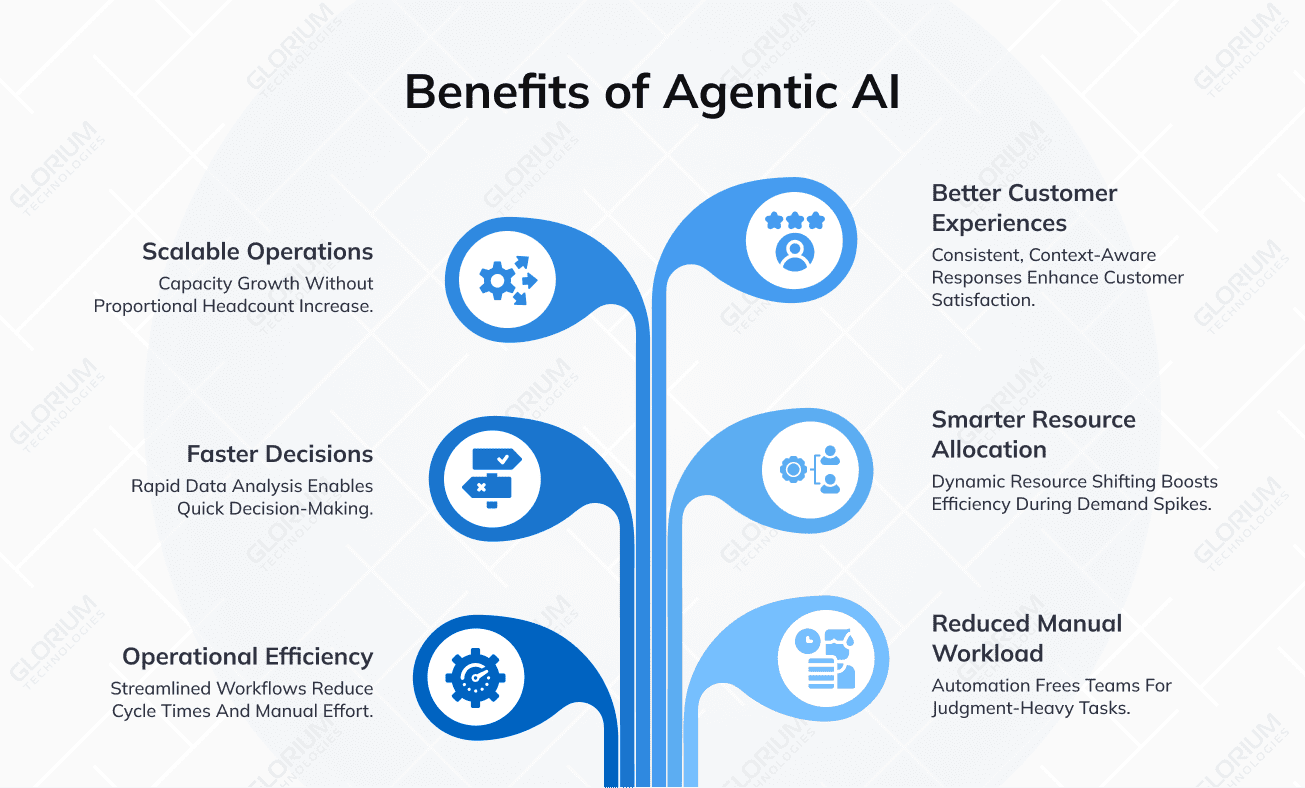
When an autonomous system owns a workflow end-to-end and helps teams solve problems faster, the gains add up across cost and capacity, with customer experience following close behind. The points below capture where most organizations see real impact.
McKinsey research backs the upside here, reporting that AI can lift customer satisfaction by as much as 45% in functions where it is applied well. Only 39% of organizations see enterprise-level EBIT impact. Most of that gap traces back to scaling challenges across the business rather than weaknesses in the technology.
Agents introduce new risks alongside their benefits, and ignoring them is how projects stall. Gartner expects more than 40% of AI projects to be canceled by the end of 2027. Rising costs and weak risk controls drive most failures, often because the business value of each project stays unclear. The challenges below explain most of those failures.
An agent acting on its own can make an unexpected call, and in production, that carries weight. The worry for many leaders is losing control of decisions that touch revenue or compliance. Strong governance handles that concern by keeping role-based access and approval gates in place. Every action stays traceable through audit logs, with a human stepping in on outcomes and edge cases.
Most enterprises run on systems that predate agents by years. Connecting an agent to legacy software often calls for open APIs and modular components that older stacks lack. Gartner notes that reworking a workflow from the ground up is frequently cheaper than forcing an agent onto infrastructure that resists it.
An agent is only as reliable as the data it reads. Inconsistent records produce unreliable actions, and broader autonomy introduces new risks around privacy and exposure. Clean data and enterprise-grade security guard against both. A phased rollout, backed by clear access controls, keeps the risk contained as the agent expands.
The strongest deployments share a clear path: prove a narrow workflow first, then widen once trust and results are in hand. The steps below describe how most successful programs move.
Pick a single process where an agent can help without touching the whole system. Customer service, finance, or IT support are common entry points because the work repeats and mistakes are reversible. A focused start lets teams test with real data, measure clearly, and build confidence before the stakes rise.
McKinsey found that fundamental workflow redesign correlates most strongly with bottom-line impact from AI. Bolting an agent onto an unchanged process limits what it can do, since people still orchestrate every step. High performers rebuild the workflow around their business objectives so enterprise AI agents can own the full process end-to-end. That habit makes them nearly three times more likely to scale agents.
Policy frameworks, retrieval systems, audit trails, and access controls are the infrastructure that lets agents run safely. Putting these in place during the pilot prevents the stalls that ruin so many projects.
Picking where to begin is often harder than understanding the technology. Most teams face the same fork: adopt an existing platform, build in-house, or partner with a team that deploys and runs the agents for them. The platforms below cover the ground most enterprises evaluate first.
| Platform | Best fit | Stack dependency |
| Salesforce Agentforce | Sales and service workflows already living in the CRM | Salesforce ecosystem |
| Microsoft Copilot Studio | Organizations standardized on Microsoft 365 and Teams | Microsoft stack |
| Google Vertex AI Agents | Data-heavy workflows tied to BigQuery and Google Cloud | Google Cloud |
| Amazon Bedrock Agents | Teams building on AWS-native infrastructure | AWS stack |
| ServiceNow AI Agents | IT service management and operations | ServiceNow |
| CogniAgent | Cross-channel agents that span whatever systems are already in place | Stack-agnostic, 2,700+ integrations |
Most enterprise platforms are fastest inside the vendor’s own ecosystem and harder to extend outside it. Agentforce is the natural choice when revenue teams already run on Salesforce; Copilot Studio fits an organization deep in Microsoft 365.
CogniAgent, the agent platform from Glorium Technologies, takes the opposite approach and stays stack-agnostic. The platform runs conversational and autonomous agents across voice, chat, and web, and connects to CRMs, ERPs, and scheduling tools through native integrations.
The right path depends on two things: how proprietary the workflow is, and who will own the agents once they go live.
Whichever path fits, the starting move is the same one the previous section described: pick a single high-value workflow, map every system it touches, and set a clear measure of success before any agent goes live. That mapping is also what decides the build-or-buy question. When all the systems sit inside one vendor’s ecosystem, a platform agent is usually the faster route. When the workflow spans three or four tools, an agent built against each of them tends to perform better, and that is where a partner earns its place.
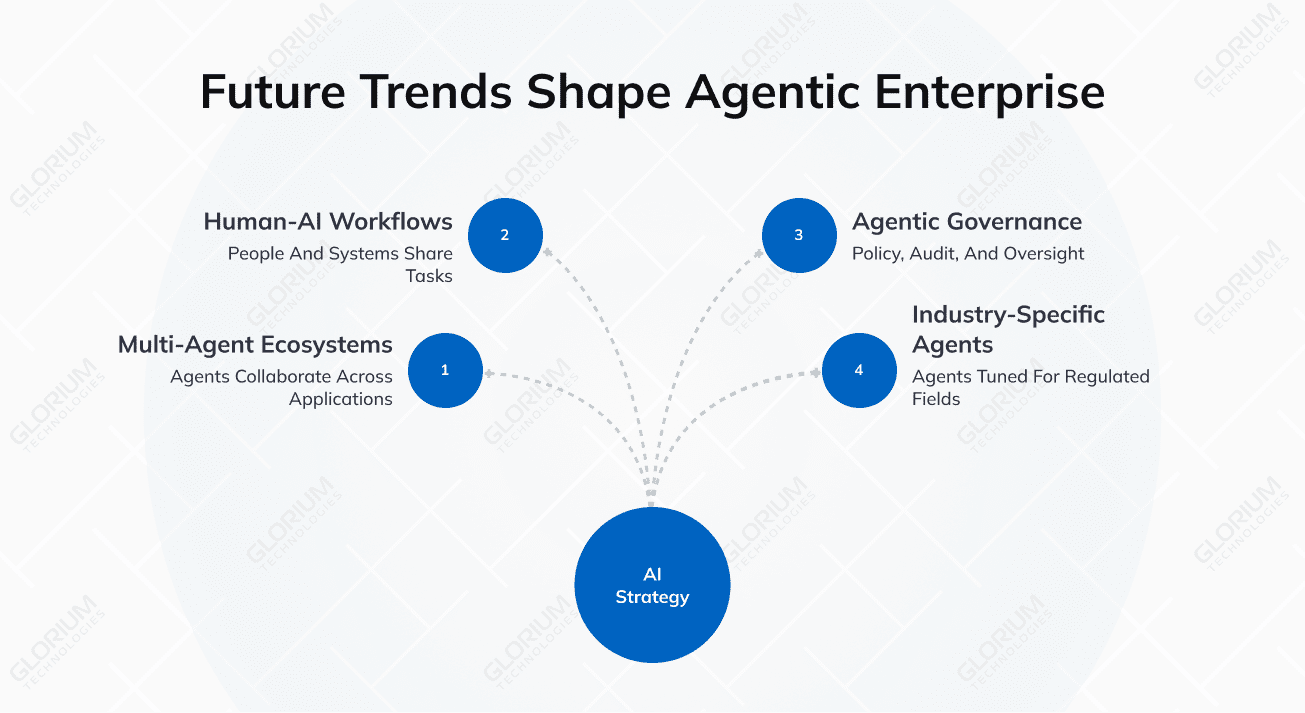
Single agents handling single tasks are the starting point. The next phase moves toward coordinated systems where multiple agents share work, and a sound AI strategy now accounts for the trends below.
Protocols such as the Model Context Protocol give agents a shared way to reach tools and data. That shared layer makes AI agent collaboration and multi-agent coordination practical.
Glorium Technologies has spent 15+ years building software for healthcare, fintech, real estate, and other industries where reliability is not optional. We integrate AI agents into enterprise workflows and connect them to your existing tools. Each deployment comes with the human expertise and governance that regulated businesses depend on.
Our work spans the full delivery path. Machine learning services prepare your data for production use, and AI software development takes care of agent design and build. For the strategy layer, AI consulting services keep direction aligned with your business goals. We hold ISO 27001 certification and work under HIPAA and GDPR frameworks, so security and compliance are built in from the first sprint.
Whether you want to validate one workflow or roll agents across departments, we start where the value is clearest and scale from there. Contact us to discuss your agentic AI roadmap, or book an intro call to map the first use case together.
Track time saved per task multiplied by how often the task runs, then add error-rate reductions and faster cycle times. Savings grow as the agent handles more volume across the workflow. Tie every metric to a specific workflow instead of AI spend overall, since use-case results are where value first appears.
Practical priorities include defining clear goals and guardrails for agentic AI tools, reviewing agent outputs for edge cases, and understanding where human approval must stay. The shift asks the human workforce to supervise autonomous work well, which matters more than learning to code. Treating oversight as part of everyone’s role separates teams that scale from teams that stall.
Yes, and the two solve different problems. RPA follows fixed rules for stable, repetitive steps, while agents handle tasks where context changes and judgment is needed. Many enterprises pair them, letting RPA run the predictable parts and agents manage the exceptions and decisions in between.
Most organizations need a year or more to resolve governance, training, and data challenges before agents run at scale. Deloitte found that only about one in five companies has a mature governance model for autonomous agents, which is the gap that stretches the timeline. A development process that starts with one workflow and expands once value is proven is the most reliable path through it.
McKinsey identifies technology, media, telecom, and healthcare as the leaders in scaling agents. These sectors combine high data volumes with workflows where automation pays off, which is why agentic adoption runs ahead of slower-moving industries there.