







Computer Vision in 2026: Technologies, Applications, Benefits, Challenges, and Future Trends
Updated September 7, 2026

 Summarize in ChatGPT
 Summarize in ChatGPT
Walk into a modern Amazon warehouse, and you’ll see robots gliding past each other in choreographed loops, each one steered by a camera and a decision made in milliseconds. Step into a hospital radiology department and you’ll find a screen flagging suspicious shadows on a chest scan before the radiologist has even sat down.
This is computer vision in 2026: not a research curiosity, but the quiet engine running underneath warehouses, clinics, factories, and storefronts.
Computer vision is the branch of artificial intelligence that gives machines the ability to interpret visual data and turn what they “see” into structured information that a business can act on. Where humans rely on biological eyes and decades of pattern recognition, computer vision uses cameras, sensors, and machine learning models to do something similar at a far greater scale.
This guide explains how computer vision algorithms actually work, where they’re already delivering measurable returns, what’s still hard about deploying them, and what’s coming next. By the end, you’ll have a grounded view of where computer vision can fit into your operations and what a serious implementation looks like in practice.
Content
Computer vision adoption has crossed the threshold from experimental to operational. According to Fortune Business Insights, the global computer vision market is valued at USD 20.7 billion in 2025 and is projected to reach USD 72.80 billion by 2034. The technology has moved from research labs and a handful of well-funded pilots into manufacturing lines, hospital workflows, retail backrooms, and farm equipment.
A few forces have accelerated this shift:
“As AI becomes multimodal, computer vision becomes the foundation that helps machines understand the world through images, videos, and real-time data.”
Boktiar Ahmed Bappy, Introduction to Computer Vision | Computer Vision for Developers
The combined effect is that 2026 represents a maturity milestone. Computer vision is moving from pilot projects into core infrastructure, running on production lines, embedded in clinical decision-support tools, and integrated with ERP, MES, and security systems.
Modern computer vision systems combine several distinct techniques, each suited to a different visual reasoning task. Understanding the core building blocks helps clarify where each fits in a real deployment.
At the simplest level, a digital image is just a grid of pixel values, numbers representing color and brightness. Computer vision works by converting that raw image data into progressively higher-level abstractions: edges, shapes, objects, scenes, and finally, decisions. The general pipeline starts with image acquisition, then proceeds through preprocessing steps such as adjusting brightness and applying noise reduction, and finally performs feature extraction and object recognition using machine learning techniques. The output is structured information, a label, a bounding box, and a confidence score that downstream computer systems can act on.
Most computer vision systems combine more than one of the following techniques:
| Technology | What it does | Representative use case |
| Image classification | Assigns a label to a whole image | Defect vs. non-defect on a production line |
| Object detection | Locates and labels objects within an image | Detecting pedestrians for autonomous vehicles |
| Image segmentation | Identifies object boundaries pixel by pixel | Tumor outlining in medical imaging |
| Optical character recognition | Reads text from images | Digitizing scanned documents and invoices |
| 3D vision | Measures depth and spatial relationships | Robotic picking in fulfillment centers |
| Object tracking | Follows objects across video frames | Traffic flow analysis at intersections |
The reason computer vision has improved so dramatically over the last decade comes down to advances in deep learning, particularly convolutional neural networks, and more recently, transformer-based vision models.
Convolutional neural networks (CNNs) were the workhorses of modern computer vision for most of the 2010s. The intuition is straightforward: instead of looking at every pixel in isolation, a convolutional neural network scans an image with small filters that detect simple features, edges, corners, textures, and then combines those into more complex patterns layer by layer. By the final layers, the network can recognize a face, a tumor, or a faulty solder joint.
Transfer learning is the practical reason CNNs work for businesses that don’t have millions of labeled images. A model pretrained on a massive general dataset already knows how to recognize edges, shapes, and common visual features. A development team can fine-tune that base model on a few thousand domain-specific images, defects on a particular product line, or scans from a specific MRI machine, and reach production-grade accuracy without the cost of training from scratch.
Since around 2020, transformer-based vision models, Vision Transformers, or ViTs, and their successors have started to overtake CNNs on many benchmarks. Transformers, originally developed for natural language processing, treat an image as a sequence of patches and use attention mechanisms to figure out which parts of the image relate to which others. This architecture is more flexible, scales better with data, and is the foundation behind today’s vision-language models that can describe images in natural language and answer questions about them.
A point that’s often underestimated: data quality and labeling matter more than model architecture. A modest model trained on clean, well-labeled images will routinely outperform a state-of-the-art model trained on noisy, inconsistently labeled data. For business applications, the data pipeline is usually where most of the engineering effort goes, even though it gets less attention than the model itself.
Wondering what this looks like in real life? Our recent project for a U.S. digital pathology startup is a good example. The team had a working prototype that predicted breast cancer recurrence risk from H&E slides, but it struggled outside its original lab because different hospitals use different scanners and staining protocols. Most of the engineering effort ended up going not into the model itself but into the preprocessing pipeline that normalized those differences across scanners. That data layer is what lets the platform deploy reliably across more than 20 pathology labs.
Computer vision has moved beyond a few headline industries and now touches almost every sector that handles visual information. Below are the areas where deployment is most mature and where the business case is most concrete.
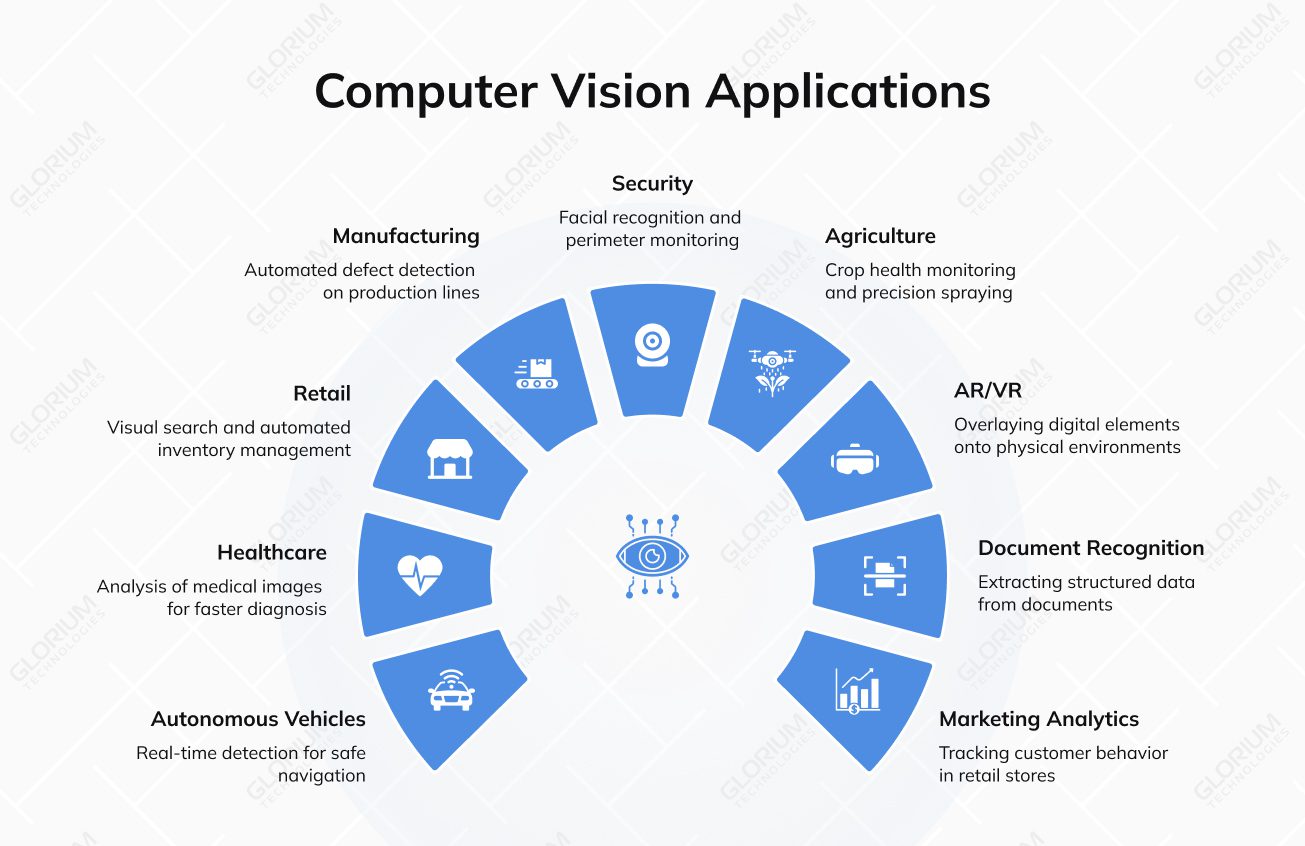
The common thread across these applications is that computer vision turns previously unstructured visual information, photos, videos, and scans into structured, queryable data that downstream systems can act on. That’s where the operational value comes from.
The business case for computer vision varies by industry, but a handful of benefits show up consistently across deployments.
Computer vision is mature enough to deploy, but it’s not plug-and-play. The challenges below are real, but each is manageable with the right approach and the right implementation partner.
The point is that successful deployments treat them as design constraints from day one rather than discovering them at go-live.
The landscape of computer vision tools has matured into three broad categories: cloud-based vision APIs, open-source frameworks, and custom-built solutions tailored to specific business needs.
| Platform / Framework | Type | Best fit | Customization | Deployment |
| Google Vision AI | Cloud API | General-purpose image classification, OCR, and content moderation | Limited | Cloud |
| AWS Rekognition | Cloud API | Facial recognition, content moderation, video analysis | Limited | Cloud |
| Azure Computer Vision | Cloud API | OCR, image tagging, spatial analysis | Limited | Cloud or edge |
| OpenCV | Open-source library | Foundational image processing and classical vision tasks | Full | Anywhere |
| PyTorch / TensorFlow | Open-source framework | Building custom deep learning models | Full | Cloud, on-prem, or edge |
| Custom-built solutions | Bespoke | Domain-specific accuracy and integration requirements | Full | Tailored |
Off-the-shelf cloud APIs work well when the use case is generic, reading printed text from a document, detecting common objects in a photo, or moderating user-uploaded content. They’re fast to integrate, predictable in cost, and require no machine learning expertise.
Custom-built solutions become necessary when the use case is specific to the business: detecting a particular type of weld defect, reading handwritten medical notes, identifying a proprietary product on a shelf, or running inference on edge hardware with strict latency and connectivity constraints. In these scenarios, generic models simply don’t reach the accuracy threshold the business needs, and the integration with existing operational systems becomes the central technical challenge.
A pragmatic pattern many organizations follow: start with a cloud API to validate the use case, then move to a custom-built solution once the requirements are clear and the volume justifies the investment.
Once you move past cloud APIs, a custom computer vision build uses a few distinct layers. Each one handles a different part of the job, from picking a starting model to running it on the right hardware. The table below shows the layers, the tools teams use most for each, and what each layer does.
| Layer | Leading tools | What it’s for |
| Pretrained models/hubs | Ultralytics (YOLO11), Hugging Face, Detectron2, MMDetection, Segment Anything (SAM) | Start from a strong checkpoint instead of training from scratch |
| Annotation & data | Roboflow, CVAT, Label Studio | Labeling, dataset versioning, and augmentation |
| Training frameworks | PyTorch, TensorFlow / Keras | Fine-tuning and custom architectures |
| Deployment & optimization | ONNX, TensorRT, OpenVINO, edge runtimes | Quantization and acceleration for latency and cost targets, especially on the edge |
| Cloud vision APIs | Google Vision AI, AWS Rekognition, Azure AI Vision, Vertex AI | Fastest path for generic use cases and proof-of-concept |
The field continues to move quickly, and several recent industry surveys give a clear picture of where investment is heading. The trends below are the ones most likely to shape computer vision deployments over the next two to three years.
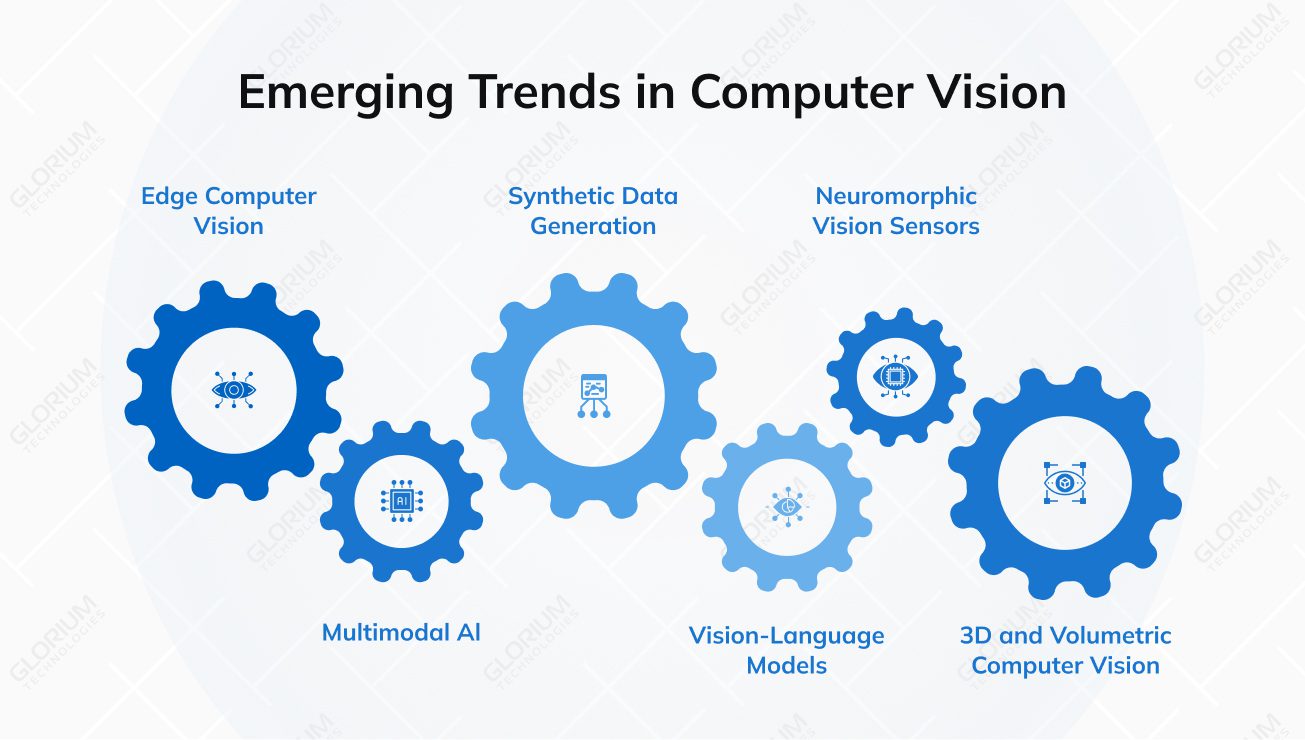
Processing visual data directly on cameras, drones, robots, and embedded devices rather than streaming everything back to the cloud. Adoption is accelerating sharply. According to Deloitte’s enterprise AI infrastructure survey of 515 U.S. enterprise leaders, 36% of organizations have already scaled AI at the edge today, and 72% expect to reach that milestone by 2028, roughly doubling current adoption levels in three years. Deloitte’s broader State of AI in the Enterprise 2026 report, which surveyed 3,235 senior leaders across 24 countries, found that 58% of companies are already using physical AI (which includes edge vision systems, robotics, and autonomous machines) to some extent, with adoption projected to hit 80% within two years.
Models that combine visual data with text, audio, and sensor inputs for richer contextual understanding. Gartner forecasts that 80% of enterprise applications will be multimodal by 2030, and Deloitte’s 2026 AI infrastructure research explicitly notes that “many enterprises want AI that is multimodal (text, voice, image, etc.) and multi-model”, making multimodality a default expectation for new enterprise deployments rather than a specialized capability. For computer vision specifically, the shift means visual data is increasingly fused with sensor telemetry, operator notes, and audio inputs to produce far more accurate root-cause analysis than vision alone.
Using AI-generated images to train vision models when real-world labeled data is scarce, sensitive, or expensive to collect. Gartner projects that by 2030, synthetic data will account for more than 95% of data used to train AI models on images and videos, and that synthetic data usage for filling edge-case scenarios in training will grow from roughly 5% today to over 90% by 2030.
Systems that describe, reason about, and answer questions based on visual inputs in natural language. Deloitte’s expanded partnership with NVIDIA, announced in March 2026, deploys vision-language models such as NVIDIA’s Cosmos Reason VLM directly into industrial environments as part of its physical AI initiative. It’s an early signal that VLMs are moving from research demos into production manufacturing, life sciences, and video analytics workflows.
Event-driven sensors that mimic the human eye’s processing, they register only changes in a scene rather than capturing full frames at fixed intervals. Deloitte’s 17th Annual Tech Trends Report (December 2025) names brain-inspired neuromorphic chips among the eight emerging technology signals that enterprise leaders should monitor, citing dramatically lower power consumption and microsecond-level response times as the differentiators driving early adoption in robotics and high-speed manufacturing.
Moving beyond 2D images into volumetric data, which is reshaping medical imaging, industrial inspection, and AR/VR. The Deloitte–NVIDIA collaboration highlights this shift in practice, combining computer vision with high-fidelity digital twins and synthetic data to bring 3D vision into production environments at an industrial scale across automotive, life sciences, and energy sectors.
The direction of travel is clear: computer vision is becoming faster, more contextual, more efficient, and more deeply integrated with other AI modalities.
Computer vision in 2026 is a deployable capability, with proven returns across manufacturing, healthcare, retail, agriculture, logistics, and security. The question for most organizations is where the first deployment should land, and what a credible roadmap looks like from there.
That’s also where most projects either succeed or stall. The technology is mature, but the implementation is still genuinely difficult: scoping the right use case, building the data pipeline, selecting the right model architecture, integrating with operational systems, and maintaining accuracy as conditions change. These are not problems an off-the-shelf platform solves on its own.
Glorium Technologies builds custom computer vision solutions for clients across healthcare, manufacturing, retail, and enterprise sectors, combining deep learning expertise with the systems integration experience needed to make computer vision work in production environments. The team handles the full implementation lifecycle, from use case scoping and data strategy through model development, edge or cloud deployment, and post-launch monitoring.
Ready to evaluate how computer vision could fit into your operations? Contact us to assess your use case, review the data and infrastructure requirements, and build an implementation plan that fits your specific business needs.
It depends on the complexity of the task, but it’s often less than people assume. Thanks to transfer learning, a well-scoped defect detection or classification model can reach production accuracy with a few thousand labeled images per class. More complex tasks like medical image segmentation or autonomous driving require significantly larger datasets. A practical first step is a data audit: looking at what visual data already exists in the organization, how it’s labeled, and where the gaps are. That audit usually clarifies the scope of the data effort within a few weeks.
Not always. Many computer vision applications run perfectly well on standard cameras, off-the-shelf GPUs, and existing on-premise servers. Edge deployments do benefit from specialized AI accelerators, but the hardware market has matured, and the cost has dropped substantially. The right hardware setup is a function of latency requirements, image volume, and where the data needs to live for compliance reasons. A proper architecture review at the start of the project answers this question concretely.
Yes, and integration is usually the part of the project that takes the most thought. Modern computer vision systems are designed to expose their outputs (detections, classifications, alerts) through APIs, message queues, and standard protocols, so they can feed ERP systems, MES platforms, video management systems, or custom dashboards. The work is in mapping the model’s output to the data structures and workflows that the existing systems expect. This is where having an implementation partner with both vision and systems integration experience pays off.
Off-the-shelf platforms are the right choice when the use case is generic and when the volume and accuracy requirements fall within what the platform supports. A custom-built solution becomes the better path when the use case is specific to the business (a particular product, a proprietary process, a regulated environment), when accuracy needs to be higher than a general model can deliver, when the data is too sensitive to send to a third-party cloud, or when latency and edge deployment matter. A short discovery phase, often two to four weeks, is usually enough to determine which path makes sense and what the implementation effort looks like.