







AI Agents in Healthcare: What They Do and Where They Pay Off in 2026
Updated July 31, 2026

 Summarize in ChatGPT
 Summarize in ChatGPT
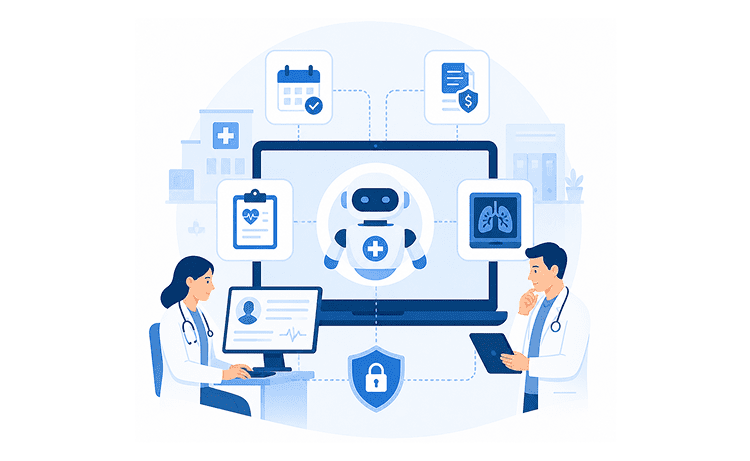
Doctors waste roughly two hours on EHR paperwork for every hour they spend with a patient, often pushing their workload deep into the night. That math is the reason AI agents in healthcare moved from pilots to production so fast. Unlike the good-old chatbots that could answer your questions or draft a simple text at most, AI agents act. They book appointments, chase down claims, draft clinical notes, and route imaging studies to the right specialist, often with a single prompt and minimal human input.
AI agent usage has already shown a 42% drop in documentation time, about 66 minutes per provider each day. McKinsey and the National Bureau of Economic Research estimate that broader AI adoption could reduce U.S. healthcare spending by 5% to 10%, or $200 billion to $360 billion a year.
Let’s explore what AI agent-based systems do, where they fit, what they may cost you, and how to approach adoption without consequences.

Content
In simple words, an agent is software that takes a goal, breaks it into steps, and carries those steps out across your system. Healthcare AI agents of the previous generation felt more like the next-level chatbots. They could flag a risk score or suggest a draft, then hand control back to you. Newer AI systems built on large language models can read a patient record, query an external database, and trigger a downstream action in one continuous flow. The model does the reasoning; the agent layer handles the doing.
An AI agent now perceives relevant data context, plans a sequence of actions, calls the tools it needs to execute the step, checks the result, and repeats. This loop is what lets AI agents operate across clinical workflows and back-office tasks alike, instead of staying boxed inside a single screen or report. An agent keeps going until the goal is met or a guardrail stops it. As McKinsey puts it, agentic systems function more like a coworker than a tool. They can run multi-step processes without requiring a human in the loop 24/7.
The field is broad, so it helps to sort agents by what they do and where they sit. Each category carries a different oversight requirement and a different payoff. The table below maps the main types, and the subsections that follow ground each one in a real setting.
| Agent type | Primary function | Example use | Human oversight |
| Clinical support | Surface evidence, draft notes | Sepsis early-warning, note drafting | High |
| Administrative | Automate paperwork | Claims, prior authorization, scheduling | Medium |
| Patient-facing | Handle conversation | Intake, triage, reminders | Medium |
| Research | Analyze molecular and trial data | Target screening, candidate ranking | High |
These agents in healthcare assist at the point of care. They read electronic health records, summarize a patient’s medical history, and offer clinical decision support. The agent makes proposals, but only medical professionals are responsible for deciding on the subsequent actions. That boundary holds across every credible deployment.
Ambient-documentation agents — Abridge, Microsoft Dragon Copilot (formerly Nuance DAX), and Suki — listen to the visit, draft the note, and push it straight into the chart. They don’t replace the clinician’s judgment; they erase the after-hours typing that drives burnout.
McKinsey reports that AI applied to the revenue cycle could deliver a 30% to 60% reduction in the cost to collect. These agents take on administrative tasks such as claims, coding, and patient registration, cutting the administrative burden that drains clinician hours.
Oracle Health’s Clinical AI Agent and Epic’s agentic features push automation into the systems your staff already works in. Orders, summaries, and administrative paperwork (the tasks that consume the most time) get handled without anyone switching tools.
Conversational AI sits at the front door of care. Virtual health assistants answer patient queries, handle patient onboarding, and send post-treatment care instructions in plain natural language. Conversational AI agents can hold a full patient interaction without a staffer on the line, then escalate when a case needs a human.
Hippocratic AI is the headline here, running safety-focused voice agents that handle non-diagnostic patient calls at a scale no call center can staff. It can manage pre-op check-ins, medication reminders, and post-discharge follow-up. The agent handles everything except for diagnosing or prescribing; a clinician retains ownership of clinical decisions
In the lab, agents accelerate both drug discovery and drug development. A BCG and Wellcome Trust analysis suggested that AI could cut the time and cost of discovery and preclinical stages by 25% to 50%. Agents increasingly help design and monitor clinical trials.
| Platform | Category | What it does |
| Hippocratic AI | Patient-facing | Safety-bounded voice agents for non-diagnostic patient calls |
| Abridge / Microsoft Dragon Copilot / Suki | Clinical support | Ambient documentation — transcribe the visit, draft the note in the EHR |
| Oracle Health Clinical AI Agent / Epic | Administrative | Agentic automation inside the EHR — orders, summaries, paperwork |
Please note that deploying any of these tools means navigating HIPAA, local regulations, and your institution’s own risk policies. The legal questions around liability and documentation ownership are still unsettled. Vendor public statements are not the same as regulatory approval.
“AI is transforming digital Health Data into insights that improve clinical trials and allowing researchers to uncover cures for diseases once thought insurmountable.”
You’ve really got to see the AI agents in action to appreciate them. By tracking a patient’s journey from check-in to final claim payment, you can see the huge difference AI agents make in clinic workflow and back-office operations.
An agent can handle intake, transcribe the encounter into the chart, schedule the follow-up, and queue the claim on top of that. Routine tasks that once required manual data entry are now automated hand-offs. Generative AI can increase up to 40% of healthcare working hours, freeing time for patient care.
Paperwork is healthcare’s heaviest tax. Administrative activities account for roughly 25% of total U.S. healthcare spending. Agents automate administrative tasks like eligibility checks and everyday-the-same paperwork, freeing up hours for healthcare professionals. Ambient scribes and note-drafting tools alone can cut charting time by up to 70%, which is why 90% of physicians believe AI can ease the after-hours documentation load.
On the clinical side, task execution by agents supports care quality without displacing judgment. By pulling relevant patient information into one view, agents help healthcare practitioners spot gaps in treatment plans and act on changes in health status faster. Better information at the bedside tends to improve patient outcomes and patient satisfaction together.
Diagnostics is where autonomy meets its sharpest limit, and where the value stands out most. Agents can read and rank, but a clinician signs off.
Regulators are moving with technology development. As of July 2025, the FDA’s database listed more than 1,250 AI-enabled medical devices cleared for marketing, up from 950 a year earlier. Radiology dominates: agents triage radiology images and relevant studies, then flag the urgent ones for a specialist. A diagnostic-support agent typically handles work like this:
In each case, the medical device or software acts as a second set of eyes. Healthcare providers keep the final call because generative output still requires human validation, especially for diagnosis and treatment recommendations.
The upside is real, but so is the gap between a polished demo and a system that survives contact with a live healthcare system. Let’s talk about the markers of a deployment built to last.
The gains stack up quickly: lighter documentation load, faster responses to patient queries, smarter use of healthcare resources, and steadier patient engagement. Today, most healthcare professionals believe AI can improve productivity and let them deliver better care.
When you assess a vendor or an internal build, look for these signals of a strong AI agent for healthcare deployment:
The agents that earn trust are the ones that produce accurate responses and let your team verify the reasoning, not just the result.
The same autonomy that creates value also raises the stakes when something goes wrong. The table below groups the main risks of AI agents with the mitigation each one calls for.
| Risk category | What it covers | Mitigation |
| Data | Privacy, breach exposure | Encryption, access controls, HIPAA/GDPR alignment |
| Regulatory | Compliance, approval | FDA pathway, EU AI Act readiness |
| Reliability | Wrong autonomous decisions | Guardrails, human review, testing |
| Integration | Legacy and EHR systems | Interoperability standards, phased rollout |
| Adoption | Clinician trust | Change management, transparency |
Agents handle sensitive health data at every step, which puts privacy at the center. Any deployment must align with HIPAA, GDPR, and emerging rules under the EU AI Act. The FDA continues to refine its stance; its January 2025 draft guidance proposes lifecycle management for AI-enabled devices. Governance over patient data is not paperwork but the license to operate.
An agent that acts on a wrong inference can compound the error across a workflow. That is why healthcare organizations cap autonomy on high-stakes steps and keep humans in the loop. The technology behind these systems, including machine learning and natural language processing, is powerful but not infallible, so testing and guardrails are non-negotiable.
Even a strong agent stalls if it cannot read your stack or win your staff. Deloitte’s survey of health executives points to an emerging AI divide between organizations that scale and those that stall. Closing it depends on connecting agents to legacy systems and earning the trust of the medical professionals who use them daily.
Adoption is already steep. Deloitte found that 75 percent of leading healthcare companies are scaling or experimenting with generative AI, and agentic systems are the next layer on top.
The near-term frontier is operational workflows run by coordinated teams of agents. One handles scheduling, the second one claims, and the third one takes on supply tracking, each calling on external data and passing work between them. This is healthcare management as a network of specialized healthcare agents working together instead of a single tool, supporting health management across the building. The shift carries a notable health benefit too: fewer dropped handoffs between systems.
Voice is becoming the default interface. Spoken conversational AI, ambient scribes, and AI agents based on speech let clinicians work hands-free and patients get mental health support or chronic-care check-ins through natural talk. As these systems mature, expect personalized treatment plans and proactive patient monitoring that adjust care for mental health and physical conditions in close to real time.

Agentic systems carry compliance, integration, and safety complexity that general development teams routinely underestimate. The hard part is the EHR interoperability, the audit logging, and the validation against clinical standards that decide whether an agent is safe to run.
Building agents that move through clinical and operational workflows while protecting patient data demands experience across the healthcare sector. Glorium Technologies has built healthcare software and AI systems for healthcare organizations that have to meet exactly these bars, from EHR integration to compliant data handling. Bringing in a partner with that track record turns a risky build into a measured one and helps your healthcare services improve without putting trust on the line.
If you are planning an agentic build, the smart first step is a conversation with a team that has shipped compliant healthcare AI before. Glorium Technologies can help you scope a pilot, map the integration, and set the guardrails. Reach out for a short discovery call to talk through where agents fit in your workflows.
For well-defined jobs like documentation and patient communication, buying might be the pragmatic call. Building makes sense when your workflow is unusual or central to how you compete. Many systems now take a third route, co-developing with a partner who handles the compliance and integration work while you keep control of the design.
A well-built agent should. Modern platforms connect through FHIR and HL7 standards, which most major systems now support. The harder part is depth. An agent that reads the chart but cannot write back to it, trigger billing, or schedule a follow-up is a copilot, not a true agent, so press any vendor on what their integration does end-to-end.
This is why high-stakes steps keep a human in the loop. A sound deployment logs every action, flags uncertain outputs for review, and routes edge cases to a person before anything reaches a patient. You decide where the agent acts on its own and where it must escalate, and the audit trail lets you trace and correct what happened.
It depends on the scope. A focused integration for one workflow often runs three to six months, while a full clinical platform with complex compliance can take twelve months or more. Start with a single high-payoff use case for a faster return.
Trust is earned at the bedside. Bring clinicians into selection and testing early, show them the agent’s reasoning and not just its output, and pick a first use case that removes obvious pain, such as after-hours charting. The payoff is real: 90 percent of physicians believe AI can ease their documentation load, so the demand is already there to build on.