








A 2026 Guide to Choosing the Best Odoo Partner for Implementation
Updated September 7, 2026

 Summarize in ChatGPT
 Summarize in ChatGPT
Odoo’s footprint continues to expand, and its ecosystem is massive. Odoo reports 756 verified companies, 15M+ users, and it also says it is adding about 7,000 new clients each month.
The recent announcement also signaled investor confidence. Odoo reported a €500 million secondary transaction led by CapitalG and Sequoia Capital, with participation from BlackRock, Mubadala Investment Company, HarbourVest Partners, AVP, and Alkeon.
Content
The companies below are grouped in one list for easy comparison, but the “best” choice depends on your scope, complexity, and roadmap.
Glorium Technologies is a certified Odoo partner that supports small and mid-sized businesses with a clear, structured Odoo rollout. Services typically cover consulting and process mapping, configuration, data migration, integrations, training, and post–go-live support. A phased approach and repeatable delivery patterns help keep timelines predictable and reduce rework during migration and go-live. Odoo’s built-in AI features can also be extended with additional automation, including CogniAgent, Glorium Technologies’ AI agent-building platform that can automate workflows around Odoo.
Novobi provides Odoo rollout and development services with a technical, engineering-led approach. Projects often include custom development and integration work on top of standard Odoo functionality.
Brainvire is a services provider that supports Odoo-related work and also delivers adjacent digital products, such as portals, mobile apps, and eCommerce experiences. This model can suit organizations that want ERP and customer-facing systems delivered under one umbrella.
Bay Forward is an Odoo partner that focuses on ERP implementation in the US market. It’s often considered by companies that want local delivery and a relatively standard set of Odoo apps.
Confianz provides Odoo-related services alongside broader software engineering work, including custom development and integrations. Engagements often combine ERP work with connectivity to other systems.
Hibou supports Odoo rollout work and emphasizes custom development and API integrations, including add-ons that extend standard Odoo behavior. The positioning often centers on practical technical improvements and tailored workflows.
OBS Solutions is an established Odoo partner with a strong global presence and a focus on Odoo ERP delivery. It is often selected by teams that want a structured rollout model and international experience.
Silverdale provides Odoo rollout support with an emphasis on ongoing improvement and support models. The approach often suits organizations that value continuity after go-live.
Captivea is present in multiple countries, delivering Odoo implementation to SMEs and mid-market clients. The company often appeals to teams that want a mature methodology and predictable delivery phases.
Tekgenio is an Odoo partner providing implementation and development services. It can be a practical choice when a project needs both rollout work and custom features from the same provider.
Bista is a long-standing provider of Odoo-related ERP services across industries, often supporting mid-market and larger organizations with established delivery patterns.
Odoo implementation partners may look similar on paper, but the day-to-day experience can be very different. This short set of criteria helps you separate “basic setup” providers from teams that can handle a full Odoo ERP rollout and support it long term.
Some partners focus on straightforward setups like CRM, Sales, and basic Inventory. That can work for a small rollout. For more complex projects, the bar is higher. The Odoo partner for enterprise should be comfortable with the Manufacturing and Accounting modules, a multi-company structure, and integrations.
A practical benchmark is whether the partner can deliver measurable outcomes in a real production environment. For example, Glorium Technologies recently worked with a U.S. lighting manufacturer and delivered a phased rollout across core operations first, then customer and finance workflows. The result was 90%+ inventory accuracy, a 35% reduction in defect rates, an 18% increase in online sales conversion, 20+ hours saved per month through shipping automation, and lower accounting overhead through QuickBooks integration.
A good implementation should not break as usage increases. Ask whether the partner has scaled projects from a small user group to a broader rollout across teams, locations, or entities. It also helps to confirm how they handle the parts that usually slow projects down later: data migration, version upgrades, and performance tuning.
A good example is Glorium Technologies’ Odoo 18 project for a health-focused restaurant chain in the United States operating across three locations. The rollout followed a structured 14–18 week, four-phase approach, starting with discovery and core operational setup, then expanding into recipe and procurement automation, HR and compliance workflows, and finally sales and loyalty. This phased model supported growth without forcing the business to “pause” operations during change. The client reported 18% revenue growth, 22% less food waste, 50% faster reporting, 28% faster workforce management, and 5% more returning customers after unifying POS, inventory, recipe management, purchasing, HR, and accounting into a single, connected system.
Relevant experience matters more than generic “years in business.” Look for proof that the partner has delivered projects similar to yours, whether that’s distribution, manufacturing, services, healthcare, or another domain. A similar scope usually means fewer surprises during discovery and a more realistic go-live plan.
Delivery quality depends on who actually does the work. Clarify whether the team is mostly in-house or relies heavily on subcontractors, and who owns analysis, configuration, development, testing, and training. A clear methodology, real QA, solid documentation, and a proper handover are often what separates a smooth rollout from a stressful one.
Odoo projects rarely end at go-live. Confirm what support looks like after launch, whether SLAs are available, and how continuous improvements are handled. Some partners focus mainly on initial delivery, while others stay involved for stabilization, upgrades, new modules, and ongoing optimization.
Most Odoo projects succeed or fail on basics: scope clarity, delivery discipline, and support after go-live. Use the checklist below to assess partner fit in a practical way, especially if Odoo will be central to finance and operations:
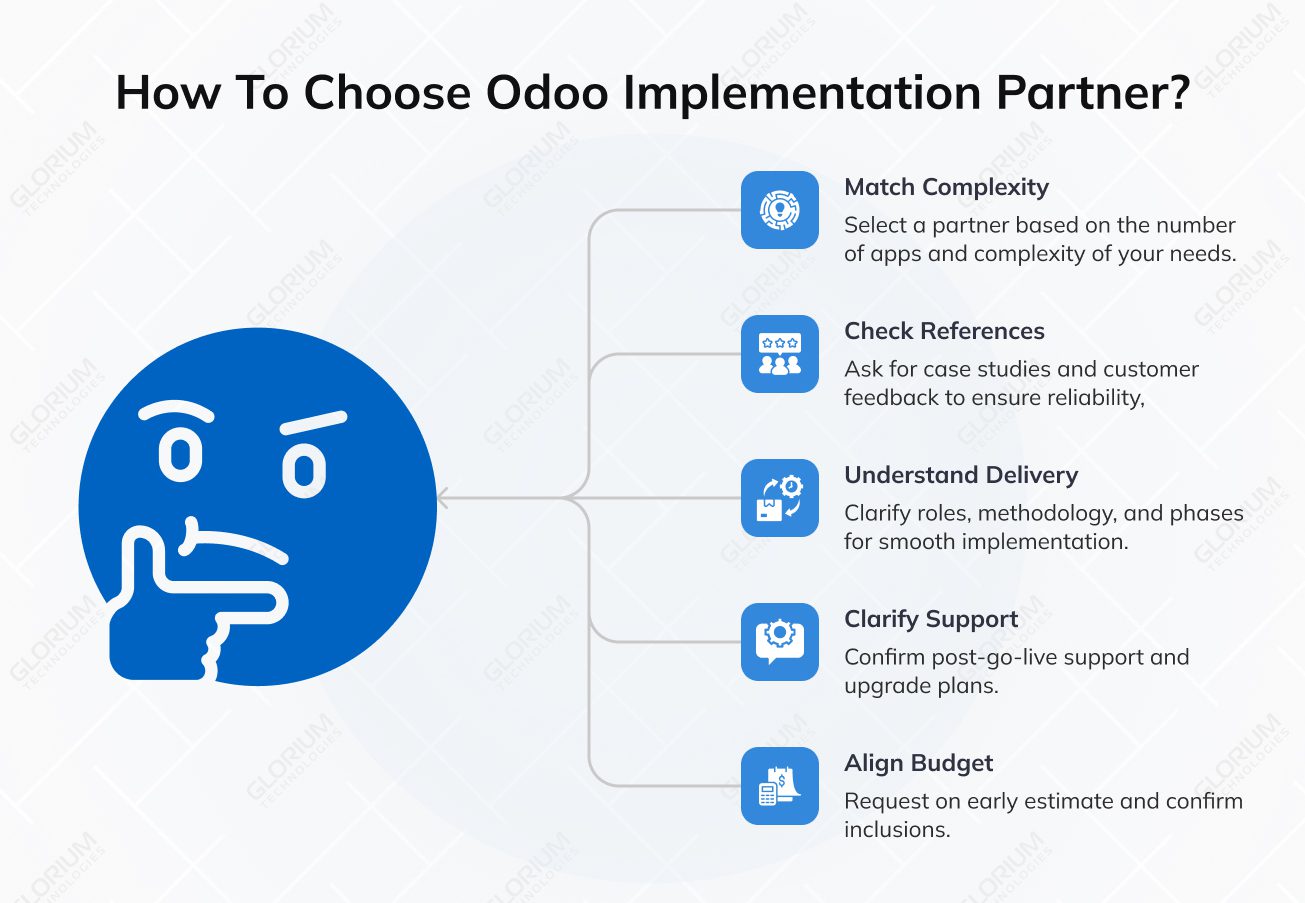
The real value of the ERP implementation shows up when the rollout fits how teams work day to day. That’s where a certified Odoo partner makes the difference.
Glorium Technologies brings 15+ years of experience and supports companies from early planning to go-live and beyond. The approach stays practical: clear requirements, a rollout plan that fits the scope, controlled custom work, clean integrations, and training that helps teams adopt Odoo quickly.
Here’s what that looks like in real life:
In a US construction project management rollout on Odoo 18 (Odoo.sh), we rebuilt procurement and execution workflows across Purchase, Inventory, Project, Timesheets, and Accounting. The client achieved 2x faster supplier response, 18% lower procurement costs, 30% less admin workload, and 23% faster project delivery through RFQ automation, real-time stock control, and connected project scheduling.
Talk to us today to achieve similar results for your business. See how Odoo works with a free demo.
Start with project fit. Look for experience with companies similar to yours in industry, size, and complexity, and ask for proof through references or case studies. Then, validate implementation depth: how many Odoo modules the team has delivered end-to-end, how they handle data migration and integrations, and whether their approach protects upgrade paths.
If you need an ERP-level rollout, Glorium Technologies is a strong choice for complex implementation. We bring 15+ years of delivery experience and work as an official Odoo partner, which means you get a team that knows the platform, its limits, and how to extend it without creating upgrade pain. Glorium Technologies supports multi-module deployments across departments, builds upgrade-safe customizations when standard Odoo isn’t enough, delivers integrations that keep data consistent across systems, and runs a structured delivery flow from discovery and testing through training, go-live, and long-term support as your Odoo ERP evolves.
Smaller partners usually fit simple, local projects with a few users and limited customization. A partner built for implementation at scale is a better match when you have many users across departments or countries, multiple Odoo apps that must work as one system, integrations with other tools, and a long-term ERP roadmap that will grow over time.
Simple projects with one or two modules and a small team can take a few weeks to a couple of months, depending on data readiness and approvals. Full Odoo ERP implementation with multiple modules, integrations, and data migration typically takes several months. In practice, the safest approach is phased delivery: a first release that covers core workflows, followed by enhancements.
You can start on your own if you keep the scope basic and accept a learning curve. For anything beyond that, an experienced Odoo implementation company helps you avoid costly design mistakes, rely on standard Odoo features rather than unnecessary customization, and plan a scalable setup that stays upgrade-friendly. If Odoo supports core operations, working with a trusted partner usually leads to faster, safer, and more sustainable results.