






12 Minimum Viable Product Examples That Proved the Long-Term Success
Updated June 21, 2026

 Summarize in ChatGPT
 Summarize in ChatGPT
Most products don’t fail because the team shipped too early. They fail because the team spent months building the wrong thing. It usually starts with a strong product idea and a long backlog. Everyone wants the first release to feel “complete.” But until real users touch it, you are still guessing.
That’s why starting small matters. A lean first version lets you test demand, see what people actually do, and course-correct before the budget is spent on features nobody uses. This is not a rare scenario, either. In an analysis of 101 startup post-mortems, the most common reason for failure was “no market need,” cited in 42% of cases.
In this guide, walk through 12 minimum viable product examples that started with a simple first step and expanded only after the market responded. You’ll see what each team tested first, how they gathered user feedback, and why those early choices mattered for long-term growth.
Content
A minimum viable product is a way to turn a product idea into evidence. Instead of investing months in an “everything included” release, teams ship a focused first version to see whether the problem is real, the offer is clear, and there is genuine demand from potential users and early adopters.
This MVP approach supports fast learning through iteration. You test one core hypothesis, observe real user behavior, and adjust based on signals that matter. In many cases, user feedback helps teams refine positioning, pricing, and the features that users actually value.
MVPs also reduce product development costs and lower investment risk. Full-scale development usually means higher spend, longer timelines, and a greater chance of building advanced features that don’t move the needle. A simple MVP keeps the scope intentionally small, so you get cost savings while still learning what the target market wants.
Some founders build the initial version themselves, while others choose MVP outsourcing to accelerate delivery or access specific expertise. In practice, an MVP can take many forms: a landing page, a landing page MVP with a pricing test, a concierge MVP that delivers value manually, a Wizard of Oz MVP that “looks automated” but runs behind the scenes, or an actual product with just the core components needed to solve one clear problem.
Many successful minimum viable product stories started with this exact mindset: build only the core components, validate quickly, and expand only after the market proves the concept.
Unlike a minimum lovable product or a minimum marketable product, a minimum viable product exists to reduce uncertainty fast. It helps you answer the hard questions early: Do target users want this? Will early users come back? Will they pay for it?
You’ve probably heard the “classic” MVP stories: Zappos, Facebook, Uber, Amazon. Below are 12 more minimum viable product examples that also began with a deliberately simple first version, generated interest, gathered user feedback, and expanded only after the MVP concept proved itself.
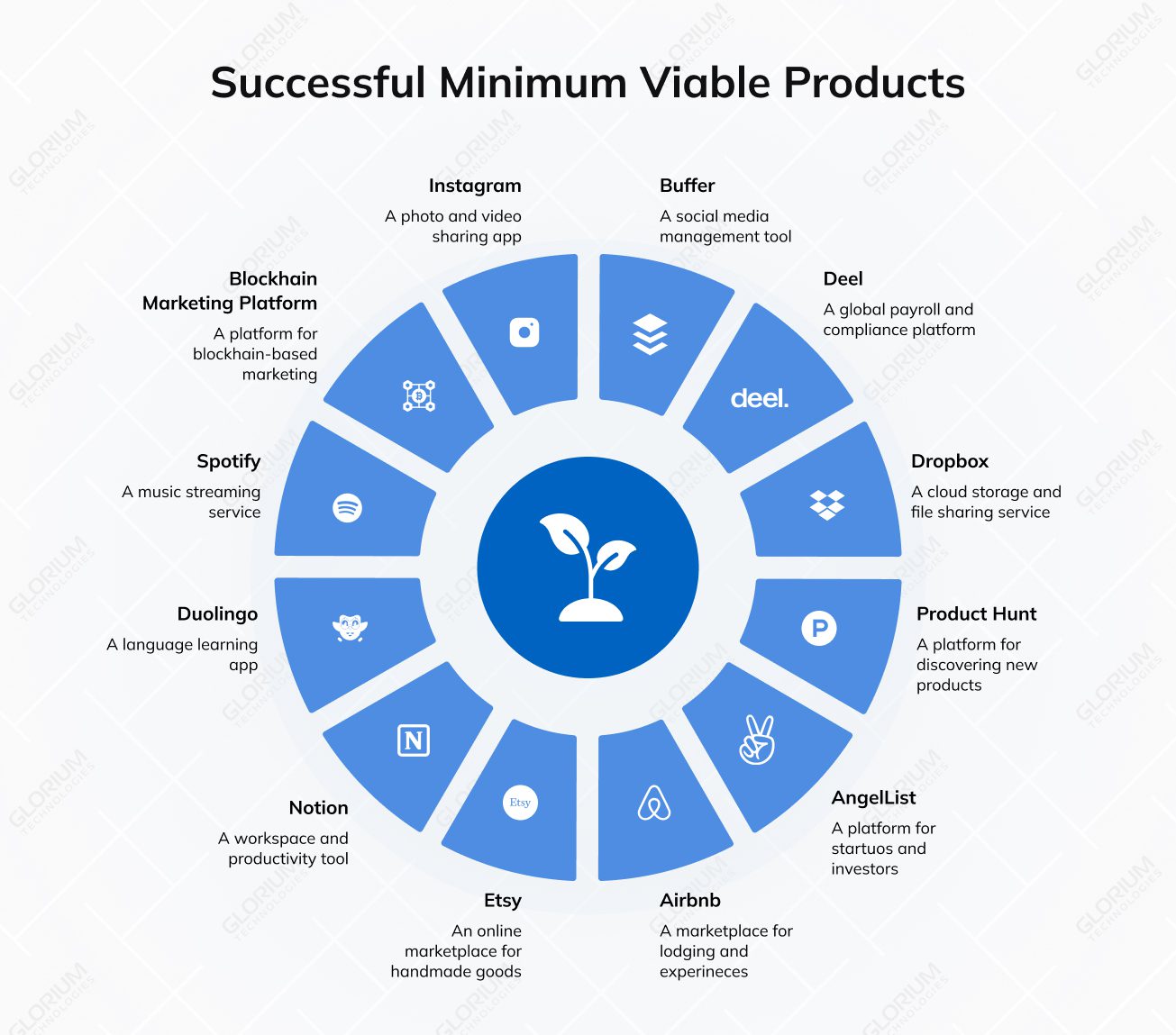
In 2010, Buffer’s founder, Joel Gascoigne, didn’t want to invest months into building a tool for scheduling social media posts without knowing if people would pay for it. So he started with a landing page MVP.
The landing page explained the product idea, asked visitors for their email address, and then revealed the pricing. In many ways, it’s a classic “fake door MVP”: the door is real (pricing, intent, sign-ups), even if the full product isn’t there yet. When the landing page showed strong interest in paid plans, the signal was clear.
Only then did he move to MVP product development and ship the first version of the actual product with core features in under two months. Buffer later expanded into analytics, team workflows, and publishing across channels, but the early MVP strategy was simply: validate willingness to pay before writing a lot of code.
Deel started with a simple bet: remote work would push more companies to hire across borders, and the biggest friction would be payments and compliance. Instead of building a broad HR suite, the first version focused on one job: help companies onboard and pay international contractors without juggling spreadsheets, payment methods, and tax paperwork.
Once that core workflow proved in demand, Deel expanded into a wider platform, adding global payroll and employer-of-record services for full-time hires.
“Whether you hire contractors, employees, or open a local entity, we handle the back office so you can give people a great experience and go global. When I spent time in San Francisco, it was clear that remote work was becoming the norm. With tools like Slack, Zoom, and Google Meet, more companies would hire outside their city, state, or country.
If that is the trend, the biggest problem to solve is payments, compliance, and local labor laws. And today, onboarding and paying international contractors is still a mess. It usually means spreadsheets, many payment methods, and piles of tax and compliance documents.”
Alex Bouaziz and Shuo Wang, co-founders of Deel
Dropbox is one of the best-known MVP examples where the team validated demand before releasing a working product. Founded in 2007, the product idea was straightforward: keep files synced and accessible across devices. The implementation was not. Cross-platform sync was difficult to demonstrate with a rough build, and early user feedback would have been overwhelming without a solid demo.
The team used a demo video MVP, an explainer video MVP designed for a tech-forward target audience. The video made the value proposition obvious and helped people understand the customer pain points they already had, but didn’t clearly articulate.
That demo video MVP drove a surge of interest, grew the waitlist, and produced honest user feedback that helped the development team prioritize features. It’s a reminder that some low-fidelity MVPs can still validate the business model if they communicate value clearly.
Product Hunt began in 2013 as a lightweight community experiment. Ryan Hoover wanted a place where people could share and discuss new tools, but he didn’t start by building custom infrastructure.
He utilized existing tools to establish a small link-sharing group, then curated the best finds into a daily email digest. That early format resembles a concierge MVP: a human-driven experience that proves demand before the product scales.
Once the concept worked and the target users kept coming back, Product Hunt evolved into the platform we know today, with submissions, voting, and comments. It’s one of those minimum viable product examples where distribution and habit came first, and polish came later.
AngelList is another strong example of starting with the simplest possible format. In its earliest days (around 2010), it began as an email list focused on one job: help startups connect with investors.The first version offered only the basic website and basic features needed for discovery and introductions. As the network grew, the product expanded into a more structured ecosystem. This is a good reminder that marketplace MVP product development often starts with a low-fidelity MVP, as long as the core functionality and matching the right people are in place.
Airbnb began as a real-life fix to a real problem: the founders needed help covering rent in San Francisco, and hotels were booked during a major event. Joe Gebbia and the team tested the MVP model in their own apartment.
Their first version was a simple website with photos, basic details, and an offer to stay on air mattresses. It was a basic website, but it proved the business model because strangers actually paid. That simple MVP validated the value proposition quickly and helped the team prioritize features for the next iteration.
From there, Airbnb expanded into a global marketplace, but the minimum viable product approach was clear: prove demand, then scale.
Etsy launched in 2005 with a narrow focus: handmade goods and vintage items. The founders saw that sellers on large marketplaces had pain points around fees and fit, so they targeted a specific target audience instead of trying to serve everyone.
Their first version was a simple multi-vendor marketplace with core features like listings, photos, descriptions, and pricing. The business model was also tested early through seller fees. Etsy’s story is a clean example of how a minimum viable product often wins by clarity: pick a niche, deliver basic functionality, and then expand.
Notion did not start as an all-in-one workspace. The first version was a simple web page builder. It worked as a prototype that let the team test the core concept and see how people used it.
After that, the product evolved into a web app builder. The idea sounded exciting, but the team learned that most people do not want to build apps. The positioning felt confusing, and the experience was hard to explain. At the same time, the technical foundation was unstable, making it difficult to distinguish between product issues and platform issues.
That is why the team decided to reset and rewrite the software. They simplified the direction and focused on what users actually wanted. Once the core experience became clear, they expanded step by step and added new features over time.
“Even before he [Ivan Zhao] started Notion, he’d been thinking about this problem for years. He really believes everyone can be a creator, and that computers should be built for creation. That mission felt compelling to me because if you can pull it off, you unlock a lot of creativity in the world.
And in early-stage investing, you’re often betting on the person more than the idea, because the idea can change. In this case, it was easy to bet on Ivan; you could see the passion and the depth of thinking he had done long before Notion existed.”
Akshay Kothari, Co-founder of Notion
Duolingo’s early releases proved that language learning could be accessible, free, and habit-forming. The product leaned into a simple loop, short lessons, progress, rewards, and that loop kept early adopters returning.
Even in private beta, demand was strong, and the team used user feedback to refine flows, add languages, and later introduce monetization. Duolingo is a strong “single feature MVP” lesson in disguise: if the core experience is sticky, expansion becomes easier and more data-driven.
Spotify began in 2006 with a focused goal: to make legal music streaming so convenient that piracy loses its appeal. That meant building a reliable experience first, before trying to perfect everything around it.
The MVP centered on desktop streaming with a free, ad-supported model and a limited beta. You could call this a higher fidelity MVP than many others in this list, because the product’s core functionality had to work well to compete with existing services. Once retention was proven, Spotify expanded devices, offline mode, and subscriptions.
This idea entered a noisy Web3 market, where investors rarely trust a concept on paper. The client needed clear proof of how SFT-based campaigns would work without making brands and collectors wrestle with blockchain tooling.
At Glorium Technologies, we started with discovery and produced a clickable Figma prototype for the core roles (Collector, Business, Admin), supported by clear specs for investor conversations. We aligned the MVP development plan with ERC-1155 mechanics for SFT campaigns and shaped a custodial wallet flow to keep onboarding simple for the users.
The outcome was an MVP-ready blueprint: a clear value proposition, defined key features, and a compliance-aware foundation that could scale into an actual product once market validation and user feedback confirmed demand.
Instagram began as Burbn, a location-based check-in product with several social features. But early usage showed something obvious: people cared most about sharing photos, not the rest.
So the team did the MVP move many avoid — they cut features instead of adding them. They stripped the product down to a simple photo-sharing first version, kept filters, and launched Instagram. This is one of the clearest and most successful MVP examples of a single-feature MVP done right: a single core loop that is easy to understand and repeat.
After that validation, Instagram expanded its social layer and shipped new features over time, building on what real users had already proven they wanted.
If you strip these MVP examples down to the basics, they’re not really about “building less.” They’re about learning faster, with less risk, and with a better understanding of what the target market will actually adopt.
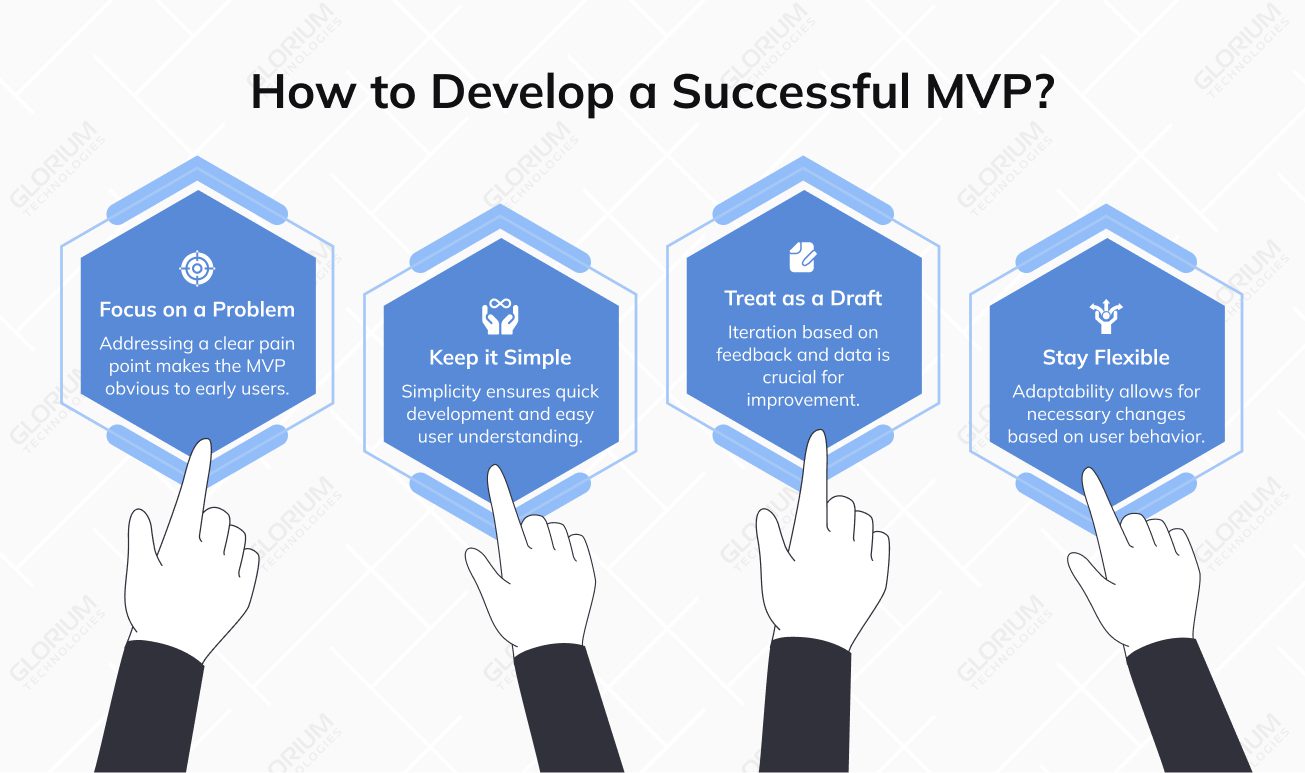
Most successful examples start with a sharp problem statement. The best development team doesn’t try to serve everyone. They pick one pain point that potential users feel today, then build the smallest thing that makes that pain noticeably smaller. That’s what makes a good MVP feel obvious to the right early users.
They also keep the first version intentionally simple. A lot of validated learning can happen before you ship a full build. Sometimes a landing page is enough to generate interest. Sometimes, a landing page MVP or fake door MVP is enough to test pricing. Sometimes, a concierge MVP is enough to deliver value manually and collect user feedback before automation. Sometimes, a Wizard of Oz MVP (an Oz MVP) creates the illusion of full automation while humans run the process behind the scenes, so you can test demand without heavy engineering. And sometimes you do need a high-fidelity MVP, especially when the product’s core functionality must work end-to-end to compete.
Another shared habit is treating the minimum viable product as a draft. The goal is to gather feedback, watch what multiple users actually do, and iterate without ego. That means you prioritize features ruthlessly, keep just the core components, and add only the new features that improve activation, retention, or willingness to pay.
Good MVP product development runs on two fuels: feedback and data. Talk to people to understand what confused them, what they expected, and what would make the MVP product worth paying for. Then track simple metrics that show intent: sign-ups, activation, repeat use, conversions. When customer feedback and data points are in the same direction, your MVP strategy gets much easier.
And finally, stay flexible. A minimum viable product will challenge assumptions. That’s normal. The win isn’t “the minimum viable product succeeded exactly as planned.” The win is finding the right direction early, whether that means reshaping key features, adjusting messaging, or pivoting the business model, before full MVP development costs lock you in.
The MVP examples in this article share the same starting point: they didn’t try to build “the full product” on day one. They proved one thing first: demand, usability, or feasibility, then expanded with confidence. That’s also how we work at Glorium Technologies.
With 15+ years of cross-industry delivery, we help teams move from idea to adoption with less noise and more evidence. Our process is stage-based and practical: we define what success looks like, tie effort to clear metrics, and make sure every step leads to a real decision, move forward, adjust, or stop, before costs snowball.
We meet you where you are. If assumptions still feel shaky, we can pressure-test demand and pricing early, before you invest heavily. If the biggest risk is alignment, we create a prototype that makes the product story easy to understand for users, stakeholders, and investors. And when the direction is clear, we build a focused MVP that’s ready for real feedback, lean by design, but solid enough to grow.
As you iterate, we help you turn feedback into visible improvements: clearer onboarding, sharper messaging, better positioning, and a roadmap that reflects what users actually do. If you want to see how this looks in practice, explore our case studies, which show how a disciplined MVP and launch approach can set the foundation for scale.
Want the same clarity for your product? A realistic first release, the right validation steps, and a clear plan for what comes next? Book an intro call with Glorium Technologies, and let’s map your MVP journey from the first build to traction.
Look for a partner with proven startup delivery, clear scoping, and real post-launch iteration. Case studies should demonstrate what was built first, why that scope was chosen, and how user feedback influenced the next release. It also helps if they can set up analytics early, so you learn fast.
Glorium Technologies has built dozens of MVPs for clients worldwide. One example is an MVP for a property renovation company that brought all renovation projects into a single dashboard, kept updates in sync, and centralized documentation. That first version passed market validation and is now ready for further development.
Glorium Technologies brings a structured approach that keeps the MVP focused on validation. With 15+ years of delivery across industries, we help you choose the right first step, prototype, PoC, or minimum viable product, define success metrics upfront, and build only what’s needed to test demand. We also connect the build to launch reality: onboarding, messaging, measurement, and a plan for the next iteration. You can review our case studies to see how we’ve helped teams move from first release to traction.
Yes. For AI startups, the key is proving value without overbuilding the “AI layer” too early. We help you define the simplest workflow that demonstrates the desired outcome (accuracy, speed, cost reduction, or better decisions), then select the right implementation path: rules and ML, an LLM-based approach, or a hybrid. We also design for responsible use, incorporating privacy, security, evaluation metrics, and a feedback loop that improves both the model and the product.
We usually start with discovery to align on the problem, target users, and the one or two metrics that define success. Then we shape the MVP scope around a single core journey and create UX/UI (often with a clickable prototype) to remove ambiguity. After that, we build the MVP, run QA, and prepare for launch with analytics and feedback capture in place. Post-release, we review results, decide what to iterate on, and plan the next milestone, whether that’s growth, fundraising, or scaling the product.
In competitive markets, “more features” rarely wins. We focus on differentiation through a sharper workflow, faster time-to-value, and a clear positioning angle that users can understand quickly. Practically, that means tight scoping, testing messaging early, prioritizing onboarding, and measuring activation and retention from day one. The goal is to ship a version that proves your edge, not a general-purpose product that blends in.
Yes. B2B MVPs usually come with longer buying cycles, multiple stakeholders, and stricter requirements around access control, integrations, and reporting. We scope the product around a specific persona and use case first, then design for the fundamentals that matter in B2B, roles and permissions, auditability where needed, clean data flows, and integration readiness. The result is a first release that’s credible for real buyers and still lean enough to iterate quickly.