








Proven Frameworks for Your Business Idea Validation
Updated November 24, 2025

 Summarize in ChatGPT
 Summarize in ChatGPT
Startups often begin with a burst of enthusiasm and a “next big thing” idea. Yet statistics show that enthusiasm alone isn’t enough. A 2025 global survey found that 42% of startups fail because they misread market demand, and a 2024 study showed that another 42% of failed projects lacked product-market fit. In contrast, firms that apply thorough validation procedures, like creating a minimum viable product (MVP) and testing it with real consumers, have a 60% higher chance of success.
This article shows why validating a business idea is so important and how it helps you avoid the “no market need” trap. You’ll gain a clear overview of practical validation methods and frameworks, and see how selecting the right path in the POC vs. MVP debate, as well as conducting small tests with potential customers, can transform a raw business idea into an investor-ready product.
Content
Business idea validation involves verifying whether your product addresses a genuine problem before investing significant time and resources. In other words, you test the idea with real people first, so you don’t invest heavily in something the market doesn’t need.
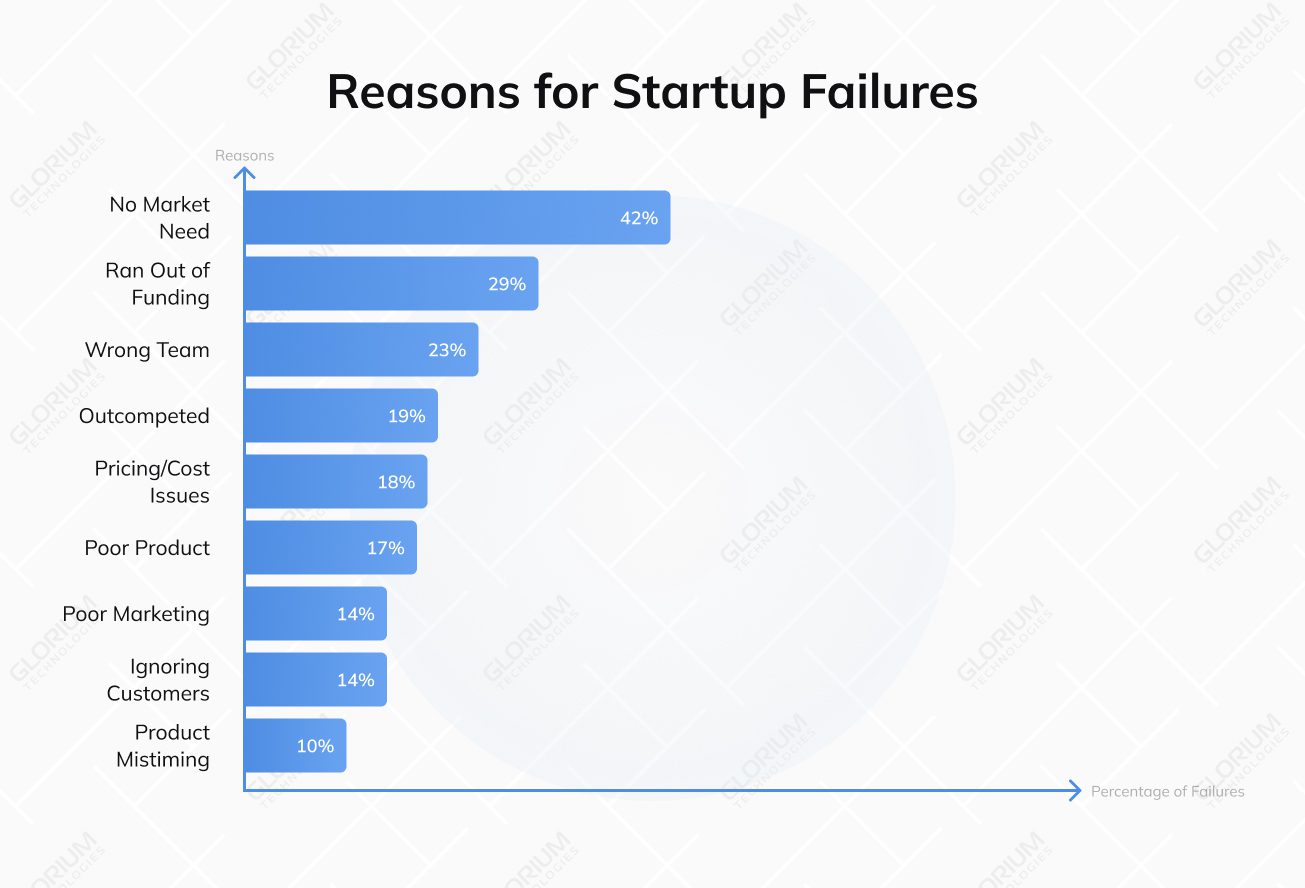
The chart below highlights the significant number of startup failures that are rooted in issues with the target market and customer, including a lack of real need, weak products, poor marketing, and ignoring user feedback. Simple MVP experiments help you collect real data from early access users, adjust quickly, and avoid investing heavily in something nobody actually needs.
In practice, product idea validation often starts with a proof of concept (POC) to check whether the solution is technically feasible, and then moves to an MVP once you see enough signal from users in the POC vs MVP journey.
“The best way to validate your business idea is to talk to users and ask if they identify with the problem and your proposed solution.”
Michael Skok, Value Props: Create a Product People Will Actually Buy
A POC shows that your business idea is technically possible. It answers questions like “Can this algorithm handle real data?” or “Can we connect these systems at all?” A POC is usually small, internal, and may never reach real users. Its role is to reduce technical risk quickly and cheaply.
An MVP checks whether the target market actually cares about your product idea. Are people willing to try it, pay for it, and return? An MVP ships only the core features, but it’s still sufficient for people to use it in real life and provide honest feedback.
In simple terms: build a POC when feasibility is unclear. Build an MVP when the tech looks solid but demand is uncertain. Use the MVP to assess market size, confirm the business model, and establish pricing based on real data.
Most teams follow a straightforward sequence:
Here’s how POC vs MVP compare at a glance:
| Aspect | POC | MVP |
| Main question | Can we build it? | Should we build more of it? |
| Primary goal | Prove technical feasibility | Test demand and product–market fit |
| Scope | One core function or risky assumption | Narrow, but usable product with key features |
| Target users | Internal team, select experts | Early users and real customers |
| Typical output | Demo, prototype, technical spike | Live product or beta version |
| When to use | When the tech, integration, or algorithm is uncertain | When tech is clear, but user value, business model, pricing, or demand are not |
| Time & cost | Short, low-cost, often throwaway | Higher effort, but still limited compared to the full product |
| Common formats | Figma flow, clickable demo, API mock, sandbox implementation | Web or mobile app, limited feature set, real onboarding, and feedback loops |
Once you understand why business idea validation matters, the question “How to do it correctly?” arises. Market research moves you from “we think” to “we know.” Instead of guessing who your users are and what they need, you start checking your assumptions with real people and data.
A good starting point is to define who you want to serve, learn how they currently solve the problem, and assess the size of your focus group. Several proven frameworks can help. Below, we explore the most popular ones.
The Harvard Business School approach turns this into five clear steps you can follow for almost any startup idea:
The lean market validation process, developed by product manager Jim Semick, is a very hands-on way to check if your product idea makes sense before you invest too much. Instead of disappearing for months to build a “version 1.0,” you run a series of small, simple tests to see how real people react to your value proposition.
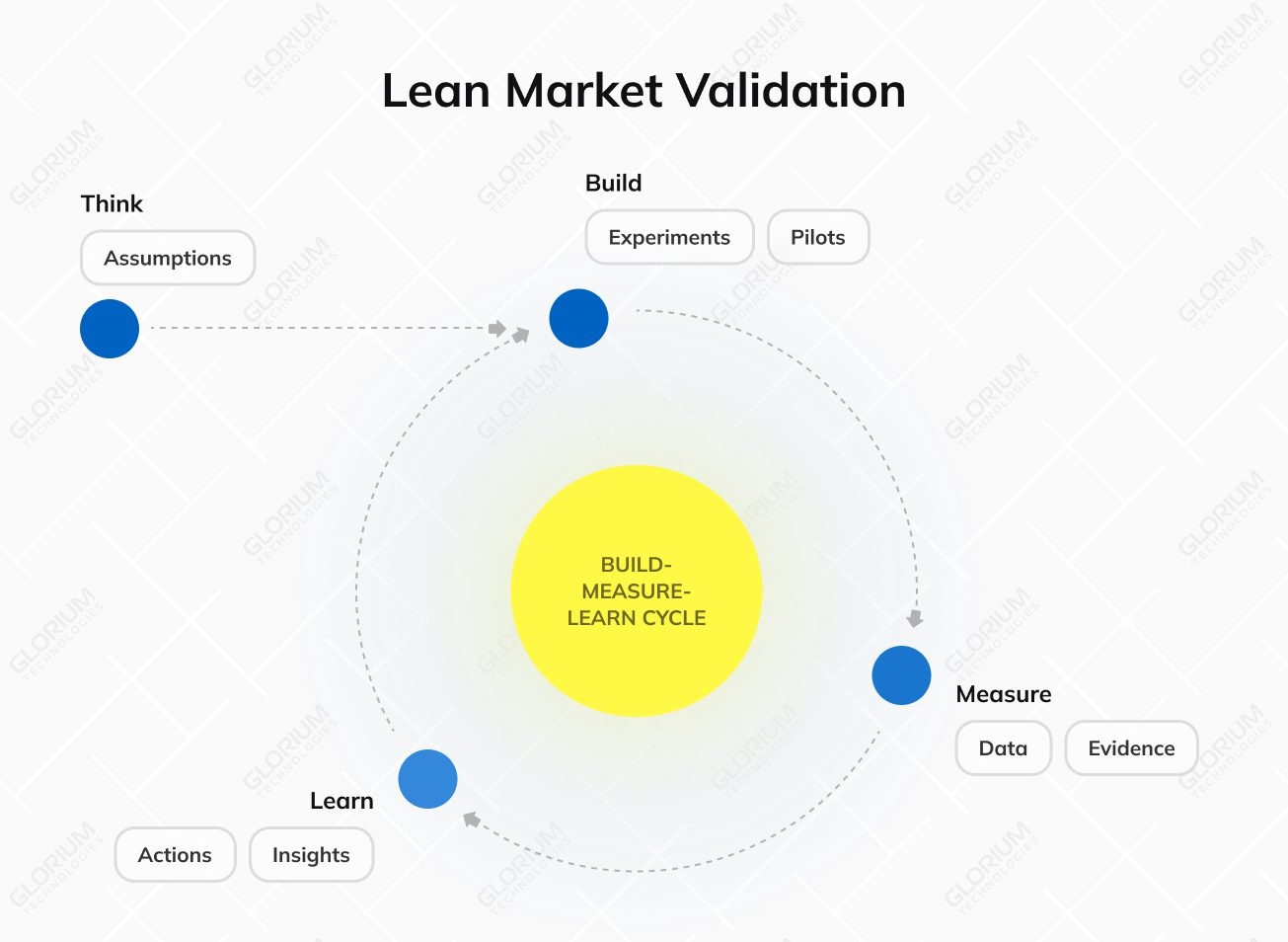
The core idea is to treat each assumption as a question: Will people even click on this? Will they leave an email? Will they book a call? Would they pay this price? You then design light experiments to get those answers. For example, you might launch a basic landing page to see who signs up, run a small ad campaign to compare two unique value propositions, or schedule short customer validation interviews to understand what actually bothers people in their daily work. Before you start, you define what success looks like (for instance, “at least 10 qualified sign-ups in a week”), so the result is easier to interpret.
“About 20-30 interviews give you valuable insights to confidently shape your product and market focus.”
Jim Semick, How to Validate a Business Idea – UCSB Workshop
The Startup Grind methodology is a problem-first way to validate business ideas. You start by defining a top-tier customer problem that is painful, frequent, and important enough that people would pay to solve it.
Then you look at how users handle it today, what existing tools get wrong, and whether there’s a real budget behind the need. Only after that do you outline your MVP: a small set of features that directly address the biggest pain points, and that early prospects help you prioritize.
A good example is the recent project of Glorium Technologies, a clinically validated fertility tracker for a Germany-based MedTech provider. The client already had a strong backend and a patented biosensor, but users still struggled with outdated tracking methods and fragmented data. Using a problem-first lens, the MVP focused on what mattered most: native iOS and Android apps (Swift, Kotlin), accurate cycle tracking, stable Bluetooth sync, and a clear, readable dashboard. As users adopted the MVP, their feedback drove the roadmap, from secure data sharing with clinicians to a Fitness Mode for active women, turning a focused MVP into a full-scale, scalable fertility platform.
Arnab Ray’s framework helps you step back and look at your business idea honestly. You start by mapping your strengths, such as team skills, domain expertise, network, and weaknesses, like missing skills, regulatory gaps, or no clear go-to-market. Then you list the main risks: market risk, technical risk, timing, competitive landscape, and funding.
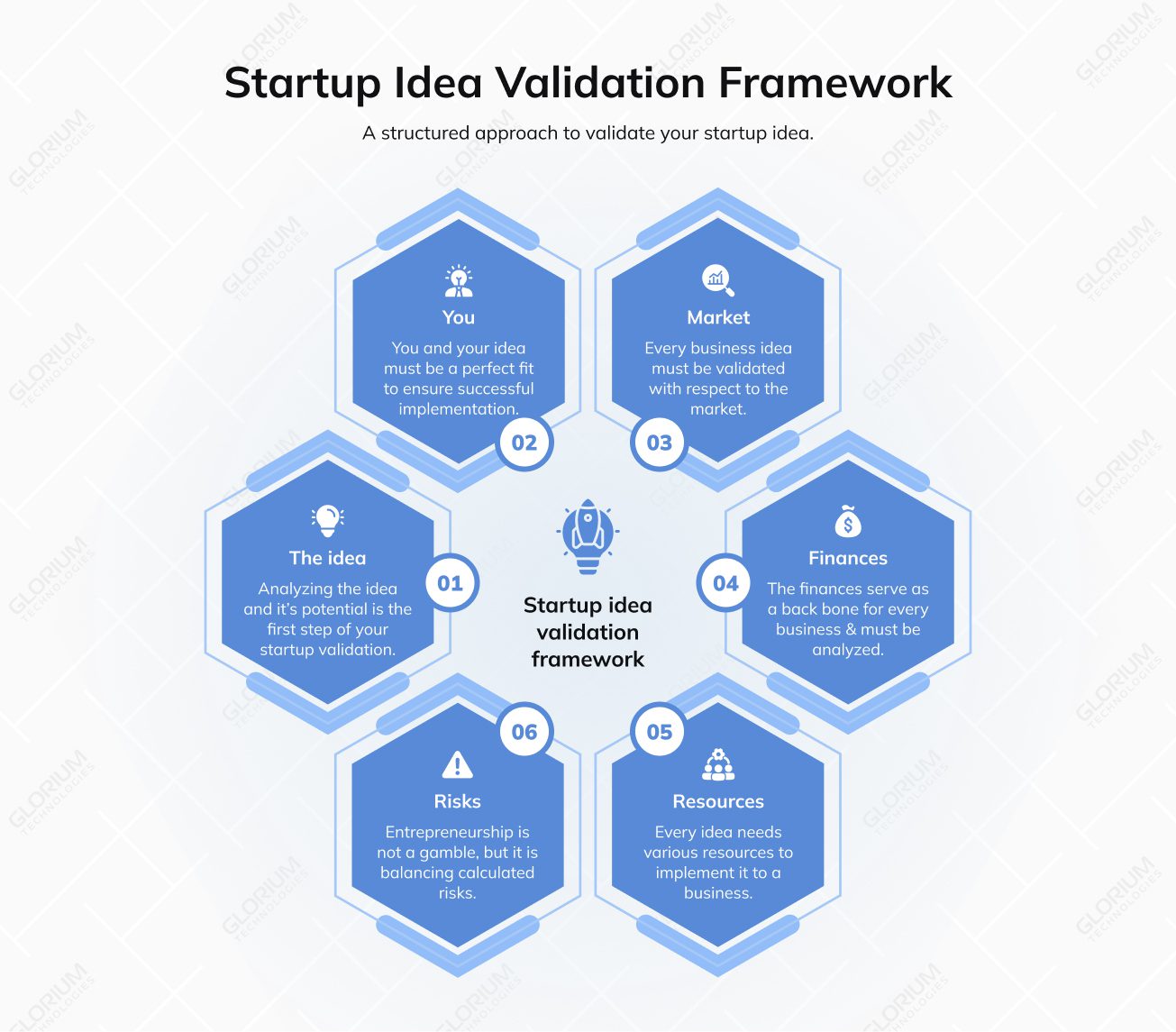
For each risk, you decide what kind of proof would reduce it: a customer discovery, a small POC, a partner call, or a quick pricing test. This gives you a simple plan: which questions to answer first, which bets are too big, and where you might need help. Instead of jumping into the development process, you get a structured picture of the product idea’s real potential and a shortlist of market validation process steps that matter most.
The Failory approach goes straight to the hardest question: will anyone pay for this? Instead of collecting vague “sounds cool” feedback, it uses pre-selling to test demand for your product idea. First, you set a clear sales goal. For example, 20 pre-orders or 10 paid pilots. Second, you create a minimum viable offer: a simple landing page or deck that explains the value, price, and timeline. But this is just the beginning.
Next, you pre-sell through your chosen channels: email list, community, calls, events, or ads. Finally, you decide based on the results. If you reach your target, you move forward with more confidence. If you don’t, you adjust the target audience, business model, message, or product idea before writing more code.
The Spdload method treats the validation process as a series of small, guided cycles. You begin with your “why”, why this product should exist now, and turn it into a few clear validation goals and hypotheses about your potential customers, their problem, and the value you want to deliver.
Then you define your target audience, write down key assumptions, and design simple experiments to test them. You can do it with the help of a landing page, a clickable prototype, a short pilot with potential customers, or a mix of all three. After each round, you compare what actually happened with what you expected, collect feedback, and decide whether to pivot, refine, or continue. The good thing is that you always know what you are testing, why you are testing it, and how each result will shape your next step.
Many early-stage founders are passionate about their startup ideas but hesitate to validate them on their own. A strategic partner with deep experience can make all the difference. With 15+ years of cross-industry expertise, Glorium Technologies has become a trusted advisor, helping refine concepts, validate assumptions, and shape a roadmap that investors take seriously.
Instead of just getting code, founders get support for all the risky first steps. MVP development services help turn a raw idea into a testable product. A product development strategy provides a clear plan for what to build first, how to launch, and how to iterate. Product research helps you understand users and market demand before committing serious budget. Together, these services cover everything founders are often afraid to do on their own.
For example, one client was building a renovation management platform for multifamily housing operators. Together with Glorium Technologies, the team shaped a focused MVP on React, Node.js, and AWS. The first version helped them test the concept with early users, close their first lead within a month, and keep enough flexibility to add AI-driven budgeting and scheduling later.
Another client was creating a blockchain-powered marketing platform for NFTs and SFTs. Before investing in full development, they needed to prove the idea and sort out technical and compliance risks. During a structured discovery phase, Glorium prepared a clickable Figma prototype and a clear technical blueprint. This gave investors something tangible to review, clarified how the platform would stand out in SFT-driven campaigns, and left the client with an architecture ready for a safe, fast move into MVP development.
Ready to validate your idea with real users and data? Glorium Technologies can make it happen. Get in touch for an introductory consultation.
Product-market fit means you’ve found a segment that consistently uses and values what you offer. In practice, you can track it through activation rates, retention, churn, NPS scores, and the share of users who return and invite others. On the business side, it appears as repeat revenue, growing deal size, and prospective customers expanding their usage without significant sales pressure.
During idea or market validation, typical metrics include landing-page conversion rates, cost per qualified lead, interview or demo acceptance rates, pre-orders or deposits, early engagement with prototypes, and clear signals of willingness to pay. For POC vs. MVP experiments, we also examine how quickly each test provides a “go/adjust/stop” signal, ensuring you don’t waste time and budget.
Look for a partner who understands both product and technology. They should be able to challenge your assumptions, help you design small experiments, and advise when to use a POC vs an MVP. Domain knowledge, security, compliance, portfolio, and customer reviews are also essential while choosing a potential partner.
Yes. For example, a blockchain marketing platform for NFTs and SFTs underwent a structured discovery phase, complete with a clickable Figma prototype and an architecture blueprint. This surfaced onboarding and compliance risks early, helping the team adjust before committing to a full build. In another case, a renovation management platform validated its key flows and integrations in an MVP first, avoiding months of work on features that early adopters didn’t actually need.
Glorium Technologies combines 15+ years of engineering experience with a strong focus on product thinking. The team helps clarify your problem, choose the proper POC vs MVP path, conduct market analysis, and design validation steps around clear business questions. With the help of market research, technical discovery, and delivery support, you can move from product idea to evidence.
Yes. Once you see enough signal from validation, Glorium Technologies can turn the most promising concept into a lean MVP that users can try. The focus is on a secure, stable core that’s intentionally small, allowing you to continue learning and iterating without being locked into a bloated initial version.
Yes. After the MVP proves demand, the same team can help you evolve it into a complete product: extending the architecture, adding deeper functionality and integrations, and tightening performance, security, and compliance. The aim is to scale in a controlled way, keeping the speed of a startup while adding the robustness your customers expect.