MVP Testing: How to Avoid Mistakes & Build What Users Want
MVP
Every year, countless businesses invest months (or even years) into products that ultimately flop—not because they were poorly made, but because they solved problems no one actually had. Recent data shows that up to 90% of startups fail through years two to five, and 34% fail due to a poor product-market fit. This makes launching the final product idea without validation a significantly costly mistake. So, how can you avoid this mistake and set a successful path in the early stages of product development? MVP development is the solution! Gathering user feedback from early adopters is essential to understand whether your product features bring necessary benefits or don't help your customers at all. At its core, MVP testing is about validating your riskiest assumptions with the least effort possible. Instead of guessing what the user base wants, you test a bare-bones version of your product to gather real-world feedback. This approach helps you:
Whether you're a startup founder, product manager, or innovator, MVP testing transforms guesswork into evidence. In this guide, you’ll learn how to test smarter—not harder—and build something people actually want.
The numbers don’t lie—34% of startups fail because there’s no market need for their product. Even well-funded companies waste millions building features users never asked for. MVP testing is your reality check before you invest too much. Without it, you’re gambling with time, money, and effort on an unproven business idea. So, what is the MVP testing meaning? It's a common first step for building digital products. The process involves creating a minimum viable version of the product and testing it with real users to gather customer feedback and understand if the product performs as expected or if it requires adjustments. Let's break it down:
Why does MVP validation matter? It helps confirm the demand for your product before you decide to overbuild, save time and money, and reduce the risk of failure. Let's explore the benefits even further.
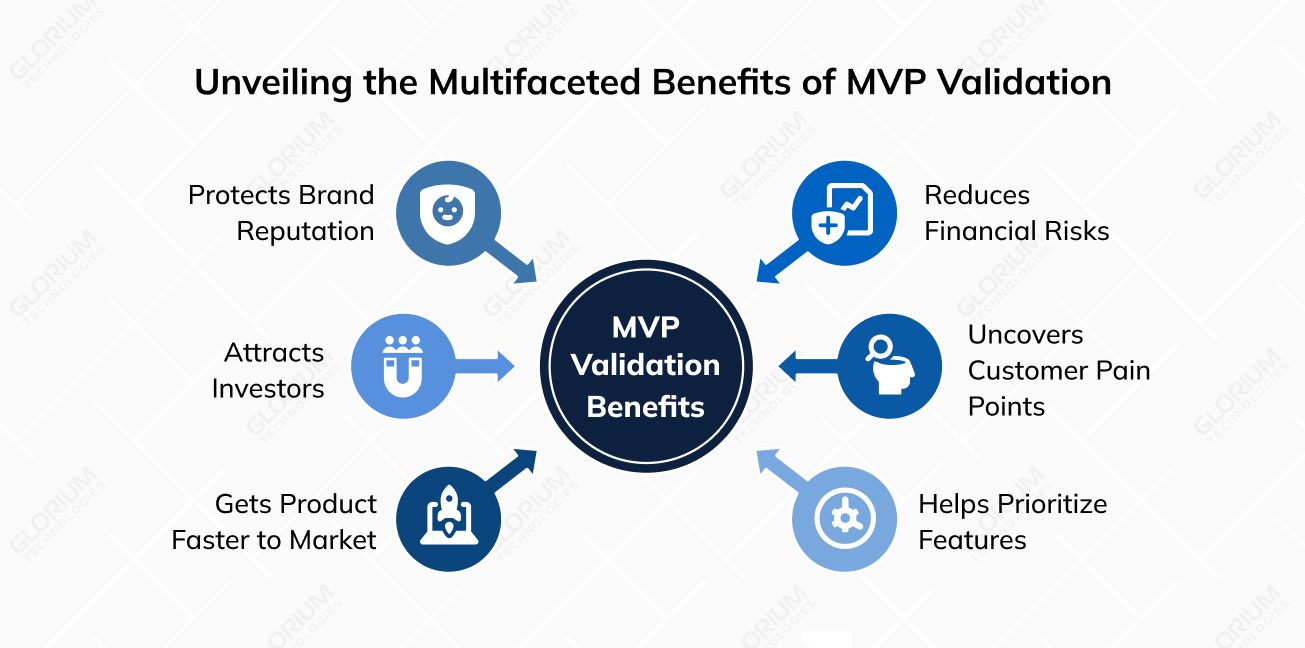
Building a full product without validation is like constructing a house on sand. MVP testing lets you fail fast and cheaply—before you’ve burned through your budget. You can cut development costs by up to 50% by avoiding unnecessary features. MVP testing can also help you avoid "future creep" by avoiding non-essential functions that bloat the budget. Let's explore this benefit by analyzing an MVP validation example by Groupon and Buffer:
Starting the development process of any product without user research is risky. However, sometimes, customers don't know exactly what they want from your product until they see it. Customer interviews, questionnaires, and market research help understand pain points, but MVP testing reveals what truly frustrates your clients—not just what they say frustrates them. For example:
Should you build an AI chatbot or a simpler FAQ section? Or is your FAQ page enough? MVP testing can help you find the best practices and necessary features that answer even the most specific needs of your customers. You won't have to guess or rely on your hunches anymore - minimum viable product testing measures user behavior (and not just opinions). It helps you learn which features drive engagement and which are wasting time.
Waiting for the perfect time to launch means you're losing to your competitors. While you're perfecting your product and adding advanced features, your competitors already offer something new to their customers. So, time-to-market is a significant element for startups. Launching a minimal viable product lets you test core functionality in weeks, not months - giving you a significant push on the market and an opportunity to test your product idea with the least amount of effort.
Investors found traction, not ideas. But when you only have a product idea, you may lose the interested parties. MVP testing shows user interest through sign-ups, pre-orders, engagement metrics, referrals, and more. This lean startup approach can turn your pitch from "We think this will work" to "We know it works." For example:
A full-scale product failure can tank your reputation. Remember Microsoft Bob? That's right - it was such a big flop that the modern market barely remembers that Microsoft ever had this idea. A failed launch can cost you more than the development budget. MVP testing, however, can help you quietly iterate your idea and make data-backed decisions. For example:
MVP testing isn't about throwing a half-built product at users—it's a tested method for validating business ideas without risking many resources. If you jump right in without a clear process, you risk:
Let's explore the proper process for MVP testing.
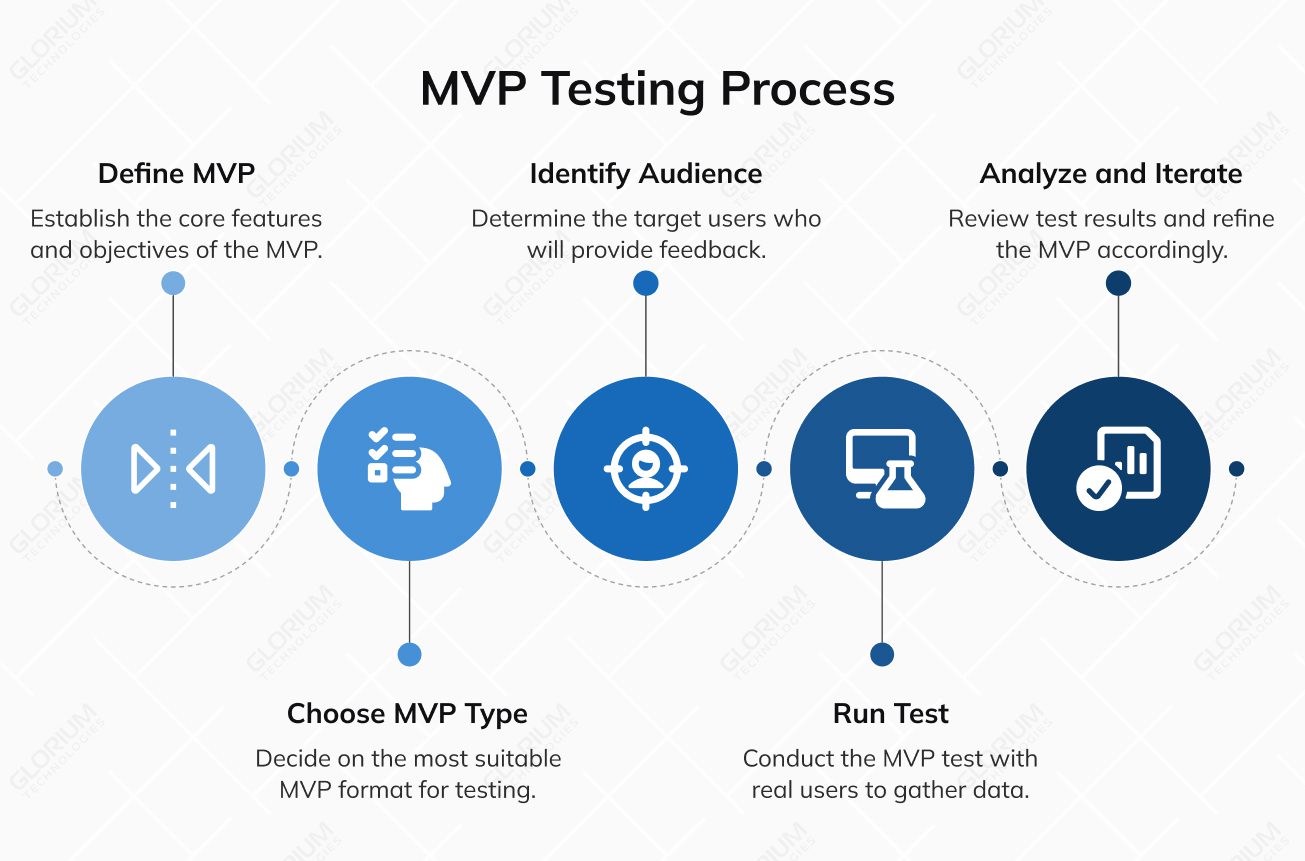
Start the process by defining your riskiest assumptions. At this stage, you're identifying the one thing that must be true for your idea to work. Imagine you belong to your target audience. What benefits would you like from your product? What primary function do you expect from this MVP? Frame your ideas as testable hypotheses: "We believe [target audience] will [take specific action] because [value proposition]."
Use a litmus test. It helps you figure out the most important thing your business idea depends on. You ask yourself: "If we’re completely wrong about this one assumption, will our whole idea fall apart?" If the answer is yes, that assumption is your biggest risk—and the first thing you should test before spending time or money on anything else.
Before investing months (or years) into building a full product, you need to test your core assumptions in the fastest, cheapest way possible—that’s where selecting the right MVP type comes in. Think of it as an experiment. If you're testing whether your audience will want your solution, a landing page might be enough. If you're testing whether your users will pay for your solution, then you should go with a concierge MVP. The goal of this whole process is to get real user feedback with minimal effort. Explore the common MVP types and their examples:
|
Type |
Best For |
Example |
|---|---|---|
|
Landing Page |
Demand validation |
Buffer’s signup page (no product yet) |
|
Concierge MVP |
Service-based ideas |
Zappos manually fulfilling shoe orders |
|
Wizard of Oz |
Tech that looks automated (but isn’t) |
Food delivery app with humans handling backend |
|
Prototype |
Physical products |
3D-printed mockups for hardware testing |
Match the MVP type to your riskiest assumption. Testing pricing? Use a fake door test. Testing usability? Build a clickable prototype.
Before launching your MVP, there's a critical question that needs to be answered: Who will actually use it? Who is your target audience? Who are you making this product for? These people are not users - they're early adopters. These are individuals who:
Why is choosing the right target audience important? It's easy to build an MVP and give it to your friends, family members, coworkers, or other irrelevant users. Because of this, you'll get misleading data and waste months building something nobody truly wants. When you test your product with early adopters, you communicate with your best critics. Unlike the mainstream market, they expect MVPs to be imperfect, so they're forgiving. And, they'll spread the word - if you solve their problem well.
This is where you test not only your MVP but also all the effort that went into validating your idea. Once you've built your MVP (in-house or with a professional MVP development company), it's time to put it in front of real users and collect proof that your idea works (or not). True validation requires:
For a successful test, you need to choose the correct metrics. Without this, you're just flying blind.
|
MVP Type |
What to Measure |
How to Track |
Real-World Example |
|
Landing Page |
Sign-up conversion rate |
Google Analytics + Heatmaps |
Dropbox's 75K waitlist signups from a demo video |
|
Concierge MVP |
Willingness to pay |
Manual invoicing/stripe links |
Zappos selling shoes without inventory |
|
Prototype |
Task completion rate |
Screen recordings (Hotjar) |
Instagram tracking photo upload frequency post-pivot |
|
Fake Door Test |
Click-through rate |
Fake "Sold Out" messages |
Buffer validating demand before coding |
Don't change your metrics mid-test, don't ignore negative signals, and don't test too broadly.
At this stage, you make a go/no-go decision. Did you know that most startups fail at this stage specifically? You'd think that the riskiest stage is the building process or identifying the audience, but sometimes, it's difficult to identify the results of testing.
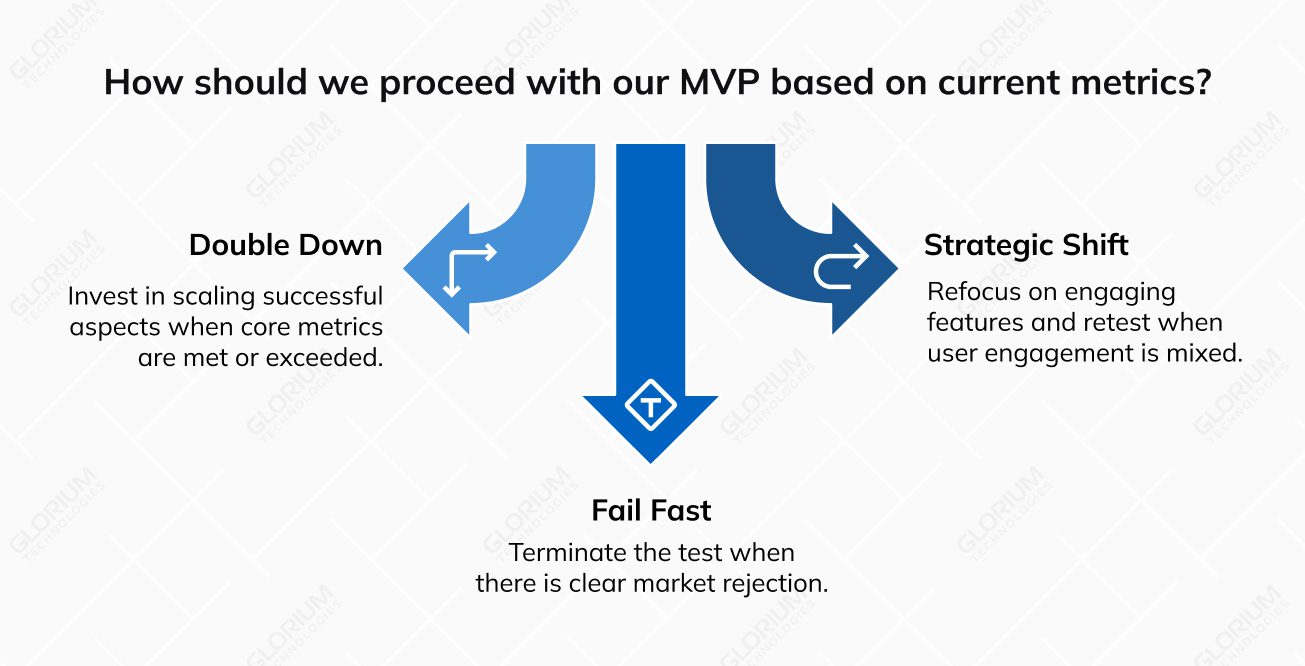
You can take three paths: Path #1: Double down When your core metrics hit or exceed the target, you can invest in scaling what's working. Remember how Dropbox saw 75,000 signups for their demo video? This is the perfect example of a situation where you can double down. Path #2: Strategic shift When users engage intensely with one aspect of your solution but ignore the others, and you receive some mixed signals, you can refocus on the "hot spot" and retest. Slack did the same when it shifted from a gaming platform to a workplace chat. Path #3: Fail fast When your solution experiences a clear market rejection across multiple tests, your best option is to kill the test before burning more cash. For example, Twitter abandoned Ode's podcasting tools and proceeded with another solution.
Using the right validation tools and methods can make or break your MVP success. Below, we'll break down the most effective testing methods, when to use them, and how to use them.
A/B testing compares two versions of a product element (like a landing page, pricing model, or feature) to see which performs better. This method removes guesswork by letting real user behavior determine the winning variant. How it works:
Analytics tools (like Google Analytics, Hotjar, or Mixpanel) track how users interact with your MVP. This reveals whether they complete key actions or drop off. To use this method, you'll need to set up event tracking (like button clicks, sign-ups, time spent on the page, etc.) and identify friction points (where users abandon the flow). You can optimize your solution based on drop-off rates.
Setting up one-on-one interviews with your users can help you understand their frustrations, needs, and motivations. This method gives you information that analytics alone can't do. Recruit target users and ask them open-ended questions, like "Walk me through how you solve this problem now?" Listen to their answers and analyze the emotional language that signals real pain points.
You've seen this before on websites and landing pages. It's the famous "coming soon" feature or product that measures interest before development. How it works? Add a button or sign up for a non-existent feature. Track the clicks and sign-ups as validation, and if the interest is low, avoid building. However, if you notice the interest rising day by day, you're good to go.
Smoke tests use paid ads to drive traffic to a landing page, measuring interest before product creation. You can run targeted ads (on Google or Facebook) to a "coming soon" page. Measure CTR and sign-ups, and if you notice high engagement, you will have a green light to build. However, if there's no or low engagement, you may want to regroup and stop putting effort into your current MVP.
Platforms like Kickstarter let you sell products before they exist, proving demand and funding production. For this method, you can launch a campaign with prototypes or mockups and set a funding goal. If the goal is unmet, you refund the backers. But if you receive successful funding, you have your market validation.
This strategy is best for physical products, premium software, or any offering that requires upfront production costs. Create a sale page with product descriptions or a beta version. Accept real payments while communicating that this is a pre-order (and not the final product). If you hit minimum orders, you can start producing.
The correct validation method depends on what you need to validate and how much risk you're trying to mitigate. Below is a simple framework to match your biggest uncertainty with the most effective validation approach.
|
What You Need to Validate |
Best Testing Methods |
Key Metrics to Track |
Effort Level |
|
Market Demand (Do people want this?) |
• Fake Door Test • Smoke Test • Explainer Video |
• Sign-up rate • CTR • Video watch time |
Low-Medium |
|
Willingness to Pay (Will they buy it?) |
• Pre-Orders • Concierge MVP • Crowdfunding (Kickstarter) |
• Conversion rate • Revenue collected • Repeat purchases |
Medium-High |
|
Usability & Functionality (Does it work?) |
• Prototype Testing • Wizard of Oz MVP • Manual-First Service |
• Task completion rate • Error rates • User satisfaction (NPS) |
Medium |
|
Competitive Edge (Is this better than alternatives?) |
• A/B Testing (vs. competitors) • User Interviews • Blog/Content Engagement |
• Preference rate • Churn/retention • Backlinks/comments |
Medium |
|
Scalability (Can this grow?) |
• Manual-First Service • Crowdfunding • Partner Pilots |
• Operational bottlenecks • Unit economics • Partner feedback |
High |
You're pouring your time, money, and passion into this idea - but what if nobody wants it? We've witnessed cases where founders wasted months building the wrong product due to assumptions, misinterpretations, and missed red flags. At Glorium Technologies, we can help you avoid these costly mistakes and set the stage for a successful MVP to full-scale product development. We specialize in fast, data-driven MVP validation. We can help you catch the market opportunities early because the market doesn't wait for anyone. We build scalable products that grow alongside your business and utilize our domain expertise to help us build MVPs way beyond the scope of basic apps. If you want to outperform your competitors and validate your idea with a professional team, request a discovery call with our representative and explore what we can do for you.
Depending on the validation method, it may take somewhere around 3-6 months. We've worked around tight timeframes, delivering results in approximately 3 months.
The budget for your MVP testing depends on various factors. Since prices vary greatly, it's better to contact the development company for a precise estimate.
We conduct deep audience research and recruit niche communities (like Facebook and Reddit groups). We use targeted ads and don't test within a local community (friends, family) to avoid bias.
Yes. We can help you validate your idea and transition it to a full-scale product ready to be launched for a larger audience.
Just enough to test your riskiest assumption (e.g., a clickable prototype, not a polished product).
Sometimes, test results are inconclusive, and we must readjust a few elements (larger sample, clearer metrics, etc.). Sometimes, it's better to pivot to a new hypothesis. However, we never guess, and we closely observe and analyze your user behavior to suggest the next steps.