







How to Improve Business Automation Through AI-Driven ERP Transformation
Updated January 19, 2026

 Summarize in ChatGPT
 Summarize in ChatGPT
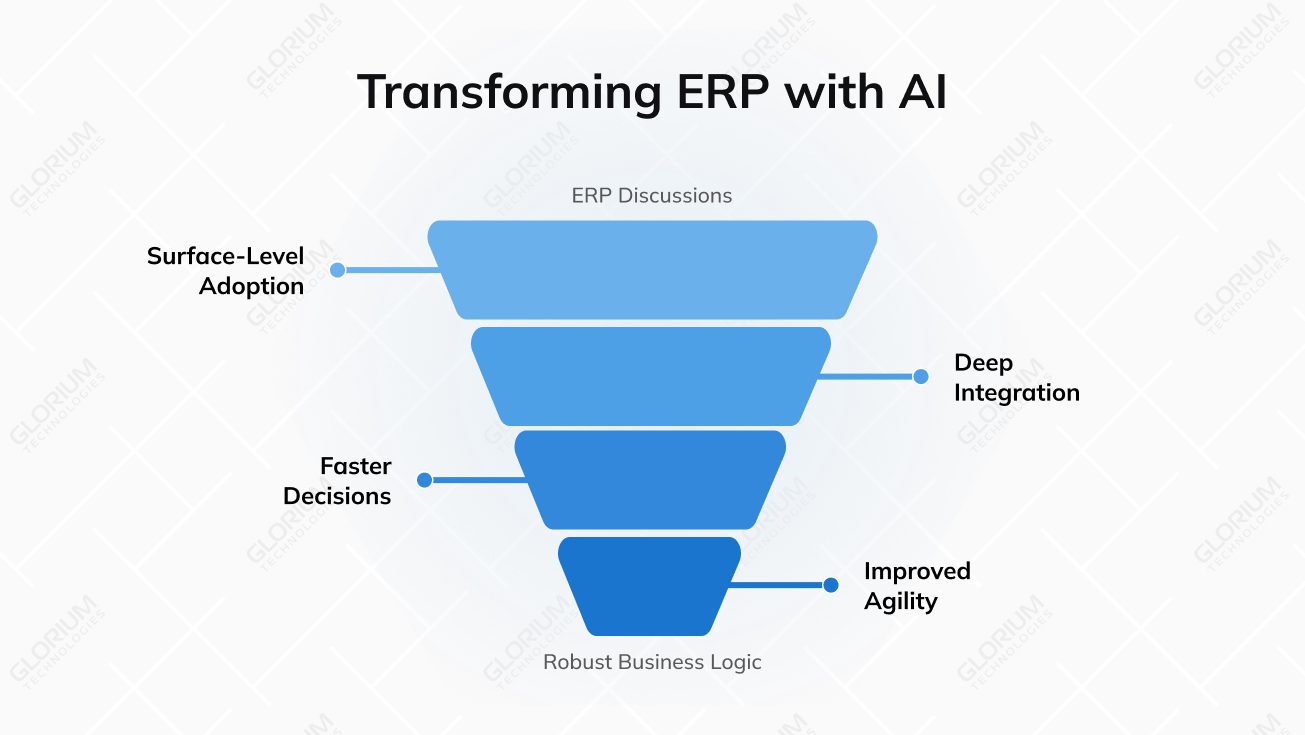
These days, 8 out of 10 ERP discussions end up centered on artificial intelligence and its promised business value. Organizations that move beyond surface-level adoption and embed AI into their ERP systems often see decisions happen 35% faster and overall agility improve by roughly 20%. Still, the implementation process is frequently clouded by misconceptions about what AI technologies can and cannot do. You need to understand the structural differences between machine learning and large language models to successfully move from experimental chatbots to robust business logic within AI-driven ERP systems.
Manufacturers or distributors don’t need another chat window that produces nice-looking, eye-catching text. And chances are high that neither do you. You need AI that can read real operational data, apply business rules, and trigger actions inside your ERP platforms without forcing your teams to abandon the screens they already use. By accessing advanced AI capabilities, you can finally break free from the constraints of legacy systems in your business operations.
Content
Modern enterprise AI can be divided into two distinct categories, each offering unique strengths for different business functions. The first one, machine learning, makes for mathematical models and decision trees trained on specific datasets to perform precise actions. These AI models are often resource-intensive to build, but they provide high reliability once they are active. On the other hand, large language models are accessible and versatile. They can handle a wide range of text-based tasks with minimal initial setup. However, the best ERP outcomes happen when you combine both AI algorithms.
ML represents mathematical models trained using historical data. You can use it in an array of situations, for example, for financial forecasting, classification, and supply chain optimization tasks if you invest enough time and effort to prepare raw data and train it. Unlike LLMs, these models excel at anomaly detection and predictive maintenance. You can make the most out of them when managing high-stakes calculations and repetitive data-driven decisions that require advanced analytics.
If you are interested in a quick start and flexibility across multiple complex tasks, pay heed to these models, as they are designed to work with natural language. They are fast to adopt and ideal for navigating unstructured business data. ChatGPT makes for the most widely known example. The only catch is that they call for architectural guardrails (format control, verification steps, tooling) to be usable in business processes.
ML provides consistent outputs for the same inputs, whereas LLMs are probabilistic and require careful management to avoid variations. Many market tools are thin wrappers around a general-purpose LLM, lacking the data security required for enterprise technology. The missing piece is almost always the same: AI isn’t connected to your core business processes and systems of record. In other words, those LLMs may come in handy when you need to draft emails or summarize notes, but they can hardly help you improve how production, inventory, purchasing, and logistics run day to day.
Common limitations seen in practice:
You might have already noticed that the market is flooded with tools that are jam-packed with AI features and act as simple proxies for popular chatbots. But true business value lies in how AI-driven ERP systems can handle real-world constraints. If you use long prompts or overloaded context, you can fall into the trap of AI ‘hallucinations’ and not even notice that. AI can provide you with a bunch of plausible, well-crafted answers that are wrong.
Want to move beyond basic AI capabilities and use it for something more than practicing small talk about the weather? You need to deeply embed the AI in ERP structure, aka your existing workflows.
AI in ERP business operations has predictable failure modes. Treat them as engineering requirements for your robust IT infrastructure. Core risks to account for are:
In Odoo projects, for example, practical AI controls start with AI agents that do more than generate text. You have to connect each model to concrete tools that can query Odoo through APIs, validate constraints, and perform actions, for example, drafting RFQs or proposing stock transfers. To reduce unpredictable outputs, successful AI ERP implementations rely on a verification loop. What does it mean? One model produces results, and another checks them against defined structure and completeness rules before passing them on. You don’t need the most expensive “reasoning-heavy” model for every task. Use lightweight models for formatting and extraction, and reserve advanced AI features for complex reasoning.
An effective AI strategy focuses on the task rather than the tool. There is no point in using the most expensive, ‘smartest’ model for every minor calculation. To maximize the benefits of AI tools at your fingertips, consider adopting a multi-model approach. It ensures cost-efficiency and speed. By pairing AI models with specialized engines – like CogniAgent – you can automate complex scheduling and resource allocation directly within the user-friendly interface of your software.
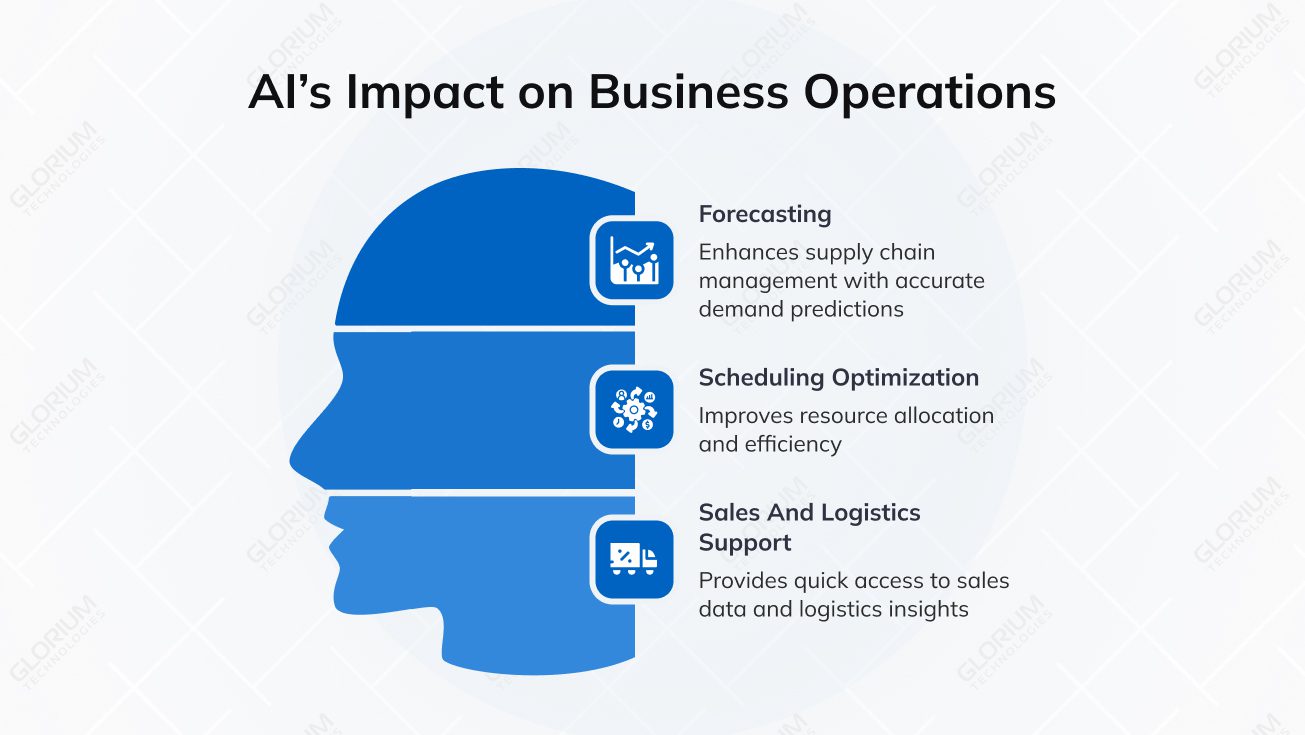
Forecasting remains one of the most requested AI tool use cases. Accurate results enable supply chain management teams to forecast demand and respond effectively to market changes. Plug-and-play AI features may seem like a first-aid kit, allowing you to use them immediately to handle the issue. But they often lack the depth of predictive analytics. Most of them rely on basic mathematical models that offer limited value. Machine learning models trained on historical data remain the most dependable way to optimize supply chains.
Large language models are not designed for numerical precision and often produce inconsistent results. Machine learning models trained on historical business data remain a more dependable option for this purpose, despite the additional effort required to integrate them.
Intelligent automation adds massive value to scheduling. Many organizations still rely on manual efforts for resource allocation or use semi-automated scheduling across production, projects, and workforce planning. This often leads to conflicts and underutilized resources.
Optimization engines based on AI algorithms (constraint-solving ones) can evaluate capacities to produce optimized schedules. When integrated into ERP planning views, users can review, accept, or adjust recommendations without altering their daily workflow. They can also capitalize on AI-driven insights – something that traditional ERP systems can’t boast of.
Sales teams often require prompt answers to questions about sales data, such as product availability and delivery timelines. With AI agents, you save yourself the hassle of switching between modules or contacting multiple departments, as they can retrieve inventory data and evaluate supply chain logistics. This turns raw data into actionable insights directly within internal communication tools, reducing response time.
You don’t always need a months-long development cycle to see results. Several high-impact areas can be enhanced within weeks by applying smart agents to manage existing paperwork and communication channels. By treating an AI agent like a new employee (providing it with the same onboarding documents and manuals), you can automate decision-making without rewriting your entire code base.
Five easy wins for your business:
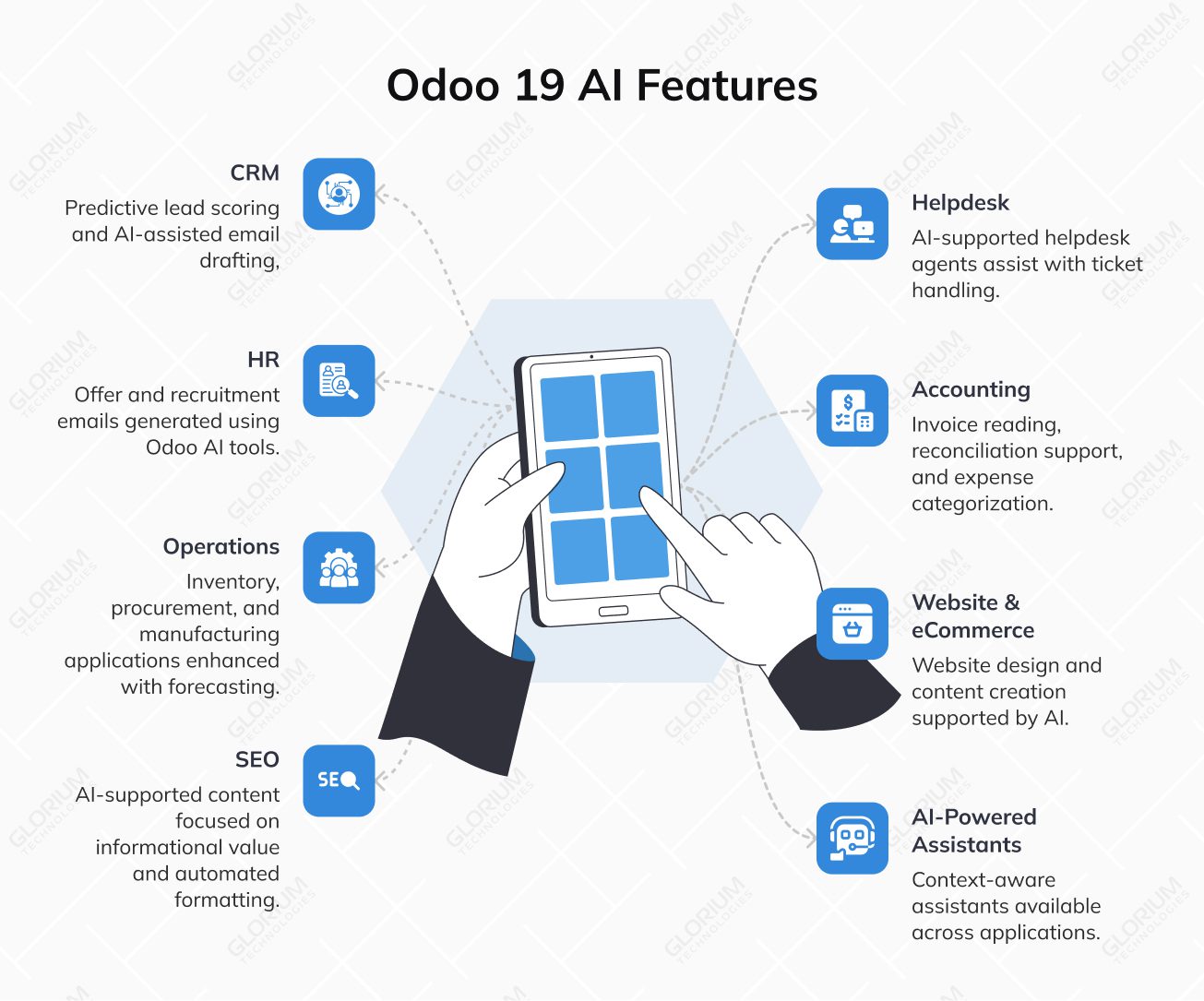
Rather than appearing overnight, AI in Odoo has developed over multiple releases, starting with early AI-powered features in Odoo 17 and expanding further in later versions. It is now built directly into everyday applications, supporting teams as they handle routine tasks, make decisions, and keep work moving throughout the day. From sales and customer service to finance, HR, and digital channels, AI features support analysis, communication, and data management. You can apply AI incrementally, focusing on practical use cases that reduce manual effort and keep users working inside familiar Odoo interfaces.
Are you on the lookout for something unlike traditional ERP systems? Odoo is modern enterprise resource planning software that is worthy of your attention. As an official implementation partner with a proven track record, Glorium Technologies is here for you. We can help you get the most out of user-friendly AI features in real business scenarios, from demand forecasting to operational planning.
Our approach to digital transformation zeroes in on applying AI tools where they have an immediate impact, improving operational efficiency without disrupting your processes. Make AI a practical part of your enterprise technology stack. Get ERP professional services at Glorium Technologies to maximize the ROI of Odoo implementation.
Generative AI is mainly used to create content — things like text, summaries, or suggestions — and it usually works outside of core business systems. CogniAgent is built for a different purpose. It operates inside an ERP solution, where it connects directly to live data and everyday workflows. Instead of stopping at content creation, it supports tailored solutions such as invoice processing, automated actions, and real-time insights that teams can use immediately while they work.
You can use different techniques, depending on the data and the problem you’re trying to solve. Simpler statistical methods can highlight values that don’t match historical patterns. For more complex datasets, machine learning models like Isolation Forests or One-Class SVMs are often used. Clustering approaches help you surface records that don’t fit within expected groups.
AI is moving toward deeper integration with business systems rather than standalone tools. We’re seeing a growing focus on task-specific agents, robotic process automation, natural language processing, live support, and AI that act on data provided. As governance improves, companies will rely more on explainable models, industry-specific solutions, and AI that supports everyday work instead of experimental use cases.